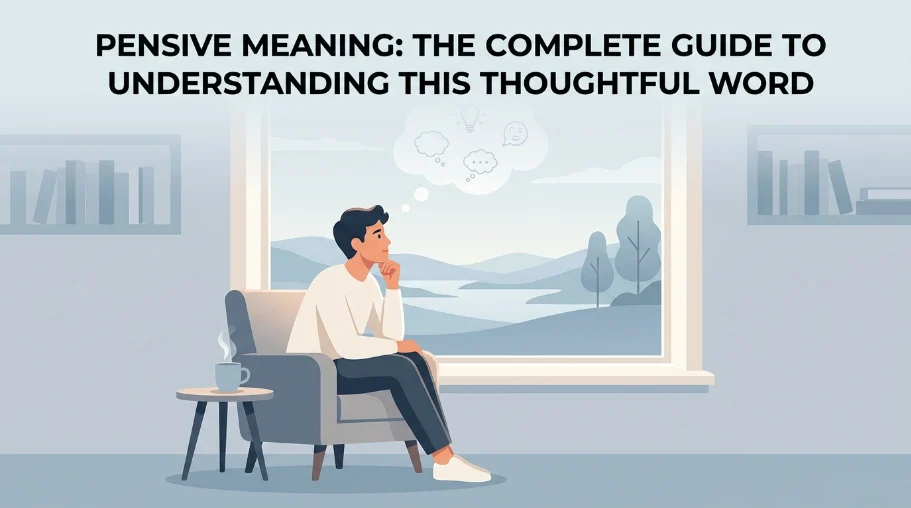
Pensive is an adjective that describes someone who is deeply or seriously thoughtful, often in a way that is slightly sad or reflective. It comes from the Latin word “pensare,” which means “to weigh” or “to consider.” A pensive person appears lost in their own thoughts, with a dreamy or wistful quality.
Have you ever seen someone staring out a window with a distant, thoughtful look on their face? That person is being pensive. This beautiful word captures a specific kind of deep thinking, often tinged with a touch of sadness or reflection.
Understanding the pensive meaning is valuable because it describes a common human experience. We all have moments when we withdraw into our thoughts, pondering life’s questions or remembering the past. Being able to express this state accurately enriches your vocabulary and helps you describe people and moods more precisely.
The challenge with pensive is that it can be confused with similar words like “thoughtful,” “contemplative,” or “reflective.” While these words are related, they each have subtle differences. Pensive specifically suggests a dreamy, often wistful quality that the others may not convey. Many people also wonder about the correct pronunciation of this word.
This article clears up the confusion around pensive once and for all. You will learn its definition, see real examples, and discover how to use it correctly. By the end, you will confidently understand and use this evocative word. Good vocabulary depends on knowing these subtle distinctions.
Key Takeaway
The main takeaway is that pensive is an adjective describing someone who is deeply absorbed in thought, often with a reflective or slightly melancholic quality . The word comes from the Latin “pensare,” meaning “to weigh,” reflecting the act of weighing thoughts in a serious manner . Synonyms include reflective, contemplative, and thoughtful, but pensive specifically suggests a dreamy or wistful quality .
Definitions and Explanations
What Does “Pensive” Mean?
The pensive meaning centers on the idea of deep, serious thoughtfulness. According to Collins English Dictionary, if you are pensive, you are thinking deeply about something, especially something that worries you slightly . Britannica Dictionary defines it more simply as “quietly sad or thoughtful” .
A pensive person is often:
- Deeply absorbed in thought
- Reflecting on something, often with a slightly sad quality
- Wistful or dreamy in their concentration
- Lost in their own musings
The American Heritage Dictionary notes that being pensive means being “engaged in deep and serious thought” and showing “deep, often melancholy thought . This wistful, slightly sad quality is what distinguishes pensive from other synonyms like “thoughtful” or “contemplative.”
| Aspect | Description |
| Part of Speech | Adjective |
| Primary Meaning | Deeply thoughtful, often with sadness |
| Pronunciation | /ˈpɛnsɪv/ (pen-siv) |
| Synonyms | Reflective, contemplative, thoughtful |
| Antonyms | Unthinking, carefree, light-hearted |
The Etymology of Pensive
Understanding the origin of pensive helps you remember its meaning. The word entered English in the 14th century, around 1325-1375 . It comes from the Old French word pensif, which is derived from the verb penser, meaning “to think” .
The ultimate root is the Latin word pensare, which means “to weigh” or “to consider . This is significant because it reflects the act of mentally weighing ideas. A pensive person is literally weighing their thoughts, considering them carefully like items on a scale. This is the same root as the word “ponder.”
| Word Part | Meaning |
| pensif (Old French) | Thoughtful |
| penser (Old French) | To think |
| pensare (Latin) | To weigh, consider |
| pendere (Latin) | To weigh, ponder |
Pronunciation of Pensive
Pensive is pronounced as /ˈpɛnsɪv/ in both American and British English. It has two syllables: pen-siv. The stress falls on the first syllable (“pen”). It rhymes with “sensitive” and “expensive.”
Pensive vs. Thoughtful
While these words are often used interchangeably, they have distinct meanings. A discussion on WordReference Forums highlights the difference :
- Pensive always refers to one’s own state of being. It suggests deep introspection, often with a wistful or melancholic quality.
- Thoughtful can refer to feelings and behavior towards other people, meaning “considerate.” It is also a more neutral term for general thinking.
“Joan is really thoughtful. When she heard my bad news, she wrote me a very supportive letter” . This meaning of “thoughtful” is completely different from “pensive” and is not a synonym. Pensive does not imply thoughtfulness toward others; it describes a personal, inward state.
Pensive vs. Contemplative vs. Reflective
These three words are all related to thinking deeply, but they have subtle differences .
| Term | Meaning | Key Quality |
| Pensive | Dreamy, wistful, or sad concentration | Wistfulness, melancholy |
| Meditative | Sustained, earnest thought | Spiritual or religious contemplation |
| Reflective | Orderly, analytic thought, often with a goal | Purposeful analysis |
Pensive is the “weakest” of the three in terms of purpose. It may involve little or no thought to any specific goal . A pensive person might simply be lost in their thoughts without trying to solve a problem.
Advantages and Disadvantages
Advantages of Using “Pensive”
Precision in description: Using pensive allows you to describe someone’s state of mind with precision. It conveys a specific quality of thoughtfulness that other words cannot. It paints a vivid picture of someone lost in their thoughts .
Literary and poetic value: Pensive has a beautiful, slightly elevated tone. It is a “higher register” word , meaning it is more formal and sophisticated. It is excellent for creative writing, literature, and descriptive prose.
Versatility: The word can describe people, expressions, moods, and even music. You can have a pensive person, a pensive look, a pensive mood, or a pensive melody .
Potential Disadvantages
Misunderstanding: Some people may not understand the word. In casual conversation, simpler alternatives like “thoughtful” or “lost in thought” might be more appropriate .
Confusion with “thoughtful”: People may confuse pensive with the “considerate” meaning of “thoughtful.” This can lead to misinterpretation. As noted in a forum discussion, “Pensive is not a synonym for this meaning” of thoughtful .
Register mismatch: Because pensive is a high-register word, it can sound out of place in everyday conversation. Using it in a very casual setting might seem pretentious or overly formal .
Real-World Examples
Examples of Pensive in Sentences
Example 1: “He had a pensive look on his face as he stared at the old photographs from his childhood” .
Example 2: “After hearing the sad news, she became pensive and sat quietly, reflecting on her memories” .
Example 3: “During the meeting, he seemed pensive, occasionally gazing out the window as if lost in another world” .
Example 4: “She was pensive a few minutes, then rousing herself, she said cheerfully” (from Jane Eyre by Charlotte Brontë) .
Example 5: “The child sat by himself, looking pensive” .
Example 6: “He sat staring out the window and heaved a pensive sigh” .
Examples in Literature
| Work | Example | Context |
| Jane Eyre by Charlotte Brontë | “She was pensive a few minutes, then rousing herself, she said cheerfully” | Character lost in thought |
| Cat’s Eye by Margaret Atwood | “She is less pensive than Sarah, more stubborn” | Character comparison |
| The Marvellers by Dhonielle Clayton | “More tears poured down, and Brownie stared at Ella with big, pensive eyes” | Describing a child’s expression |
Common Phrases with Pensive
“Pensive mood”: A state of being thoughtfully reflective. Example: “She was in a pensive mood after reading the letter.”
“Pensive look”: An expression showing deep thought. Example: “He gave her a pensive look before answering.”
“Pensive silence”: A quietness accompanied by deep thought. Example: “A pensive silence fell over the room.”
Describing Pensive People
You can use pensive to describe someone who is:
- A pensive poet
- A pensive young man
- A pensive student
- A pensive artist
- A pensive traveler
Regional and Global Usage
Global English
Pensive is a standard English word used across all English-speaking regions. Its meaning is consistent and widely understood. There is no significant regional variation in its definition or usage.
Formal vs. Informal Usage
Pensive is primarily a formal or literary word. It appears in academic writing, literature, and professional contexts. In casual conversation, people often use simpler synonyms like “thoughtful” or “lost in thought” . A discussion on WordReference Forums notes that “pensive is a much higher register word” , meaning it is more formal and educated.
| Context | Example |
| Formal/Academic | “The study examined the pensive expressions of participants.” |
| Literary | “The pensive poet found inspiration in solitude.” |
| Everyday/Casual | “He looked like he was deep in thought.” |
Common Mistakes
Mistake 1: Confusing “Pensive” with “Considerate” Thoughtfulness
The most common error is confusing pensive with the “considerate” meaning of thoughtful. As noted in a forum discussion, “This is a completely different meaning of thoughtful, meaning careful of the feelings of others, considerate. Pensive is not a synonym for this meaning” .
Correction: Use pensive for personal, inward thoughtfulness. Use thoughtful for caring behavior towards others.
Mistake 2: Assuming Pensive Always Means Sad
While pensive often has a slightly sad or melancholy quality, it is not always sad. The primary meaning is “deeply thoughtful . The sadness is a secondary nuance, not a requirement. Some sources note that “Pensive does not imply sadness” .
Correction: Use pensive for thoughtful reflection. Use “sad” or “melancholy” for clear descriptions of unhappiness.
Mistake 3: Misspelling the Word
Pensive is sometimes misspelled as “pensieve” (from the Harry Potter series). The correct spelling is p-e-n-s-i-v-e.
Correction: Remember the spelling: pensive. It is related to “ponder” and “weigh.”
Exercises
Exercise 1: Fill in the Blank
Choose the correct word to complete each sentence.
- “He had a _________ look on his face as he stared out the window.”
- “She became _________ after hearing the sad news.”
- “The _________ young man spent a great deal of time contemplating his future.”
- “During the meeting, he seemed _________, occasionally gazing into space.”
Exercise 2: Identify the Meaning
Determine whether each description is “pensive” or not.
- Someone staring out a window with a wistful expression.
- Someone writing a supportive letter to a friend in need.
- Someone lost in thought, reflecting on past memories.
- Someone solving a math problem with intense concentration.
Exercise 3: Choose the Correct Word
Select the best word for each context.
- “The poet was in a _________ mood.” (Pensive/Considerate)
- “She wrote a _________ note to her sick friend.” (pensive/thoughtful)
- “He sat with a _________ expression, far away in his thoughts.” (pensive/thoughtful)
Answer Key
Exercise 1 Answers:
- Pensive (a thoughtful, dreamy look)
- Pensive (reflective after sad news)
- Pensive (deeply thoughtful)
- Pensive (lost in thought)
Exercise 2 Answers:
- Pensive (yes, wistful reflection)
- Not pensive (this is thoughtful/considerate behavior)
- Pensive (yes, lost in reflection)
- Not pensive (this is focused concentration, not wistful reflection)
Exercise 3 Answers:
- Pensive (a reflective, slightly wistful mood)
- Thoughtful (considerate behavior towards others)
- Pensive (a reflective expression)
Related Concepts and Comparisons
Pensive vs. Wistful
These words are closely related but have distinct meanings .
| Term | Meaning |
| Pensive | Deeply thoughtful, often with reflection |
| Wistful | Yearning, longing, or nostalgia |
You can be pensive and thoughtful without being wistful. Wistfulness specifically involves longing or regret.
Pensive vs. Melancholy
| Term | Meaning |
| Pensive | Deeply thoughtful, sometimes but not always sad |
| Melancholy | A deep, persistent sadness |
Melancholy is primarily about sadness. Pensive is primarily about thoughtfulness, with sadness as a secondary quality.
Pensive vs. Brooding
| Term | Meaning |
| Pensive | Dreamy, thoughtful, sometimes wistful |
| Brooding | Dark, gloomy, often angry or resentful |
Brooding has a much darker, more negative tone than pensive.
The Noun and Adverb Forms
| Form | Word | Meaning |
| Adjective | Pensive | Deeply thoughtful |
| Adverb | Pensively | In a thoughtful manner |
| Noun | Pensiveness | The state of being thoughtful |
FAQs
What does pensive mean in simple terms?
Pensive means being deeply thoughtful, often with a slightly sad or wistful quality. A pensive person is lost in their own thoughts .
What is an example of pensive?
An example is someone staring out a window with a reflective, dreamy expression. Another example is someone sitting quietly, lost in thought after hearing sad news .
How do you pronounce pensive?
Pensive is pronounced /ˈpɛnsɪv/ (pen-siv). It rhymes with “sensitive.”
Is pensive a positive or negative word?
Pensive is generally neutral, though it often has a slightly melancholy or wistful quality. It is not strongly positive or negative. It describes a thoughtful state rather than a happy or unhappy one .
What is the difference between pensive and thoughtful?
Pensive describes a personal, inward state of deep reflection, often with a wistful quality. Thoughtful can mean “considerate” towards others or general thinking . Pensive is a more specific, higher-register word.
What is the origin of the word pensive?
The word comes from the Latin pensare, meaning “to weigh” or “to consider” . It reflects the act of weighing thoughts in a serious manner.
Can a thing be described as pensive?
Yes, things like expressions, moods, music, or silences can be described as pensive. For example, “a pensive sigh” or “a pensive mood” .
What is the noun form of pensive?
The noun form is pensiveness . The adverb form is pensively .
What are some synonyms for pensive?
Synonyms include reflective, contemplative, thoughtful, wistful, and meditative. However, pensive specifically suggests a dreamy, often wistful quality .
What is the opposite of pensive?
Antonyms include unthinking, carefree, and light-hearted . A carefree person is the opposite of a pensive person.
Conclusion
This guide has explored the meaning and usage of the evocative word pensive. It is an adjective that describes someone who is deeply absorbed in thought, often with a reflective or slightly sad quality. The word comes from the Latin “pensare,” meaning “to weigh,” reflecting the act of weighing thoughts. Synonyms include reflective, contemplative, and thoughtful, but pensive specifically suggests a dreamy, wistful quality .
The best practical advice is to use pensive when you want to describe a specific kind of thoughtful state one that is reflective, slightly wistful, and often tinged with a touch of melancholy. Consider your audience, as it is a high-register word that may not be suitable for all contexts . Remember that it is not a synonym for the “considerate” meaning of “thoughtful.” Good vocabulary depends on understanding these subtle distinctions, and now you have the knowledge to use this beautiful word correctly.











18 thoughts on “Pensive Meaning | The Complete Guide to Understanding This Thoughtful Word”