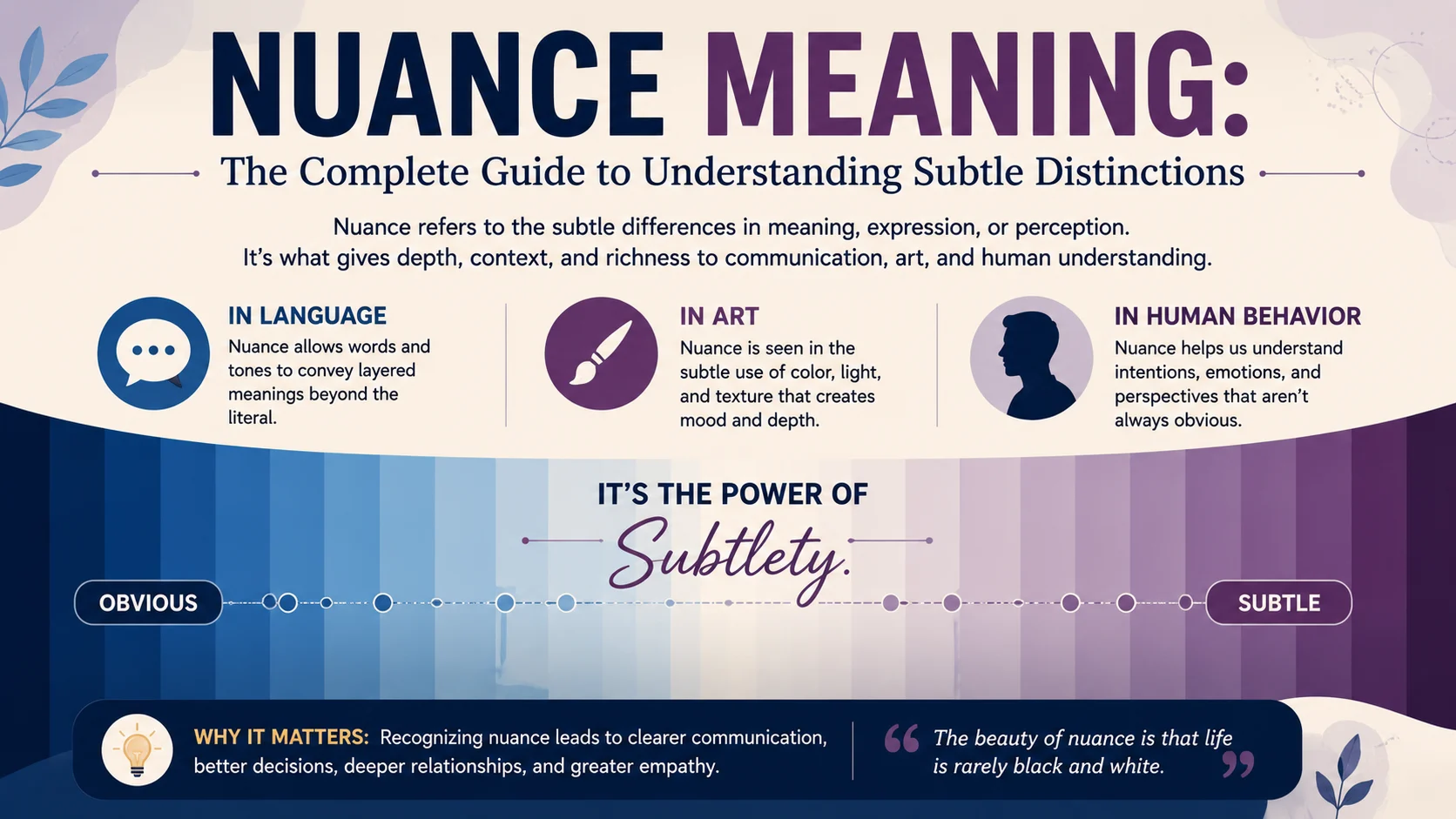
Nuance means a subtle or slight difference in meaning, expression, or sound. It refers to the delicate shades of meaning that add depth and complexity to language, art, and communication. Understanding nuance helps you appreciate the finer points of expression and avoid oversimplification.
Have you ever heard someone say, “There’s a nuance to that,” and wondered what they meant? This word appears frequently in discussions about language, art, and communication. It describes the subtle distinctions that make things richer and more complex.
Understanding the nuance meaning is essential for clear communication. When you grasp nuance, you can express yourself more precisely and understand others more deeply. You can also avoid misunderstandings that come from oversimplifying complex ideas.
The confusion around nuance often comes from its abstract nature. Unlike concrete words, nuance describes something intangible. Many people also confuse it with similar words like “subtlety” or “shade.” The challenge is understanding how nuance applies to different contexts.
This article clears up the confusion around nuance once and for all. You will learn its definition, see real examples, and discover how to use it correctly. By the end, you will have a thorough understanding of this sophisticated word. Good communication depends on appreciating these subtle distinctions.
The main takeaway is that nuance refers to a subtle or slight difference in meaning, expression, or sound . It is the delicate shade of meaning that adds depth and complexity . A nuanced understanding means you can appreciate these subtle distinctions and avoid seeing things in black and white . Synonyms include subtlety, shade, distinction, and gradation .
Definitions and Explanations
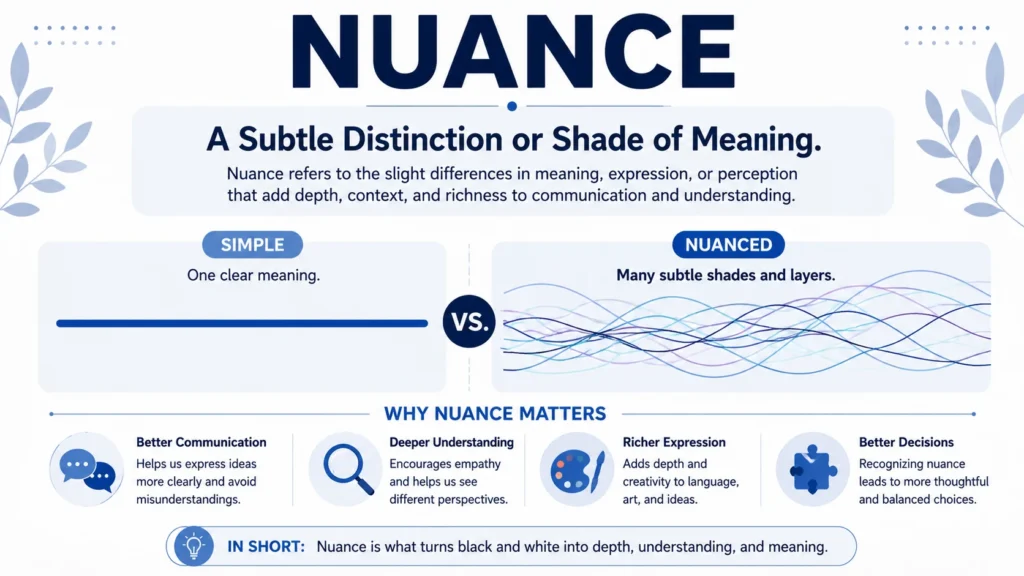
What Does “Nuance” Mean?
The nuance meaning centers on the idea of subtle differences. It is a noun that describes a delicate shade of meaning, feeling, or value . When you notice a nuance, you are recognizing something small but significant.
For example, the words “slim” and “skinny” both mean thin. However, “slim” often has a positive connotation, while “skinny” can be negative. This is a nuance in meaning. It is not a huge difference, but it matters.
Nuance can also refer to subtle differences in expression. A speaker might change their tone of voice to convey sarcasm or sincerity. This tonal nuance changes the meaning of their words . In art, nuance can be a slight variation in color or shading that adds depth to a painting.
The Etymology of Nuance
Understanding the origin of nuance helps you remember its meaning. The word entered English in the late 18th century from French . The French word nuance means “shade” or “hue.
The French word itself comes from the Latin nūbēs, meaning “cloud” . The connection is that clouds create subtle variations in light and shade. A nuance is like the subtle shading of a cloud. It is a slight variation that adds depth and complexity.
| Part of Speech | Noun (also used as a verb) |
| Pronunciation | NOO-ahns or NYOO-ahns |
| Plural | Nuances |
| Related Adjective | Nuanced |
| Related Adverb | Nuance |
Nuance as a Verb
While nuance is primarily a noun, it can also be used as a verb . When you nuance something, you give it subtle differences or shades of meaning . For example, “The author nuanced the character’s motivations to make them more realistic.”
However, the noun form is much more common. The adjective form, nuanced, is also very common. A nuanced understanding means you have a deep, subtle appreciation of something.
What Does “Nuanced” Mean?
The adjective nuanced describes something that has or shows subtle distinctions . A nuanced argument considers multiple perspectives and shades of meaning. It does not rely on simple, black-and-white thinking.
For example, a nuanced view of a political issue understands that both sides have valid points. A nuanced performance by an actor shows subtle emotions that make a character feel real . The word nuanced is often used as a compliment.
Advantages and Disadvantages
Advantages of Appreciating Nuance
| Advantage | Explanation |
| Better Communication | You can express yourself more precisely and avoid misunderstandings. |
| Deeper Understanding | You can appreciate the complexity of people, situations, and ideas. |
| Improved Decision-Making | You can make more informed choices by considering all the subtle factors. |
| Empathy and Connection | You can understand others’ perspectives more deeply. |
| Enhanced Creativity | You can appreciate the subtle details that make art and literature powerful. |
Disadvantages of Overemphasizing Nuance
| Disadvantage | Explanation |
| Analysis Paralysis | Overthinking subtle distinctions can lead to indecision. |
| Oversimplification | Sometimes people use “nuance” to avoid taking a clear stand. |
| Alienation | Overly nuanced language can seem pretentious or confusing. |
| Time and Effort | Appreciating nuance requires careful attention and reflection. |
Real-World Examples
Nuance in Language and Communication
Language is full of nuance. Subtle word choices can change the entire tone of a message.
- “I can’t go” vs. “I won’t go”: The first suggests inability; the second suggests refusal. This nuance changes the meaning significantly.
- “That’s an interesting idea” can be a genuine compliment or a polite dismissal, depending on tone.
- Sarcasm is entirely dependent on nuance. The words say one thing, but the tone says another.
Nuance in Literature and Art
Artists and writers use nuance to create depth and realism.
- Character Development: A nuanced character has both strengths and flaws. They are not purely good or evil. This makes them feel real .
- Painting: A painter uses subtle shading and color variations to create depth and texture. These nuances make a painting lifelike.
- Music: A nuanced performance includes subtle variations in tempo and volume. These nuances express emotion and add interest.
Nuance in Everyday Life
Nuance appears in everyday situations.
- “It depends”: This is a nuanced response to a question. It acknowledges that the answer is not simple.
- Reading people: Understanding someone’s mood requires reading subtle cues. These nuances in body language and tone reveal their feelings.
- Making decisions: A nuanced decision considers multiple factors. It is not just “yes” or “no.”
Regional and Global Usage
The word nuance is used consistently across all English-speaking regions. It has the same meaning and pronunciation in the US, UK, Canada, and Australia. However, pronunciation can vary slightly.
Pronunciation Variations
| Region | Common Pronunciation |
| American English | NOO-ahns or NYOO-ahns |
| British English | NYOO-ahns |
| Australian English | NYOO-ahns |
Formal vs. Informal Usage
Nuance is a formal word. You would use it in professional writing, academic papers, and thoughtful conversations. It is less common in casual speech. In informal settings, people might use “subtlety” or “shade” instead. However, using nuance correctly in conversation can show sophistication.
Common Mistakes
Mistake 1: Using “Nuance” to Mean “Subtle”
Subtle” is an adjective meaning delicate or understated. Nuance is a noun meaning a subtle distinction. You can have a subtle nuance, but nuance is not a synonym for subtlety.
Correction: Use nuance when referring to a specific subtle difference. Use “subtle” when describing something delicate.
Mistake 2: Overusing “Nuance”
Because nuance is a formal word, overusing it can make your writing sound pretentious. It is best used for specific situations where subtle distinctions are the focus.
Correction: Use nuance when you want to emphasize a subtle distinction. For other contexts, use simpler words like “difference” or “distinction.”
Mistake 3: Mispronunciation
Some people mispronounce nuance. They might say “NOO-ance” or “NYOO-ance.” The correct pronunciation is “NOO-ahns” or “NYOO-ahns.”
Correction: Practice saying the word. Remember that it has two syllables and ends with a soft “ns” sound.
Mistake 4: Confusing “Nuance” with “Nuisance”
These words sound similar but have very different meanings. A nuance is a subtle difference. A nuisance is an annoyance.
Correction: Focus on the “ance” ending. A nuance is a “shade” of meaning. A nuisance is a “pain.”
Exercises
Exercise 1: Fill in the Blank
Choose the correct word: nuance, nuanced, subtlety, or distinction.
- The actor’s performance was full of _________, revealing his character’s hidden emotions.
- There is a _________ between a “strong opinion” and being “stubborn.”
- Her _________ understanding of the issue impressed everyone.
- The painting’s beauty comes from the _________ colors and shading.
Exercise 2: Identify the Nuance
Identify the nuance in each pair of sentences.
- “She is a frugal shopper.” vs. “She is a cheap shopper.”
- “He is confident.” vs. “He is arrogant.”
- “The movie was entertaining.” vs. “The movie was meaningful.”
Answer Key
Exercise 1 Answers:
- Nuance (or subtlety – both work)
- Distinction (or nuance – both work)
- Nuanced (adjective)
- Subtle (or nuanced – both work)
Exercise 2 Answers:
- “Frugal” has a positive connotation of being wise with money. “Cheap” has a negative connotation of being stingy.
- “Confident” is positive and implies self-assurance. “Arrogant” is negative and implies excessive pride.
- Entertaining” means it was enjoyable. “Meaningful” means it had depth and significance.
Related Concepts and Comparisons
Nuance vs. Subtlety
| Term | Meaning | Usage |
| Nuance | A subtle distinction or shade of meaning | A noun |
| Subtlety | The quality of being delicate or understated | A noun, often describing a quality |
A nuance is a specific thing. Subtlety is a quality that can produce nuance. A performance can have subtlety, which creates nuance.
Nuance vs. Distinction
| Term | Meaning | Usage |
| Nuance | A subtle distinction | Focuses on delicate, small differences |
| Distinction | A clear difference | Can be larger and more obvious |
A nuance is a type of distinction. It is a very fine and subtle one. All nuances are distinctions, but not all distinctions are nuances.
Nuance vs. Shade
| Term | Meaning | Usage |
| Nuance | A subtle difference in meaning or expression | Abstract, intellectual |
| Shade | A slight variation in color or opinion | More visual, can be used for opinions |
These words are closely related. In the context of opinions or meaning, they are synonyms. “Shade” is more informal.
Nuance vs. Gradation
| Term | Meaning | Usage |
| Nuance | A subtle difference | Focuses on a single distinction |
| Gradation | A series of gradual steps | Focuses on a sequence of changes |
Gradation is about a smooth transition across multiple points. Nuance is about a delicate difference at a single point.
FAQs
What does nuance mean in simple terms?
Nuance means a subtle or slight difference in meaning, expression, or sound. It is a delicate shade of meaning that adds depth and complexity .
What is a synonym for nuance?
Synonyms for nuance include subtlety, shade, distinction, gradation, and refinement . These words all describe a slight difference.
How do you pronounce nuance?
Nuance is commonly pronounced “NOO-ahns” or “NYOO-ahns” . The first syllable rhymes with “too” or “you,” and the second syllable rhymes with “dance.”
What does nuanced mean?
Nuanced means having or showing subtle distinctions . It describes something that is complex and not black and white. A nuanced understanding recognizes subtle differences.
Can nuance be used as a verb?
Yes, nuance can be used as a verb meaning to give subtle differences to something . For example, “The writer nuanced the character’s personality.”
What is an example of nuance?
One example of nuance is the difference between “slim” and “skinny.” Both mean thin, but “slim” has a positive connotation while “skinny” can be negative. This subtle difference in meaning is a nuance .
Why is nuance important?
Nuance is important because it allows for precise and accurate communication. It helps us understand the complexity of people, situations, and ideas . Without nuance, we risk oversimplifying.
Is nuance positive or negative?
Nuance is neutral. It is a descriptive word. However, it is often used positively to describe someone who has a deep and sophisticated understanding .
What does “nuance of meaning” mean?
Nuance of meaning” refers to subtle differences in what a word or phrase can mean. These slight variations add depth and allow for precise expression .
How do you develop a nuanced understanding?
Developing a nuanced understanding requires careful observation, active listening, and a willingness to consider multiple perspectives. It also requires avoiding simple, black-and-white thinking.
Conclusion
This guide has explored the rich meaning of the word nuance. It describes the subtle shades of meaning, expression, or sound that add depth and complexity to our world . We have learned that appreciating nuance is key to effective communication and deep understanding.
The best practical advice is to be open to nuance in your own thinking. Avoid simple, black-and-white judgments. Instead, look for the subtle distinctions that make people and situations complex. When you speak or write, choose your words carefully to express these nuances. When you listen or read, pay attention to the subtle cues that reveal deeper meaning.
Good communication depends on appreciating these delicate differences. Now you have the knowledge to use nuance correctly and to appreciate it in the world around you.




15 thoughts on “Nuance Meaning| The Complete Guide to Understanding Subtle Distinctions”