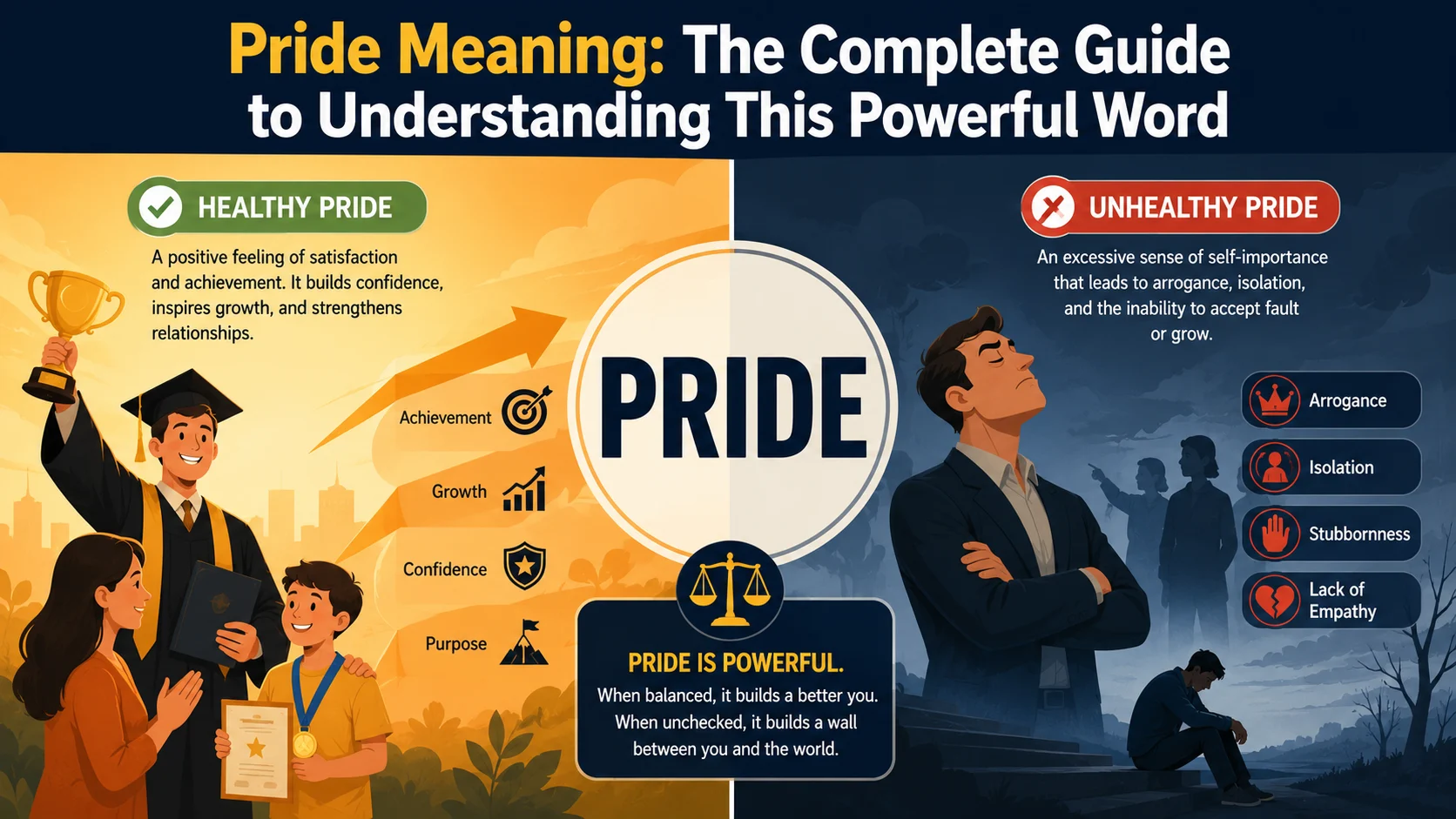
Pride is a complex noun with dual meanings. It can mean a feeling of deep satisfaction from one’s achievements or the achievements of those close to you. It can also mean an excessive belief in one’s own abilities, which is often considered a vice. Understanding pride meaning helps you recognize its positive and negative forms.
Have you ever felt that swell of happiness when you accomplished something difficult? That feeling is pride. It is a word that describes one of the most fundamental human emotions. However, pride is also one of the most complex words in the English language.
Understanding pride meaning is important because this emotion shapes our lives. It drives us to achieve great things. It can motivate us to do better and be better. Yet, too much pride can also be a destructive force. It can lead to arrogance, conflict, and personal failure.
The confusion around pride comes from its dual nature. It can be a virtue, a positive emotion that builds self-esteem. It can also be a vice, an excessive self-regard that leads to foolish decisions. Many people are unsure how to distinguish between healthy pride and destructive pride.
This article clears up the confusion around pride once and for all. You will learn its definitions, see real examples, and discover how to recognize its different forms. By the end, you will have a thorough understanding of this powerful word. Good communication depends on understanding these important distinctions.
The main takeaway is that pride has multiple meanings, ranging from a positive sense of self-worth to a negative trait of arrogance . As a positive quality, pride is a feeling of satisfaction from achievements, work, or the accomplishments of those you care about . As a negative quality, pride is an excessive belief in your own abilities, which can lead to treating others with contempt . The word can be both a virtue and a vice, depending on how you use and express it.
Definitions and Explanations
What Does “Pride” Mean?
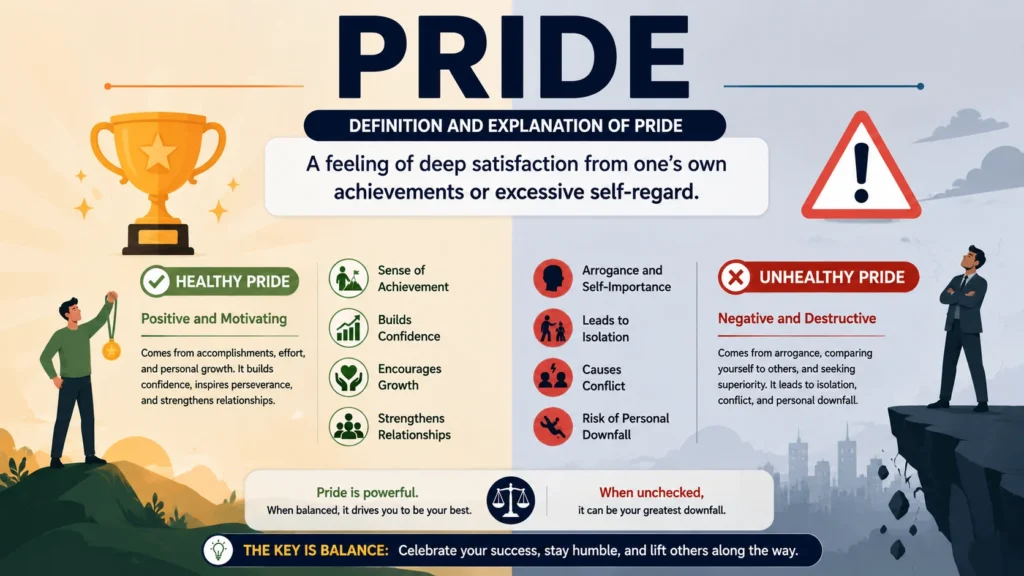
The pride meaning is deeply layered. It is a noun that describes a specific human emotion and a personality trait. The most common definition is a feeling of deep pleasure or satisfaction derived from one’s own achievements, the achievements of those with whom one is closely associated, or from qualities or possessions that are widely admired .
For instance, a parent feels pride when their child graduates. An artist feels pride when they complete a beautiful painting. An employee feels pride when their hard work leads to success. In these cases, pride is a positive and healthy emotion.
However, pride can also have a negative meaning. It can mean having an excessively high opinion of oneself . In this sense, pride is a form of arrogance. It makes people think they are better than others. This type of pride can be dangerous and destructive.
The Etymology of Pride
Understanding the origin of pride helps you remember its meaning. The word entered English around 1150-1200, coming from the Old English word prȳde . The Old English prȳde came from the Latin prodesse, which means “to be useful .
The word is also related to the Old French prud or prou, meaning “valiant” or “good” . This is the same root as the word “proud.” Interestingly, the word has always carried this dual meaning. Even in its earliest uses, it could mean both a positive sense of self-worth and a negative, arrogant quality.
| Part of Speech | Noun |
| Pronunciation | /praɪd/ (rhymes with “side”) |
| Related Adjective | Proud |
| Related Adverb | Proudly |
| Synonyms (Positive) | Self-respect, dignity, honor |
| Synonyms (Negative) | Arrogance, vanity, conceit |
Positive Pride: The Virtue
Positive pride is a healthy and essential emotion. It is a feeling of satisfaction and self-worth that comes from achieving something meaningful . This form of pride builds confidence and motivates you to continue improving.
Examples of positive pride include:
- Pride in a job well done: You worked hard on a project, and it succeeded.
- Pride in accomplishments: You achieved a personal goal, like running a marathon.
- Pride in family: You feel proud of your child’s achievements.
- Pride in community: You are proud of your hometown or country.
Negative Pride: The Vice
Negative pride is an excessive and often irrational belief in one’s own abilities . People with this trait think they are superior to others. They often treat people with contempt or disdain. This type of pride is considered one of the “seven deadly sins” in Christian tradition .
Examples of negative pride include:
- Arrogance: Acting like you are better than others.
- Vanity: Being excessively focused on your own appearance or status.
- Conceit: Having an inflated sense of your own abilities.
- Hubris: Excessive pride that often leads to a downfall.
Pride in LGBTQ+ Context
In modern times, “pride” also refers to the LGBTQ+ rights movement. This usage celebrates the self-affirmation, dignity, equality, and increased visibility of LGBTQ+ people . The annual Pride Month celebrations in June commemorate the Stonewall Riots of 1969.
| Form | Meaning | Example |
| Positive Pride | Satisfaction from achievement | “I felt pride when I graduated.” |
| Negative Pride | Arrogance, excessive self-regard | “His pride prevented him from apologizing.” |
| LGBTQ+ Pride | Self-affirmation and equality | “Pride Month is celebrated in June.” |
Advantages and Disadvantages
Advantages of Healthy Pride
| Advantage | Explanation |
| Motivation | Pride in your work pushes you to achieve more and aim higher . |
| Self-Esteem | It builds a positive self-image and confidence in your abilities . |
| Resilience | People with healthy pride are better at handling setbacks. |
| Purpose | Feeling pride in your contributions gives your life meaning . |
| Leadership | Others are drawn to confident, capable individuals. |
Disadvantages of Excessive Pride
| Disadvantage | Explanation |
| Damaged Relationships | Arrogant behavior pushes people away and creates conflict . |
| Inability to Learn | If you think you know everything, you will stop learning . |
| Poor Judgment | People may make bad decisions because they overestimate their abilities . |
| Social Isolation | People do not like being around others who act superior. |
| Downfall | Excessive pride, or hubris, often leads to a fall . |
The Fine Line Between Healthy and Unhealthy Pride
The line between healthy and unhealthy pride can be thin. It is not about what you feel, but how you express it. Healthy pride is internal and private. It is a feeling of satisfaction that does not need to be broadcast to the world. Unhealthy pride is external and comparative. You feel the need to show others that you are better than them.
| Healthy Pride | Unhealthy Pride |
| Internal satisfaction | External validation |
| Driven by personal achievement | Driven by comparison |
| Quiet confidence | Boastful arrogance |
| Lifts others up | Puts others down |
| Based on reality | Based on delusion |
Real-World Examples
Examples of Positive Pride
Example 1: “She felt a surge of pride as she watched her daughter walk across the stage to receive her diploma.” This is pride in a family member’s achievement.
Example 2: “The craftsman took great pride in his work, ensuring every detail was perfect.” This is pride in one’s own work.
Example 3: “The team’s victory filled them with a sense of pride and accomplishment.” This is pride in a group achievement.
Examples of Negative Pride
Example 1: “His pride prevented him from admitting he was wrong, even when presented with clear evidence.” This is pride as a refusal to accept fault.
Example 2: “She was blinded by her own pride and could not see that her plan had serious flaws.” This is pride leading to poor judgment.
Example 3: “His arrogance and pride made him unpopular with his colleagues.” This is pride leading to social isolation.
Pride in Proverbs and Culture
Many cultures have proverbs about pride.
- “Pride comes before a fall”: This proverb warns that excessive pride often leads to a person’s downfall.
- Swallowing one’s pride”: This phrase means to do something you consider below your dignity or to admit you were wrong.
- Pride of place”: This means the most important or prominent position.
Regional and Global Usage
Global English
The word pride is used globally in all English-speaking regions. Its meaning is consistent across the US, UK, Canada, and Australia. There is no significant regional variation in its definition.
Pride in Different Cultures
The concept of pride exists in all cultures, though its expression may vary. Cultural attitudes toward pride and humility can vary significantly. In some cultures, openly expressing pride is viewed as a sign of confidence and achievement, while others place greater value on modesty and restraint. In Japanese culture, for instance, humility and modest self-presentation are often preferred over overt displays of personal accomplishment.
LGBTQ+ Pride Around the World
LGBTQ+ Pride is celebrated worldwide, but the legal and social acceptance of LGBTQ+ people varies greatly. In some countries, Pride parades are massive public celebrations. In others, they are illegal or dangerous. This global context adds another layer to the pride meaning.
Common Mistakes
Mistake 1: Confusing Pride with Vanity
Vanity is an excessive focus on your own appearance or superficial qualities. Pride can be about deeper achievements or values. Vanity is always shallow. Pride can be deep and meaningful.
Correction: Use pride for a sense of satisfaction from meaningful achievements. Use vanity for excessive focus on appearance.
Mistake 2: Confusing Pride with Conceit
Conceit is an inflated sense of your own abilities or intelligence. It is always negative. Pride can be positive or negative. Positive pride is earned and justified. Conceit is often unearned.
Correction: Use conceit for an unjustified, inflated self-opinion. Use pride for a justified sense of accomplishment.
Mistake 3: Thinking Pride Is Always Negative
Many people think of pride only as the sin of arrogance. This is a mistake. Pride can be a very positive and healthy emotion. It is essential for self-esteem and motivation.
Correction: Recognize that pride has both positive and negative meanings. The context of the sentence tells you which is being used.
| Mistake | Example | Correction |
| Equating with vanity | “Her pride in her looks was excessive.” | “Her vanity was excessive.” |
| Equating with conceit | “His pride made him think he was the smartest.” | “His conceit made him think he was the smartest.” |
| Assuming negative | “I felt pride, which is bad.” | “I felt a healthy sense of pride.” |
Exercises
Exercise 1: Identify the Type of Pride
Is the pride positive or negative in each sentence?
- She took pride in her work.
- His pride prevented him from asking for help.
- They marched with pride in the parade.
- He was too proud to admit his mistake.
- The team’s pride in their victory was well-deserved.
- Pride kept him from accepting the offer.
- She felt pride when her son got his degree.
- His pride led to his downfall.
Exercise 2: Fill in the Blank
Choose pride, vanity, or conceit.
- She looked at her reflection with _________, admiring her new dress.
- His _________ in his work made him a respected craftsman.
- He had the _________ to think he could do it better himself.
- The parent’s _________ at their child’s success was heartwarming.
Answer Key
Exercise 1 Answers:
- Positive (Taking pride in work is healthy)
- Negative (Prevents asking for help)
- Positive (LGBTQ+ pride, self-affirmation)
- Negative (Unable to admit a mistake)
- Positive (Well-deserved, group achievement)
- Negative (Prevents accepting help)
- Positive (Family pride)
- Negative (Leads to downfall)
Exercise 2 Answers:
- Vanity (Excessive focus on appearance)
- Pride (Positive, work-related)
- Conceit (Inflated self-opinion)
- Pride (Positive, family achievement)
Related Concepts and Comparisons
Arrogance vs. Pride
| Term | Meaning | Connotation |
| Pride | Satisfaction from achievement | Can be positive or negative |
| Arrogance | Exaggerated sense of self-importance | Always negative |
Dignity vs. Pride
| Term | Meaning | Connotation |
| Pride | Feeling of self-worth | Can be positive or negative |
| Dignity | Being worthy of respect | Always positive |
Hubris vs. Pride
| Term | Meaning | Connotation |
| Pride | General term for self-worth or arrogance | Variable |
| Hubris | Excessive pride that leads to downfall | Always negative, often used in literature |
The Seven Deadly Sins
In Christian tradition, pride is one of the seven deadly sins. It is considered the most serious of all sins . The others are:
| Sin | Description |
| Pride | Excessive belief in one’s own abilities |
| Greed | Excessive desire for wealth |
| Lust | Excessive desire for sexual pleasure |
| Envy | Desire for others’ possessions or qualities |
| Gluttony | Excessive consumption |
| Wrath | Excessive anger |
| Sloth | Excessive laziness |
FAQs
What is the meaning of pride?
Pride is a feeling of deep satisfaction from one’s own achievements or the achievements of those close to you . It can also mean an excessive belief in your own abilities, which is often seen as a vice.
Is pride positive or negative?
Pride can be both positive and negative . Positive pride is a healthy feeling of self-worth and accomplishment. Negative pride is an excessive self-regard that leads to arrogance.
What is the difference between pride and arrogance?
Pride can be a healthy emotion, while arrogance is always negative . Arrogance is an exaggerated sense of self-importance and a belief that you are better than others.
What does it mean to “take pride” in something?
To “take pride” in something means to feel satisfaction and accomplishment from it . It means you care about the quality of your work.
What is LGBTQ+ Pride?
LGBTQ+ Pride is a movement that celebrates the self-affirmation, dignity, equality, and increased visibility of LGBTQ+ people . It commemorates the Stonewall Riots of 1969.
Is pride a sin?
In Christian theology, pride is considered one of the seven deadly sins . It is seen as the most serious sin because it is the root of all other sins.
What is the saying “pride comes before a fall”?
This proverb means that excessive pride often leads to a person’s downfall . When people become too arrogant, they are likely to make mistakes.
What are some synonyms for pride?
Positive synonyms include self-respect, dignity, and honor. Negative synonyms include arrogance, vanity, and conceit.
How do you pronounce pride?
Pride is pronounced /praɪd/. It rhymes with “side” and “tide.”
How can I have healthy pride without being arrogant?
Focus on your own achievements and satisfaction rather than comparing yourself to others . Have quiet confidence, not boastful arrogance. Recognize that others have their own strengths.
What is national pride?
National pride is a feeling of love and devotion to one’s country . It is a feeling of patriotism and belonging.
What is the origin of the word pride?
The word comes from the Old English prȳde and the Latin prodesse, meaning “to be useful” .
Conclusion
This guide has explored the rich and complex pride meaning. Pride is a word with two faces. It can be a positive emotion, a deep sense of satisfaction and self-worth that comes from achievement. It can also be a negative trait, an excessive and often destructive belief in your own superiority . Understanding this duality is key to using the word correctly and recognizing it in yourself and others.
The best practical advice is to cultivate healthy pride while avoiding the pitfalls of arrogance. Celebrate your achievements and the achievements of those you care about. Feel the satisfaction of a job well done. However, remember that healthy pride is internal and grounded in reality. It is not about being better than others; it is about being the best version of yourself. Recognize that excessive pride can damage relationships, cloud your judgment, and lead to a downfall.











17 thoughts on “Pride Meaning: The Complete Guide to Understanding This Powerful Word”