
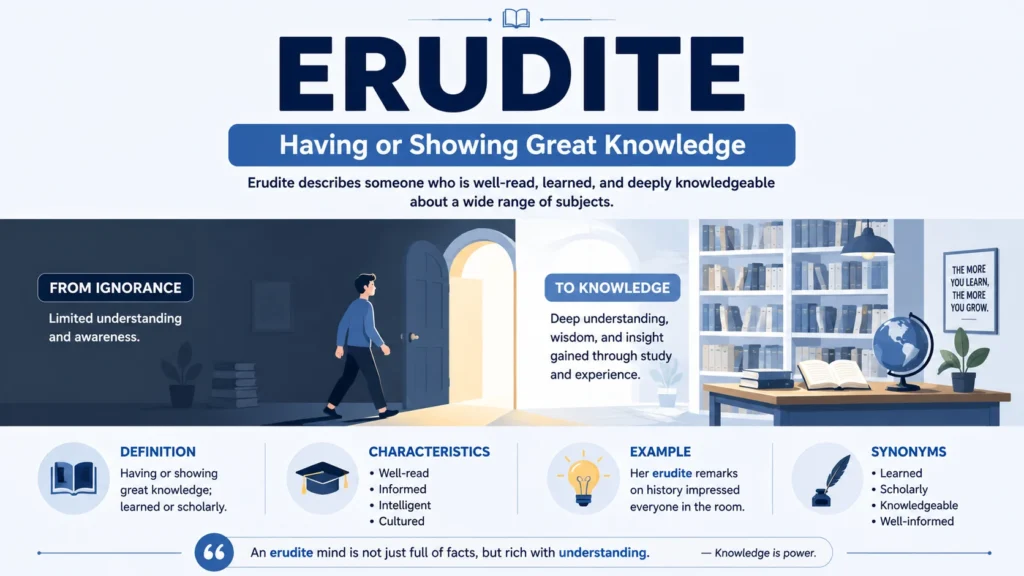
Erudite means having or showing great knowledge that comes from studying and learning . An erudite person displays extensive scholarship and is deeply learned in a particular subject or subjects. Being erudite is about possessing profound knowledge that goes beyond surface-level understanding .
Introduction
Have you ever met someone who seems to know everything about a topic? That person might be described as erudite. This word is more than just a fancy term for “smart.” It carries a specific meaning that sets it apart from other words for intelligence.
Understanding the erudite meaning is useful for improving your vocabulary and expressing yourself more precisely. Writers, speakers, and professionals often use this word to describe people who are deeply learned and well-read. It is a word that signals respect for scholarship and intellectual achievement.
The confusion around erudite often comes from its similarity to other words like “educated” or “knowledgeable.” While these words are related, erudite suggests a higher level of learning. It implies a depth of understanding that comes from years of study. Many people also wonder how to pronounce it correctly, as it has two accepted pronunciations.
This article clears up the confusion around erudite once and for all. You will learn its definition, see real examples, and discover how to use it correctly. By the end, you will have a thorough understanding of this scholarly word. Good vocabulary depends on knowing these subtle distinctions.
The main takeaway is that erudite refers to someone who has or shows great knowledge gained through extensive study . It comes from the Latin word ērudītus, meaning “to instruct” or “to bring out of a rough state” . An erudite person is not just intelligent but has a deep, scholarly knowledge that often comes from reading and academic pursuits . Synonyms include learned, scholarly, well-read, and knowledgeable .
Definitions and Explanations
What Does “Erudite” Mean?
The erudite meaning is rooted in the idea of deep, scholarly knowledge. If you call someone erudite, you are saying they have great learning and are very knowledgeable in a specific area or multiple areas . They possess knowledge that goes beyond what most people know .
An erudite person is not just someone who is smart or has good common sense. Instead, their intelligence is academic in nature . They are highly educated, have read widely, and can discuss complex topics with authority. For instance, an erudite professor can explain difficult concepts clearly because they understand the material inside and out .
The word also carries a slight nuance. Some people use erudite to describe someone who might display their knowledge in a somewhat showy way . However, the primary meaning is positive, describing someone who is impressively learned.
The Etymology of Erudite
Understanding the origin of erudite helps you remember its meaning. The word entered English in the late Middle Ages, around 1375-1425 . It comes from the Latin word ērudītus.
The Latin ērudītus is the past participle of ērudīre, which means “to instruct” or “to educate . This word itself is made of two parts. The prefix *ē-* (a form of *ex-*) means “out of.” The root rudis means “rough,” “untrained,” or “ignorant” .
Therefore, the literal meaning of erudite is “brought out of a rough or ignorant state . When someone educated you, they brought you out of ignorance and into knowledge. This is a beautiful way to think about the meaning of learning. It is also the same origin as the word “rude,” which describes someone unpolished or uncultured.
| Part of Speech | Adjective |
| Pronunciation (American) | ER-yoo-dite or ER-oo-dite |
| Pronunciation (British) | ERR-oo-dite |
| Related Noun | Erudition |
| Related Adverb | Eruditely |
Erudite vs. Learned
Learned and erudite are very similar, and dictionaries often use them to define each other . However, there is a subtle difference. Learned” simply means having much knowledge. “Erudite” suggests a more formal and scholarly knowledge that comes from intensive study.
An erudite person is usually deeply learned in a specific field. They have studied the classic texts and primary sources. They can speak with authority on the subject . “Learned” is a more general term that can describe anyone with extensive knowledge.
For example, a person can be learned about cooking from years of experience. A person would be erudite about the history of cooking, having read scholarly books and academic papers on the topic. The erudite individual’s knowledge is academic in nature.
Erudite vs. Knowledgeable
The distinction between erudite and knowledgeable is similar. “Knowledgeable” is a broader and more accessible term. It means you have a good general knowledge of many things or a specific topic.
“Erudite” suggests a more profound and more formal level of knowledge . An erudite person is usually well-read and scholarly. Their knowledge comes from a deep engagement with books, research, and academic study. You can be knowledgeable about cars because you are a mechanic. You are erudite about cars if you have studied the history and engineering of automobiles in great detail.
| Term | Connotation | Source of Knowledge |
| Erudite | Deep, scholarly, formal | Intensive reading and academic study |
| Learned | Extensive, deep | General or specific, often from study |
| Knowledgeable | Well-informed, practical | Experience and general learning |
| Scholarly | Academic, rigorous | Formal study and research |
Advantages and Disadvantages
Advantages of Being Erudite
| Advantage | Explanation |
| Deep Understanding | You develop a profound and thorough grasp of a subject, not just surface knowledge. |
| Credibility and Authority | Being erudite establishes you as a credible expert. People will value your opinion. |
| Excellent Communication | You can articulate complex ideas clearly and precisely, making you an effective communicator. |
| Intellectual Stimulation | Engaging in deep study is often intellectually rewarding and can bring a lifelong sense of purpose. |
| Problem-Solving | You can approach problems from multiple angles and think of creative solutions. |
Disadvantages and Challenges
| Disadvantage | Explanation |
| Appearing Elitist | Others might perceive you as showing off or being out of touch if you use overly complex language . |
| Knowledge Gaps | It is possible to be erudite in one field but know very little about others. |
| Difficulty Connecting | Erudite language can sometimes alienate people who do not share your background or vocabulary. |
| Maintaining Knowledge | Keeping up with a field requires significant and ongoing time and effort. |
Real-World Examples
Examples in Sentences
Here are examples showing how to use erudite correctly in a sentence .
1: “He was never dull, always erudite and well informed.”
2: “An erudite lecture on the latest discoveries in astronomy.”
3: “She was erudite without being stuffy or pompous.”
4: “Mr. Smith is erudite and rigorous but also funny.”
In Literature and Academia
In academic writing, you might describe a scholar by saying, “The author’s erudite analysis of the text uncovers layers of meaning that had previously gone unnoticed.” When describing a person, you could say, “He was a deeply soulful and erudite man with a genuine passion for the theatre.”
In Modern Contexts
Erudite is not just for old books and professors. It is used in modern business and media. A recent article described “the internet’s erudite elite” . This refers to highly knowledgeable people who are successful online.
Describing Erudite People
You can use erudite to describe people in various roles:
- An erudite professor or scholar
- An erudite lecturer or speaker
- An erudite writer or author
- An erudite commentator or analyst
Regional and Global Usage
Global English
The word erudite is a standard English word used globally. Its meaning is consistent across all English-speaking regions, including the US, UK, Canada, and Australia. There is no regional variation in its definition. It is used in formal writing, academic papers, and even some media.
Pronunciation Variations
There are two common pronunciations for erudite . Both are correct. In American English, you can say either “ER-yoo-dite” or “ER-oo-dite.” In British English, it is more commonly pronounced “ERR-oo-dite.” Some people consider the “ER-yoo-dite” pronunciation to sound more “erudite” because it is slightly less common .
Formal vs. Informal Usage
Erudite is primarily a formal word. You would use it in a book, an academic paper, a formal speech, or professional writing. It is less common in casual conversation. In informal settings, people might use “smart,” “knowledgeable,” or “well-read” instead. However, using erudite correctly in conversation can certainly impress people.
Common Mistakes
Mistake 1: Confusing “Erudite” with “Intelligent”
“Intelligent” is a general term for being smart or having a good capacity for learning. Erudite is more specific. It means you have actually used that capacity to acquire a great deal of scholarly knowledge. Intelligence is the potential; erudition is the result.
Correction: Use erudite when referring to someone’s scholarly knowledge. Use “intelligent” or “smart” for general brainpower.
Mistake 2: Using “Erudite” as a Noun
Erudite is an adjective. It describes a person or thing. The noun form is erudition . For example, you would say “His erudition is impressive,” not “His erudite is impressive.”
Correction: Use erudite to describe a person (“an erudite scholar”). Use erudition to name the quality (“He is known for his erudition”).
Mistake 3: Mispronunciation
Some people mispronounce erudite. They might say “E-rude-ite” or “E-rew-dite.” The correct pronunciations are “ER-yoo-dite” or “ER-oo-dite” .
Correction: Practice saying the word. Remember that it rhymes with “you” and “bite,” not “rude” and “kite.”
Mistake 4: Overusing It
Because erudite is a formal word, using it too often can make your writing sound stiff or pretentious. It is best used sparingly, for impact.
Correction: Use erudite when you want to emphasize a person’s deep, scholarly knowledge. For other contexts, use simpler synonyms like “knowledgeable” or “well-read.”
Exercises
Exercise 1: Fill in the Blank
Choose the correct word: erudite, erudition, knowledgeable, or learned.
- The professor’s _________ lecture on ancient history was fascinating.
- She has a reputation for her incredible _________, having read every major work on the subject.
- He is a _________ mechanic who can fix any car.
- The _________ professor spent his life studying the classics.
Exercise 2: Identify the Error
Each sentence might have an error. Identify and correct any mistakes.
- “He is known for his erudite.”
- “The book is an erudite and fascinating read.”
- “She was very erudite about local gossip.”
- “I love listening to erudite speakers.”
Answer Key
Exercise 1 Answers:
- Erudite (describes the lecture)
- Erudition (is the noun form)
- Knowledgeable (practical knowledge)
- Learned (or Erudite – both work to describe a scholarly professor)
Exercise 2 Corrections:
- “He is known for his erudition.” (Use the noun form)
- No error. “Erudite” is an adjective describing the book.
- “She was very knowledgeable about local gossip.” (Gossip is not a scholarly topic)
- No error.
Related Concepts and Comparisons
Erudite vs. Intellectual
“Intellectual” describes someone who is interested in ideas and uses their intellect. An intellectual may or may not be erudite. An intellectual thinks deeply. An erudite person has deep knowledge. An erudite person is often an intellectual, but an intellectual is not necessarily erudite.
| Term | Focus | Definition |
| Erudite | Having deep knowledge | Possessing extensive, scholarly learning. |
| Intellectual | Thinking deeply | Being engaged with ideas and abstract concepts. |
Erudite vs. Highbrow
“Highbrow” is a more informal word for someone interested in sophisticated or intellectual culture. It can be a little dismissive. Erudite is a more respectful and formal term.
| Term | Connotation | Usage |
| Erudite | Respectful, formal | Describing someone’s deep learning. |
| Highbrow | Informal, sometimes dismissive | Describing sophisticated cultural tastes. |
Erudite vs. Lettered
Lettered” is an older word that means educated or literate. It is a synonym for erudite .
| Term | Connotation | Usage |
| Erudite | Formal, modern | Still in common use |
| Lettered | Old-fashioned | Less common, literary |
FAQs
What does erudite mean in simple terms?
Erudite simply means having or showing great knowledge that comes from reading and studying . An erudite person is very learned and scholarly.
What is the best synonym for erudite?
Some of the best synonyms for erudite are learned, scholarly, well-read, and knowledgeable . These words all describe someone who has extensive knowledge.
How do you pronounce erudite?
Erudite is commonly pronounced “ER-yoo-dite” or “ER-oo-dite” . Both pronunciations are correct. In British English, it is often pronounced “ERR-oo-dite.”
What is the noun form of erudite?
The noun form is erudition . Erudition is the quality of being erudite or having extensive learning .
Is erudite a positive word?
Yes, erudite is a positive word. It describes someone in a respectful way. It suggests a person is highly educated and deeply knowledgeable .
What is the difference between erudite and learned?
The terms are very similar, but erudite often suggests a more formal and academic type of knowledge . Learned is a slightly broader term .
Can a book be described as erudite?
Yes, a book can be described as erudite . This means the book is written by someone very knowledgeable and is dense with scholarly information.
What is the origin of the word erudite?
Erudite comes from the Latin word ērudītus, meaning “instructed” or “learned” . It is related to the word “rude,” meaning rough or untaught.
Is erudite the same as educated?
Not quite. An educated person has received some level of schooling. An erudite person has gone far beyond that to achieve deep scholarly knowledge .
Conclusion
This guide has explored the rich meaning of the word erudite. It describes a person who has not just knowledge, but deep, scholarly learning that comes from extensive study and reading . We have learned that an erudite person is highly learned, often in a specific academic field, and possesses a profound understanding that goes beyond the surface .
The best practical advice for using erudite is to consider your audience. It is a formal word, so it is best used in writing and formal conversations where you want to be precise and impactful. Do not be afraid to use it, but avoid overusing it. When you call someone erudite, you are paying them a great compliment, acknowledging their intellectual depth and scholarly dedication.

Andrew Morris is a writer at Meaninga.com who specializes in word meanings, slang, idioms and modern language trends. He creates clear, accurate and easy to understand content for everyday readers.






9 thoughts on “Erudite Meaning| The Complete Guide to Understanding This Scholarly Word”