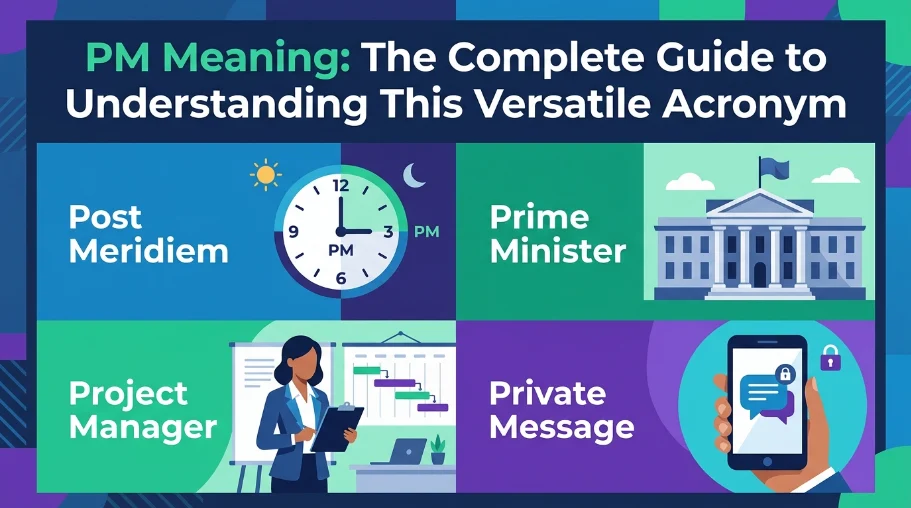
PM is an acronym with multiple meanings depending on the context. The most common definition is “Post Meridiem” for timekeeping, referring to the period from noon to midnight . It can also stand for “Prime Minister” in government , “Project Manager” in business, or “Private Message” in digital communication.
Have you ever seen the acronym PM and wondered what it means? This small abbreviation appears everywhere on clocks, in text messages, in business emails, and in government news. Its meaning changes completely depending on where you see it. Understanding the various PM meanings is essential for clear communication.
The challenge with PM is its versatility. In one context, it tells you the time of day. In another, it refers to a head of government. In business, it describes a project manager. In digital communication, it means a private message. This variety can create significant confusion for anyone encountering the term.
This article clears up the confusion around PM once and for all. You will learn the definitions, see real examples from different fields, and discover how to interpret the acronym correctly based on context. By the end, you will confidently understand what PM means in any situation. Good communication depends on knowing these important distinctions.
Key Takeaway
The main takeaway is that PM has several distinct meanings that vary by context. “Post Meridiem” refers to the time from noon to midnight . “Prime Minister” is the head of government in many countries. “Project Manager” is a professional role in business. “Private Message” is used in digital communication. Additional meanings include “Particulate Matter” in environmental science and “Performance Management” in human resources.
Definitions and Explanations
What Does “Post Meridiem” Mean?
Post Meridiem is a Latin phrase meaning “after midday . It is commonly abbreviated as PM, p.m., or pm and is used to indicate the hours from 12:00 noon to 11:59 at night . This timekeeping system helps people distinguish between morning and afternoon/evening hours.
The 12-hour clock method defines all 24 hours of the day using the numbers 1 to 12, followed by am or pm. 5 AM is early in the morning, while 5 PM is late in the afternoon. 1 AM is one hour after midnight, and 11 PM is one hour before midnight .
The abbreviation AM stands for Ante Meridiem, which means “before midday” and covers the period from midnight to noon . Together, AM and PM make the 12-hour clock system work effectively.
| Term | Latin Meaning | Time Period |
| AM | Ante Meridiem (before midday) | Midnight to 11:59 AM |
| PM | Post Meridiem (after midday) | 12:00 PM (noon) to 11:59 PM |
What Is a “Prime Minister”?
A Prime Minister (PM) is the head of government in many parliamentary systems around the world . This includes countries like the United Kingdom, Canada, India, and Australia. The Prime Minister leads the executive branch and is usually the leader of the political party with the most seats in parliament.
In political contexts, PM is a standard abbreviation. For example, you might see news headlines like “PM addresses the nation” or “The PM visited the disaster site” . The term is used formally in government documents and media.
What Is a “Project Manager”?
In business and professional contexts, PM stands for “Project Manager” or “Project Management” . A Project Manager is the individual responsible for planning, managing, and executing various projects . They ensure that projects stay on course, meet deadlines, and stay within budget.
Project managers work in many industries, including construction, technology, healthcare, and finance. Their role is essential for coordinating teams and delivering successful outcomes.
What Is a “Private Message”?
In digital communication, PM stands for “Private Message” . This refers to a message sent privately between users on social media platforms or messaging apps. Unlike public posts or comments, a PM is intended to be seen only by the recipient.
Other similar terms include DM (Direct Message) and IM (Instant Message) . On platforms like Twitter (X) and Instagram, DM is more common, while PM is used on forums and some messaging apps.
Other Meanings of PM
PM has many other meanings in specialized contexts:
| Meaning | Context |
| Particulate Matter | Environmental science, air quality |
| Performance Management | Human resources, business |
| Pre-Menstrual | Healthcare |
| Physical Memory | Computing |
| Phase Modulation | Electronics, telecommunications |
| Promethium | Chemistry (chemical symbol Pm) |
| Postmortem | Medical examination |
| Paymaster | Military, business |
| Police Magistrate | Legal system |
| Provost Marshal | Military police |
Advantages and Disadvantages
Advantages of Different PM Contexts
Post Meridiem advantages:
- Provides clear distinction between morning and afternoon hours
- Reduces confusion in scheduling and timekeeping
- Widely understood in many countries
Prime Minister advantages:
- Clear designation of head of government
- Recognized internationally in political contexts
- Standard abbreviation used in media and documents
Project Manager advantages:
- Professional designation for a key business role
- Recognized across industries
- Standard abbreviation in project management
Private Message advantages:
- Enables private communication between users
- Essential for many social media platforms
- Widely understood in digital communication
Disadvantages and Challenges
Post Meridiem disadvantages:
- Can be confusing with 12:00 AM and 12:00 PM
- Not used in the 24-hour clock system
- Some people find the Latin origin confusing
Prime Minister disadvantages:
- Only relevant in parliamentary systems
- Not used in presidential systems
- Can be confused with other PM meanings
Project Manager disadvantages:
- May be confused with Prime Minister or Private Message
- Not specific about industry or role
- Requires additional context for clarity
Private Message disadvantages:
- Can be confused with other PM meanings
- Some platforms use DM instead
- May be unfamiliar to older or less tech-savvy users
Real-World Examples
Examples of PM as “Post Meridiem”
Example 1: Scheduling
“Our meeting is at 3:00 PM tomorrow afternoon.”
Example 2: Event planning
“The conference will run from 9:00 AM to 5:00 PM.”
Example 3: Daily routine
“I usually have dinner around 7:00 PM.”
Examples of PM as “Prime Minister”
Example 1: News headline
“The PM announced new economic policies today.”
Example 2: Political discussion
“The PM met with foreign leaders at the summit.”
Example 3: Formal address
“The PM addressed the nation on the crisis.”
Examples of PM as “Project Manager”
Example 1: Business introduction
“I work as a PM for a software development company.”
Example 2: Job description
“The PM is responsible for ensuring the project stays on schedule.”
Example 3: Project update
“Our PM helped us resolve the issue quickly.”
Examples of PM as “Private Message”
Example 1: Forum request
“Please PM me if you have any questions.”
Example 2: Social media
“I sent you a PM with the details.”
Example 3: Online community
“Members can PM each other for private conversations.”
Examples in Sentences
| Context | Sentence |
| Post Meridiem | “The school day ends at 3:30 PM.” |
| Prime Minister | “The PM visited the affected area.” |
| Project Manager | “Our PM leads weekly team meetings.” |
| Private Message | “I’ll send you a PM with the information.” |
| Particulate Matter | “The PM levels were high today.” |
Regional and Global Usage
Global English
PM is used consistently across English-speaking regions, but the context determines the meaning. In the United States, PM is most commonly used for timekeeping . In the UK and Commonwealth countries, it can mean Prime Minister or Post Meridiem depending on context.
Timekeeping Usage
The AM/PM system is primarily used in English-speaking countries and former British colonies. In many other parts of the world, the 24-hour clock is more common. The Latin origins of Post Meridiem explain its use in many European languages .
Political Usage
In parliamentary systems, PM is a standard abbreviation for Prime Minister. Countries that use this include the United Kingdom, Canada, India, Australia, and New Zealand. In the United States, the term “President” is used instead.
Business Usage
In business contexts, PM is widely recognized as Project Manager or Project Management. This usage is global and consistent across industries.
Digital Communication
In digital communication, PM for Private Message is used globally. However, some platforms prefer DM (Direct Message) or IM (Instant Message).
Common Mistakes
Mistake 1: Confusing the Different Meanings
The most common error is assuming PM has only one meaning. Someone might read “PM” in a business context and think it means “Post Meridiem” instead of “Project Manager.
Correction: Always consider the context. If you are reading about time, it means “Post Meridiem.” If you are reading about politics, it means “Prime Minister.” If you are reading about business, it means “Project Manager.” If you are reading a message, it means “Private Message.
Mistake 2: Using the Wrong Form in Context
Some people use PM incorrectly in their writing. For example, they might use “PM” to mean “Project Manager” in a timekeeping context.
Correction: Be clear about your meaning. If there is any chance of confusion, spell out the full term. For example, “The PM (Project Manager) approved the budget.”
Mistake 3: Confusing AM and PM
Many people mix up AM and PM when writing times. 12:00 AM is midnight, and 12:00 PM is noon .
Correction: Remember that AM is before noon, and PM is after noon. The word “Ante” means “before,” and “Post” means “after.
| Incorrect | Correct | Reason |
| 12:00 AM noon | 12:00 PM noon | Noon is after midday |
| 12:00 PM midnight | 12:00 AM midnight | Midnight is before midday |
Mistake 4: Forgetting Periods
Some style guides require periods between letters (P.M.), while others prefer PM without periods. Inconsistency can look unprofessional.
Correction: Follow the style guide for your context. In general, PM without periods is more common in modern writing, but P.M. is also acceptable.
Exercises
Exercise 1: Identify the Meaning
Determine what PM means in each context.
- “The concert starts at 8:00 PM.”
- “The PM announced new environmental policies.”
- “I’ll send you a PM with the details.”
- “Our PM has 10 years of experience.”
- “The PM levels were measured in micrograms per cubic meter.”
Exercise 2: Fill in the Blank
Complete each sentence with the correct form of PM.
- “The meeting is scheduled for 2:30 __________.”
- “The __________ visited the disaster site yesterday.”
- “Please __________ me if you have any questions.”
- “The __________ presented the project timeline.”
Answer Key
Exercise 1 Answers:
- Post Meridiem (time context)
- Prime Minister (political context)
- Private Message (digital context)
- Project Manager (business context)
- Particulate Matter (environmental context)
Exercise 2 Answers:
- PM (Post Meridiem)
- PM (Prime Minister)
- PM (Private Message)
- PM (Project Manager)
Related Concepts and Comparisons
PM vs. AM
| Term | Meaning | Time Period |
| AM | Ante Meridiem (before midday) | Midnight to noon |
| PM | Post Meridiem (after midday) | Noon to midnight |
PM vs. DM
| Term | Meaning | Platform |
| PM | Private Message | Forums, older platforms |
| DM | Direct Message | Twitter (X), Instagram |
PM vs. CEO
| Term | Meaning | Context |
| PM | Prime Minister or Project Manager | Government or Business |
| CEO | Chief Executive Officer | Business (corporate) |
FAQs
What does PM stand for?
PM can stand for several things: “Post Meridiem” for timekeeping, “Prime Minister” in government, “Project Manager” in business, or “Private Message” in digital communication. The meaning depends on the context.
What does PM mean in time?
In timekeeping, PM stands for “Post Meridiem,” a Latin phrase meaning “after midday.” It indicates the hours from 12:00 noon to 11:59 at night .
What does PM mean in government?
In government, PM stands for “Prime Minister.” The Prime Minister is the head of government in many parliamentary systems .
What does PM mean in business?
In business, PM stands for “Project Manager” or “Project Management.” A Project Manager is responsible for planning, managing, and executing projects .
What does PM mean in texting?
In texting and social media, PM stands for “Private Message.” It refers to a message sent privately between users .
What is the difference between AM and PM?
AM stands for Ante Meridiem (before midday) and covers the hours from midnight to noon. PM stands for Post Meridiem (after midday) and covers the hours from noon to midnight .
Is it PM or P.M.?
Both are correct. PM without periods is more common in modern writing, while P.M. is also acceptable. The key is to be consistent.
Is PM used worldwide?
The AM/PM system is primarily used in English-speaking countries and former British colonies. Many other countries use the 24-hour clock system.
What is a PM in project management?
In project management, a PM is a Project Manager. This person is responsible for planning, managing, and executing projects .
Conclusion
This guide has explored the various meanings of the acronym PM in different contexts. PM can mean “Post Meridiem” for timekeeping, “Prime Minister” in government, “Project Manager” in business, “Private Message” in digital communication, and other meanings like “Particulate Matter” in environmental science.
The best practical advice is to always consider the context when encountering PM. The meaning depends entirely on the situation. If you are writing, define the acronym on first use to avoid confusion for your readers. Understanding these distinctions will help you communicate more clearly and professionally.
Good communication depends on understanding these important distinctions. Now you have the knowledge to interpret and use PM correctly in any context.









27 thoughts on “PM Meaning | The Complete Guide to Understanding This Versatile Acronym”