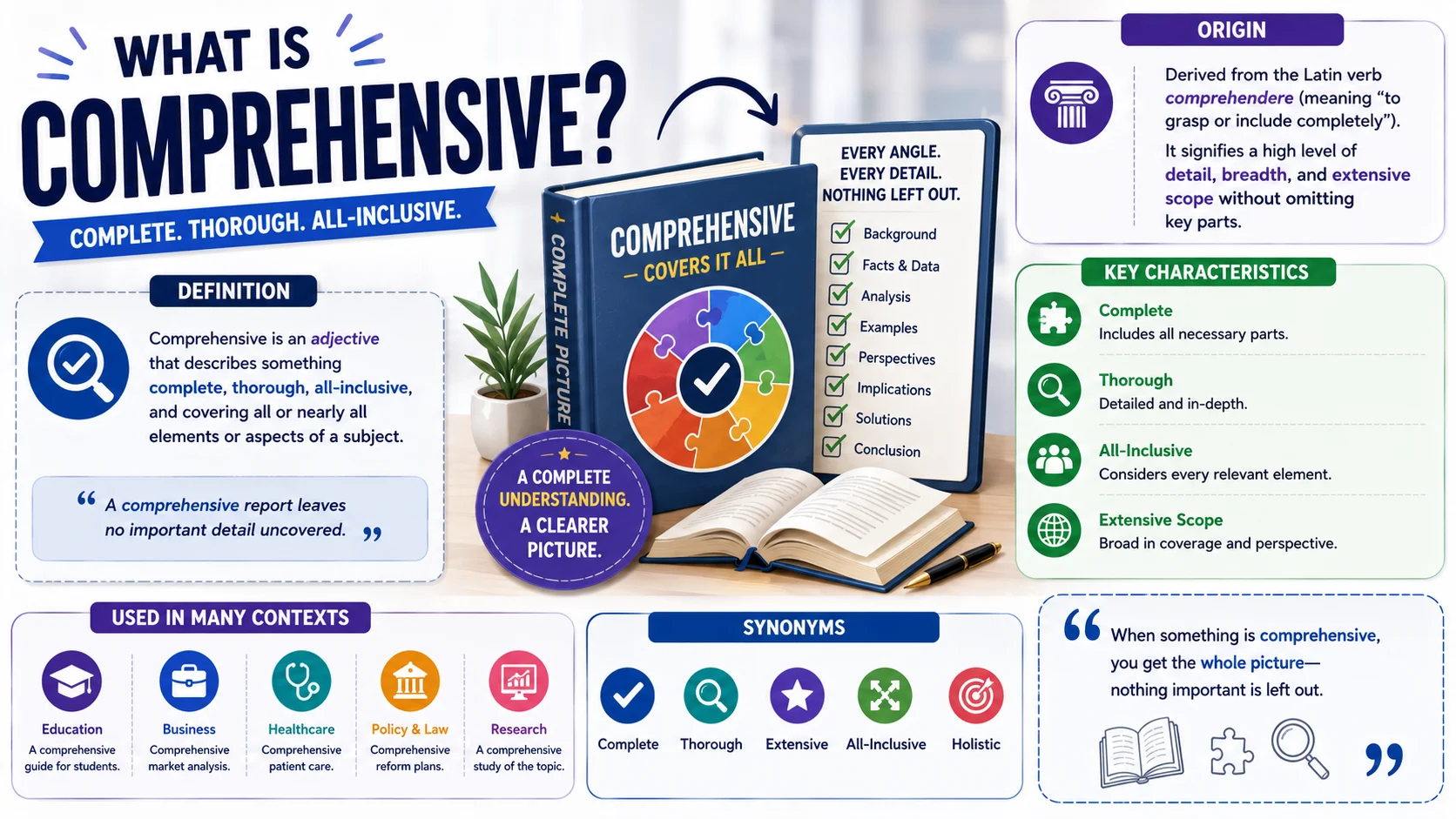
Comprehensive is an adjective that describes something complete, thorough, all-inclusive, and covering all or nearly all elements or aspects of a subject. Derived from the Latin verb comprehendere (meaning “to grasp or include completely”), it signifies a high level of detail, breadth, and extensive scope without omitting key parts.
Understanding the complete comprehensive meaning helps you elevate your academic writing, evaluate insurance policies accurately, structure business reports effectively, and articulate complex ideas with precision. Furthermore, this essential word bridges educational terminology with professional standards, legal agreements, and everyday English communication. Consequently, when people search for this phrase, they usually want to uncover what the term truly covers, how it differs from similar words like exhaustive or detailed, or how it applies in specialized fields like auto insurance and secondary education.
Additionally, various industries rely on the term to signal quality, thoroughness, and thorough coverage. For example, business leaders craft comprehensive strategic plans to address market opportunities, risks, and operational goals. Similarly, medical professionals conduct comprehensive health assessments to evaluate every aspect of a patient’s well-being. Therefore, mastering every dimension of the definition enriches your vocabulary and deepens your communication skills.
Quick Answer Box
| Aspect | Details |
| Primary Meaning | Complete; including all or nearly all elements, aspects, or details |
| Etymology Origin | From Latin comprehensivus and comprehendere (“to grasp or include completely”) |
| Common Contexts | Insurance policies, academic exams, business reports, medical evaluations |
| Pronunciation | “kahm-pree-HEN-siv” |
| Tone | Professional, authoritative, thorough, academic, inclusive |
What Does Comprehensive Meaning Represent in History and Language?
To understand the core comprehensive meaning, one must trace its linguistic roots and its transformation into a standard marker of thoroughness.
1. Etymology and Linguistic Foundations
Historically, the word traces back to Late Latin comprehensivus, stemming from the classical Latin verb comprehendere. This root verb combines com- (“together”) with prehendere (“to grasp” or “to seize”). Thus, at its core, something that is comprehensive literally “grasps everything together” into a single, cohesive unit.
2. Conceptual Scope and Intent
Unlike words that describe simple length or size, comprehensive emphasizes total coverage within a specific boundary. When an analysis, study, or policy earns this label, it guarantees that no significant angle, variable, or relevant piece of information was overlooked.
“To be comprehensive is not merely to offer a lot of information. It is to build a structure so complete that no vital piece is left out.”
Contextual Dynamics and Nuances of the Term
However, the precise application of comprehensive shifts depending on whether it appears in financial services, public education, academic testing, or corporate strategy.
1. In Insurance (Comprehensive Coverage)
In auto insurance, “comprehensive coverage” refers to a specific type of protection for your vehicle against damage caused by events other than a collision.
- What It Covers: Theft, vandalism, falling objects, windshield cracks, natural disasters (such as hail or floods), and collisions with animals.
- Key Distinction: Collision insurance covers accidents involving other cars or static objects, whereas comprehensive insurance covers non-collision incidents.
2. In Education (Comprehensive Schools and Exams)
In academic and educational systems, the word takes on two specialized meanings:
- Comprehensive High Schools: Public secondary schools (common in the UK, US, and Canada) that offer a broad curriculum accommodating students of all academic abilities and backgrounds, rather than specializing strictly in vocational or elite academic tracks.
- Comprehensive Examinations (“Comps”): Rigorous, broad-scale evaluations required for graduate students (master’s or Ph.D. candidates) to demonstrate total mastery of their discipline before starting a dissertation.
3. In Business and Healthcare
In professional environments, calling a report, audit, or review comprehensive indicates high rigor and professional standards:
- Comprehensive Business Plan: A document detailing market analysis, financial projections, competitive positioning, and operational strategies.
- Comprehensive Health Exam: An in-depth medical workup that includes physical checks, blood panels, organ function screenings, and family history reviews.
How Comprehensive Compares to Similar Descriptive Terms
Understanding how comprehensive compares to related vocabulary clarifies its exact place in precise communication:
| Word | Primary Focus | Key Difference vs. Comprehensive |
| Comprehensive | Breadth and total inclusion of essential parts | Balanced, thorough, covers all necessary aspects without unnecessary filler |
| Exhaustive | Total, painstaking inclusion of every minute detail | Focuses on absolute completeness to the point of complete fatigue or maximum capacity |
| Detailed | Focus on specific, individual points | Focuses on depth of individual items rather than covering the whole scope |
| Thorough | Care, attention, and accuracy in execution | Describes the quality of work performed rather than the overall scope |
Real-Life Conversation Examples
Reviewing everyday workplace, academic, and practical dialogue shows how people use the term across various settings.
1. Planning a Project at Work
David: Did you review the market research document sent by the consulting team?
Rachel: Yes, it is incredible. They provided a comprehensive breakdown of our competitors, customer demographics, and potential regulatory risks.
David: Perfect! That gives us everything we need to finalize our strategy.
2. Discussing Insurance Options
Mark: I am trying to decide which auto insurance options I need for my new truck.
Sarah: If you live in an area prone to severe storms or hail, you should definitely add comprehensive coverage along with collision.
Mark: Good call. That way I am protected even if a tree branch falls on it in the driveway.
3. Academic Graduate Studies
Prof. Vance: How is your preparation going for your Ph.D. requirements?
Elena: I am spending the entire summer studying for my comprehensive exams next month!
Prof. Vance: Stay focused! Once you pass those “comps,” you can focus entirely on writing your dissertation.
Key Characteristics of Comprehensive Works
Whether evaluating a written guide, a software platform, or a research paper, several consistent traits define a comprehensive work:
- Holistic Scope: Addresses every major branch, topic, or sub-category associated with the central subject.
- Clear Organization: Uses logical structures, tables, headings, and categories to make extensive information easy to digest.
- Balanced Depth: Provides sufficient detail on every subtopic without losing sight of the overall core message.
- Actionable Completeness: Answers all fundamental questions so the reader or user does not need to consult multiple additional sources for basic clarity.
FAQs
What is the primary meaning of comprehensive?
The primary meaning of comprehensive is complete, thorough, and including all or nearly all elements or aspects of something.
What is the difference between comprehensive and exhaustive?
While both mean thorough, comprehensive means covering all essential parts completely and balancedly. Exhaustive means accounting for every single tiny detail, often to the point of being tiring or overly meticulous.
What does comprehensive insurance cover?
In auto insurance, comprehensive insurance covers damage to your vehicle caused by non-collision events, such as theft, vandalism, extreme weather, falling objects, or hitting an animal.
What are comprehensive exams in university?
Comprehensive exams (often called “comps”) are major tests that graduate students take to demonstrate a complete understanding of their entire field of study before beginning dissertation work.
What is a comprehensive school?
A comprehensive school is a secondary school that accepts students of all academic abilities from the surrounding local community, offering both academic and vocational education programs.
Is “comprehensive” an adjective or a noun?
Comprehensive is primarily an adjective (e.g., “a comprehensive report”). However, in informal speech or regional British usage, it can function as a noun referring to a comprehensive school.
How do you pronounce “comprehensive”?
It is pronounced kahm-pree-HEN-siv (or /ˌkɒm.prɪˈhen.sɪv/).
What is an antonym for comprehensive?
Common antonyms include incomplete, partial, limited, narrow, selective, or superficial.
Can a person be described as comprehensive?
No. Comprehensive describes objects, plans, reports, systems, or ideas. To describe a person who is thorough and detail-oriented, use words like meticulous, thorough, or conscientious.
What is the noun form of comprehensive?
The noun form is comprehensiveness, which refers to the quality of being thorough and all-inclusive.
Conclusion
Ultimately, whether encountered in a business proposal, an insurance policy, a university handbook, or a vocabulary guide, understanding the comprehensive meaning reveals a concept defined by thoroughness and structural integrity. The evolution of the term from its Latin roots to modern professional standards shows how language defines total coverage. By recognizing the practical and industry-specific contexts of the word, you can communicate with greater authority and create work that stands out for its clarity and completeness.









4 thoughts on “Comprehensive Meaning| The Ultimate Guide and Semantic Meaning”