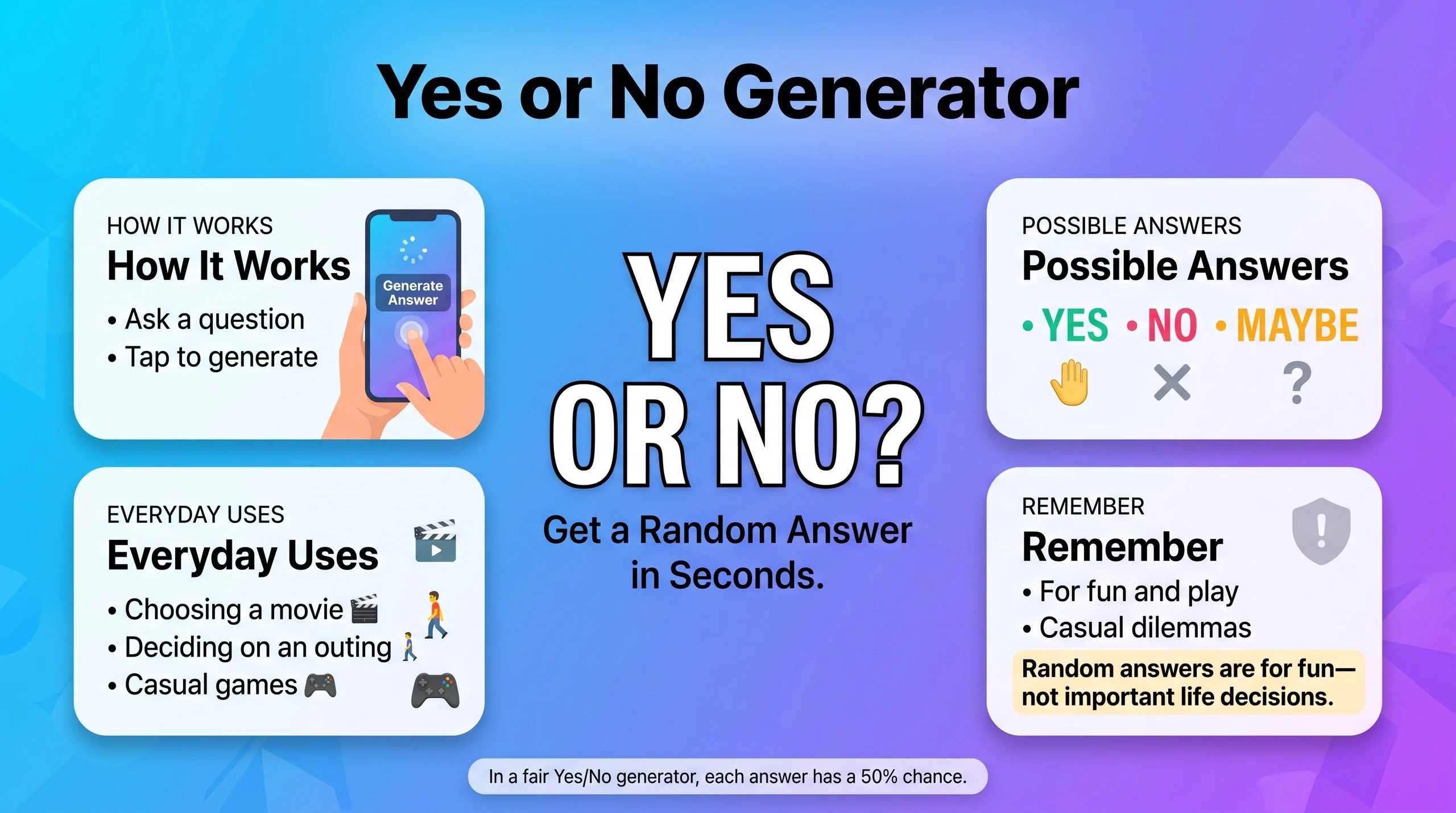
A yes or no generator is an online tool that randomly selects “Yes” or “No” to help you make a quick decision. Enter a question if you wish, then press the generate button to receive an answer. A fair two-option generator gives each answer a 50% chance. Some tools also offer “Maybe” or custom options.
Sometimes, even a simple question can leave you wondering what to do. Should you send that message, watch another movie, go out with friends, or try something new? A yes or no generator offers a quick and entertaining way to break the tie. Instead of spending more time debating, you can generate a random answer and see how you feel about the result. These tools are useful for casual choices, party games, friendly challenges, and everyday decisions. However, a random answer is not a prediction or expert recommendation. It works best when either outcome is acceptable and the decision does not involve serious consequences.
What Is a Yes or No Generator?
A yes or no generator is a digital decision tool that randomly chooses between two answers: Yes and No.
You can use it when you have a question but cannot decide which option to choose. The tool generates an answer without understanding the question or evaluating the situation.
For example, you might ask:
- Should I watch a movie tonight?
- Should I try a new hobby?
- Should we order pizza?
- Should I play another round?
After you generate an answer, you receive either Yes or No. Some tools also include Maybe, Ask Again Later, or a list of custom choices.
The result is random rather than a prediction of what will happen. Think of it as a digital version of flipping a coin.
How Does a Yes or No Generator Work?
A basic yes or no generator uses a random selection method to choose one of two possible answers.
The process is simple:
- Think of a question that can be answered with Yes or No.
- Open the generator.
- Press the button to generate an answer.
- Read the result and decide what to do next.
In a fair two-answer generator, Yes and No each have a 50% probability for every independent draw.
For example, if you generate an answer five times, you might receive Yes three times and No twice. The results do not need to alternate or balance perfectly over a small number of attempts.
Some online tools use browser-based random number generation, while others may use different methods. The exact implementation depends on the tool.
Yes or No Generator for Everyday Decisions
A random answer can make small choices easier when both options are acceptable.
Choosing What to Do
Not sure whether to stay home or go out? A random answer can help you break the tie.
Examples:
- Should I go for a walk?
- Should I try that new restaurant?
- Should I start reading a new book?
- Should I invite my friends over?
If the answer makes you feel relieved or disappointed, pay attention to that reaction. It may help you recognize which option you already prefer.
Making Decisions With Friends
A yes or no generator can also settle friendly disagreements.
For example, two friends cannot decide whether to play a board game or watch a movie. They agree that Yes means playing the game and No means watching the movie. The generator then chooses one of the options at random.
This approach works best when everyone agrees to accept the result before generating it.
Playing Games
Yes or no generators can add randomness to casual games, quizzes, and party activities.
Examples include:
- Truth-or-dare-style games.
- Quick group challenges.
- Random questions during a game night.
- Lighthearted online polls.
- Choosing whether to complete an optional challenge.
Make sure everyone is comfortable with the activity and that the result does not pressure anyone into doing something unsafe or unwanted.
Yes, No, or Maybe: Which Option Should You Choose?
Some generators provide a third answer: Maybe.
| Answer | Meaning | Best Use |
|---|---|---|
| Yes | Choose the affirmative option | When the question has a clear positive outcome |
| No | Choose the negative option | When the question has a clear negative outcome |
| Maybe | Leave room for uncertainty | When a middle option is acceptable |
In a fair generator with three equally likely outcomes, each answer has a one-in-three chance, or approximately 33.3%.
For example, “Should I go out tonight?” could produce Yes, No, or Maybe. In this case, Maybe might encourage you to check your schedule or decide later.
However, the generator does not know whether Maybe is the most sensible choice. It simply selects from the available options.
Is a Yes or No Generator Really 50/50?
A properly implemented two-option generator can give Yes and No equal chances. Each independent draw has a 50% probability of producing either result.
However, a 50/50 probability does not guarantee that the results will be evenly divided over a few attempts.
For example:
- One draw could produce Yes.
- Three consecutive draws could produce No.
- Five consecutive draws could produce Yes.
These outcomes are possible because each draw is independent. A previous answer does not automatically make the opposite answer more likely next time.
If you want a fair result, choose a tool that explains its random selection method rather than relying only on its appearance.
Benefits of Using a Yes or No Generator
1. Quick Results
A generator provides an answer in seconds, which can be helpful when you are stuck between two low-stakes choices.
2. Less Overthinking
Sometimes, people spend more time debating a minor decision than the decision deserves. A random result can help end that cycle.
3. Simple to Use
Most generators require little more than pressing a button. Some also allow you to enter a question or add extra answer options.
4. Useful for Games
Random answers can make casual activities more spontaneous, especially when a group needs a quick tie-breaker.
5. Available Online
Many generators work directly in a web browser without requiring a special device or a physical coin.
When Should You Avoid a Random Yes or No Answer?
A random answer should not replace careful judgment when the outcome could seriously affect your life.
Avoid relying on a generator for decisions involving:
- Medical treatment or health concerns.
- Financial commitments, loans, or major purchases.
- Legal matters.
- Personal safety or dangerous activities.
- Serious relationship decisions that require honest communication.
For example, if you are deciding whether to seek medical attention for concerning symptoms, a random Yes or No is not an appropriate substitute for medical guidance.
Instead, use the tool for entertainment or as a way to notice your own reaction. For important choices, consider the facts, consequences, available alternatives, and advice from a qualified person when needed.
Frequently Asked Questions
1. What is a yes or no generator?
A yes or no generator is a digital tool that randomly chooses between Yes and No. It is commonly used for simple decisions, games, and breaking ties.
2. Is a random yes or no generator free?
Many online yes or no generators are free to use. Features, advertisements, and usage limits vary by website.
3. Does a yes or no generator give a guaranteed correct answer?
No. The tool selects a random result; it does not know the correct answer to your personal question or predict the future.
4. Can a yes or no generator include Maybe?
Yes. Some generators offer Maybe as a third possible result. In a fair three-option generator, each answer has an equal one-in-three chance.
5. Why does the generator keep giving me the same answer?
Independent random results can repeat. A previous No does not make Yes more likely on the next draw.
6. Can I use a yes or no generator for games?
Yes. It can be useful for casual games, friendly challenges, and tie-breakers, provided the activity remains safe and voluntary.
7. Is a yes or no generator the same as flipping a coin?
For a fair two-option selection, the basic probabilities are the same: each outcome has a 50% chance. A digital generator provides the answer as words rather than heads or tails.
8. Should I trust the answer for an important decision?
No. Treat the result as entertainment or a way to explore your own preference. Important decisions deserve careful thought and reliable information.
Conclusion
A yes or no generator is a simple way to get a random answer when you are stuck between two low-stakes choices. It can help settle friendly disagreements, add fun to games, and reduce unnecessary overthinking. With a fair two-option generator, Yes and No each have a 50% chance, although consecutive answers can repeat. Remember that randomness does not provide knowledge or predict outcomes. Use the tool for casual decisions, and rely on sound judgment when the choice matters.