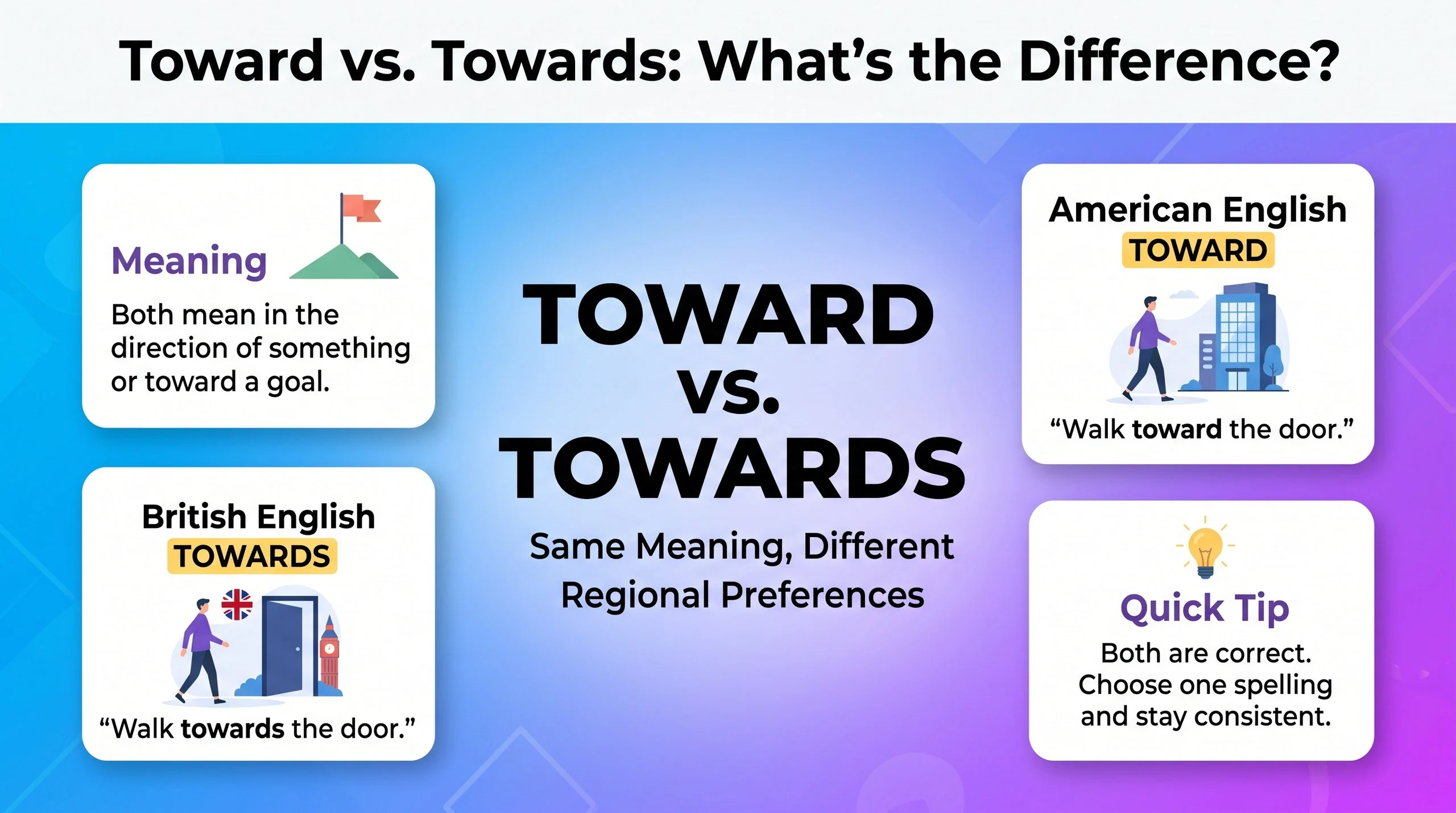
Toward and towards have the same meaning: in the direction of something, or showing progress toward a goal. “Toward” is more common in American English, while “towards” is more common in British English. Both spellings are correct.
Toward or towards is a common English usage question because both words express direction, movement, or progress. The good news is that neither spelling is incorrect. The main difference is regional preference: American English generally favors toward, while British English often uses towards. Both words can describe physical movement, such as walking toward a door, or progress toward an objective, such as working toward a promotion. They can also express an attitude or relationship, as in “her attitude toward change.” Although the difference is small, choosing one form consistently can make your writing more polished. This guide explains the meaning of both words, shows how to use them in everyday sentences, and helps you decide which spelling works best for your audience.
What Is the Difference Between Toward and Towards?
The words toward and towards mean the same thing. Both can describe movement in a particular direction, progress toward a goal, or a person’s attitude about something.
The main difference is how they are used in different varieties of English:
- Toward: More common in American English.
- Towards: More common in British English.
For example:
- American English: “She walked toward the station.”
- British English: “She walked towards the station.”
Both sentences are grammatically correct and communicate the same idea.
When Should You Use Toward?
Use toward when writing for an American English audience or following a style guide that prefers the shorter spelling.
Examples:
- He walked toward the front door.
- We are working toward a common goal.
- Her attitude toward the project was positive.
- The company made progress toward its annual target.
- The dog ran toward its owner.
In each sentence, toward expresses direction, progress, or a relationship to something.
Toward in American English
American publications, educational materials, and professional writing commonly use toward. If you are writing a US-focused article, choosing this spelling is a practical way to maintain consistency.
For example:
“Every small step brings you closer to your goal. Keep working toward the future you want.”
When Should You Use Towards?
Use towards when writing in British English or following a style guide that prefers the longer spelling.
Examples:
- She walked towards the station.
- They are moving towards an agreement.
- His feelings towards the decision changed.
- The child ran towards her mother.
- The team is working towards a better result.
The meaning remains the same as toward. The extra letter does not change the word’s grammatical function.
Towards in British English
British English commonly uses towards in newspapers, books, school materials, and everyday writing.
For example:
“The team is working towards a solution that benefits everyone.”
This sentence is natural in British English. An American writer might use toward instead.
Toward vs. Towards: Quick Comparison
| Feature | Toward | Towards |
|---|---|---|
| Meaning | In the direction of; progressing in the direction of | Same meaning |
| American English | More common | Correct, but less common |
| British English | Correct | More common |
| Grammar | Preposition | Preposition |
| Example | Walk toward the exit | Walk towards the exit |
Neither spelling is universally better. The best choice depends on your audience and preferred style.
How to Use Toward and Towards in Sentences
Both words work in several common contexts.
1. Physical Direction
Use either spelling when describing movement toward a place or person.
- The students walked toward the classroom.
- The students walked towards the classroom.
Both sentences are correct.
2. Progress and Goals
The words can describe efforts to achieve something.
- She is working toward a degree.
- She is working towards a degree.
The meaning is that she is making progress toward completing her education.
3. Attitudes and Feelings
Both words can introduce the object of someone’s attitude.
- His attitude toward change was cautious.
- His attitude towards change was cautious.
The choice is stylistic, not grammatical.
4. Time and Deadlines
The words can also describe an approaching point in time, although other expressions may sound more natural in some sentences.
- We are moving toward the end of the year.
- We are moving towards the end of the year.
Both forms are acceptable.
5. Contributions and Responsibilities
The words can describe an action that supports a larger result.
- The donation went toward the cost of repairs.
- The donation went towards the cost of repairs.
Both sentences mean that the donation helped pay for the repairs.
Is Toward or Towards More Correct?
Neither word is more correct than the other. Both are standard English spellings.
The difference is mainly regional. American English tends to favor toward, whereas British English tends to favor towards. Other English varieties may use either form depending on local convention and editorial preference.
If you are writing for a specific publication, follow its style guide. Otherwise, choose the spelling that matches your audience and use it consistently.
Toward vs. Towards in Formal Writing
Both words are appropriate for formal and informal writing.
For example, you can use either spelling in:
- Academic essays
- Business reports
- Professional emails
- Blog posts
- News articles
- Everyday messages
The important point is consistency. If you are writing an American English article, use toward throughout unless there is a specific reason to retain another spelling. For a British English article, towards may be the more natural choice.
Neither spelling makes a sentence more formal or professional on its own.
Common Mistakes to Avoid
1. Thinking One Spelling Is Incorrect
Incorrect assumption: “Towards is always wrong in American English.”
Correction: Towards is an accepted English spelling. It is simply less common in American usage.
2. Changing Spellings Without a Reason
Switching between toward and towards within the same article can make your writing look inconsistent.
Choose a form that suits your audience and stick with it.
3. Confusing Regional Preference With Grammar
The difference is not a tense rule or a change in meaning. Both words function as prepositions.
4. Assuming the Extra “S” Changes the Meaning
The extra letter does not change the meaning. “Moving toward success” and “moving towards success” express the same idea.
Frequently Asked Questions
1. Is it toward or towards?
Both spellings are correct. American English generally prefers toward, while British English commonly prefers towards.
2. Is towards grammatically correct?
Yes. Towards is a standard English preposition. It is widely used in British English and is also accepted in American English.
3. Do toward and towards mean the same thing?
Yes. Both words can mean in the direction of something, making progress toward a goal, or having an attitude about something.
4. Which spelling should I use in American English?
Toward is generally the preferred choice in American English. However, towards is not grammatically wrong.
5. Which spelling is preferred in British English?
Towards is generally more common in British English, although toward is also acceptable.
6. Is toward more formal than towards?
No. Neither spelling is inherently more formal. The choice usually reflects regional usage or an editorial style preference.
7. Should I use toward or towards in academic writing?
Use the form preferred by your institution, publisher, or style guide. If no preference is specified, choose one spelling and use it consistently.
8. Can I use both toward and towards in the same article?
You can, but it is usually better to maintain consistency. Choose the spelling that best fits your target audience unless you are quoting a source or preserving a specific title.
Conclusion
Toward and towards are both correct English words with the same meaning. They describe direction, progress, attitudes, and movement toward a point or goal. The main difference is regional preference: American English generally favors toward, while British English commonly favors towards. Neither spelling is inherently more formal or grammatically superior. For clear, professional writing, choose the form that suits your audience, follow any relevant style guide, and use it consistently throughout your work.