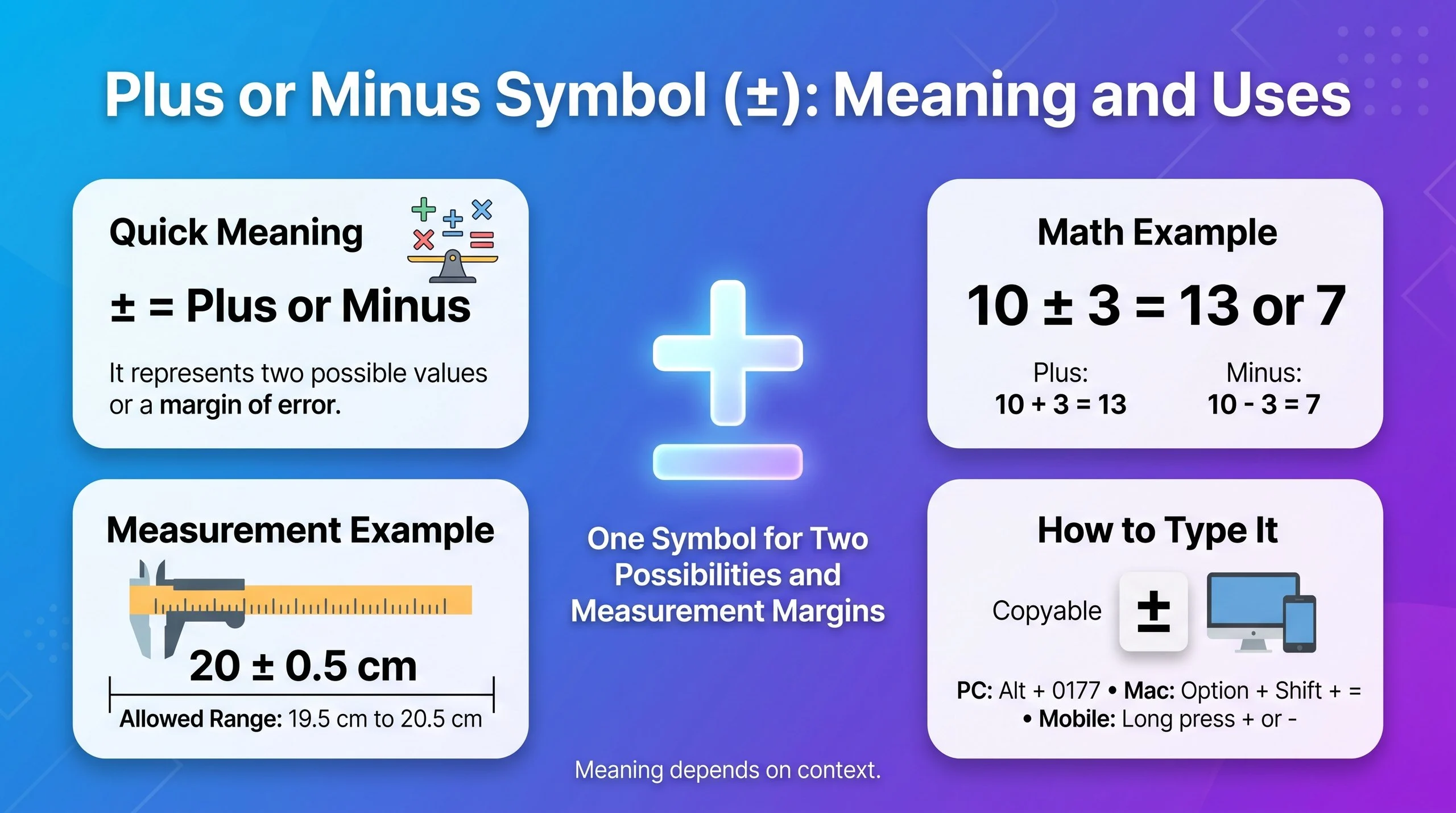
The plus or minus symbol (±) means “plus or minus.” It indicates that a value can be either greater or smaller by a specified amount, represents two possible mathematical results, or expresses an approximate measurement range. For example, 10 ± 2 means a value from 8 to 12.
The plus or minus symbol (±) is a mathematical sign used in equations, measurements, statistics, science, and everyday calculations. It combines the plus sign (+) and minus sign (−) into one symbol. Depending on the context, it can indicate an allowed range, show two possible answers, or communicate uncertainty in a measurement. For example, a measurement of 25 ± 1 cm means the stated value is 25 centimeters with a margin of 1 centimeter. In algebra, the same symbol can represent two solutions that must be evaluated separately. Understanding how to read and use this symbol helps you interpret mathematical expressions, scientific data, and numerical information accurately.
What Is the Plus or Minus Symbol?
The plus or minus symbol is written as ±. It combines two mathematical operations: addition and subtraction.
The symbol has several common uses:
- Showing a range: A value may vary above or below a stated number.
- Representing two possibilities: An equation may have one result using addition and another using subtraction.
- Expressing measurement uncertainty: A reported measurement may include a margin of uncertainty or tolerance.
The exact meaning depends on the context. In some expressions, both the plus and minus possibilities must be calculated. In others, the symbol describes an acceptable range around a measured value.
What Does ± Mean in Math?
In mathematics, ± generally tells you to consider both addition and subtraction.
For example:
10 ± 3
This can represent two values:
- 10 + 3 = 13
- 10 − 3 = 7
Therefore, the two possible results are 13 and 7.
However, context matters. If the expression describes a measurement, 10 ± 3 may instead indicate a range from 7 to 13.
Plus or Minus Symbol in Algebra
The symbol frequently appears when solving equations, especially quadratic equations.
For example:
[
x = \frac{-b \pm \sqrt{b^2-4ac}}{2a}
]
This formula contains ± because the numerator can use either addition or subtraction before dividing by (2a).
To evaluate the expression, calculate both possibilities separately whenever both are valid.
For instance:
[
x = 5 \pm 2
]
The results are:
- (x = 5 + 2 = 7)
- (x = 5 – 2 = 3)
Thus, the possible values are 7 and 3.
What Does ± Mean in Measurements?
In measurements, the plus or minus symbol commonly communicates a stated value and an accompanying margin.
For example:
Length = 20 ± 0.5 cm
This indicates a central or stated value of 20 centimeters with a margin of 0.5 centimeters. If the margin defines the permitted range, the values extend from 19.5 cm to 20.5 cm.
The same format appears in science, engineering, manufacturing, and laboratory reports.
Examples of Measurement Ranges
| Expression | Lower Value | Upper Value |
|---|---|---|
| 10 ± 1 | 9 | 11 |
| 50 ± 2 | 48 | 52 |
| 100 ± 5 | 95 | 105 |
| 25 ± 0.5 | 24.5 | 25.5 |
These ranges assume the number after ± is an absolute margin. In scientific reports, the meaning may depend on whether the value represents measurement uncertainty, standard deviation, a confidence interval, or a manufacturing tolerance.
Plus or Minus Symbol in Science and Statistics
Scientists and statisticians use ± to report values alongside information about variability or uncertainty.
For example, a report might state:
Average temperature = 22 ± 2°C
Depending on the report’s method, the ±2°C may represent a measurement uncertainty, standard deviation, or another specified quantity.
The symbol alone does not explain which statistical measure is being reported. Always check the accompanying explanation, table notes, or methods section.
In experiments, reporting uncertainty helps readers understand how precise a result is and how much variation may be present.
How to Type the Plus or Minus Symbol (±)
You can copy the symbol directly from here:
±
On Windows
Depending on your keyboard layout and application, you can enter the symbol using one of these methods:
- Alt code: Hold Alt and type
0177on the numeric keypad. - Character Map: Open Character Map, find the plus-minus sign, and copy it.
- Copy and paste: Copy ± from this article and paste it where needed.
The Alt-code method generally requires a numeric keypad and may behave differently across applications or keyboard configurations.
On Mac
On many macOS keyboard layouts, you can type the symbol using:
Option (⌥) + Shift + =
Keyboard shortcuts can vary by input source and layout. If this shortcut does not work, use the macOS Character Viewer to find and insert “plus-minus sign.”
On a Mobile Phone
On many iPhone and Android keyboards:
- Open the keyboard.
- Tap the numbers or symbols key, often labeled
123or?123. - Look for additional mathematical symbols.
- If ± is unavailable, copy and paste it from this page.
The exact steps depend on your device, operating system, and keyboard app.
In Microsoft Word
You can insert the symbol using the application’s symbol menu. In some Word versions, typing 00B1 and pressing Alt + X converts the Unicode code into ±.
In HTML
Use the HTML entity ± to display the plus or minus symbol on a webpage.
Its Unicode code point is U+00B1.
Difference Between Plus (+), Minus (−), and Plus or Minus (±)
Although these symbols look related, they have different functions.
| Symbol | Name | Common Meaning |
|---|---|---|
| + | Plus sign | Addition or a positive value |
| − | Minus sign | Subtraction or a negative value |
| ± | Plus or minus | Both addition and subtraction possibilities, or a stated margin around a value |
| ∓ | Minus or plus | The paired sign used in some mathematical expressions |
For example, (8 + 2 = 10), while (8 – 2 = 6).
By comparison, (8 \pm 2) can represent both results: 10 and 6, or a range from 6 to 10 when describing a value with a margin of 2.
The symbol ∓ is sometimes paired with ± to indicate opposite sign choices in related expressions.
Common Mistakes When Using ±
1. Treating It as a Single Operation
The plus or minus symbol does not always mean you should perform both operations at once. In an equation, it commonly represents two alternatives that must be evaluated separately.
2. Assuming Every Range Is a Statistical Confidence Interval
An expression such as 20 ± 2 may describe a tolerance or uncertainty, but it does not automatically mean a 95% confidence interval. The interpretation depends on the source.
3. Forgetting the Units
When reporting measurements, include the appropriate unit, such as 15 ± 1 mm or 22 ± 2°C.
4. Confusing ± With −
The minus sign indicates subtraction or a negative value. The plus or minus symbol indicates two possible signs or a margin around a stated value.
5. Assuming the Range Always Includes Every Value
An expression such as 10 ± 2 often describes the interval from 8 to 12. Whether endpoints are included depends on the context and the convention being used.
Frequently Asked Questions
1. What is the plus or minus symbol?
The plus or minus symbol is ±. It indicates addition and subtraction possibilities or a margin around a stated value.
2. How do I copy the plus or minus symbol?
Copy this character: ±. You can paste it into documents, messages, spreadsheets, equations, or online forms.
3. What does 5 ± 2 mean?
It can represent two calculations: 5 + 2 = 7 and 5 − 2 = 3. When used to describe a value and its margin, it represents a range from 3 to 7.
4. How do I type ± on Windows?
One common method is to hold Alt and type 0177 on the numeric keypad. You can also use Character Map or copy the symbol directly.
5. How do I type ± on a Mac?
On many macOS keyboard layouts, Option + Shift + = enters ±. Otherwise, use Character Viewer to locate and insert the symbol.
6. What is the difference between ± and ∓?
The symbol ± means plus or minus, while ∓ means minus or plus. They are often paired in mathematical expressions to indicate opposite sign choices.
7. Does ± always mean a range?
No. In algebra, it may represent two separate solutions. In measurements, it often describes a margin around a central value. Its meaning depends on context.
8. What is the Unicode for the plus or minus symbol?
The Unicode code point for the plus or minus symbol is U+00B1. In HTML, you can use ± to display it.
Conclusion
The plus or minus symbol (±) is a useful mathematical character that represents two possible sign choices or a margin around a stated value. It appears in algebra, scientific measurements, statistics, engineering, and everyday numerical explanations. For example, 10 ± 2 can represent the two values 12 and 8 or a range from 8 to 12, depending on the context. You can type the symbol using keyboard shortcuts, insert it through a symbol menu, or copy it directly as ±. Understanding how the symbol is used helps you interpret equations and measurements more accurately.