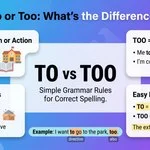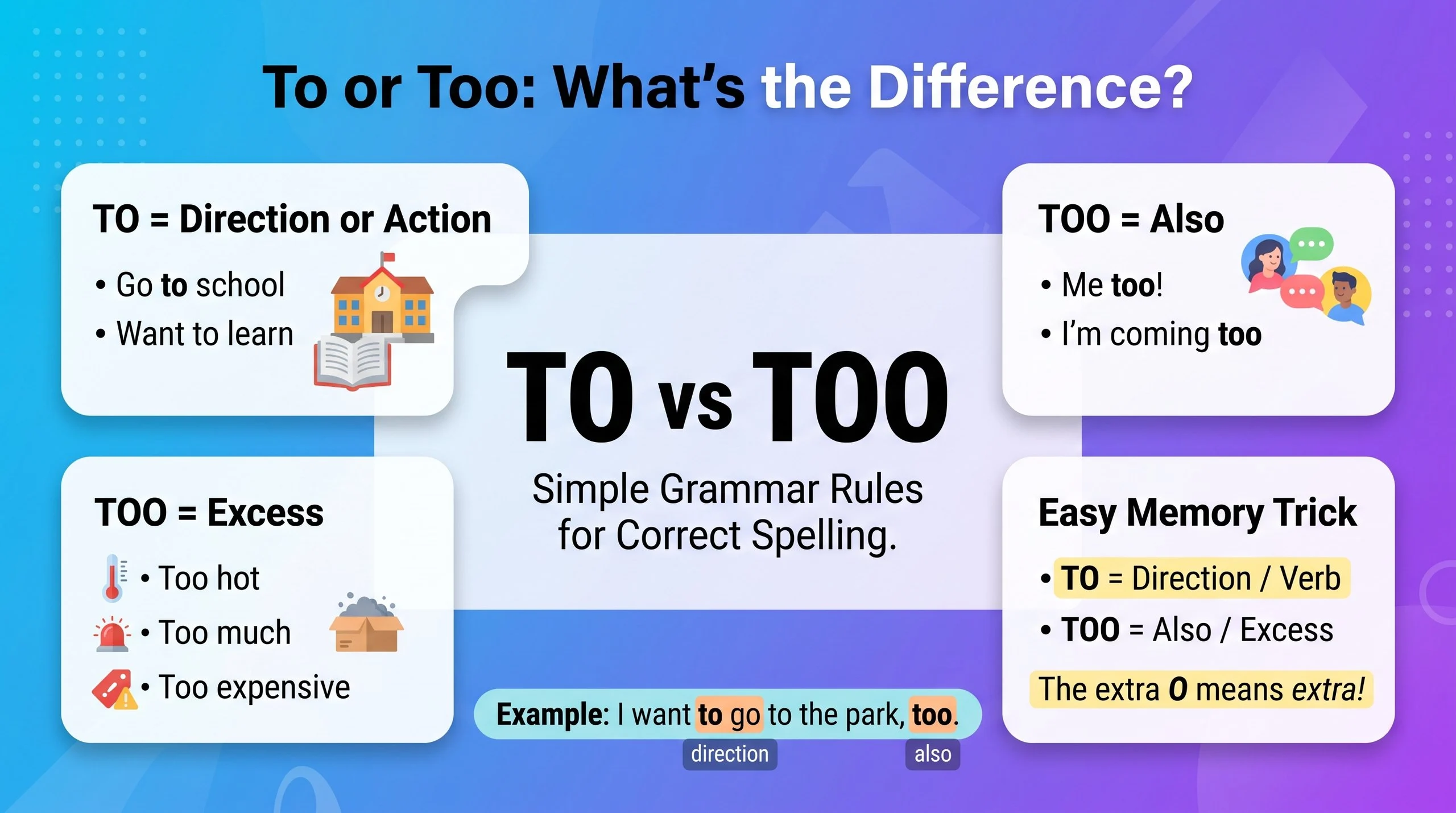
To and too sound alike but have different meanings. Use to to show direction, a recipient, or an action, as in “I want to learn.” Use too to mean “also” or “more than necessary,” as in “I want to learn too” or “It is too difficult.”
Have you ever paused while writing a message because you were unsure whether to use to or too? These two words sound the same in most varieties of English, but their meanings and grammatical roles are different. Writing “I want too go” instead of “I want to go” creates a spelling mistake, while writing “I love you to” instead of “I love you too” changes the correctness of the sentence. Fortunately, the difference is easy to learn. Once you understand when each word is used, you can choose the right spelling in everyday conversations, school assignments, emails, and social media posts.
What Is the Difference Between To and Too?
The main difference is how each word works in a sentence.
To commonly indicates direction, a destination, a recipient, or an action. It can also express a relationship or endpoint.
Too is an adverb that usually means “also” or “more than necessary.”
Compare these examples:
- “I’m going to school.” — To shows the destination.
- “I’m going too.” — Too means also.
- “It’s too cold outside.” — Too means excessively cold.
- “I want to sleep.” — To comes before the verb sleep.
Both spellings are correct English words, but they cannot usually replace each other without changing the meaning or making the sentence incorrect.
What Does To Mean?
The word to has several common grammatical uses. It often works as a preposition or as part of an infinitive verb.
1. To Shows Direction or Destination
Use to when someone or something moves toward a place.
Examples:
- We drove to the beach.
- She walked to school.
- He is traveling to New York.
- I went to the store after work.
In each example, to connects the action with a destination.
2. To Comes Before a Verb
Use to before the base form of a verb to create an infinitive.
Examples:
- I want to learn English.
- They need to leave early.
- She hopes to become a doctor.
- We decided to stay home.
A helpful pattern is to + base verb.
For instance, “to eat,” “to write,” “to study,” and “to travel” are all correct.
3. To Identifies a Recipient
To can indicate the person who receives something.
Examples:
- Give the keys to me.
- She sent a letter to her friend.
- I explained the problem to my teacher.
- He handed the package to his neighbor.
Here, to helps identify who receives the item or information.
4. To Expresses a Limit or Endpoint
To can also show a range, endpoint, or connection.
Examples:
- The store is open from nine to five.
- Count from one to ten.
- The temperature rose to 30 degrees.
- Add two to the total.
The meaning depends on how the word functions in the sentence.
What Does Too Mean?
The word too usually has two main meanings: “also” and “more than necessary.”
1. Too Means Also
Use too when you want to say that something applies to another person or situation as well.
Examples:
- I want to come too.
- She likes chocolate too.
- Have a great weekend, too!
- My brother is joining us too.
In these sentences, you can usually replace too with “also” without changing the basic meaning.
For example, “I want to come too” means “I also want to come.”
2. Too Means More Than Necessary
Too can also describe something that exceeds a desirable, acceptable, or practical amount.
Examples:
- The coffee is too hot.
- This bag is too heavy.
- The movie was too long.
- The shoes are too expensive.
In these examples, too suggests that the amount or quality creates a problem or goes beyond what is wanted.
3. Too Often Appears Before Adjectives and Adverbs
You will frequently see too before an adjective or adverb.
Examples:
- Too cold
- Too expensive
- Too difficult
- Too quickly
- Too slowly
- Too loudly
You can also use it in expressions such as “too much,” “too many,” and “too late.”
Examples:
- There is too much sugar in the tea.
- Too many people arrived at once.
- It is too late to call.
To vs. Too: Comparison Table
| Feature | To | Too |
|---|---|---|
| Main use | Direction, recipient, or infinitive verb | Also or excessively |
| Before a base verb | Yes, as in “to go” | Not for this purpose |
| Shows destination | Yes | No |
| Means “also” | No | Yes |
| Means “more than necessary” | No | Yes |
| Example | I need to study. | I need help too. |
To or Too in Everyday Sentences
Sometimes both words appear in the same sentence. Understanding their separate roles makes the correct spelling easier to identify.
Example 1: “I Want to Go Too”
This sentence uses both words correctly.
- To introduces the verb go.
- Too means also.
The sentence means that the speaker also wants to go.
Example 2: “It’s Too Late to Leave”
Again, both words have different functions.
- Too means later than is suitable or practical.
- To introduces the verb leave.
Example 3: “She Went to the Party Too”
- To identifies the destination.
- Too means she went as well.
Example 4: “The Box Is Too Heavy to Lift”
- Too means excessively heavy.
- To introduces the action lift.
These examples demonstrate why the two spellings should not be treated as interchangeable.
Common Mistakes With To and Too
Because the words sound alike, writers often confuse them when typing quickly. Here are frequent errors and their corrections.
| Incorrect | Correct | Explanation |
|---|---|---|
| I want too eat. | I want to eat. | To comes before the verb eat. |
| It is to cold. | It is too cold. | Too means excessively. |
| I love you to. | I love you too. | Too means also. |
| We went too the park. | We went to the park. | To indicates the destination. |
| There is to much noise. | There is too much noise. | Too much expresses excess. |
| She wants too study. | She wants to study. | To introduces the infinitive study. |
| I will come to. | I will come too. | Too means as well. |
Mistake 1: Using Too Before an Infinitive Verb
Incorrect: “I need too finish my homework.”
Correct: “I need to finish my homework.”
The word to introduces the verb finish. Too does not perform that grammatical role.
Mistake 2: Using To When You Mean Also
Incorrect: “I enjoyed the movie to.”
Correct: “I enjoyed the movie too.”
The intended meaning is that the speaker enjoyed the movie as well.
Mistake 3: Forgetting the Extra O in Too Much
Incorrect: “There is to much work today.”
Correct: “There is too much work today.”
Too much means more work than is desired or manageable.
Mistake 4: Confusing Too With Very
Consider these two sentences:
- “The room is very warm.”
- “The room is too warm.”
Very indicates a high degree of warmth. Too suggests that the warmth exceeds a desirable level.
This difference can change the meaning of your sentence.
Easy Tricks to Remember To and Too
Trick 1: Remember the Extra O
The word too has an extra o. Think of that extra letter as representing something extra.
- Too = also
- Too = more than necessary
Examples: “Me too,” “too much,” and “too expensive.”
This is a memory trick rather than a formal grammar rule.
Trick 2: Replace Too With Also
If you can replace the word with “also” and preserve the meaning, too is usually correct.
Example:
“I want to join too.”
Try: “I also want to join.”
The meaning stays the same, so too is correct.
Trick 3: Check for a Verb
If you are writing a phrase such as “___ go,” “___ eat,” or “___ learn,” you usually need to before the base verb.
Examples:
- To go
- To eat
- To learn
- To improve
However, do not rely on the next word alone. Look at the meaning and grammatical structure of the whole sentence.
What About Two?
The number two is a third word that sounds like to and too in most English accents.
Although this article focuses on to and too, knowing all three forms can help prevent additional mistakes.
- To: I want to leave.
- Too: I want to leave too.
- Two: I have two tickets.
Two always refers to the number 2 or a quantity of two.
Frequently Asked Questions
1. What is the difference between to and too?
To commonly shows direction, identifies a recipient, or introduces an infinitive verb. Too means “also” or “more than necessary.” For example, “I want to go” and “I want to go too” are both correct but have different meanings.
2. Is it “I love you to” or “I love you too”?
The correct expression is “I love you too.” Here, too means “also” or “in return.” The word to would not be correct in this sentence.
3. Is it “me to” or “me too”?
Use “me too” when you mean “me also.” For example, if someone says, “I love pizza,” you can respond, “Me too!”
4. Is it “too much” or “to much”?
The correct phrase is “too much.” It means more than is needed or wanted. For example, “There is too much salt in this soup.”
5. Is it “to late” or “too late”?
The correct phrase is “too late.” Too means that the time is beyond what is suitable or useful. For example, “It is too late to change the plan.”
6. Can to and too appear in the same sentence?
Yes. For example, “I want to come too.” The first word introduces the verb come, while the second means also.
7. Are to and too homophones?
Yes. In most English accents, to and too sound the same but have different spellings and meanings. Words with the same pronunciation but different meanings or spellings are called homophones.
8. How can I remember when to use to or too?
Remember that to often shows direction or comes before a verb, while too means “also” or “excessively.” The extra o in too can remind you of something extra.
Conclusion
Understanding to or too is easier when you focus on meaning instead of pronunciation. Use to for direction, recipients, and infinitive verbs, as in “I went to school” and “I want to learn.” Use too when you mean “also” or “more than necessary,” as in “I’m coming too” and “It’s too cold.” Remember the extra-o trick, check whether you mean “also,” and read the complete sentence before choosing a spelling. With a little practice, you can avoid these common grammar mistakes in messages, schoolwork, and professional writing.

Andrew Morris is a writer at Meaninga.com who specializes in word meanings, slang, idioms and modern language trends. He creates clear, accurate and easy to understand content for everyday readers.