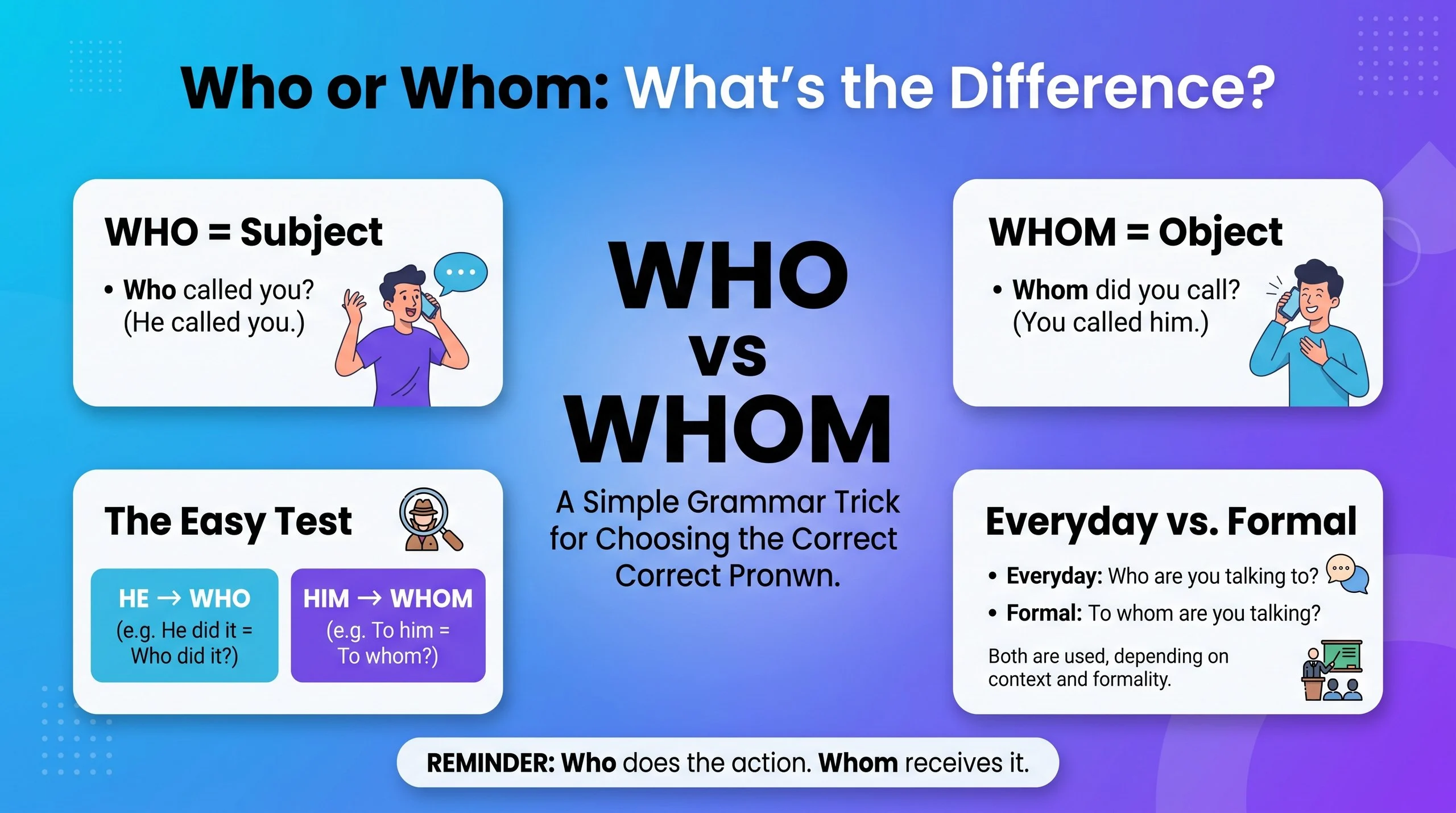
Use who when referring to the subject of a sentence, the person doing the action. Use whom when referring to the object, the person receiving the action or affected by it. For example, “Who called you?” is correct because who performs the action, while “Whom did you call?” is correct because whom receives the action.
Have you ever wondered whether to write “Who did you meet?” or “Whom did you meet?” Both forms appear in English, but choosing the right one can be confusing. The difference comes down to grammar: who functions as a subject, while whom functions as an object. Although everyday conversations often favor who, especially in informal American English, whom still appears in formal writing and certain expressions. Fortunately, a simple trick involving the words he and him can help you choose correctly. Once you understand the basic rule, you can use who and whom more confidently in questions, emails, essays, and everyday conversations.
What Is the Difference Between Who and Whom?
The main difference between who and whom is their grammatical function.
Who is a subject pronoun. It refers to the person doing an action or performing the role of a subject.
Whom is an object pronoun. It refers to the person receiving an action or serving as the object of a verb or preposition.
Compare these examples:
- “Who called you?” — Who performs the action of calling.
- “Whom did you call?” — Whom receives the action of calling.
- “Who is at the door?” — Who is the subject of the sentence.
- “To whom did you speak?” — Whom follows the preposition to.
In everyday speech, many English speakers use who in situations where traditional formal grammar calls for whom. This is especially common in questions such as “Who did you invite?” In formal writing, however, whom remains useful when the grammatical role is clear.
What Does Who Mean?
The word who refers to a person or people and functions as a subject pronoun.
Use who when the person is performing an action or when the person is the subject of a sentence.
1. Who as the Subject of a Question
Examples:
- Who sent this message?
- Who opened the window?
- Who wants to join us?
- Who is coming to dinner?
In each example, who identifies the person performing the action or being described.
For instance, in “Who opened the window?” the person identified by who is the one who opened it.
2. Who in Statements
Who also introduces clauses that identify or describe a person.
Examples:
- She is the woman who helped me.
- I know someone who speaks Japanese.
- He is the friend who called yesterday.
- The student who won the prize looked surprised.
In these examples, who performs the action within the clause: helped, speaks, called, and won.
3. Who in Indirect Questions
An indirect question reports or embeds a question within another sentence.
Examples:
- I wonder who left the lights on.
- Do you know who called?
- She asked who was responsible.
- Tell me who is coming.
Who remains correct when it functions as the subject of the embedded question.
What Does Whom Mean?
The word whom is an object pronoun. It refers to the person receiving an action or following a preposition.
Although it can sound formal or old-fashioned in casual conversation, whom is still grammatically useful.
1. Whom as the Object of a Verb
Examples:
- Whom did you invite?
- Whom did she choose?
- Whom are they waiting for?
- Whom did the manager interview?
In each sentence, the person identified by whom receives the action.
For example, in “Whom did you invite?” you perform the action of inviting, while the person you invite is the object.
2. Whom After a Preposition
Traditional formal grammar uses whom after prepositions such as to, for, with, by, and from.
Examples:
- To whom should I send the email?
- With whom did you travel?
- For whom is this gift?
- From whom did you receive the package?
- By whom was the report written?
In everyday conversation, people often move the preposition to the end and use who instead:
- Who should I send the email to?
- Who did you travel with?
- Who is this gift for?
These conversational versions are widely accepted in ordinary English. The forms with whom often sound more formal.
3. Whom in Indirect Questions
Whom can also function as the object in an indirect question.
Examples:
- I don’t know whom she invited.
- Tell me whom you selected.
- He asked whom we had contacted.
- They wanted to know whom the committee had chosen.
In informal speech, who is often used instead of whom in these sentences.
The Easiest Trick: He or Him?
One of the simplest ways to distinguish who from whom is to replace the word with he or him, or another matching subject/object pronoun such as she/her or they/them.
- If he or she fits, use who.
- If him or her fits, use whom.
Example 1: Who Called You?
Try answering the question with a pronoun:
“___ called you.”
You would say, “He called you,” not “Him called you.”
Therefore, who is correct.
Example 2: Whom Did You Call?
Try simplifying the sentence:
“You called ___.”
You would say, “You called him,” not “You called he.”
Therefore, whom is the traditional grammatical choice.
Example 3: Who Is Coming?
Try: “She is coming.”
Because she fits as the subject, who is correct.
Example 4: To Whom Did You Give the Book?
Try: “I gave the book to him.”
Because him follows the preposition to, whom is correct in the formal version.
This trick is particularly useful when a question’s word order makes the grammatical subject and object less obvious.
Who vs. Whom: Comparison Table
| Feature | Who | Whom |
|---|---|---|
| Grammatical role | Subject | Object |
| Pronoun comparison | He, she, they | Him, her, them |
| Common use | Who called? | Whom did you call? |
| After a preposition | Usually not in formal constructions | Often used in formal constructions |
| Everyday speech | Very common | Less common |
| Formal writing | Correct when used as a subject | Useful when used as an object |
Who or Whom in Everyday Sentences
Sometimes, choosing the right pronoun becomes easier when you compare both versions.
Example 1: Who Did You Meet?
In casual conversation, “Who did you meet?” is widely accepted. Under traditional formal grammar, whom is the object of meet, so “Whom did you meet?” is the formal alternative.
Both versions are common, but they differ in tone and formality.
Example 2: Who Wants Pizza?
The correct choice is who because the person wants pizza.
You could answer, “She wants pizza.” Since she functions as the subject, who is appropriate.
Example 3: Who Are You Talking To?
This is a natural, widely used conversational question. The formal alternative is “To whom are you talking?”
The second version places the preposition before whom and generally sounds more formal.
Example 4: The Person Who Helped Me
Use who because the person performs the action of helping.
Correct: “The person who helped me was very kind.”
Incorrect in standard grammar: “The person whom helped me was very kind.”
Example 5: The Person Whom I Helped
Use whom in traditional formal grammar because the person receives the action of helping.
Correct formal version: “The person whom I helped thanked me.”
A more conversational alternative is “The person who I helped thanked me.” Many speakers use who in this object position in informal English.
Common Mistakes With Who and Whom
1. Using Whom as a Subject
Incorrect: “Whom is coming to the party?”
Correct: “Who is coming to the party?”
The person coming is the subject, so who is correct.
2. Using Who After a Preposition in Formal Writing
Incorrect in traditional formal grammar: “To who should I address the letter?”
Correct formal version: “To whom should I address the letter?”
In casual speech, “Who should I address the letter to?” is also widely used.
3. Choosing Whom Just Because a Sentence Sounds Formal
Whom is not automatically more correct. It must serve as an object.
For example, “Whom is responsible?” is incorrect in standard grammar because the pronoun is the subject of is responsible. The correct form is “Who is responsible?”
4. Ignoring the Structure of the Sentence
A question may begin with who even when the pronoun refers to an object in everyday usage. To identify the traditional formal form, rewrite the sentence in a simpler order and check whether he or him fits.
For example, “Who did she call?” becomes “She called him.” Therefore, whom is the traditional formal object form.
5. Overusing Whom in Casual Conversation
Although whom remains correct in formal contexts, it can sound stiff in some everyday conversations. Match the pronoun to the tone and audience of your writing.
When Should You Use Who or Whom?
Choose the form based on grammar and context.
Use who in everyday questions and statements when the person is the subject. Examples include “Who is calling?” and “The woman who works here is helpful.”
Use whom when the person is the object in formal grammar, particularly after a preposition. Examples include “Whom did you invite?” and “To whom should I speak?”
In casual American English, who often replaces whom in object questions. This usage is common and natural in everyday speech. However, knowing the formal distinction helps you write more precisely in academic work, professional correspondence, and edited prose.
Frequently Asked Questions
1. What is the difference between who and whom?
Who is a subject pronoun, while whom is an object pronoun. Use who for the person doing the action and whom for the person receiving the action or following a preposition in formal grammar.
2. Is it “Who did you call?” or “Whom did you call?”
“Whom did you call?” is the traditional formal choice because the person is the object of call. “Who did you call?” is extremely common and widely accepted in everyday English.
3. Is it “Who is there?” or “Whom is there?”
The correct form is “Who is there?” The pronoun is the subject of the sentence, so who is required.
4. Is it “Who do you live with?” or “Whom do you live with?”
Both forms occur. “Who do you live with?” is natural in everyday speech. “With whom do you live?” is the more formal construction.
5. How can I remember who versus whom?
Use the he-or-him test. If he or she fits, choose who. If him or her fits, choose whom in traditional grammar.
6. Is whom outdated?
Whom is less common in casual conversation, but it is not obsolete. It remains useful in formal writing, especially after prepositions and when the object role needs to be clear.
7. Can I use who instead of whom?
In many informal contexts, yes. Speakers frequently use who in object positions, as in “Who did you invite?” In formal writing, whom may be preferred when it is clearly the object.
8. Which is correct: “the person who I met” or “the person whom I met”?
In traditional formal grammar, “the person whom I met” is preferred because the person is the object of met. “The person who I met” is common in everyday English and is generally accepted in informal contexts.
Conclusion
The difference between who or whom comes down to the role the pronoun plays in a sentence. Use who for the subject, as in “Who called?” Use whom for the object in traditional formal grammar, as in “Whom did you call?” The he-or-him trick makes the choice easier: he points to who, while him points to whom. Although whom is less common in casual American English, understanding both forms helps you choose wording that suits your audience, whether you’re writing a text message, an email, or a formal essay.