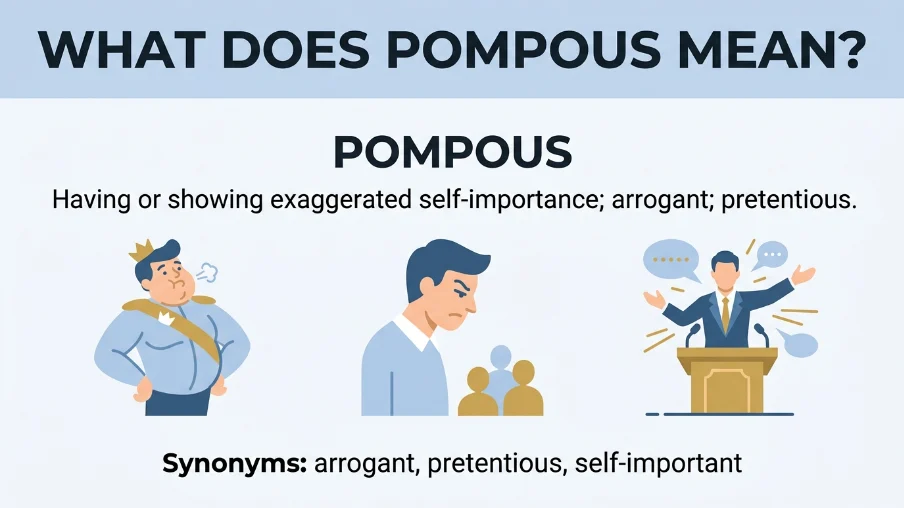
The word pompous means having or showing an exaggerated sense of self-importance. A pompous person acts as if they are better, smarter, or more important than others. It is an adjective with a negative connotation, often used to describe arrogant behavior or pretentious speech .
Have you ever met someone who talks down to others, uses overly complicated words, or acts like they are the most important person in the room? You have probably encountered a pompous person. The word pompous describes this exact kind of behavior. It is a powerful adjective that paints a clear picture of arrogance and self-importance.
Understanding the meaning of pompous is important for several reasons. First, it helps you describe people and situations accurately. Second, it allows you to recognize pompous behavior in yourself and others. Third, it is a common word in literature, media, and everyday conversation. Using it correctly makes your writing and speech more precise.
The challenge with pompous is that it has a few subtle meanings. It can describe a person’s attitude, their speech, or even a grand display. However, the core idea is always about excessive pride and self-importance. Many people also confuse it with similar words like pretentious or arrogant.
This article clears up the confusion once and for all. You will learn the definitions, see real examples, and discover the subtle differences between pompous and related words. By the end, you will use this word with confidence and precision.
Key Takeaway
The main takeaway is that pompous describes someone who displays exaggerated self-importance, often through arrogant behavior or pretentious speech . It comes from the Latin word pompa, meaning a grand procession or display . People use it negatively to criticize those who think they are better than others. The word also describes overly grand or high-flown language .
Definition and Explanation
What Does “Pompous” Mean?
Pompous is an adjective that primarily describes a person who acts with excessive self-esteem or exaggerated dignity . A pompous person has an inflated sense of their own importance. They often behave in a way that suggests they are superior to others.
The word has three main meanings:
- Excessive self-importance: Someone who is arrogant and believes they are better than others. For example, “He was a pompous official who enjoyed giving orders” .
- Pretentious speech or style: Language that is overly grand, high-flown, or bombastic. For example, “She winced at his pompous phraseology” .
- Ceremonial or stately display: A showy or magnificent display. This is an older meaning. For example, “a pompous funeral” .
| Meaning | Description | Example |
| Self-importance | Arrogant, conceited behavior | “A pompous politician” |
| Pretentious style | Overly grand language | “A pompous speech” |
| Stately display | Showy magnificence (archaic) | “A pompous ceremony” |
The Etymology of “Pompous”
The word pompous has an interesting history. It comes from the Latin word pompa, which means a grand procession or display . This is the same root as the English word pomp, which means a showy display or ceremony.
The word entered English in the 14th century via Old French pompeux . Initially, it described something grand, magnificent, or stately. Over time, the meaning shifted. Today, we use pompous primarily to criticize people who are full of themselves .
Think of it this way: someone who is pompous treats everyday life as if they are walking in their own grand procession. They expect others to admire them. They act as if they are performing on a stage and everyone else is just an audience member.
Pompous vs. Pomp and Circumstance
You might have heard the phrase “pomp and circumstance.” This phrase describes a grand or showy display, often at formal ceremonies . Pomp and circumstance is not negative. It describes the grandeur of an event, like a graduation ceremony.
Pompous, however, is almost always negative. It describes a person’s attitude, not an event. A graduation ceremony can be full of pomp and circumstance. A speaker at that ceremony can be pompous.
| Term | Meaning | Connotation |
| Pomp and circumstance | Grand, showy display or ceremony | Neutral or positive |
| Pompous | Self-important, arrogant | Negative |
Advantages and Disadvantages
Understanding the word pompous has advantages and disadvantages. This section explores both sides.
Advantages of Using the Word Correctly
- Precision: Using pompous accurately helps you describe people and situations with precision. It conveys a specific type of arrogance.
- Rich vocabulary: Using words like pompous shows a strong command of English. It makes your writing more sophisticated.
- Critique: Pompous is an effective word for criticizing behavior without resorting to slang or insults. It is a formal and appropriate way to describe arrogance.
- Understanding literature: The word appears frequently in literature, journalism, and academic writing. Understanding it helps you comprehend these texts better.
- Cultural awareness: Recognizing pompous behavior helps you navigate social and professional situations. You can identify when someone is acting arrogant and respond appropriately.
Disadvantages of Using the Word Incorrectly
- Misunderstanding: Using pompous to describe someone who is simply confident or formal could confuse your audience.
- Offense: Calling someone pompous can be offensive. It is a strong criticism. Using it carelessly can damage relationships.
- Overuse: Using pompous too often can make your writing sound repetitive. It might also make you seem overly critical.
- Inaccuracy: Applying the word to situations where it does not fit can weaken your writing. It might make you seem less knowledgeable.
| Aspect | Correct Usage | Incorrect Usage |
| Precision | Accurately describes arrogant behavior | Misapplied to formal but humble behavior |
| Tone | Professional and descriptive | Could seem overly critical or harsh |
| Impact | Strong, clear critique | Might cause confusion or offense |
Real-World Examples
Seeing pompous used correctly in real-world contexts helps solidify the meaning.
Examples of “Pompous” in Action
- “He was somewhat pompous and had a high opinion of his own capabilities” . This describes a person who thinks highly of themselves.
- “The pompous speaker boasted about his accomplishments for too long” . This describes arrogant behavior that bores an audience.
- “She found it difficult to talk about her achievements without sounding pompous” . This describes how someone’s words can come across as arrogant.
- “The politician’s pompous speech did not sit well with the audience” . This describes a speech that was overly grand and self-important.
- “He liked to be rather pompous” . This describes a person’s habitual behavior.
Common Contexts for “Pompous”
| Context | Example | Reason |
| Politics | “a pompous politician” | Politicians are often criticized for arrogance. |
| Business | “pompous officials” | Officials in positions of power can be pompous. |
| Academia | “pompous professors” | Academics can be seen as pretentious. |
| Social settings | “She could be rather pompous” | Personal relationships can reveal pompous behavior. |
Pompous Behavior and Characteristics
A pompous person often exhibits these traits:
- Uses overly complicated language to sound smart
- Talks about their achievements constantly
- Interrupts others or dismisses their opinions
- Expects special treatment
- Looks down on people they consider inferior
- Struggles to admit when they are wrong
Regional and Global Usage
The word pompous is used consistently across all English-speaking regions.
Global English Consistency
English speakers worldwide use pompous to describe arrogant, self-important behavior. Whether you are in the US, the UK, Australia, or Canada, the meaning is the same. There are no significant regional variations in how people use this word.
Pronunciation Differences
There is a slight difference in pronunciation between American and British English.
| Region | Pronunciation | Rhymes with |
| American English | /ˈpɑːm.pəs/ | “Amp us” |
| British English | /ˈpɒm.pəs/ | “Pomp us” |
Cultural Nuances
In many cultures, pompous carries a negative tone. It implies insincerity or inflated self-worth . However, in traditional or formal societies, a certain level of pomp might be seen as a sign of authority or dignity. The perception is context-sensitive .
In modern egalitarian cultures, humility is highly valued. Pompous behavior is often met with criticism or mockery. Understanding this cultural context helps you use the word appropriately.
Common Mistakes
This section highlights frequent errors people make with pompous. Learning about them will help you avoid them.
Mistake 1: Confusing Pompous with Confident
Some people mistake confidence for pompousness. Confidence is positive. It is a healthy belief in your abilities. Pompousness is negative. It is an exaggerated belief in your superiority.
| Trait | Description | Example |
| Confident | Sure of one’s abilities; humble | “She was confident in her presentation.” |
| Pompous | Arrogant, self-important | “He was pompous about his achievements.” |
Mistake 2: Confusing Pompous with Pretentious
Pompous and pretentious are similar but not identical. They are often used together . However, they have subtle differences.
- Pompous: Focuses on arrogance and self-importance. A pompous person acts like they are better than others.
- Pretentious: Focuses on trying to appear more important or cultured than you are. A pretentious person puts on an act.
| Term | Focus | Example |
| Pompous | Arrogance, superiority | “He was a pompous windbag.” |
| Pretentious | Trying to impress, fake | “She used pretentious language.” |
Mistake 3: Confusing Pompous with Grandiose
Grandiose describes something that is impressive or magnificent on a large scale. It can describe a plan, an idea, or a building. Pompous describes a person’s attitude.
| Term | Focus | Example |
| Grandiose | Large scale, impressive | “He had a grandiose plan.” |
| Pompous | Arrogant behavior | “He was a pompous man.” |
Mistake 4: Misusing the Archaic Meaning
The older meaning of pompous is “ceremonial or stately . Some people might use pompous this way in modern writing. However, it is rare and could confuse readers.
Correction: Use pompous to describe arrogant behavior. Use grand or magnificent to describe stately displays. Avoid the archaic meaning unless you are writing in a historical context.
Synonyms and Related Words
Understanding synonyms helps you use pompous with precision.
Formal Synonyms
| Synonym | Meaning | Nuance |
| Arrogant | Having an exaggerated sense of one’s own importance | General term for superiority |
| Haughty | Disdainfully proud | Suggests looking down on others |
| Imperious | Giving orders in an arrogant manner | Suggests domineering behavior |
| Overbearing | Unpleasantly domineering | Suggests controlling behavior |
| Supercilious | Behaving as if you think you are better than others | Suggests a sneering attitude |
Synonyms Related to Speech and Style
| Synonym | Meaning | Nuance |
| Bombastic | High-sounding but with little meaning | Focuses on inflated language |
| Grandiloquent | Pompous or extravagant in language | Focuses on lofty speech |
| Pretentious | Trying to appear more important than you are | Focuses on the attempt to impress |
| Ostentatious | Designed to impress | Focuses on showy display |
Common Synonyms
| Word | Part of Speech | Meaning |
| Pompous | Adjective | Self-important, arrogant |
| Arrogant | Adjective | Overly self-important |
| Haughty | Adjective | Disdainfully proud |
| Pretentious | Adjective | Trying to impress |
| Grandiose | Adjective | Impressive in a self-important way |
Exercises
Test your knowledge with these exercises.
Exercise 1: Fill in the Blank
Choose the correct word to complete each sentence.
- He was a _________ man who thought he was better than everyone else.
- She gave a _________ speech that was full of empty phrases.
- The _________ official enjoyed giving orders to his subordinates.
- It is difficult to talk about your achievements without sounding _________.
- The critic described the novel as _________ and self-important.
Exercise 2: Identify the Error
Each sentence has a mistake. Identify the incorrect word and correct it.
- “He was confident, not pompous.” (Assume the sentence is wrong)
- “She acted in a pompous manner, but she was actually very confident and humble.”
- “The ornate ceremony was extremely pompous and grand.”
- “The politician’s arrogant and pompous speech was well-received.”
Exercise 3: Choose the Best Word
Select the best word to complete each sentence.
- “He had a _________ plan to take over the world.” (pompous/grandiose)
- “Her _________ attitude made her difficult to work with.” (pretentious/pompous)
- “The building was _________ and impressive.” (pompous/grand)
- “His _________ language was meant to impress.” (bombastic/haughty)
Answer Key
Exercise 1 Answers:
- Pompous (self-important)
- Pompous (pretentious, empty)
- Pompous (enjoys giving orders)
- Pompous (arrogant about achievements)
- Pompous (self-important)
Exercise 2 Corrections:
- “He was confident, not arrogant.” (Confident and pompous are not opposites)
- “She acted in a confident manner, but she was actually very insecure.” (Pompous does not fit with humble)
- The ornate ceremony was extremely grand and magnificent.” (Archaic meaning of pompous is rare)
- “The politician’s arrogant and pompous speech was poorly received.” (Pompous speeches are not well-received)
Exercise 3 Answers:
- Grandiose (large-scale plan)
- Pompous (arrogant behavior)
- Grand (impressive building)
- Bombastic (inflated language)
Related Concepts and Comparisons
Understanding how pompous relates to other concepts helps build a complete picture.
Pompous vs. Arrogant
These words are often used interchangeably, but they have subtle differences.
- Arrogant: Having an exaggerated sense of one’s own importance or abilities. It is a general term.
- Pompous: Arrogant behavior that is often displayed through language, manner, or attitude. It often implies a showy or ostentatious quality .
| Term | Focus | Example |
| Arrogant | General superiority | “He was arrogant.” |
| Pompous | Self-important display | “He was pompous in his speech.” |
Pompous vs. Pretentious
These words are very similar but not identical.
- Pompous: Acting as if you are better than others. It is about arrogance.
- Pretentious: Trying to appear more important or cultured than you are. It is about putting on an act .
| Term | Focus | Example |
| Pompous | Arrogance | “He was pompous.” |
| Pretentious | Fake sophistication | “He used pretentious language.” |
Pompous vs. Bombastic
Both words relate to language.
- Pompous: Arrogant and self-important (can apply to behavior and speech).
- Bombastic: High-sounding but with little meaning (applies specifically to language) .
| Term | Focus | Example |
| Pompous | Arrogant behavior and speech | “He was pompous.” |
| Bombastic | Inflated, meaningless language | “His speech was bombastic.” |
Pompous vs. Grandiose
- Pompous: Arrogant, self-important behavior.
- Grandiose: Impressive in a large scale, often unrealistically so .
| Term | Focus | Example |
| Pompous | Attitude | “He was pompous.” |
| Grandiose | Plan or idea | “He had a grandiose plan.” |
FAQs
What is the meaning of pompous?
Pompous means having or showing exaggerated self-importance. It describes someone who acts as if they are better, smarter, or more important than other people . It can also describe overly grand or pretentious language .
What does pompous mean in simple words?
In simple words, pompous means acting like you are more important than everyone else. A pompous person is arrogant and full of themselves. They often talk down to others .
What is an example of pompous?
An example of a pompous person is someone who constantly boasts about their achievements, uses overly complicated words to sound smart, and dismisses the opinions of others . A politician who gives a long, self-important speech is also pompous .
Is pompous positive or negative?
Pompous is a negative word. It is used to criticize arrogant, self-important behavior. Calling someone pompous is an insult . It suggests that the person is full of themselves and looks down on others.
What is the difference between pompous and arrogant?
Pompous and arrogant are similar, but pompous often implies a showy or pretentious quality. Arrogant is a more general term for having an exaggerated sense of one’s own importance. Pompous behavior often includes an ostentatious display of dignity .
What is the difference between pompous and pretentious?
Pompous focuses on arrogance and self-importance. Pretentious focuses on trying to appear more important or cultured than you really are. A pompous person genuinely believes they are better. A pretentious person is putting on an act .
What part of speech is pompous?
Pompous is an adjective. It is used to describe nouns. For example, “a pompous person” or “a pompous speech.” The noun form is pompousness or pomposity .
Where does the word pompous come from?
The word comes from the Latin word pompa, meaning a grand procession or display . It entered English in the 14th century via Old French pompeux . It originally meant magnificent, but it now means arrogant .
How do you pronounce pompous?
In American English, it is pronounced /ˈpɑːm.pəs/ (PAHM-pus) . In British English, it is pronounced /ˈpɒm.pəs/ (POM-pus) . It has two syllables.
What are synonyms for pompous?
Synonyms for pompous include arrogant, pretentious, self-important, haughty, grandiose, overbearing, and bombastic .
Conclusion
This guide has clarified the meaning and usage of pompous. Pompous is an adjective that describes someone who acts with exaggerated self-importance. It is a negative word used to criticize arrogant, pretentious behavior. The word comes from the Latin word pompa, meaning a grand procession. Over time, its meaning shifted from “magnificent” to “self-important.
The best practical advice is to use pompous carefully. It is a strong criticism. Use it when you want to describe someone who is arrogant, full of themselves, and displays their superiority in a showy way. Understand the difference between pompous, arrogant, and pretentious to choose the most precise word. Remember that pompous almost always has a negative connotation.
Good vocabulary depends on understanding these subtle distinctions. Now you have the knowledge to use pompous correctly every time. Use this guide as a reference whenever you are unsure. Over time, the right choice will become second nature to you.

Andrew Morris is a writer at Meaninga.com who specializes in word meanings, slang, idioms and modern language trends. He creates clear, accurate and easy to understand content for everyday readers.




16 thoughts on “Pompous Meaning | A Complete Guide to Understanding and Using the Word”