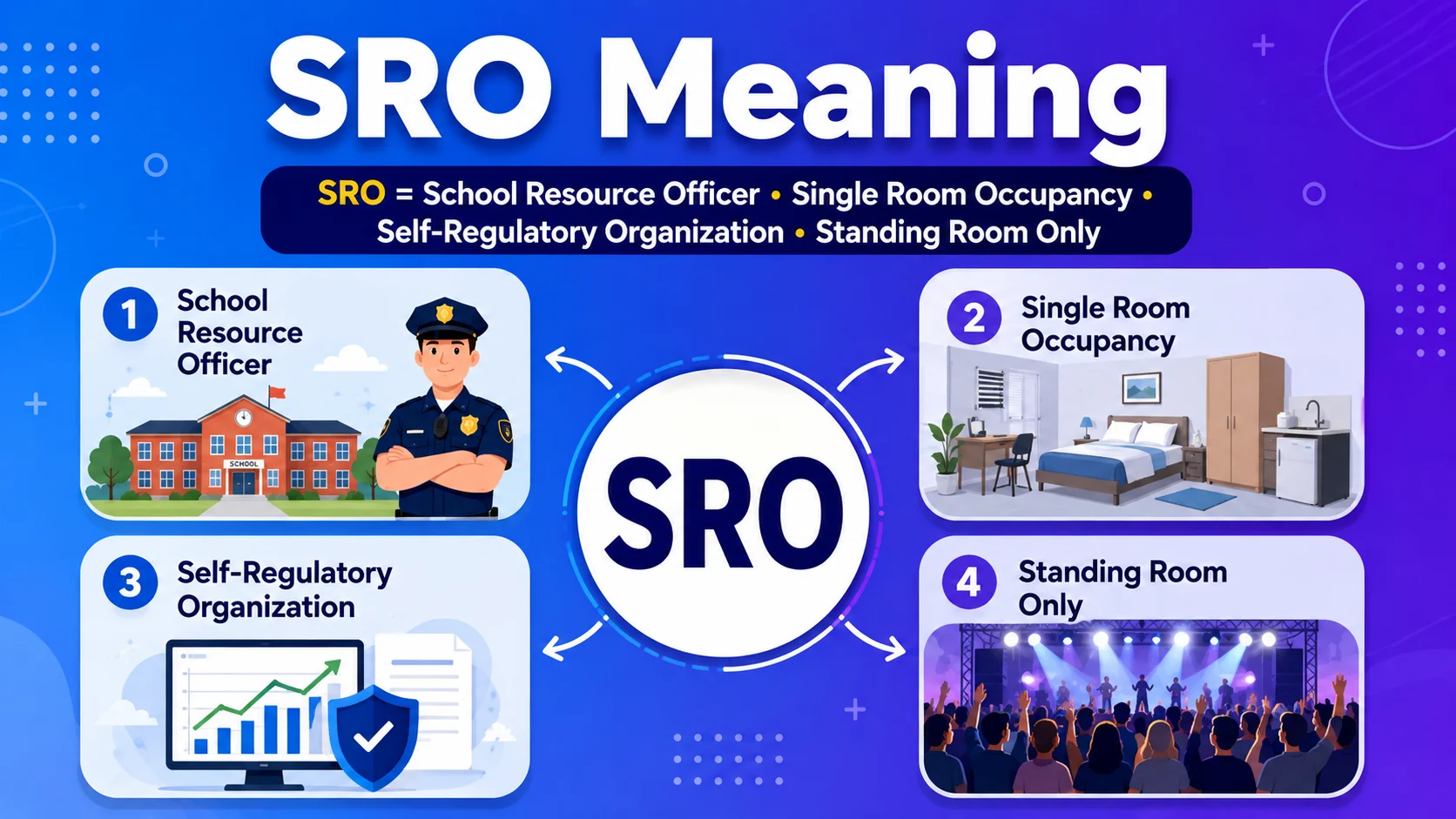
The sro meaning varies by context, most commonly representing School Resource Officer in education, Single Room Occupancy in housing, Self-Regulatory Organization in finance, or Standing Room Only in entertainment and ticketing.
Understanding the exact sro meaning depends entirely on the specific industry or context of your conversation. Over the years, professional sectors across the United States adopted this convenient three-letter acronym for distinct purposes. For example, law enforcement officials use it to describe campus safety officers in public schools. Similarly, urban planners use the phrase to designate low-cost residential housing units in major metropolitan areas. Consequently, recognizing how the acronym changes across industries prevents confusion during daily discussions. Furthermore, mastering these definitions ensures you navigate financial, legal, and educational topics with complete confidence.
Quick Answer Overview
| Attribute | Summary Details |
| Primary Meaning | School Resource Officer, Single Room Occupancy, or Self-Regulatory Organization |
| Cultural Context | Professional US terminology used in municipal government, real estate, finance, and safety |
| Primary Sectors | Law Enforcement, Education, Housing & Urban Development, Financial Markets, and Entertainment |
| Example Sentence | “The local school board met with the SRO to review campus security protocols.” |
| Overall Tone | Professional, administrative, formal, or informational |
What Does sro meaning Represent?
Historically, three-letter acronyms emerged in government and administrative sectors to shorten complex institutional titles. The term SRO evolved as an efficient shortcut across multiple distinct fields. Consequently, searching for the true sro meaning requires looking closely at four dominant sectors.
First, in education and safety, SRO stands for School Resource Officer. In this setting, the acronym describes a sworn law enforcement officer responsible for safety and crime prevention in public schools. Additionally, these officers mentor students and collaborate with educational staff.
Second, in real estate and municipal policy, SRO signifies Single Room Occupancy. This housing format features small individual rooms designed for single residents. Typically, tenants share communal bathroom and kitchen facilities within the building. Therefore, city leaders often discuss SRO housing when addressing affordable housing strategies.
Third, in financial regulation, SRO stands for Self-Regulatory Organization. Entities like FINRA (Financial Industry Regulatory Authority) hold SRO status. Consequently, these non-governmental organizations set industry standards and enforce rules among member brokerage firms.
Fourth, in entertainment and sports ticketing, SRO means Standing Room Only. Event venues sell these tickets when all standard seating areas sell out completely.
| Industry Sector | Primary Expansion | Functional Definition | Typical Application |
| Law Enforcement & Education | School Resource Officer | Sworn police officer stationed within a school environment | Campus safety, mentoring, and emergency response |
| Real Estate & Housing Policy | Single Room Occupancy | Multi-tenant building offering individual affordable rooms | Low-income urban housing and transitional living |
| Finance & Market Regulation | Self-Regulatory Organization | Non-governmental body exercising regulatory authority over an industry | Setting trading standards, licensing, and compliance |
| Entertainment & Event Venues | Standing Room Only | Ticket tier offering entry without an assigned physical seat | Sold-out sports games, concerts, and theater shows |
Contextual Dynamics & Nuances of the Acronym
The true sro meaning shifts dramatically based on the surrounding conversation. Therefore, evaluating context helps you instantly identify the correct definition.
1. Educational and Safety Policy Contexts
When school boards or parent-teacher associations discuss school safety, SRO refers strictly to law enforcement personnel. For instance, discussions around campus security budgets or emergency drills almost always involve a School Resource Officer. Consequently, administrative reports emphasize community engagement and student safety protocols.
2. Urban Planning and Real Estate Discussions
In municipal zoning meetings, SRO refers to Single Room Occupancy housing units. City officials and housing advocates frequently evaluate SRO properties during debates on urban density and homelessness prevention. Furthermore, real estate developers discuss SRO conversions when renovating historic downtown residential buildings.
3. Financial Market Compliance and Trading
Within Wall Street and banking circles, SRO refers to Self-Regulatory Organizations. Financial advisors and stockbrokers must follow rules enforced by these regulatory bodies. Consequently, compliance officers regularly mention SRO guidelines during regulatory audits and licensing reviews.
4. Live Events and Ticket Purchases
When buying tickets for popular concerts or sporting events, SRO denotes Standing Room Only access. Event organizers display this label clearly on ticketing websites. Therefore, buyers know in advance that their ticket does not include a dedicated stadium seat.
Real-Life Conversation Examples Displaying sro meaning
To see how the term functions across different settings, review these five real-life dialogue scenarios.
1: School Board Meeting
- Principal Davis: “We reviewed our campus safety plan for the upcoming academic year.”
- Parent: “Will our dedicated SRO be present during morning drop-off hours?”
- Principal Davis: “Yes, Officer Martinez will monitor the main parking area every morning.”
- Contextual Analysis: In this educational setting, the acronym refers directly to a School Resource Officer providing security.
2: City Housing Committee
- Council Member: “Our city needs to preserve affordable housing options in the downtown district.”
- Urban Planner: “Protecting existing SRO buildings prevents low-income residents from losing their homes.”
- Council Member: “Agreed, let us draft a preservation ordinance for these Single Room Occupancy properties.”
- Contextual Analysis: Here, municipal leaders use the acronym to describe affordable Single Room Occupancy housing buildings.
3: Wall Street Compliance Department
- Junior Trader: “Do I need to report this personal stock transaction to our firm?”
- Compliance Officer: “Yes, every financial advisor must adhere to strict SRO reporting standards.”
- Junior Trader: “I will submit the documentation through the compliance portal immediately.”
- Contextual Analysis: The speakers refer to Self-Regulatory Organization regulations governing broker-dealer conduct.
4: Ticket Office at a Concert Hall
- Customer: “Do you have any reserved seats left for tonight’s show?”
- Ticket Agent: “Reserved seating is completely sold out, but we still have SRO tickets available.”
- Customer: “That works for me! I do not mind standing near the stage area.”
- Contextual Analysis: In an entertainment venue setting, the abbreviation means Standing Room Only tickets.
5: Academic Research Conference
- Researcher A: “Our study analyzes how municipal policies impact urban housing stability.”
- Researcher B: “Did your team include historical data on SRO unit conversions?”
- Researcher A: “Yes, we tracked conversion rates across ten major metropolitan areas over two decades.”
- Contextual Analysis: Scholars discuss historical housing data specifically focused on Single Room Occupancy units.
Platform & Sector Breakdown
Different industries adopt the acronym to streamline specialized communication. Consequently, analyzing individual sector applications reveals how the term operates day-to-day.
| Sector | Primary Focus Area | Key Stakeholders Involved |
| Education Systems | Student Safety & Law Enforcement | School administrators, police departments, parents, students |
| Real Estate Development | Affordable Urban Housing | City planners, housing advocates, landlords, local tenants |
| Financial Regulatory Systems | Market Integrity & Securities Regulation | Stockbrokers, investment firms, FINRA regulators, investors |
| Event Operations | Venue Management & Ticketing | Venue managers, ticketing platforms, event attendees |
School Resource Officers in Education
In the American education system, School Resource Officers bridge the gap between local police departments and school districts. Specifically, SROs receive specialized training to handle youth-related issues on campus.
Furthermore, effective SRO programs prioritize building positive relationships with students. Officers frequently coach youth sports teams or deliver drug prevention presentations. Consequently, school districts evaluate SRO performance based on community trust and student safety outcomes.
Single Room Occupancy in Real Estate and Housing
Single Room Occupancy housing played a vital role in American cities throughout the twentieth century. Historically, residential hotels offered inexpensive accommodations for low-income workers and retirees.
However, urban redevelopment projects reduced the total supply of SRO buildings over recent decades. Today, housing advocates work hard to preserve remaining SRO units. Consequently, modern urban planners view SRO properties as an essential component of comprehensive homelessness prevention programs.
| Housing Type | Typical Room Size | Private Amenities | Shared Facilities |
| Single Room Occupancy (SRO) | 80 to 140 sq. ft. | Basic bed, desk, small closet | Kitchens, laundry facilities, bathrooms |
| Standard Studio Apartment | 300 to 500 sq. ft. | Full private kitchen and bathroom | On-site gym, parking garage, mailroom |
| One-Bedroom Apartment | 500 to 800 sq. ft. | Private bedroom, kitchen, bathroom | Community courtyard, storage units |
Self-Regulatory Organizations in Finance
In the financial services sector, Self-Regulatory Organizations enforce professional standards without relying solely on direct government control. For example, FINRA operates as an independent, non-governmental SRO overseeing securities firms in the United States.
Specifically, SROs write industry rules, conduct periodic examinations, and discipline non-compliant member brokers. Consequently, this regulatory framework protects individual investors while maintaining transparent, fair financial markets.
Alternative Meanings and NLP Variations of the Term
Beyond the main definitions, the acronym appears in specialized technological, scientific, and organizational niches.
| Domain / Niche | Full Unabbreviated Title | Specialized Meaning |
| Technology & Gaming | Silkroad Online | Popular MMORPG multiplayer online computer game |
| Corporate Management | Senior Research Officer | High-level executive heading research and development teams |
| Government & Defense | Special Recovery Officer | Military specialist overseeing asset recovery operations |
| Chemistry & Physics | Supplementary Residual Oxygen | Specific chemical measurement in industrial manufacturing |
Furthermore, linguistic variations depend heavily on standard pluralization and possessive forms. Specifically, writing “SROs” refers to multiple officers, housing units, or regulatory bodies simultaneously.
Misinterpretations: When NOT to Use the Acronym
Although abbreviations save time, using this acronym without clear context creates immediate confusion. Therefore, keep these potential pitfalls in mind during daily communication.
1. Mixing Up Industry Sectors
Avoid introducing the acronym into cross-functional meetings without specifying your target sector first. For example, telling a real estate client about “SRO requirements” when discussing a commercial property might make them think of police officers rather than housing units.
2. Assuming External Knowledge
Never assume that general audiences know specialized industry abbreviations. For instance, when drafting a public press release about school safety, spell out “School Resource Officer” upon first mention. Consequently, readers follow your narrative without needing to look up legal or educational jargon.
3. Formal Academic and Legal Documentation
When writing legal contracts or academic research papers, formal style guides require defining acronyms at their initial appearance. Specifically, write out “Single Room Occupancy (SRO)” during the first paragraph before using the abbreviated form later in the text.
How to Navigate Conversations About SROs Comfortably
When encountering this acronym in professional or casual settings, maintaining clear communication requires a few simple techniques.
Option 1: Clarify Context Immediately
If someone uses the abbreviation unexpectedly, ask a quick clarifying question to confirm their exact meaning.
- Colleague: “We need to discuss the new SRO guidelines before tomorrow.”
- Your Response: “Just to clarify, are we discussing the school resource officer policy or the financial regulatory standards?”
Option 2: Define the Term Naturally
When leading a presentation, introduce the full term smoothly to keep every listener on the same page.
- Your Statement: “Our municipal housing plan focuses on preserving Single Room Occupancy, or SRO, properties downtown.”
- Impact: Listeners instantly grasp your topic without feeling confused by technical housing policy terms.
Option 3: Pivot Across Industry Sectors
When transitioning between different administrative topics in a single meeting, highlight the shift clearly.
- Your Statement: “Now that we covered venue ticketing and SRO tickets, let us shift to our campus safety officers.”
- Impact: The clear transition prevents audience members from confusing event ticketing options with school security staff.
FAQs
What is the exact sro meaning in educational settings?
In public and private schools, the acronym stands for School Resource Officer. These sworn law enforcement officers work directly on school campuses to protect students, mentor youth, and maintain secure educational environments.
What does sro meaning represent in affordable housing discussions?
In real estate and urban development, the phrase stands for Single Room Occupancy. It describes residential buildings containing small, individual living spaces designed for single tenants who share communal bathrooms and kitchens.
How does sro meaning function within financial regulation?
In financial services, the term refers to a Self-Regulatory Organization. Entities like FINRA exercise statutory authority to regulate member brokerage firms and enforce industry ethics standards across US financial markets.
What does SRO stand for on a concert ticket?
On event tickets, SRO stands for Standing Room Only. Purchasing an SRO ticket grants access to the venue but does not provide an assigned physical seat.
What are the main responsibilities of a School Resource Officer?
School Resource Officers handle campus safety, enforce local laws, conduct safety drills, and educate students on law-related topics. Additionally, they serve as informal counselors and positive mentors within school communities.
Why are Single Room Occupancy buildings important to cities?
SRO buildings provide essential affordable housing options for low-income individuals, older people, and seasonal workers. Preserving these units prevents urban displacement and helps lower homelessness rates in major cities.
Is FINRA considered an SRO in the financial market?
Yes, FINRA operates as a prominent Self-Regulatory Organization in the United States. It registers securities firms, writes market rules, conducts compliance examinations, and disciplines non-compliant financial professionals.
What is the difference between an SRO housing unit and a studio apartment?
An SRO unit consists of a single private room with shared building bathrooms and kitchens. In contrast, a standard studio apartment includes a private, self-contained kitchen and bathroom inside the unit.
Can a private company act as a Self-Regulatory Organization?
Non-governmental, non-profit entities typically operate as SROs under government oversight. For example, the Securities and Exchange Commission (SEC) oversees financial SROs to ensure they enforce rules fairly.
How do event venues manage Standing Room Only areas?
Venues designate specific open areas, such as elevated balconies or spaces near the stage, for SRO ticket holders. Staff members monitor these zones to ensure crowd safety and prevent overcrowding.
Conclusion
Ultimately, grasping the full sro meaning allows professionals to navigate conversations smoothly across multiple essential industries. Whether you are reviewing school campus safety plans, analyzing city housing policies, evaluating financial compliance guidelines, or purchasing concert tickets, context dictates the exact definition. By recognizing these distinct applications, you ensure clear communication across legal, financial, educational, and municipal discussions.








14 thoughts on “sro meaning| What It Means in Finance, Housing & Law”