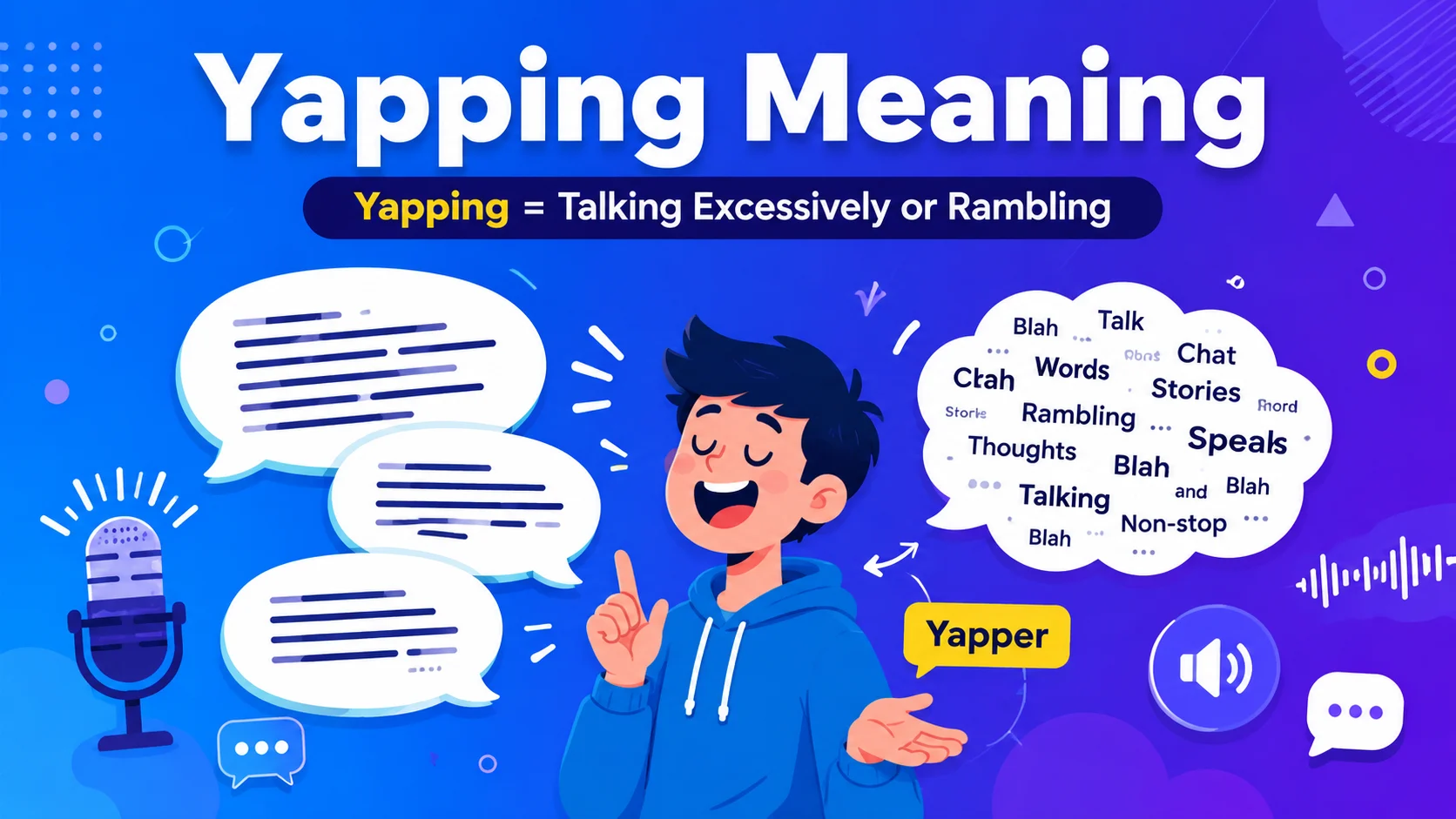
Yapping refers to talking excessively, rambling endlessly, or speaking at length about topics that carry little to no importance. In modern internet culture, calling someone a “yapper” means they are talking non-stop without reaching a clear or meaningful point.
Understanding the exact yapping meaning helps internet users navigate modern digital conversations across platforms like TikTok and Snapchat. Over the past few years, online communities transformed this old word into a viral slang sensation. Specifically, younger generations now use it to playfully call out friends who chatter endlessly. Consequently, seeing the term in comment sections or group chats has become an everyday occurrence. Furthermore, mastering this piece of Gen Z vocabulary ensures you never feel lost during online discussions.
Quick Answer Overview
| Attribute | Summary Details |
| Meaning | Talking excessively, rambling without a point, or chatting non-stop |
| Cultural Context | Modern Gen Z internet slang, viral TikTok meme culture, and daily casual messaging |
| Primary Platforms | TikTok, Snapchat, Instagram Reels, X (formerly Twitter), and Discord |
| Example Sentence | “Bro has been yapping for thirty minutes straight about his video game strategy.” |
| Overall Tone | Playful, sarcastic, lightly teasing, or self-deprecating |
What Does yapping meaning Represent?
Historically, the word “yap” referred directly to the sharp, high-pitched bark of a small dog. Traditional dictionaries defined it as annoying, relentless barking. Additionally, older generations used the term casually to describe noisy, meaningless human chatter.
However, modern digital culture completely reinvented this term. Today, the core yapping meaning centers on somebody who speaks continuously without delivering actual substance. For example, when a creator posts a ten-minute video to explain a simple two-second thought, viewers quickly label it as a “yap session.”
Furthermore, internet users have expanded the word into an entire family of comedic nouns and adjectives. Consequently, someone who rambles frequently is now called a “yapper” or a “certified yapper.” Similarly, taking a long time to tell a basic story is called “attending Yap University.”
Despite its potential to sound rude, the modern phrase is rarely malicious. Instead, internet users deploy it as a lighthearted joke. Consequently, people frequently apply the term to themselves when they realize they have been talking for too long.
| Era | Primary Meaning | Common Context | Tone |
| Historical / Traditional | Sharp barking of small dogs; annoying human chatter | Literal descriptions of animals or noisy crowds | Irritated or literal |
| Modern Slang Evolution | Rambling at length on digital platforms | TikTok comments, viral memes, group chats | Humorous and meme-centric |
| Current Daily Usage | Friendly callouts; self-aware oversharing | Texting, voice notes, casual social interactions | Playful, teasing, self-deprecating |
Contextual Dynamics & Nuances of the Term
The true yapping meaning changes depending on who is speaking and where the conversation occurs. Therefore, understanding context is vital before using the term in daily conversation.
1. Friendly and Playful Teasing
Most commonly, friends use the word to poke fun at each other during casual chats. For instance, if your friend sends ten voice messages in a row, you might respond with a joke about their talking habits. In this scenario, the term builds rapport rather than causing offense.
2. Self-Deprecating Humorous Disclosure
Surprisingly, people often use the word against themselves. For example, after writing a long text message explaining a personal story, a sender might add, “Sorry for yapping so much!” In this context, it shows self-awareness and keeps the conversation light.
3. Sarcastic Dismissal
Conversely, the term can carry a sharper edge when delivered to strangers online. For instance, when an influencer posts a controversial rant, comment sections often fill with users writing, “Who let bro yap?” Here, the phrase serves as a humorous shortcut to dismiss someone’s opinion.
4. Educational or Passionate Rambling
Occasionally, people use the slang when someone speaks passionately about a niche hobby. For example, a gamer explaining complex game lore for two hours is lovingly described as “yapping about their favorite universe.” In this case, it acknowledges genuine enthusiasm.
Real-Life Conversation Examples Displaying yapping meaning
To see how the term functions in natural dialogue, examine these five real-life conversational scenarios.
1: Group Texting on iMessage
- Alex: “Guys, I just spent forty minutes telling my barista my entire life backstory.”
- Jordan: “Classic Alex. You literally cannot stop the yap!”
- Alex: “Honestly true. I earned my doctorate in yapology today.”
- Contextual Analysis: Here, both speakers use the slang self-deprecatingly and playfully to highlight over-sharing.
2: TikTok Comment Section
- Video Creator: Posts a 7-minute monologue about why they changed their morning coffee routine.
- Viewer 1: “Top tier yapping right here.”
- Viewer 2: “I watched the whole video and learned zero actual information.”
- Contextual Analysis: Viewers use the term to highlight that the video contained excessive length with minimal core content.
3: Discord Gaming Channel
- Player A: “Wait, why are we buying this weapon? Let me break down the weapon stats from the patch notes three years ago…”
- Player B: “Bro, stop yapping and just press start!”
- Contextual Analysis: Player B uses the word as a quick, active command to stop unnecessary explanation during fast-paced gameplay.
4: Snapchat Story Reply
- User A: Posts a story with 15 consecutive text slides analyzing a TV show finale.
- User B: “You are yapping heavily today haha!”
- User A: “I know, I have so many thoughts and nobody to listen!”
- Contextual Analysis: User B points out the extreme length of the post, while User A comfortably embraces the label.
5: Casual In-Person Hanging Out
- Sam: “Anyway, that is why I think mechanical keyboards are superior to normal ones.”
- Taylor: “That was a legendary yap session, Sam. I understood none of it.”
- Sam: “Fair enough, I will lower my volume now.”
- Contextual Analysis: Taylor uses the term affectionately to acknowledge Sam’s deep, niche monologue.
Platform-Specific Breakdown
Online platforms cultivate unique cultures. Consequently, the way people use this slang varies significantly across different social networks.
| Platform | Primary Usage Pattern | Key Content Formats |
| Snapchat | Teasing long voice recordings and text-heavy stories | Voice notes, private story overlays, Bitmoji sticker replies |
| TikTok | Calling out long monologues or labeling casual vlogs | Comment sections, “Yap With Me” vlogs, trending audio scripts |
| Summarizing lengthy captions or public statements | Reels comments, broadcast channels, feed captions | |
| iMessage / Text | Self-aware apologies after sending long text blocks | Multi-paragraph text threads, casual group chat banter |
How It Is Used on Snapchat
On Snapchat, communication relies heavily on direct picture snaps and quick voice notes. Consequently, when a user sends a continuous sequence of long voice recordings, recipients frequently label them as “yap audio.”
Furthermore, Snapchat users frequently post long text overlays on their private stories. In response, friends send quick replies using popular Bitmoji stickers or short text clips pointing out the lengthy rant. Overall, Snapchat culture encourages short interactions, making long messages prime targets for this friendly callout.
The Role of yapping meaning on TikTok
TikTok represents the absolute birthplace of modern yapping memes. Specifically, the platform thrives on short-form video content designed for quick attention spans. Therefore, creators who talk slowly or excessively immediately face jokes in the comment section.
Additionally, TikTok creators intentionally produce comedic videos titled “Yap With Me While I Do My Makeup” or “Daily Yap Session.” In these videos, creators openly embrace the label to connect authentically with viewers. Consequently, TikTok transformed the word from a potential insult into an engaging content category.
| TikTok Content Step | Creator Action | Audience Perception |
| Step 1: Record Video | Record an unscripted, casual daily vlog | Highly relatable and conversational |
| Step 2: Apply Label | Title the post “Daily Yap Session” | Clear self-awareness and invitation to chat |
| Step 3: Audience Engagement | Viewers comment on the rambling style | High engagement through playful banter |
Instagram and Texting Dynamics
On Instagram, the term appears regularly within Reels comment sections and broadcast channels. For example, when a public figure posts a lengthy statement, users quickly summarize it in the comments by writing, “TL;DR: Pure yapping.”
Similarly, in personal SMS text threads, the word acts as a conversational safety valve. Specifically, when someone sends a long “wall of text,” they often follow up immediately with a self-aware apology. As a result, the phrase helps maintain smooth, relaxed communication between friends.
Alternative Meanings and NLP Variations of the Phrase
In modern digital communication, language evolves rapidly. Consequently, internet users created numerous lexical variations and derivatives based on this single root word.
| Slang Variation | Grammatical Form | Exact Contextual Meaning |
| Yapper | Noun | A person who continuously talks or rambles without stopping |
| Yap Session | Noun Phrase | A dedicated period of time spent chatting casually or endlessly |
| Yapology | Noun (Jargon) | The comical “academic study” or art of talking endlessly |
| Yap University | Proper Noun (Joke) | A fictional university where over-talkers supposedly earn degrees |
| Certified Yapper | Noun Phrase | An affectionate title given to someone known for non-stop talking |
| Yapped Out | Adjective | Being completely exhausted after listening to someone talk for too long |
Furthermore, older generations used traditional terms that closely parallel this modern slang. Specifically, words like babbling, rambling, gabbing, and chattering share similar dictionary definitions. However, these older terms lack the modern comedic punch and viral meme status of the current internet phrase.
Misinterpretations: When NOT to Use the Term
Although this slang is popular, using it in the wrong environment can cause unnecessary misunderstandings or offense. Therefore, keep these critical boundaries in mind.
1. Professional Workplace Environments
Never use this slang during formal work meetings, emails, or presentations. For example, telling a manager or client that they are “yapping” during a strategy session sounds deeply disrespectful. Instead, use professional alternatives like “elaborating,” “providing details,” or “speaking at length.”
2. Serious Emotional Discussions
When a friend or partner opens up about a difficult personal situation, avoid referring to their words as yapping. Using the term during sensitive moments minimizes their real feelings and makes you appear emotionally cold. Instead, practice active listening without trivializing their speech.
3. Formal Academic Settings
Similarly, avoid using the term in academic essays, classroom debates, or scholarly discussions. Professors and educators expect precise, formal English. Consequently, using internet slang in academic papers lowers your writing credibility.
How to Respond in Chat Comfortably
When someone playfully calls you out for talking too much online, knowing how to respond keeps the energy light and fun. Here are three comfortable ways to react depending on the situation.
Option 1: Lean Into the Joke (Comedic Response)
If a close friend teases you, embrace the title proudly with humor.
- Friend: “You are really yapping today!”
- Your Response: “I know! I just graduated top of my class at Yap University.”
- Your Response: “I have a daily word quota to meet, don’t stop my grind.”
Option 2: Polished Acknowledgment (Neutral Response)
If you genuinely spoke for too long and want to bring the conversation back on track, pivot smoothly.
- Friend: “Bro, that was a huge yap session.”
- Your Response: “Haha fair point! Long story short, we should meet at 6 PM.”
- Your Response: “My bad! I will get straight to the point next time.”
Option 3: Playful Comeback (Banter Response)
When chatting in a lively group chat, send a humorous deflection back to your friends.
- Friend: “Who invited the chief yapper?”
- Your Response: “Someone has to keep this boring chat alive!”
- Your Response: “You love listening to my podcasts, don’t lie.”
FAQs
What is the exact yapping meaning in social media?
In social media contexts, the term describes someone who posts overly long videos, write-ups, or voice notes containing little practical value. Viewers use it to playfully point out that the content creator rambled without getting straight to the main point.
Does yapping meaning differ from traditional rambling?
While the core concept is identical, the cultural usage differs significantly. Traditional rambling carries a neutral or negative tone without stylistic humor. In contrast, the modern slang features comedic, self-deprecating meme roots that make it far lighter in casual conversations.
Why is yapping meaning so popular among Gen Z?
The phrase gained massive popularity because it perfectly matches short-form internet culture. Platforms like TikTok prioritize rapid-fire, highly concentrated entertainment. Consequently, Gen Z created a concise, funny word to describe content or conversations that break this fast-paced norm.
What is a yapper in modern slang?
A yapper is a noun used to describe a person who frequently speaks at great length. While it can act as a mild criticism for someone being annoying, friends regularly use it as an affectionate nickname for talkative social circle members.
Is calling someone a yapper an insult?
Usually, it is not a serious insult. In roughly eight out of ten online interactions, users employ the term playfully among peers. However, if spoken aggressively toward a stranger, it functions as a rude command telling them to be quiet.
How do you stop yapping in a conversation?
To keep your speech concise, practice structuring your main thoughts before speaking. Focus on delivering the core takeaway or headline first. Afterwards, allow the other person to ask questions if they want additional details.
Where did the internet trend of yapping originate?
Although the word “yap” existed for centuries to describe dog barks, the modern slang trend exploded on TikTok around late 2022 and early 2023. Creators began making viral comedy sketches labeling long-winded monologues as “yap sessions,” causing the term to spread globally.
What is a yap session on video apps?
A yap session is an informal video recording where a creator talks casually about random daily thoughts, personal opinions, or life updates. Instead of following a structured script, the host speaks freely to build an authentic connection with their audience.
Can yapping be considered a positive social trait?
Yes, in many casual contexts, being a yapper means you are charismatic, energetic, and capable of keeping conversations lively. Many social groups appreciate having an outgoing person who comfortably fills awkward silences.
How does yapping compare to vent culture?
Venting involves expressing genuine emotional frustration or seeking comfort regarding real-life problems. Conversely, the slang term usually applies to lighthearted, unimportant, or mundane topics that carry minimal emotional weight.
Conclusion
Ultimately, understanding the true yapping meaning offers a fascinating look into how digital culture continuously reshapes the English language. What began centuries ago as a simple word describing a barking dog now serves as a central pillar of Gen Z humor. By taking complex speech habits and boiling them down into a single, lighthearted slang term, internet users built a fun way to navigate daily conversations. Whether you are posting a daily vlog on TikTok or sending long voice notes to friends on Snapchat, embracing this vocabulary keeps your online interactions fresh, relevant, and engaging.


2 thoughts on “yapping meaning| What It Means in Gen Z Slang”