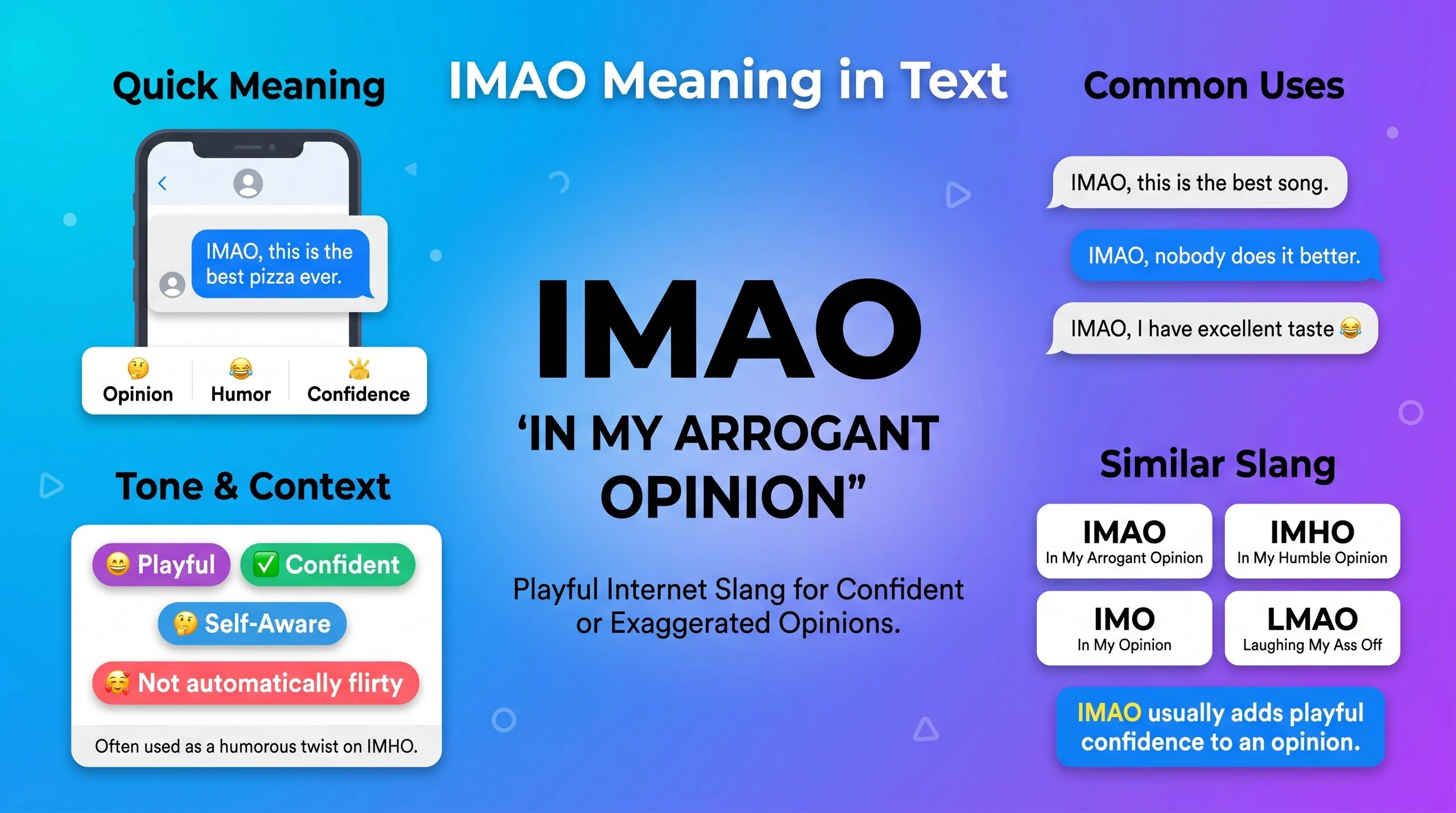
IMAO usually means “In My Arrogant Opinion” in text. It is a playful variation of IMHO (“In My Humble Opinion”) and is often used humorously before or after a personal opinion. In some contexts, people may use IMAO as a typo for LMAO.
IMAO meaning in text can depend on the context. Most commonly, IMAO means “In My Arrogant Opinion.” It is a humorous twist on IMHO, or “In My Humble Opinion.”
People use IMAO when sharing an opinion in a playful, exaggerated, or self-aware way. For example, someone might write, “That’s the best movie of the year, IMAO.” The phrase adds a jokingly confident tone to the opinion.
However, there is another important possibility. Some people type IMAO when they intended to write LMAO, meaning “Laughing My Ass Off.” Therefore, context matters when interpreting this abbreviation.
What Does IMAO Mean in Text?
| Term | Meaning | Common Use |
|---|---|---|
| IMAO | In My Arrogant Opinion | Humorous or self-aware opinion |
| IMHO | In My Humble Opinion | Giving an opinion politely |
| LMAO | Laughing My Ass Off | Showing strong amusement |
| IMAO as a typo | Sometimes intended as LMAO | Typing mistake or variation |
What Does IMAO Mean in Texting?
In casual texting, IMAO most commonly means “In My Arrogant Opinion.”
It is a playful variation of IMHO, which means “In My Humble Opinion.” Instead of presenting an opinion modestly, IMAO intentionally sounds more confident or arrogant.
For example:
“IMAO, this is the best pizza in town.”
The speaker is jokingly saying:
“In my arrogant opinion, this is the best pizza in town.”
The humor comes from deliberately describing the speaker’s own opinion as arrogant.
Why Do People Use IMAO?
People use IMAO to make an opinion sound humorous or exaggerated.
Instead of writing:
“In my opinion, this is the best song.”
someone might write:
“IMAO, this is the greatest song ever.”
The abbreviation adds a playful sense of confidence.
It can also soften an opinion by making the speaker appear self-aware. Rather than seriously claiming that their opinion is unquestionably correct, they are joking about sounding overly confident.
Common reasons to use IMAO include:
- Sharing a strong opinion
- Adding humor
- Being intentionally overconfident
- Making a sarcastic comment
- Playing with the meaning of IMHO
- Making a casual conversation more entertaining
Examples of IMAO in Text
Here are some natural examples:
Example 1
“IMAO, pineapple belongs on pizza.”
The person is humorously presenting a strong opinion.
Example 2
“That’s easily the best episode, IMAO.”
The speaker is jokingly emphasizing confidence in their opinion.
Example 3
“IMAO, nobody makes better burgers than my dad.”
This adds a playful, exaggerated tone.
Example 4
“IMAO, this outfit is perfect.”
The person is simply adding humorous confidence to their opinion.
Example 5
“IMAO, I have excellent taste in music.”
Here, IMAO makes the statement sound deliberately self-confident.
IMAO in Real-Life Conversations
Talking About Movies
Alex: Which superhero movie is the best?
Sam: IMAO, the second one is easily the best.
Alex: I knew you were going to say that 😂
The abbreviation makes Sam’s strong opinion sound playful.
Discussing Food
Friend: Who makes the best cookies?
You: IMAO, definitely my mom.
Friend: Can’t argue with that.
Here, IMAO adds a jokingly confident tone.
Talking About Music
Alex: What’s the best album this year?
Sam: IMAO, this one isn’t even close.
Alex: Fair enough.
The phrase emphasizes that the statement is the speaker’s personal opinion.
IMAO on Snapchat, TikTok, Instagram, and Text Messages
- IMAO can appear in many informal online conversations.
IMAO on Snapchat
On Snapchat, IMAO may appear in messages between friends when someone is sharing a strong opinion.
“IMAO that was the funniest movie ever 😂”
The phrase makes the opinion sound playful.
IMAO on TikTok
On TikTok, users may use IMAO in comments or captions when expressing an exaggerated opinion.
For example:
“IMAO, this is the best trend on here.”
The exact tone depends on the surrounding comment.
IMAO on Instagram
On Instagram, IMAO can appear in captions, comments, Stories, or DMs.
“IMAO, this is the best photo I’ve taken.”
It adds a casual and humorous voice.
IMAO in Text Messages
In private texts, IMAO usually introduces or emphasizes an opinion.
“IMAO, you should definitely pick the blue one.”
It means the speaker is giving their personal view in a playful way.
What Does IMAO Mean From a Girl?
If a girl uses IMAO, she most likely means “In My Arrogant Opinion.”
She may be jokingly presenting a strong opinion.
For example:
“IMAO, I make the best pasta.”
The statement is playful rather than a serious claim about being better than everyone else.
However, if the surrounding conversation is clearly humorous, IMAO could also be a typo or playful version of LMAO. Context helps determine the intended meaning.
What Does IMAO Mean From a Guy?
If a guy sends IMAO, it usually means “In My Arrogant Opinion.”
For example:
“IMAO, my team is winning this year.”
The speaker is jokingly showing confidence in their opinion or prediction.
Still, if the message is clearly reacting to something funny, check whether the sender may have intended LMAO instead.
Is IMAO Flirty?
IMAO is not inherently flirty.
Its main purpose is to introduce a humorous or exaggerated opinion.
For example:
“IMAO, you have the best music taste.”
This could be friendly or playful. It does not automatically indicate romantic interest.
However, context can give the message a flirtatious tone. The abbreviation itself does not establish that meaning.
Is IMAO Rude?
IMAO is generally not rude, but the word “arrogant” makes the expression intentionally bold.
In a friendly conversation, that exaggeration is usually humorous.
For example:
“IMAO, I’m obviously the funniest person here.”
Friends may understand this as a joke.
However, using IMAO in a serious disagreement could make a message sound sarcastic, dismissive, or overly confident. Therefore, consider your audience and the tone of the conversation.
IMAO vs. Similar Texting Abbreviations
| Term | Meaning | Main Difference |
|---|---|---|
| IMAO | In My Arrogant Opinion | Humorous, confident opinion |
| IMHO | In My Humble Opinion | Modest personal opinion |
| IMO | In My Opinion | Neutral personal opinion |
| LMAO | Laughing My Ass Off | Strong laughter or amusement |
| LOL | Laughing Out Loud | General laughter |
| TBH | To Be Honest | Introduces a candid opinion |
| NGL | Not Gonna Lie | Introduces an honest statement |
IMAO vs. IMHO
These expressions are intentionally opposite in tone.
IMAO = In My Arrogant Opinion
IMHO = In My Humble Opinion
IMHO sounds modest, while IMAO jokingly exaggerates confidence.
IMAO vs. LMAO
These two abbreviations are completely different when used intentionally.
IMAO = In My Arrogant Opinion
LMAO = Laughing My Ass Off
However, because IMAO can look similar to LMAO, someone may occasionally type IMAO accidentally when they intended to write LMAO.
Common Phrases With IMAO
You may see IMAO in phrases such as:
- IMAO, that’s the best one.
- IMAO, you’re wrong 😂
- IMAO, this is better.
- IMAO, I have the best taste.
- IMAO, nobody does it better.
- IMAO, this song is perfect.
- IMAO, that’s an easy choice.
Usually, the abbreviation appears before or after the opinion.
Common Mistakes When Interpreting IMAO
The biggest mistake is assuming IMAO always means “Laughing My Ass Off.” Although some people may use it accidentally as a typo for LMAO, the established playful meaning is “In My Arrogant Opinion.”
Another mistake is confusing IMAO with IMHO.
IMHO presents an opinion modestly. In contrast, IMAO intentionally adds exaggerated confidence.
Also, do not assume that IMAO is always serious. The word “arrogant” is often used humorously.
How Do You Respond to IMAO?
Your response depends on the statement that follows IMAO.
If you agree, you could say:
- “Fair enough 😂”
- “I agree.”
- “You might be right.”
- “Facts.”
- “Honestly, same.”
- “Can’t argue with that.”
If you disagree, you can keep it playful:
- “Absolutely not 😂”
- “You wish.”
- “Hard disagree.”
- “That’s debatable.”
- “No chance.”
For example:
Friend: “IMAO, I make the best burgers.”
You: “You wish 😂”
This keeps the conversation light.
When Should You Use IMAO?
Use IMAO in casual conversations when you want to share an opinion with a humorous, exaggerated, or self-aware tone.
It works well in:
- Text messages
- Group chats
- Snapchat
- Instagram DMs
- TikTok comments
- Casual social media posts
- Conversations with friends
However, IMAO is not suitable for most professional or formal writing. In those situations, use “in my opinion” or another clear phrase instead.
Does IMAO Have Other Meanings?
The most recognized informal meaning of IMAO is “In My Arrogant Opinion.”
However, context matters because some users may type IMAO accidentally when they mean LMAO. This can happen because the abbreviations look similar on a keyboard.
Therefore, look at the surrounding message.
If IMAO appears next to an opinion, such as:
“IMAO, this is the best movie.”
it likely means “In My Arrogant Opinion.”
If it appears after something funny:
“That video was hilarious IMAO 😂”
the sender may have intended LMAO.
Frequently Asked Questions
1. What does IMAO mean in text?
IMAO usually means “In My Arrogant Opinion.” It is a humorous variation of IMHO that people use when sharing an opinion with exaggerated confidence or playful self-awareness.
2. What does IMAO stand for?
IMAO stands for “In My Arrogant Opinion.” It is an informal internet expression that jokingly presents a personal opinion as if the speaker is extremely confident about it.
3. Is IMAO the same as LMAO?
No. IMAO usually means “In My Arrogant Opinion,” while LMAO means “Laughing My Ass Off.” However, IMAO can sometimes appear as an accidental typo for LMAO.
4. What does IMAO mean on Snapchat?
On Snapchat, IMAO usually means “In My Arrogant Opinion.” Someone may use it before or after a strong opinion to make the statement sound playful, confident, or intentionally exaggerated.
5. Is IMAO flirty?
IMAO is not inherently flirty. It usually introduces a humorous opinion. Although it can appear in romantic conversations, the abbreviation itself does not indicate romantic interest.
6. What does IMAO mean from a girl?
If a girl uses IMAO, she most likely means “In My Arrogant Opinion.” She may be jokingly emphasizing confidence in something she believes or prefers.
7. What does IMAO mean from a guy?
If a guy sends IMAO, it generally means “In My Arrogant Opinion.” However, if the message is clearly reacting to something funny, he may have accidentally typed IMAO instead of LMAO.
8. How should I respond to IMAO?
Respond based on the opinion that follows it. You can agree with “Facts” or “Fair enough,” or disagree playfully with “Hard disagree 😂.” If the meaning seems unclear, ask what the sender intended.
Conclusion
IMAO usually means “In My Arrogant Opinion” in casual online communication. It is a playful variation of IMHO that adds exaggerated confidence or humor to a personal opinion. For example, “IMAO, this is the best movie ever” presents a strong opinion in a joking way. However, context matters because some people may accidentally type IMAO when they intend to write LMAO, meaning “Laughing My Ass Off.” IMAO is not automatically flirty or rude, although its bold wording can sound sarcastic in some conversations. In most cases, look at the statement around IMAO to understand whether the sender is expressing an opinion or making a typing mistake.

Andrew Morris is a writer at Meaninga.com who specializes in word meanings, slang, idioms and modern language trends. He creates clear, accurate and easy to understand content for everyday readers.