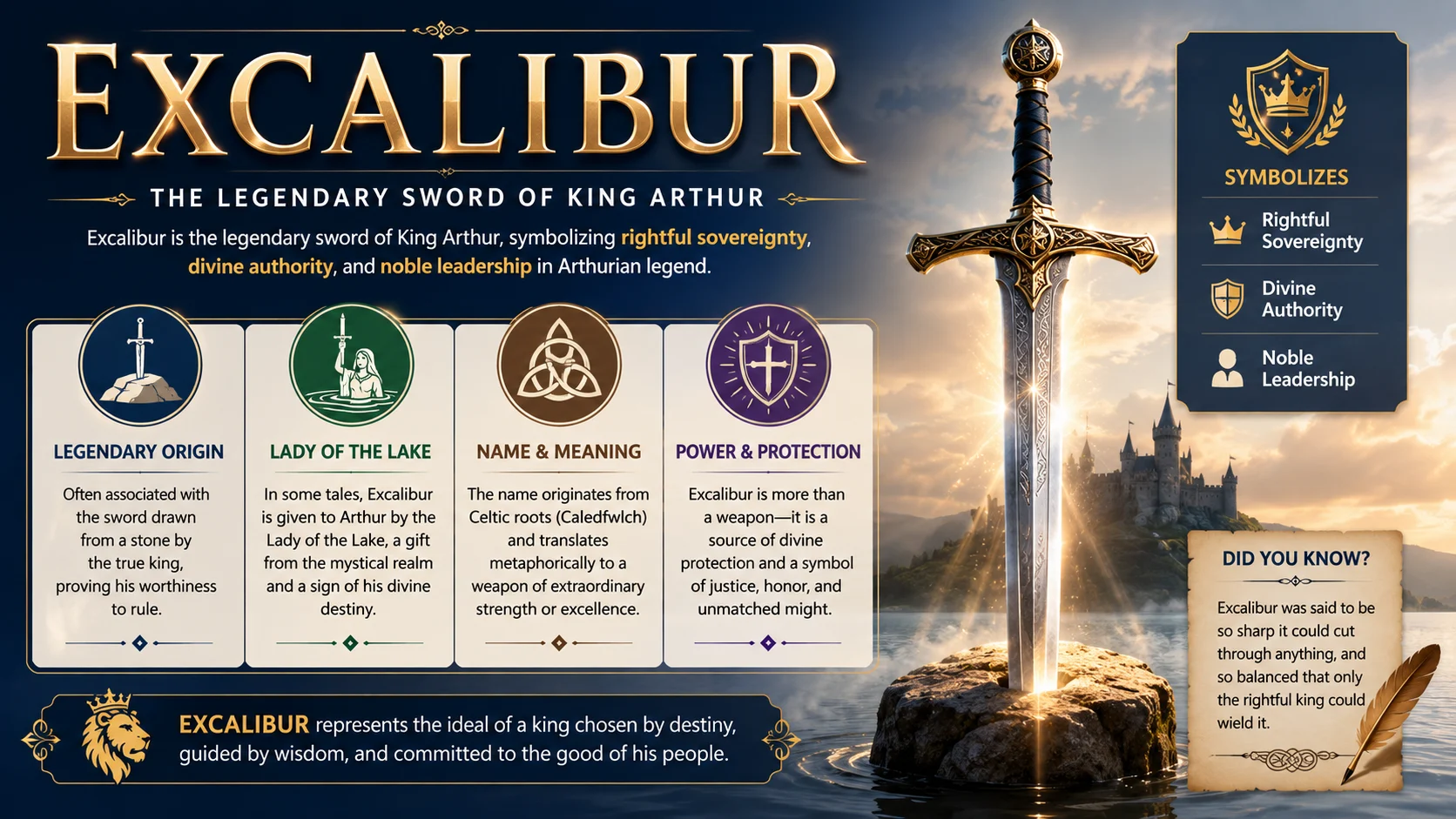
Excalibur refers to the legendary magical sword of King Arthur, symbolizing rightful sovereignty, divine authority, and noble leadership in Arthurian legend. Often associated with the enchanted blade drawn from a stone or received from the Lady of the Lake, the name originates from Celtic roots and translates metaphorically to a weapon of extraordinary strength, divine protection, or unmatched excellence.
Understanding the complete Excalibur meaning helps you explore European folklore, appreciate literary symbolism, decode popular media references, and enrich your vocabulary. Furthermore, this iconic weapon bridges ancient Celtic myths with medieval chivalric romance and modern fantasy storytelling. Consequently, when people search for this phrase, they usually want to uncover where the term comes from, whether it is the same as the “Sword in the Stone,” what magical powers it possessed, or how it functions as a metaphor today.
Additionally, modern industries, entertainment franchises, and branding experts frequently adopt the term to designate peak performance, unmatched power, or cutting-edge technology. For example, defense systems, luxury watches, and gaming weapons often use the name to signal elite quality. Therefore, mastering every dimension of the definition enriches your cultural knowledge and deepens your understanding of mythic storytelling.
Quick Answer Box
| Aspect | Details |
| Primary Meaning | The legendary sword of King Arthur; a symbol of rightful power and divine kingship |
| Etymology Origin | Evolved from Welsh Caledfwlch and Geoffrey of Monmouth’s Latin Caliburnus |
| Core Symbolism | Divine right to rule, ultimate justice, unbreakable strength, leadership |
| Associated Figures | King Arthur, Merlin, the Lady of the Lake, Sir Bedivere / Sir Girflet |
| Tone | Mythic, heroic, majestic, authoritative, legendary |
What Does Excalibur Meaning Represent in Myth and Literature?
To understand the core Excalibur meaning, one must trace its journey through medieval Welsh tales, French chivalric romances, and British folklore.
1. Etymology and Linguistic Foundations
Historically, the name Excalibur evolved through centuries of linguistic adaptation across multiple European languages:
- Welsh Roots (Caledfwlch): Early Welsh tales refer to Arthur’s sword as Caledfwlch, combining caled (hard, tough) and bwlch (breach, notch, or cleft). It literally translates to “Hard-Cleft” or “Battle-Breacher.”
- Latinization (Caliburnus): In the twelfth century, chronicler Geoffrey of Monmouth Latinized the Welsh name to Caliburnus in his History of the Kings of Britain, linking it conceptually to chalybs (the Greek and Latin word for steel).
- French and English Transformation: French poets adapted Caliburnus into Escalibor or Excalibor, which ultimately entered Middle English as Excalibur.
2. The Dual Origin Myth: Sword in the Stone vs. Lady of the Lake
Arthurian literature presents two distinct stories regarding how Arthur obtained the sword:
- The Sword in the Stone: In Robert de Boron’s poem Merlin, Arthur proves his rightful lineage as King of England by pulling a magic sword from an anvil set upon a stone, fulfilling the prophecy: “Whoso pulleth out this sword of this stone and anvil, is rightwise king born of all England.”
- The Lady of the Lake: In later prose traditions (and Thomas Malory’s Le Morte d’Arthur), Arthur breaks his original sword in combat. Merlin leads him to a magical lake, where a mysterious arm clothed in white samite rises from the water holding Excalibur, presented by the Lady of the Lake.
“Excalibur is not merely steel and iron. It is the physical embodiment of a king’s sacred vow to protect his people with justice and honour.”
Magical Properties and Symbolic Nuances
However, Excalibur was far more than a sharp blade. Its magical attributes and scabbard played crucial roles in Arthurian lore.
1. The Blade and the Scabbard
According to medieval legends, Excalibur possessed awe-inspiring powers:
- The Shining Blade: The sword shone so brightly in battle that it blinded Arthur’s enemies with the light of thirty torches.
- The Magical Scabbard: Merlin repeatedly warned Arthur that the scabbard was ten times more valuable than the sword itself. As long as Arthur wore the scabbard, he could lose no blood, rendering him virtually immune to fatal wounds in battle.
- The Loss of the Scabbard: Arthur’s half-sister, Morgan le Fay, stole the protective scabbard, leaving Arthur vulnerable during his tragic final battle at Camlann.
2. The Return to the Lake
Following the fatal Battle of Camlann, a dying King Arthur commands his loyal knight (Sir Bedivere or Sir Girflet) to hurl Excalibur back into the enchanted lake. After hesitating twice out of reluctance to discard such a magnificent weapon, the knight finally throws it into the water. A hand emerges from the waves, catches the sword by the hilt, brandishes it three times, and draws it beneath the surface.
How Excalibur Compares to Other Legendary Weapons
Understanding how Excalibur compares to other famous mythical weapons highlights its unique status in world folklore:
| Weapon | Mythological Tradition | Primary Symbolism and Attribute |
| Excalibur | Arthurian / British Legend | Rightful kingship, divine sovereignty, blinding light |
| Durandal | French Paladin Lore (Charlemagne) | Unbreakable blade, heroic duty, holy relics in the hilt |
| Mjölnir | Norse Mythology (Thor) | Raw cosmic power, thunder, protection against giants |
| Gram (Balmung) | Germanic / Norse Sagas | Sword pulled from a tree, dragonslaying, shattered and reforged |
Real-Life Conversation and Cultural Examples
Reviewing everyday dialogue and pop culture contexts shows how people use the term today.
1. Describing an Ultimate Tool or Solution
Marcus: How did you finally manage to fix that complex software bug?
Elena: Our lead engineer wrote a custom script. It worked like an absolute Excalibur!
Marcus: That is amazing! It solved a problem that held up the entire team for weeks.
2. Discussing Fantasy Literature and Film
Liam: Why do so many fantasy stories feature a chosen hero pulling a magical sword from a shrine?
Chloe: They are all referencing the classic Excalibur archetype! It represents proving your destiny through worthiness rather than raw force.
3. Business and Branding Context
Devon: Why did the company name their new flagship product “Project Excalibur”?
Sarah: They want to communicate that it is their premier, most powerful tool designed to slice through market competition.
Key Characteristics of the Excalibur Archetype
Whether analyzing folklore or modern storytelling, several consistent qualities define the Excalibur concept:
- Divine Legitimacy: Serves as proof that the wielder possesses the moral right and spiritual backing to lead.
- Worthiness Over Might: The weapon cannot be claimed through brute strength alone. It requires purity of purpose, character, or bloodline.
- Dual Nature: Functions both as a destructive weapon of war and a sacred instrument of justice and peace.
- Relinquished Power: True sovereignty involves returning power back to its origin when the hero’s task is finished.
FAQs
What is the primary meaning of Excalibur?
Excalibur is the legendary magical sword of King Arthur, symbolizing rightful sovereignty, divine authority, leadership, and noble power.
Is Excalibur the same as the Sword in the Stone?
In early legends, yes. However, in major works like Thomas Malory’s Le Morte d’Arthur, they are two different swords. Arthur breaks the original sword pulled from the stone and later receives Excalibur from the Lady of the Lake.
Where does the word “Excalibur” come from?
The word evolved from the Welsh name Caledfwlch (meaning “hard-cleft” or “battle-breacher”), which was Latinized as Caliburnus before becoming Excalibur through French and English translations.
What powers did Excalibur have?
Excalibur was sharp enough to slice through iron, shone with the light of thirty torches to blind foes, and had a magical scabbard that prevented its wearer from losing blood or sustaining fatal wounds.
Who threw Excalibur back into the lake?
Depending on the version of the legend, King Arthur ordered either Sir Bedivere or Sir Girflet to hurl the sword back into the enchanted lake after the Battle of Camlann.
What does “Excalibur” mean metaphorically today?
Metaphorically, an “Excalibur” refers to a ultimate tool, decisive solution, or powerful asset that bestows unmatched authority or capability upon its user.
Why is Excalibur associated with the Lady of the Lake?
The Lady of the Lake is the mystical ruler of the watery realm of Avalon who presents Excalibur to King Arthur and reclaims it upon his death.
Was Excalibur a real historical sword?
No historical proof exists that Excalibur or King Arthur existed in the exact manner described in chivalric romance. However, the story was heavily inspired by ancient Celtic myth and real sub-Roman British battle leaders.
What happened to Excalibur’s scabbard?
King Arthur’s half-sister, Morgan le Fay, stole the magical scabbard and threw it into a deep lake, leaving Arthur unprotected before his final confrontation with Mordred.
How do you pronounce “Excalibur”?
It is pronounced eks-KAL-ih-bur (or /ɛkˈskælɪbər/).
Conclusion
Ultimately, whether encountered in medieval Arthurian romance, modern fantasy cinema, or everyday figurative speech, understanding the Excalibur meaning reveals a concept defined by authority, moral worthiness, and legendary power. The evolution of the term from ancient Welsh poetry to global pop culture shows how stories capture our enduring fascination with righteous leadership. By recognizing the rich symbolic and historical contexts of the word, you can enrich your vocabulary and appreciate the world’s most famous mythical weapon.











26 thoughts on “Excalibur Meaning| The Ultimate Guide and Semantic Meaning”