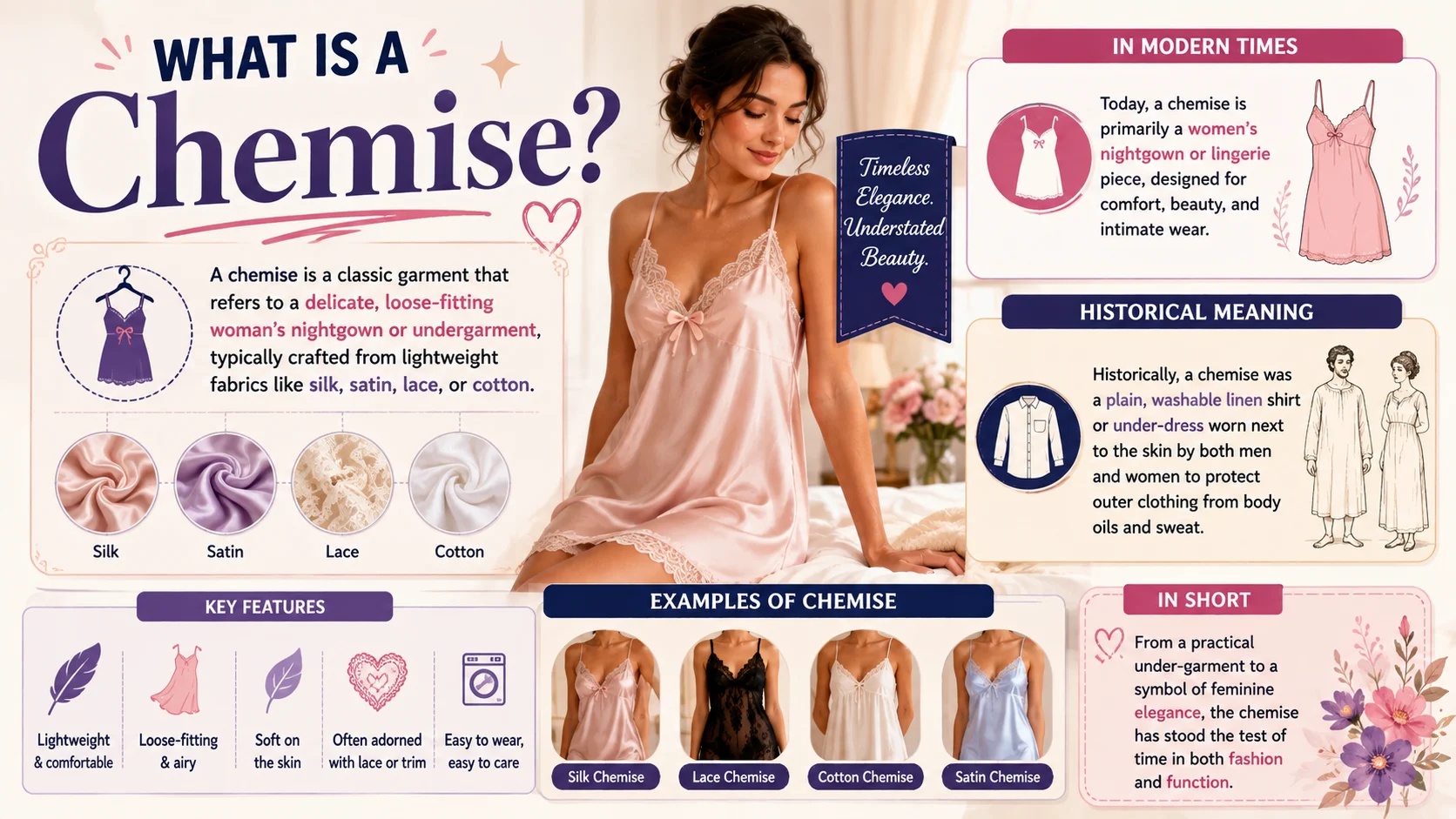
A chemise is a classic garment that refers to a delicate, loose-fitting woman’s nightgown or undergarment, typically crafted from lightweight fabrics like silk, satin, lace, or cotton. Historically, a chemise was a plain, washable linen shirt or under-dress worn next to the skin by both men and women to protect outer clothing from body oils and sweat.
Understanding the complete chemise meaning helps you appreciate fashion history, navigate luxury sleepwear categories, elevate your literary vocabulary, and decode historical costume terminology. Furthermore, this versatile word bridges medieval undergarments with high-fashion silhouettes and modern loungewear staples. Consequently, when people search for this phrase, they usually want to uncover where the term comes from, how it differs from a shift or slip, or how its function transformed over centuries of fashion history.
Additionally, the fashion industry frequently adopts the term to describe straight-cut, unbelted dresses that hang loosely from the shoulders. For example, nineteenth-century European fashion famously popularized the chemise à la reine, a flowing white muslin gown that revolutionized women’s dress standards. Similarly, contemporary lingerie designers use the term to designate comfortable, elegant sleepwear. Therefore, mastering every dimension of the definition enriches your fashion vocabulary and deepens your understanding of historical textiles.
Quick Answer Box
| Aspect | Details |
| Primary Meaning | A loose-fitting woman’s nightgown, slip, or historical linen undergarment |
| Etymology Origin | From Late Latin camisia (shirt/nightgown) via Old French chemise |
| Historical Role | Protective base layer worn under corsets, doublets, and heavy gowns |
| Modern Fashion Context | Elegant lingerie, strappy nightwear, or a straight-cut “chemise dress” |
| Tone | Elegant, delicate, comfortable, classic, romantic |
What Does Chemise Meaning Represent in History and Culture?
To understand the core chemise meaning, one must trace its journey from ancient linen base layers to aristocratic French gowns and modern sleepwear collections.
1. Etymology and Linguistic Origins
Historically, the word derives from the Old French chemise, which traces back to the Late Latin term camisia, meaning a shirt or nightgown. In modern French, the word chemise simply translates to a button-down shirt (typically a men’s shirt), whereas a woman’s blouse is called a chemisier. However, when adopted into the English language during the Middle Ages, the word specifically retained its connection to lightweight undergarments and loose-fitting dresses.
2. Historical Function as a Base Layer
From the Middle Ages through the early twentieth century, washing heavy outer garments made of velvet, wool, or brocade was extremely difficult. Consequently, men and women wore a clean linen or cotton chemise directly against their skin. This protective layer absorbed sweat and body oils, preserving valuable outer clothing. Women wore their chemise underneath stays, corsets, and petticoats to prevent chafing.
“For centuries, the chemise served as the unsung foundation of fashion. It was the soft barrier that protected fine garments from the body and the body from rigid stays.”
Contextual Dynamics and Nuances of the Term
However, the precise application of chemise shifts depending on whether it appears in historical costuming, twentieth-century fashion design, or modern sleepwear catalog listings.
1. Historical Evolution: Shift, Smock, and Chemise
In historical English terminology, the garment went by several names depending on the era and social class:
- Smock: The traditional Anglo-Saxon term for the basic female undergarment used prior to the eighteenth century.
- Shift: A popular seventeenth and eighteenth-century English term for the same simple linen under-dress.
- Chemise: Adopted into aristocratic English fashion during the late eighteenth century as a more refined, French-inspired term for the shift.
2. The Revolutionary Chemise Dress (Chemise à la Reine)
In the 1780s, Queen Marie Antoinette of France popularized a radical new style called the chemise à la reine. Made of lightweight, sheer white cotton muslin, this dress resembled an undergarment rather than a heavy royal gown. It featured a soft, gathered waist and comfortable sleeves, setting the stage for the Regency Empire-waist dresses of the early nineteenth century.
3. The 1950s Chemise Dress Silhouette
In 1957, fashion designer Crist\u00f3bal Balenciaga introduced the iconic “chemise dress” (also known as the sack dress). This design bypassed the restrictive, pinched-waist silhouettes of the era, hanging straight down from the shoulders to create a sleek, architectural, and comfortable shape.
4. Modern Lingerie and Sleepwear
Today, the word most commonly refers to a short, sleeveless nightgown that resembles a camisole extended into a short dress. Modern chemises often feature adjustable shoulder straps, soft lace trims, and breathable fabrics like silk, modal, or satin.
How Chemise Compares to Similar Garments
Understanding how a chemise compares to other garments clarifies its unique place in fashion and sleepwear:
| Garment | Structure and Fit | Primary Purpose |
| Chemise | Loose-fitting, straight cut, lightweight fabric | Nightwear, romantic loungewear, or historical base layer |
| Slip | Fitted or bias-cut, smooth synthetic or silk fabric | Layered under sheer dresses to prevent clinging and transparency |
| Camisole | Waist-length top with spaghetti straps | Layered base-layer top worn under blouses or sheer tops |
| Nightshirt | Button-up or T-shirt style cut, usually cotton | Casual, relaxed sleepwear with structured collar or crew neck |
Real-Life Conversation Examples
Reviewing everyday workplace, shopping, and historical dialogue shows how people use the term across various settings.
1. Shopping for Lingerie and Sleepwear
Clara: I am looking for a comfortable birthday gift for my sister. She prefers breathable, elegant sleepwear.
Sales Associate: I highly recommend a silk chemise! It is lightweight, drapes beautifully, and feels wonderful to sleep in.
Clara: That sounds perfect. A chemise is much more elegant than a standard pajama set.
2. Discussing Fashion History
Julian: Why do Regency-era dresses from the early 1800s look so different from Victorian gowns?
Sophia: Fashion shifted toward the chemise style popularized in France! Women traded heavy corsets and structured hoops for flowing white cotton muslin.
Julian: That must have been a massive relief for comfort!
3. Reading Classical Literature
Emma: The novel mentions that the character put on her linen chemise before lacing up her corset.
Liam: That makes sense. Without a soft chemise underneath, a stiff Victorian corset would cause severe skin irritation.
Key Characteristics of a Modern Chemise
Whether browsing luxury loungewear or analyzing clothing designs, several consistent qualities define the modern chemise:
- Lightweight Fabric Construction: Crafted from soft, breathable materials such as silk, satin, cotton lawn, or high-grade rayon.
- Unstructured Silhouette: Drapes naturally over the body without rigid boning, heavy zippers, or tight waistbands.
- Delicate Detailing: Frequently decorated with soft lace inserts, ribbon trims, bias cuts, or delicate spaghetti straps.
- Versatile Length: Typically falls between mid-thigh and knee length, offering an effortless balance of comfort and elegance.
FAQs
What is the primary chemise meaning in English?
The primary meaning of a chemise is a loose-fitting, delicate woman’s nightgown or undergarment. Historically, it referred to a plain linen shirt or under-dress worn directly against the skin.
What is the difference between a chemise and a slip?
While both are lightweight garments, a chemise is designed primarily as standalone sleepwear or loungewear. A slip is designed specifically as an undergarment worn beneath dresses to smooth the silhouette and eliminate static cling.
Where does the word “chemise” originate?
The word comes from Old French chemise, which originates from the Late Latin word camisia, meaning a shirt, nightgown, or tunic.
What is a chemise dress in fashion history?
A chemise dress is a straight-cut, unbelted dress that hangs loosely from the shoulders without a defined waistline. Famous examples include Marie Antoinette’s chemise à la reine and Balenciaga’s 1957 sack dress.
Is a chemise comfortable to sleep in?
Yes! Because modern chemises are cut loosely from soft, breathable fabrics like silk, satin, or modal, they are widely considered among the most comfortable sleepwear options available.
What is the difference between a chemise, shift, and smock?
All three terms describe the same basic under-dress throughout history. “Smock” is the older English term, “shift” became popular in the seventeenth century, and “chemise” was adopted from French in the late eighteenth century.
Did men historically wear a chemise?
Yes! In medieval and Renaissance Europe, both men and women wore linen chemises (or shirts) as a protective base layer beneath heavy tunics, doublets, and gowns.
How do you pronounce “chemise” correctly?
In English, it is pronounced shuh-MEEZ (or /ʃəˈmiːz/). The first syllable uses a soft “sh” sound, and the second syllable rhymes with “freeze.”
Can a chemise be worn as outerwear today?
Yes! Modern fashion trends often style silk or satin chemises (and slip dresses) as chic outerwear by layering them under blazers, denim jackets, or cozy sweaters.
What French word is used for a men’s shirt today?
In modern French, une chemise refers to a button-down shirt (usually for men), while a woman’s dress shirt is called un chemisier.
Conclusion
Ultimately, whether encountered in a luxury sleepwear boutique, featured in a historical costume exhibit, or discovered within classical literature, understanding the chemise meaning reveals a garment defined by enduring comfort and timeless elegance. The evolution of the term from a humble linen protective layer to an iconic revolutionary dress silhouette and a modern loungewear favorite shows how fashion adapts over time. By recognizing the rich historical and practical contexts of the word, you can enrich your vocabulary and appreciate the foundation of modern dress design.











1 thought on “Chemise Meaning| The Ultimate Guide and Semantic Meaning”