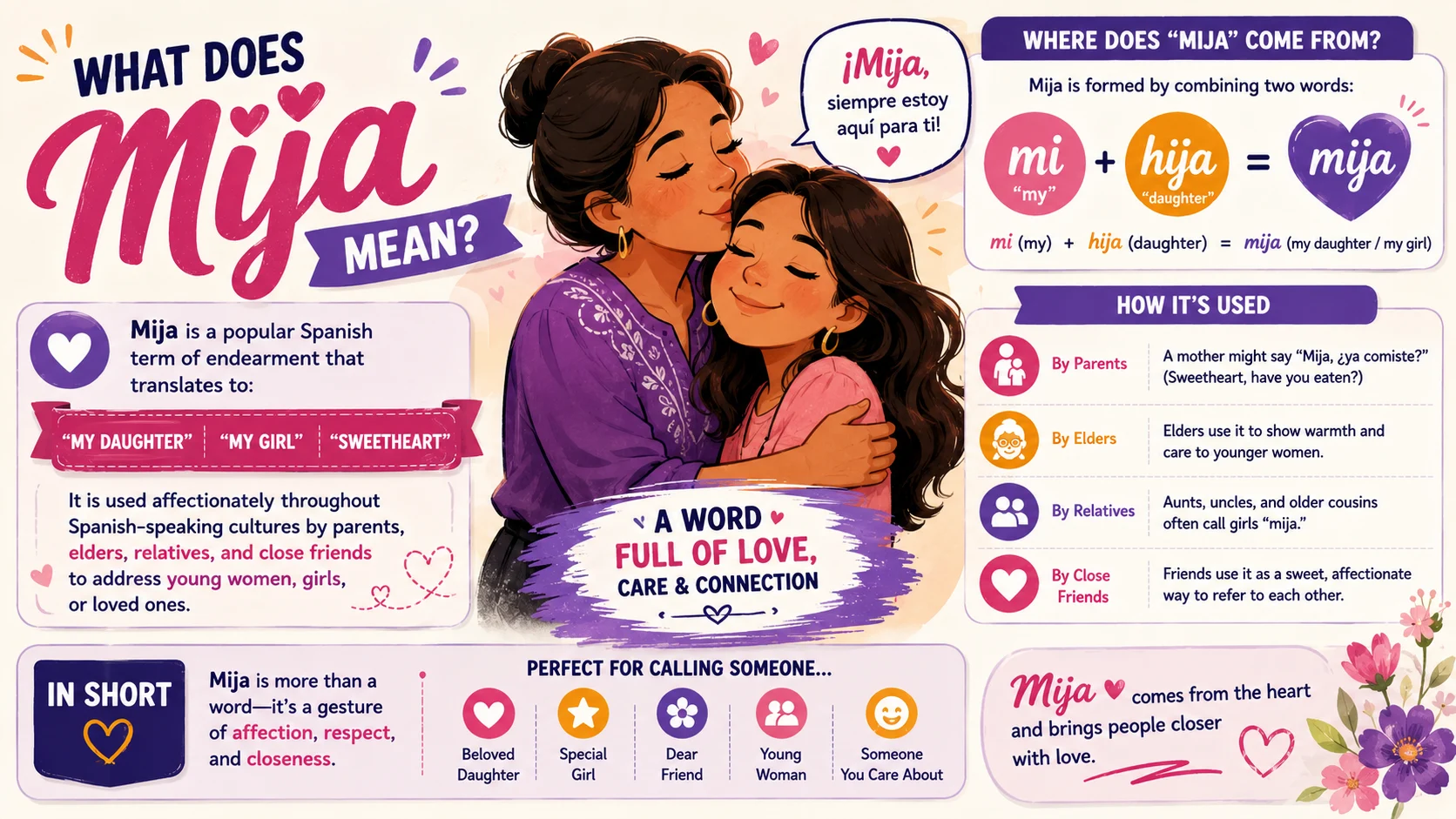
Mija is a popular Spanish term of endearment that translates to “my daughter,””my girl,” or “sweetheart.” Formed by combining two words (mi meaning “my” and hija meaning “daughter”), it is used affectionately throughout Spanish-speaking cultures by parents, elders, relatives, and close friends to address young women, girls, or loved ones.
Understanding the complete mija meaning helps you appreciate Hispanic family dynamics, navigate casual conversations in Spanish-speaking communities, decode modern pop culture references, and connect warmly with Spanish speakers. Furthermore, this tender expression carries deep cultural warmth that bridges formal language with everyday family affection. Consequently, when people search for this phrase, they usually want to uncover where the term comes from, how it is pronounced, who can say it appropriately, and how it compares to similar terms like mijo.
Additionally, Latin American television shows, music, movies, and literature frequently feature mija to convey genuine intimacy, maternal care, or playful camaraderie. For example, a mother might say mija when offering comforting advice to her daughter. Similarly, an older neighbor or close family friend might use it to greet a younger woman in a welcoming way. Therefore, mastering every dimension of the definition enriches your vocabulary and deepens your understanding of Spanish linguistic culture.
Quick Answer Box
| Aspect | Details |
| Literal Translation | “My daughter” (Contraction of mi + hija) |
| Primary Contexts | Family gatherings, parenting, friendly chat, Latino pop culture |
| Grammatical Gender | Feminine (mijo is the masculine equivalent for “my son”) |
| Common Pronunciation | “MEE-hah” |
| Tone | Affectionate, warm, caring, informal, protective |
What Does Mija Meaning Represent in Culture and Language?
To understand the core mija meaning, one must trace its grammatical formation and its cultural role across Spanish-speaking countries.
1. Linguistic Contraction (Portmanteau)
In spoken Spanish, native speakers naturally shorten common two-word phrases for faster, more fluid communication. The word mija is a natural linguistic portmanteau (combination) of two distinct Spanish words:
mi (my) + hija (daughter) = mija
In written Spanish, the silent letter “h” in hija is dropped completely in the contracted form, creating a smooth phonetic word that flows easily in casual speech.
2. Cultural Heart of Hispanic Family Life
Across Latin America, Spain, and Hispanic communities in the United States, terms of endearment play a central role in daily social interactions. Calling someone mija expresses warmth, respect, and emotional closeness.
“In Spanish-speaking households, calling someone mija is more than just a greeting. It is an embrace made of words that instantly creates a sense of home.”
Contextual Dynamics and Nuances of the Term
However, the exact emotional weight of mija shifts depending on who is speaking, their age relative to the listener, and the situation.
1. From Parent or Grandparent to Child
This represents the most traditional and literal usage of the word. Mothers, fathers, grandmothers (abuelas), and grandfathers (abuelos) use mija constantly when speaking to their daughters or granddaughters.
- Parental Guidance:“Eat your dinner, mija.”
- Comforting Words:“Do not worry about the exam, mija, you prepared well.”
2. From Elders to Younger Community Members
In many Hispanic cultures, older generations address younger women or girls as mija even if there is no direct biological relationship. This reflects a broad, community-oriented approach to care and respect.
- Community Warmth: An older shopkeeper, neighbor, or aunt (tía) might greet a young woman with, “Good morning, mija! How is your family doing?”
3. Between Close Friends (Casual Slang)
Among peers and close friends, mija can function as informal slang similar to “girl,” “bestie,” or “sis” in English. In this context, it signals solidarity, shared humor, or playful banter.
- Friendship Banter:“Mija, you will not believe what happened today!”
Mija vs. Mijo and Other Spanish Terms of Endearment
Understanding how mija compares to other popular Spanish affectionate terms clarifies its unique place in everyday conversation:
| Term | Literal Origin | English Equivalent | Primary Context |
| Mija | Mi + hija | My daughter, sweetheart, girl | Feminine address for daughters, young women, or close friends |
| Mijo | Mi + hijo | My son, buddy, sonny | Masculine address for sons, young men, or close male friends |
| Cariño | Affection / Care | Darling, sweetheart | Gender-neutral term for romantic partners or children |
| Mi amor | My love | My love, honey | Used for romantic partners, spouses, and young children |
| Nena | Baby / Little girl | Babe, girl, kiddo | Informal term for young girls or romantic partners |
Real-Life Conversation Examples
Reviewing everyday workplace, home, and casual dialogue shows how people use the term across various settings.
1. A Mother Speaking to Her Daughter at Home
Elena: Mija, remember to take your jacket before leaving for school!
Sofia: Thanks, Mom! The weather forecast said it might rain later.
Elena: Exactly, stay warm and have a great day!
2. Friends Catching Up Over Coffee
Maria: Mija, you have to tell me how your job interview went!
Lucia: It was amazing! They offered me the senior position on the spot.
Maria: I am so proud of you! That is incredible news!
3. An Elder Offering Friendly Advice
Abuela: Sit down and rest for a minute, mija. You have been working hard all afternoon.
Carmen: Thank you, Abuela! I will make us some tea.
Pronunciation and Usage Guidelines
Mastering mija requires keeping a few simple linguistic tips in mind:
- Phonetic Breakdown: Pronounce it as MEE-hah. The first syllable rhymes with “see,” and the second syllable uses a soft Spanish “j” sound (similar to the English “h” in “hat”).
- Grammar Agreement: Always use mija when addressing a female individual and mijo when addressing a male individual.
- Respect Social Context: While native speakers use it naturally with younger people, non-native speakers should ensure they share a warm, friendly rapport before using terms of endearment.
- Avoid Overuse in Formal Settings: Keep mija for personal conversations, casual workplaces, and family settings. Avoid using it in formal business contracts or strict corporate meetings.
FAQs
What does “mija” literally mean in Spanish?
Literally, mija is a contraction of the Spanish words mi (my) and hija (daughter), translating directly to “my daughter.”
What is the male version of “mija”?
The male equivalent is mijo, which combines mi (my) and hijo (son) to mean “my son” or “my boy.
Can a guy call his girlfriend “mija”?
Yes! Romantic partners sometimes use mija or mijo as a sweet, informal term of affection, similar to “babe” or “sweetheart” in English.
Is “mija” considered offensive or disrespectful?
No, mija is overwhelmingly an affectionate, warm, and loving term. However, if used by a stranger toward an adult woman in a professional environment, it might sound overly patronizing or overly familiar.
How do you pronounce “mija” correctly?
It is pronounced MEE-hah. The letter “j” produces a soft breathy sound like the “h” in the English word “home.”
Is “mija” used in all Spanish-speaking countries?
Yes! While extremely popular in Mexico, Central America, and Mexican-American culture, mija is recognized and widely used throughout Latin America and Spain.
Can you use “mija” for someone who is not your child?
Absolutely! Elders, relatives, teachers, family friends, and peers frequently use mija to address girls and younger women as a sign of affection and community closeness.
What is the plural form of “mija”?
The plural form is mijas (referring to a group of girls/daughters) or mijos (referring to a mixed group or a group of boys/sons).
What does “mija” mean in text messaging?
In text messages and social media DMs, mija works just like in spoken conversation, serving as a friendly, informal way to start a message to a female friend or relative.
What is the difference between “hija” and “mija”?
Hija is the standard noun for “daughter.” Mija is the affectionate contraction for “my daughter” used specifically when speaking directly to someone.
Conclusion
Ultimately, whether heard in a quiet family kitchen, featured in a television drama, or shared between close friends, understanding the mija meaning reveals a word filled with genuine warmth. The evolution of the term from a basic grammatical contraction to an iconic cultural expression shows how language brings people closer together. By recognizing the rich social contexts of the word, you can appreciate the heart of Spanish-speaking cultures and communicate with greater empathy and cultural awareness.

Andrew Morris is a writer at Meaninga.com who specializes in word meanings, slang, idioms and modern language trends. He creates clear, accurate and easy to understand content for everyday readers.