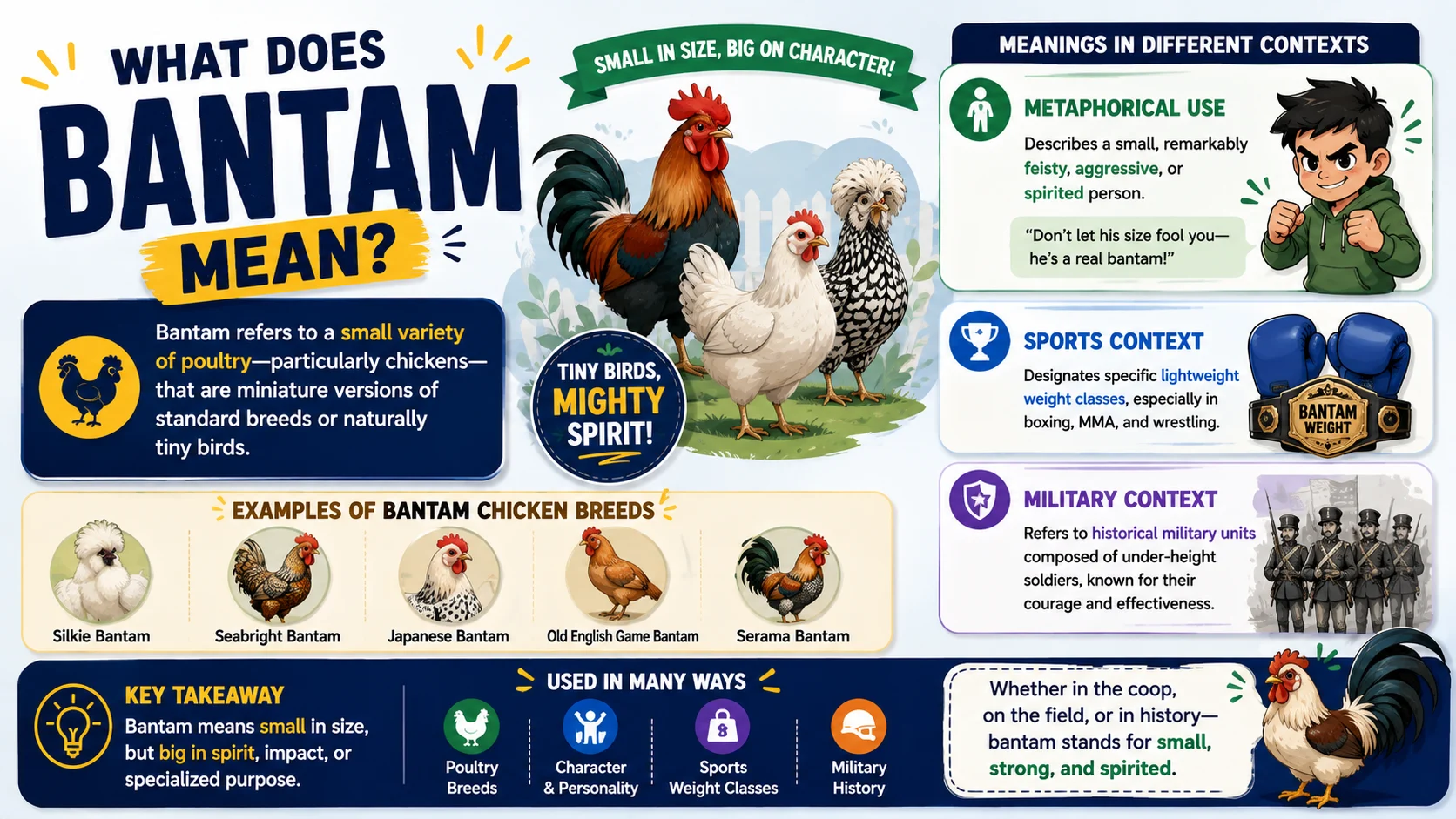
Bantam refers to a small variety of poultry (particularly chickens) that are miniature versions of standard breeds or naturally tiny birds. Metaphorically, the term describes a small, remarkably feisty, aggressive, or spirited person. In sports and military contexts, it designates specific lightweight weight classes and historical military units composed of under-height soldiers.
Understanding the complete bantam meaning helps you appreciate agricultural history, navigate sports weight categories, elevate your literary vocabulary, and decode military terminology. Furthermore, this colorful word bridges international trade routes with modern athletic divisions and everyday English idioms. Consequently, when people search for this phrase, they usually want to uncover where the term comes from, how it applies to boxing and hockey divisions, or why small chickens share a name with feisty competitors.
Additionally, various industries adopt the term to categorize compact yet high-performing entities. For example, poultry breeders value bantams for their manageable size, vibrant plumage, and energetic personalities. Similarly, combat sports utilize the bantamweight class to feature exceptionally fast, highly technical fighters. Therefore, mastering every dimension of the definition enriches your vocabulary and deepens your understanding of language and sports history.
Quick Answer Box
| Aspect | Details |
| Primary Meaning | A miniature breed of chicken; a small, spirited, or aggressive person |
| Etymology Origin | Named after Bantam (Banten), a historic seaport town in Java, Indonesia |
| Sports Contexts | Bantamweight division in boxing, MMA, wrestling, and youth hockey |
| Military History | Bantam battalions composed of soldiers below standard height requirements |
| Tone | Spirited, energetic, feisty, compact, assertive |
What Does Bantam Meaning Represent in History and Culture?
To understand the core bantam meaning, one must trace its journey from Indonesian trading ports to European farms and global sports arenas.
1. The Geographical and Maritime Origins
Historically, the word derives from Bantam (now Banten), a major historic seaport province located on the western tip of Java, Indonesia. During the sixteenth and seventeenth centuries, Dutch and English sailors trading in Southeast Asia discovered exceptionally small, hardy native chickens. Sailors purchased these tiny birds to provide fresh meat and eggs during long voyages. Upon returning to Europe, traders applied the port’s name to the miniature poultry species, giving birth to the English term bantam.
2. Figurative Evolution in Modern Language
Over time, English speakers noticed that bantam roosters exhibited extraordinarily bold, aggressive, and protective behavior despite their small physical stature. Consequently, the word transformed into a popular adjective and noun describing small individuals who possess outsized confidence, high energy, or a combative attitude.
“A true bantam is not defined by physical stature. They carry enough confidence and spirit to command the entire room.”
Contextual Dynamics and Nuances of the Term
However, the precise application of bantam shifts depending on whether it appears in agriculture, athletic competition, or historical literature.
1. In Agriculture and Avian Breeding
In poultry keeping, bantams are divided into two primary categories:
- True Bantams: Naturally small chicken breeds that have no standard-sized equivalent (such as Sebright, Nankin, and Rosecomb).
- Miniaturized Bantams: Selectively bred miniature versions of large standard chicken breeds (such as Bantam Rhode Island Red and Bantam Orpington).
Because of their small size, bantams require less feed, need smaller coops, and are popular among urban farmers and poultry show competitors.
2. In Sports and Athletic Divisions
In professional and amateur athletics, the term designates specific weight or age divisions designed to match smaller or younger competitors fairly.
- Bantamweight in Combat Sports: A professional weight division in boxing, mixed martial arts (MMA), and wrestling. In professional men’s boxing, bantamweight typically tops out at 118 pounds (53.5 kg), whereas in the UFC, men’s bantamweight is capped at 135 pounds (61.2 kg).
- Bantam in Youth Sports: In youth ice hockey and baseball, the bantam level historically designated age brackets for young athletes (typically ages 13 to 14).
3. In Military History (WWI Bantam Battalions)
During World War I, the British Army established specialized Bantam Battalions. These official infantry units recruited physically fit men who met all health standards but fell below the standard minimum height requirement of 5 feet 3 inches. These courageous soldiers served with great distinction on the Western Front.
How Bantam Compares to Similar Descriptive Terms
Understanding how bantam compares to other words describing small or spirited traits clarifies its unique place in the English language:
| Word | Primary Focus | Key Nuance and Energy |
| Bantam | Small physical size paired with fiery spirit | Feisty, confident, bold, aggressive, compact |
| Diminutive | Purely physical measurement or stature | Neutral, quiet, small, unpretentious |
| Feisty | Temperament and lively energy | Spirited, touchy, aggressive regardless of size |
| Pygmy | Biological dwarfing or miniature species | Scientific description of unusually small species |
Real-Life Conversation Examples
Reviewing everyday workplace and casual dialogue shows how people use the term across various settings.
1. Discussing Combat Sports
Alex: Are you watching the championship fight card this Saturday night?
Sarah: Absolutely! The main event features two of the fastest strikers in the bantamweight division.
Alex: It is going to be incredible. Bantam fights always deliver non-stop speed and technique!
2. Talking About Backyard Farming
Jordan: I am thinking about raising a few chickens in my backyard suburban garden.
Taylor: You should definitely look into bantam breeds!
Jordan: Why bantams specifically?
Taylor: They take up half the space, eat far less grain, and are super friendly!
3. Describing a Feisty Personality
Maya: Do not underestimate the new project director just because she is quiet at first glance.
Chloe: Oh, I saw her handle that difficult client meeting yesterday. She is an absolute bantam when pushed!
Maya: Exactly! She stands her ground and never backs down.
Key Characteristics of Bantam Personalities and Breeds
Whether referring to avian species or human traits, several consistent qualities define the bantam concept:
- Compact Efficiency: Maximize output and impact while occupying minimal space or requiring fewer resources.
- Outsized Confidence: Displaying assertive, fearless body language regardless of physical competition or environment.
- High Agility and Speed: Exhibiting rapid reflexes, quick decision-making, and high physical energy.
- Resilience and Grit: Overcoming physical size disadvantages through superior determination, skill, and bold action.
FAQs
What is the primary bantam meaning in English?
The primary meaning of bantam is a small variety of chicken. Metaphorically, it refers to a small, feisty, or aggressive person who possesses outsized courage and energy.
Where does the word “bantam” come from?
The word originates from Bantam (Banten), a historic seaport town in Java, Indonesia, from which European traders originally imported miniature chickens.
What is a bantamweight in boxing and MMA?
In combat sports, bantamweight is a weight division for lightweight fighters. In men’s boxing, the limit is 118 pounds, while in UFC/MMA, the limit is 135 pounds.
What is a “true bantam” chicken?
A true bantam is a naturally occurring miniature chicken breed that has no larger standard-sized counterpart, such as a Sebright or Belgian d’Uccle.
How big are bantam chickens compared to regular chickens?
Bantam chickens are typically one-half to one-third the size of standard large fowl, weighing between 1.5 to 2.5 pounds on average.
What were WWI Bantam Battalions?
WWI Bantam Battalions were special British Army infantry regiments formed from healthy, fit male recruits who were shorter than the standard minimum height requirement of 5 feet 3 inches.
Is “bantam” an insult or a compliment?
It depends on context! Calling someone a bantam can compliment their fiery courage, energy, and toughness, though it can occasionally poke light fun at someone’s short physical stature or combative nature.
What does bantam mean in youth hockey?
Historically, in youth hockey, the bantam level referred to an age division typically comprising 13- and 14-year-old players before they advanced to midget or high school hockey.
Do bantam chickens lay edible eggs?
Yes! Bantam chickens lay perfectly healthy, delicious eggs. However, their eggs are smaller, typically requiring two bantam eggs to equal one standard large store-bought egg.
What is the adjective form of bantam?
The word bantam itself serves as both a noun and an adjective (for example, “a bantam rooster” or “a bantamweight fighter”).
Conclusion
Ultimately, whether encountered on an urban homestead, in a martial arts ring, or within historical literature, understanding the bantam meaning reveals a concept defined by spirit over scale. The evolution of the term from an Indonesian trading port to a symbol of athletic speed and courageous determination shows how language captures the essence of compact strength. By recognizing the rich cultural and practical contexts of the word, you can enrich your vocabulary and appreciate the feisty champions of the natural and athletic worlds.