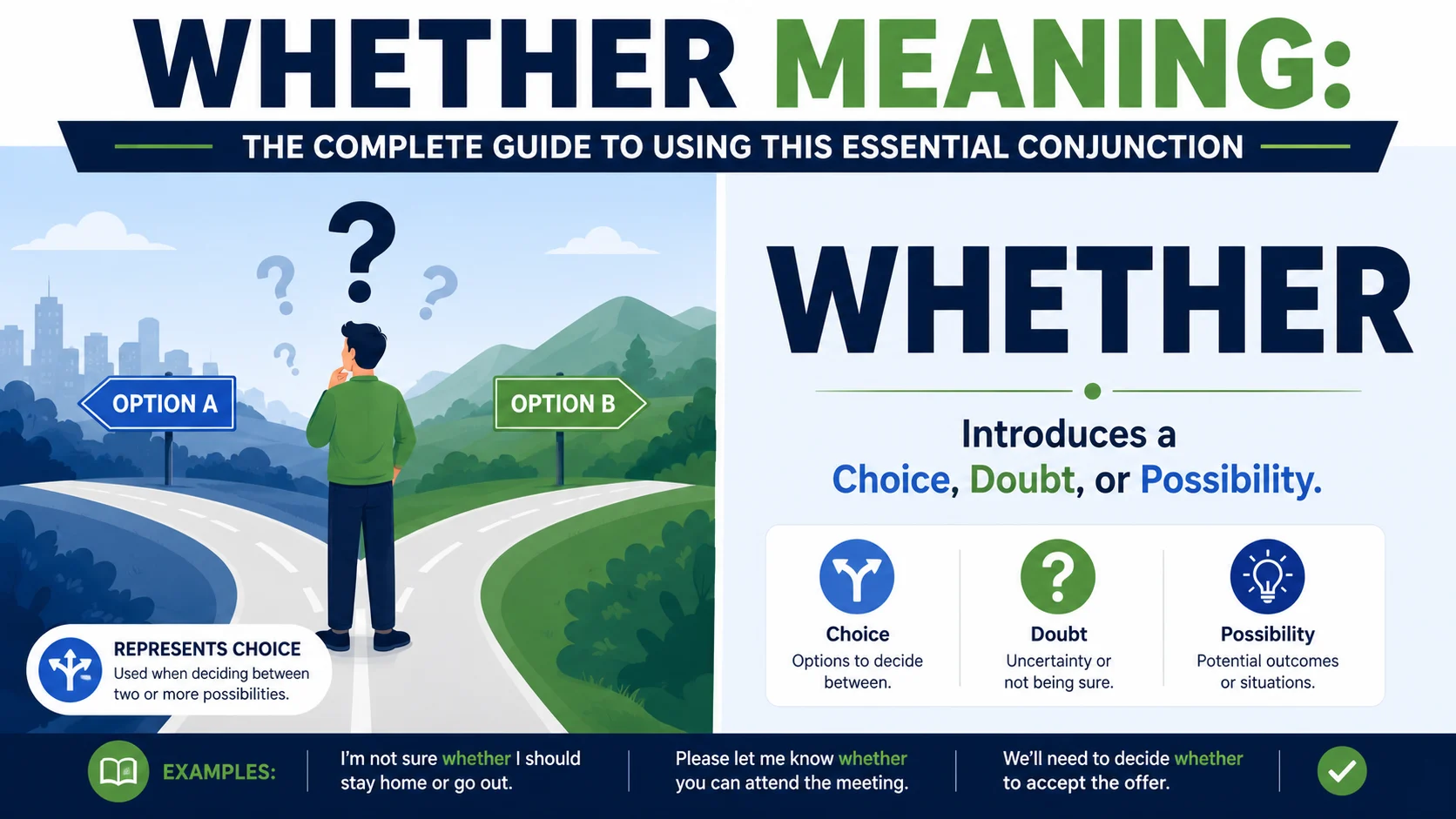
Whether is a conjunction used to introduce a choice, doubt, or possibility between two or more alternatives . It is commonly used to ask indirect yes/no questions or to express that something will happen regardless of the circumstances . A key feature is that it is often followed by “or not” to emphasize the alternatives .
Have you ever been unsure about whether to use “whether” or “if”? These words seem interchangeable at first glance, but they carry distinct meanings. Understanding the whether meaning is essential for expressing choices and conditions with precision.
The confusion around “whether” comes from its similarity to “if” and its homophones “weather” and “wether”. While “whether” presents alternatives, “weather” describes atmospheric conditions, and “wether” is a castrated male sheep. This confusion can lead to embarrassing writing mistakes if you don’t know the differences.
This article clears up the confusion around “whether” once and for all. You will learn its definition, see real examples, and discover the important differences between “whether” and related words. By the end, you will confidently use “whether” to express choices and possibilities.
The main takeaway is that whether is a conjunction used to introduce a choice or doubt between two or more alternatives . It is the go-to word for indirect yes/no questions and situations where the outcome is uncertain . While “if” can sometimes be used in its place, “whether” is always the correct choice when presenting options or before an infinitive .
Definitions and Explanations
What Does “Whether” Mean?
The whether meaning centers on introducing alternatives. It is a conjunction that presents a choice, doubt, or possibility between two or more options . For example, “I don’t know whether to turn left or right” presents two alternatives.
Whether can be used in several ways:
- To introduce an indirect yes/no question: “I asked whether she was coming”
- To present two or more alternatives: “Whether we win or lose, we must try our best”
- To express that something will happen regardless: “We’re going whether you like it or not”
| Feature | Description |
| Part of speech | Conjunction |
| Core meaning | Introduces a choice, doubt, or possibility between alternatives |
| Pronounciation | /ˈwɛðɚ/ (rhymes with “feather”) |
| Synonyms | If (sometimes), whether or not |
Whether vs. If
The distinction between “whether” and “if” is one of the most common grammar questions . While often interchangeable, there are important differences .
| When to Use | Example | |
| Whether | When presenting two or more alternatives | “I can’t decide whether to go to the beach or the mountains.” |
| If | When introducing a condition | “If it rains, we’ll stay inside.” |
Here is a helpful rule: use “whether” when you are asking an indirect question with two or more options . Use “if” for conditional sentences. When in doubt, “whether” is often the safer choice in formal writing .
When to Use “Whether”
Use “whether” in these specific situations:
- Before an infinitive: “I can’t decide whether to go or stay.”
- After a preposition: “We discussed whether we should leave.”
- When introducing a noun clause: “Whether he attends is his decision.”
- To avoid ambiguity: “Let me know whether you can come.”
When to Use “If”
Use “if” primarily for conditional sentences:
- “I will go if you come with me.”
- “If you study, you will pass the exam.”
Whether vs. Weather
These words are homophones, meaning they sound identical but have different meanings and spellings .
| Word | Meaning | Example |
| Whether | Conjunction expressing choice | “I don’t know whether to go.” |
| Weather | Atmospheric conditions (noun) | “The weather is beautiful today.” |
| Weather | To endure or withstand (verb) | “We will weather the storm.” |
Memory Tricks to Remember the Difference
- Whether has an “h” and presents options, like “which”
- Weather describes Earth’s atmosphere (notice the “ea” like “Earth”)
- A wether is a castrated male sheep, a word you likely will never use
Whether vs. Wether
This is a less common confusion, but it’s important to know the difference . A “wether” is a castrated male sheep or ram . Unless you are writing about livestock, you will almost certainly never need to use this word. If your spell-checker underlines it, it is likely a mistake for “whether” or “weather.”
Advantages and Disadvantages
Advantages of Using “Whether” Correctly
- Clarity: Using “whether” correctly eliminates ambiguity about whether you are presenting options or a condition
- Precision: It signals to your reader that you are considering alternatives
- Professionalism: Correct usage demonstrates strong grammar skills, especially in formal writing
- Avoids ambiguity: In sentences like “Let me know if you’re coming,” “whether” is clearer than “if”
Potential Disadvantages
- Formality: In very casual writing or speech, “whether” can sometimes sound more formal than “if”
- Confusion: Its similarity to “weather” and “wether” can lead to spelling errors
Real-World Examples
Examples of “Whether” in Sentences
Introducing alternatives
- “I can’t decide whether to buy the green dress or the blue one.”
- “Whether we succeed or fail, we must try.”
- “It matters little whether we go or stay.”
Indirect yes/no questions
- “Do you know whether he’s coming tonight?”
- “He asked whether his hat was on straight.”
- “She asked whether we could have pizza for dinner.”
With “or not”
- “I have to decide whether or not to respond to this letter.”
- “We’re going whether or not you decide to come along.”
After prepositions
- “The amount of cake they can eat depends on whether their friends come.”
- “I asked about whether the package got to her.”
Before an infinitive
- “She doesn’t know whether to go to the movies or study.”
- “They can’t decide whether to save some cake.”
Common Phrases with “Whether”
| Phrase | Meaning |
| “Whether you like it or not” | Something will happen regardless of your preference |
| “Whether or not” | Used to emphasize alternatives or possibilities |
| “Whether … or …” | Presenting two or more alternatives |
Regional and Global Usage
The meaning and usage of “whether” are consistent across all English-speaking regions. It is used in the same way in the United States, the United Kingdom, Canada, Australia, and other English-speaking countries.
Formal vs. Informal Usage
- Formal writing: “Whether” is preferred over “if” in formal contexts
- Informal speech: “If” is often used interchangeably with “whether” in casual conversation
- Academic and professional writing: “Whether” is the standard choice for presenting alternatives
Common Mistakes
Mistake 1: Using “If” Instead of “Whether” Before an Infinitive
Correction: Use “whether” before an infinitive. “I don’t know if to go” is incorrect. “I don’t know whether to go” is correct .
Mistake 2: Using “Whether” Instead of “If” in Conditional Sentences
Correction: Use “if” for conditions. I will go whether you come” is incorrect (unless you mean “whether or not you come”). “I will go if you come” is correct .
Mistake 3: Using “Whether” After a Preposition
Correction: This is correct. “We talked about whether we should leave.”
Mistake 4: Confusing “Whether” with “Weather”
Correction: Remember that “weather” describes the atmosphere, and “whether” expresses choice .
Exercises
Exercise 1: Fill in the Blank
Choose whether or if to complete each sentence.
- “I can’t decide _____ to go or stay.”
- “_____ it rains, we will cancel the picnic.”
- “She asked _____ we were coming.”
- “_____ you like it or not, we have to finish this.”
- “I will help you _____ you ask nicely.”
Exercise 2: Identify the Error
Each sentence has a mistake. Identify the incorrect word and correct it.
- “I don’t know if to go to the party.”
- “Whether it rains, I will stay home.”
- “The whether today is beautiful.”
- “I need to decide if or not I will attend.”
Answer Key
Exercise 1 Answers:
- Whether (before an infinitive)
- If (conditional sentence)
- Whether or If (indirect question, both are often acceptable)
- Whether (presenting alternatives)
- If (condition)
Exercise 2 Corrections:
- “I don’t know whether to go to the party.” (Use “whether” before an infinitive)
- “If it rains, I will stay home.” (Use “if” for conditions)
- “The weather today is beautiful.” (Use “weather” for atmospheric conditions)
- “I need to decide whether or not I will attend.”
Related Concepts and Comparisons
Whether vs. If
| Aspect | Whether | If |
| Part of speech | Conjunction | Conjunction |
| Primary use | Introducing alternatives | Introducing conditions |
| Before an infinitive | Yes | No |
| After a preposition | Yes | No |
| Formal writing | Preferred | Less formal |
Whether vs. Weather
| Aspect | Whether | Weather |
| Part of speech | Conjunction | Noun/Verb |
| Meaning | Expresses choice | Atmospheric conditions/To withstand |
| Pronunciation | /ˈwɛðɚ/ | /ˈwɛðɚ/ |
Whether vs. Wether
| Aspect | Whether | Wether |
| Part of speech | Conjunction | Noun |
| Meaning | Expresses choice | Castrated male sheep |
| Usage | Common | Very rare |
FAQs
What does whether mean?
Whether is a conjunction used to introduce a choice, doubt, or possibility between two or more alternatives . It can also be used to express that something will happen regardless of circumstances .
What is the difference between whether and if?
Whether presents alternatives, while if introduces a condition . “Whether” is used when there are two or more options, and “if” is used for conditional sentences .
Is it “whether” or “weather”?
“Whether” is a conjunction expressing choice. “Weather” refers to atmospheric conditions (noun) or to endure something (verb) . They sound the same but have different meanings.
How do you pronounce whether?
Whether is pronounced /ˈwɛðɚ/, which rhymes with “feather” .
Can you start a sentence with whether?
Yes, you can start a sentence with “whether.” For example, “Whether we win or lose, we must try our best” .
What is the difference between whether and rather?
Whether presents a choice between two possibilities . Rather expresses preference or degree.
Is it “whether or not” or “whether”?
Both are correct. “Whether or not” is often used for emphasis, but “whether” alone can also imply the “or not” .
Conclusion
This guide has explored the meaning and usage of the word whether. It is a conjunction that introduces a choice, doubt, or possibility between alternatives. The key distinction to remember is that “whether” presents options, while “if” introduces conditions. They sound the same as “weather” and “wether,” but have different meanings.
The best practical advice is to use “whether” when you are presenting alternatives or asking an indirect yes/no question. Use “if” for conditional sentences. When in doubt, especially in formal writing, “whether” is often the safer and more precise choice.

Andrew Morris is a writer at Meaninga.com who specializes in word meanings, slang, idioms and modern language trends. He creates clear, accurate and easy to understand content for everyday readers.








14 thoughts on “Whether Meaning| The Complete Guide to Using This Essential Conjunction”