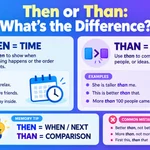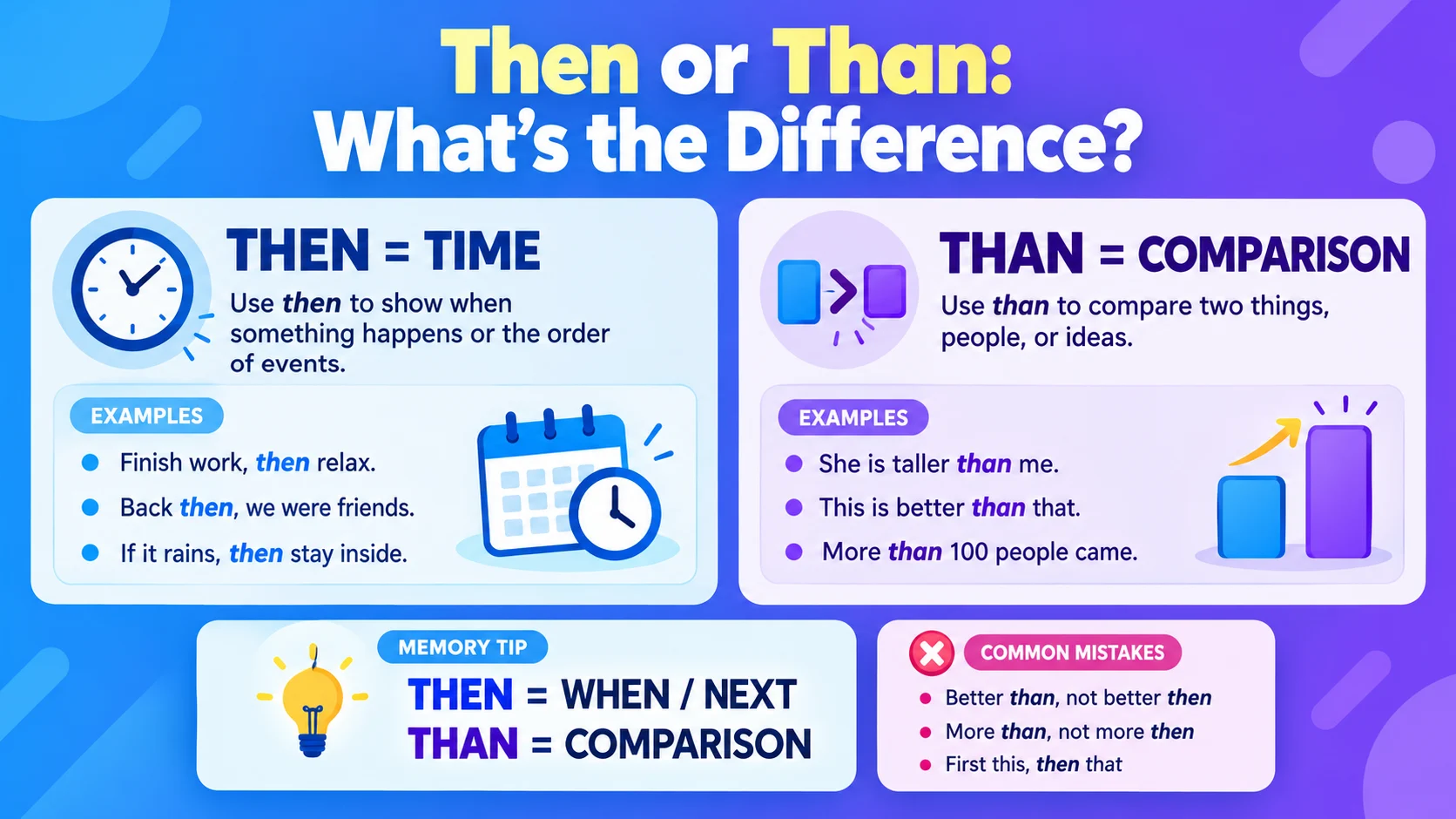
Then or than is a common grammar question because these two words look similar and can sound alike in everyday speech. However, they have different meanings and uses. Then usually refers to time, sequence, or a result, while than is used to compare people, things, amounts, or choices.
For example, you might write, “I finished my homework, then I watched TV.” In contrast, you would say, “This book is better than that one.” Both sentences are correct because each word serves a different purpose.
Fortunately, you can learn a simple rule to remember the difference. Once you understand how each word works, you can use then and than confidently in everyday conversations, emails, school assignments, and professional writing.
Then vs. Than
| Word | Main Meaning | Example |
|---|---|---|
| Then | At that time, next, or as a result | Finish dinner, then wash the dishes |
| Than | Used to compare things | My car is faster than yours. |
Easy rule to remember: Use then for time or what happens next. Use than when comparing things.
What Does Then Mean?
The word then usually refers to time, order, or a result. It helps readers understand when something happened or what should happen next.
For example, you might use then to describe two actions in order. You can also use it to refer to a past moment or introduce a consequence.
1. Then Means Next
Use then when one action follows another.
Examples:
- First, wash your hands, then prepare dinner.
- I finished my homework and then played video games.
- She packed her bags, then left for the airport.
- We visited the museum and then went to lunch.
In each example, then shows the order of events. The first action happens before the next one.
2. Then Refers to a Time
Then can also mean “at that time.” This use often appears when discussing the past or referring to a particular moment.
Examples:
- Life was simpler back then.
- I was living in Chicago then.
- We were classmates back then.
- She was working at the company then.
Similarly, the phrase “since then” refers to the period between a past event and now.
For example: “I moved to Dallas five years ago, and I have lived here since then.”
3. Then Shows a Result or Consequence
Sometimes, then means “in that case” or helps introduce a logical result.
Examples:
- If you are tired, then take a break.
- If the store is closed, then we will come back tomorrow.
- You have finished your work, so then you can relax.
- If everyone agrees, then we can begin.
In these sentences, then connects a condition with a possible result. It is especially common in if-then statements.
What Does Than Mean?
The word than is mainly used to compare two or more people, objects, actions, or ideas. It often follows comparative words such as better, taller, faster, more, and less.
For example, “Mia is taller than Ava” compares two people’s heights. Likewise, “This phone costs less than mine” compares prices.
1. Than Compares People or Things
Use than when showing how one person or thing differs from another.
Examples:
- My brother is taller than me.
- This restaurant is better than the last one.
- Her bag is heavier than mine.
- Summer is warmer than spring in this region.
In each sentence, than introduces the second part of a comparison.
2. Than Compares Amounts
Than also appears when comparing numbers, quantities, or degrees.
Examples:
- I have more than ten books.
- The trip took less than two hours.
- More than 100 people attended the event.
- This box weighs less than five pounds.
Therefore, remember to use than after expressions such as more than, less than, and fewer than.
3. Than Expresses Preferences
You can also use than to compare choices or preferences.
Examples:
- I would rather walk than drive.
- She prefers reading than watching TV.
- We would rather stay home than go out.
- He likes coffee more than tea.
For the most natural standard phrasing, write “She prefers reading to watching TV.” However, “I would rather read than watch TV” is correct because rather than compares two choices.
Then or Than: Key Differences
Although the words look similar, their grammatical jobs are different. The easiest way to choose correctly is to identify what your sentence expresses.
| Situation | Correct Word | Example |
|---|---|---|
| Describing what happens next | Then | Eat breakfast, then leave. |
| Referring to a past time | Then | Things were different back then. |
| Showing a consequence | Then | If it rains, then stay inside. |
| Comparing height | Than | She is taller than her sister. |
| Comparing prices | Than | This costs more than that. |
| Expressing a preference | Than | I would rather walk than wait. |
Remember: If your sentence answers “when?” or “what happens next?”, choose then. If it compares two things, choose than.
Common Phrases With Then and Than
Some expressions always use one word in standard English. Learning these phrases can help you avoid mistakes.
Common Phrases With Then
- By then: By that time.
- Back then: At an earlier time.
- Since then: From that time until now.
- Until then: Up to that time.
- Every now and then: Occasionally.
- First, then: Showing a sequence.
- And then: Introducing the next event.
- If…then: Showing a condition and its result.
Examples:
- By then, everyone had arrived.
- I have not seen her since then.
- We can wait until then.
- Every now and then, I visit my old school.
Common Phrases With Than
- More than: A greater amount.
- Less than: A smaller amount or degree.
- Better than: Superior to something else.
- Other than: Except for or apart from.
- Rather than: Instead of one choice.
- Fewer than: A smaller number.
- Bigger than: Greater in size.
- No sooner…than: A construction showing that one event followed another immediately.
Examples:
- This is more than I expected.
- Nobody other than Sam knew the answer.
- We chose tea rather than coffee.
- No sooner had we arrived than it started raining.
These common expressions are worth memorizing because they make everyday writing easier.
Then or Than in Everyday Sentences
Here are examples that show how the meaning changes depending on the word you choose.
Examples Using Then
- I took a shower, then got dressed.
- We lived in New York back then.
- Finish your assignment, and then you can play.
- If you are ready, then let’s go.
- She called me and then sent a message.
- I have not visited that place since then.
Examples Using Than
- My sister is younger than I am.
- This movie is more exciting than the first one.
- The train is faster than the bus.
- I would rather sleep than watch television.
- The project took less time than expected.
- This bag is heavier than the other one.
Notice how then places actions in order or refers to time. Meanwhile, than compares people, objects, amounts, or preferences.
Common Mistakes With Then and Than
Even experienced writers sometimes confuse these words. However, a quick check of the sentence’s meaning usually reveals the correct choice.
Mistake 1: Writing “Better Then” Instead of “Better Than”
Incorrect: This restaurant is better then the other one.
Correct: This restaurant is better than the other one.
Why? The sentence compares two restaurants, so than is necessary.
Mistake 2: Writing “More Then” Instead of “More Than”
Incorrect: She has more then twenty books.
Correct: She has more than twenty books.
Why? The sentence compares the quantity with a number.
Mistake 3: Writing “First…Than”
Incorrect: First, finish your homework, than watch TV.
Correct: First, finish your homework, then watch TV.
Why? The sentence describes a sequence of actions, so then is correct.
Mistake 4: Confusing “Other Than” With “Other Then”
Incorrect: Nobody other then Alex attended.
Correct: Nobody other than Alex attended.
Why? The phrase other than means “except for” or “apart from.”
Mistake 5: Writing “Rather Then” Instead of “Rather Than”
Incorrect: I would rather read then watch TV.
Correct: I would rather read than watch TV.
Why? The sentence compares two possible choices.
Easy Tricks to Remember Then or Than
If you often mix up these words, try these simple memory tricks.
Trick 1: Then Has an E for Time
Think of the word then alongside when. Both contain the letter e, and then often answers a question about time.
Examples:
- When did you arrive? I arrived then.
- What happens next? Finish your work, then relax.
This trick works well for sentences about time and sequence.
Trick 2: Than Has an A for Comparison
Think of than as the word you use when making a comparison or analysis.
Examples:
- She is faster than her brother.
- This book is better than that one.
- I have more than enough time.
Whenever you compare two things, than is usually the correct choice.
Trick 3: Replace Then With “Next”
Read your sentence and see whether you can replace then with next.
For example: “I ate dinner, then watched a movie.”
The sentence still makes sense as “I ate dinner, next watched a movie.” The wording is a little awkward, but the meaning remains clear. Therefore, then is the right choice.
Trick 4: Look for Comparison Words
If your sentence contains better, taller, faster, more, or less, check whether it compares two things.
For example: “My new laptop is faster than my old one.”
Because the sentence compares speed, than is correct.
Frequently Asked Questions
Is it then or than?
Both words are correct, but they serve different purposes. Use then for time, sequence, or consequences. In contrast, use than when comparing people, things, amounts, or choices.
Is it better than or better then?
The correct phrase is “better than.” The word than introduces a comparison between two things. For example, “This phone is better than my old phone” compares the quality of two phones.
Is it more than or more then?
The correct expression is “more than.” Use it when comparing amounts, numbers, or degrees. For example, “The event attracted more than 500 people” compares attendance with a specific number.
Should I write other than or other then?
Use “other than.” This phrase means “except for” or “apart from.” For example, “Other than Mia, everyone arrived early.” In standard English, “other then” is incorrect for this meaning.
Is it rather than or rather then?
The correct phrase is “rather than.” It compares alternatives or expresses a preference. For instance, “I would rather stay home than go out” presents staying home and going out as two choices.
Can then mean “in that case”?
Yes. Then can introduce a consequence or response. For example, “If you are feeling sick, then you should rest.” In this sentence, then means something close to “in that case.”
How can I remember the difference between then and than?
Remember that then relates to time, while than relates to comparison. You can also associate then with when because both contain the letter e. For comparisons, use than.
Are then and than pronounced the same?
They are often pronounced similarly, but their vowel sounds differ in many accents. Then usually has a short “e” sound, like hen, while than often has a short “a” sound, like man.
Conclusion
Choosing between then or than becomes easier when you focus on the meaning of your sentence. Use then when discussing time, order, or a result, as in “Finish your work, then take a break.” In contrast, use than when comparing people, things, amounts, or choices, as in “This book is better than that one.” Remember the simple trick: then connects with time, while than connects with comparison. With regular practice, you can avoid common spelling mistakes and write more clearly. Before submitting an assignment or email, check the sentence’s meaning to make sure you have chosen the correct word.

Andrew Morris is a writer at Meaninga.com who specializes in word meanings, slang, idioms and modern language trends. He creates clear, accurate and easy to understand content for everyday readers.