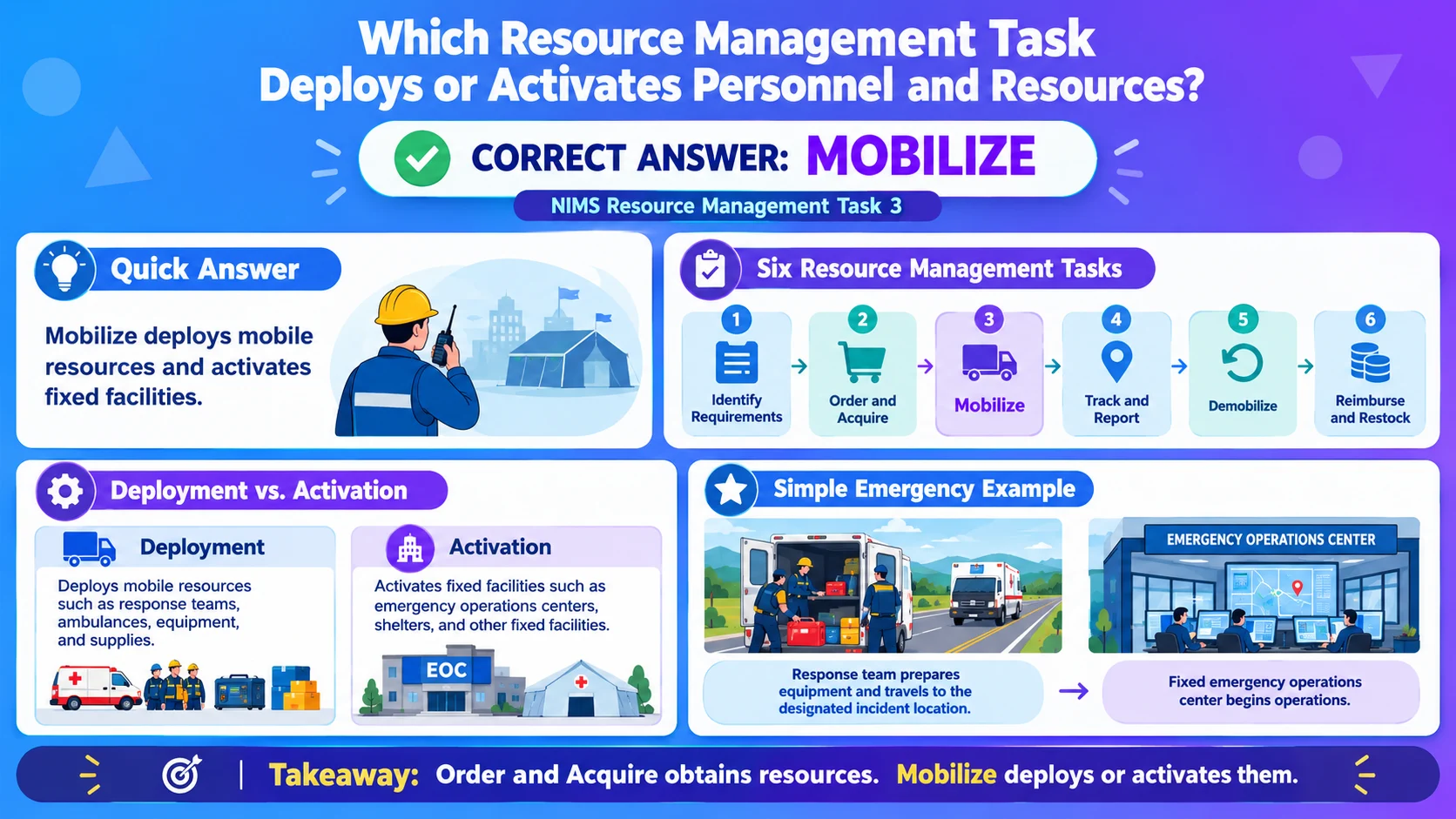
The resource management task that deploys or activates personnel and resources is Mobilize. Under the National Incident Management System (NIMS), mobilization prepares authorized personnel, equipment, teams, supplies, and facilities for an incident. It follows the process of identifying resource requirements and ordering or acquiring the resources. Once the appropriate authority notifies resource providers, personnel and equipment can move toward their assigned locations, while fixed facilities can be activated to support emergency operations.
Understanding this task helps emergency responders, incident managers, and FEMA exam candidates distinguish mobilization from other resource management activities.
Question: Which resource management task deploys or activates personnel and resources?
Answer: Mobilize.
Mobilize is the resource management task responsible for deploying mobile resources and activating fixed facilities after authorized notification. It is the third task in the commonly taught six-task NIMS resource management sequence.
What Is Resource Management in NIMS?
The National Incident Management System, commonly called NIMS, provides a shared framework for managing incidents across government agencies, nongovernmental organizations, and private-sector partners.
During an emergency, organizations may need firefighters, medical teams, law enforcement officers, vehicles, communications equipment, food, water, and other supplies. Therefore, they need a consistent process for identifying, requesting, deploying, tracking, and releasing those resources.
NIMS resource management helps organizations make sure the right resources reach the right place at the right time. It also supports accountability, coordination, and responder safety.
For example, after a major flood, an incident management team may identify a need for rescue boats and trained personnel. Next, the team requests the necessary resources. Once authorized, those resources are mobilized and sent to the designated location.
What Does the Mobilize Task Mean?
Mobilize means preparing and deploying authorized resources or activating facilities so they can support an incident.
This task begins after the appropriate notification or authorization. Resource providers then arrange the personnel, equipment, transportation, and other details needed for the response.
Mobilization may involve:
- Notifying personnel that they have been requested.
- Confirming resource availability.
- Preparing teams, vehicles, and equipment.
- Arranging transportation to the incident.
- Providing reporting instructions and contact details.
- Confirming the expected arrival time.
- Activating fixed facilities when required.
- Ensuring resources follow the correct check-in procedures.
These steps help prevent confusion when multiple agencies respond to the same incident.
However, mobilization does not mean that resources can simply travel to an incident without authorization. Personnel should follow established dispatch and reporting procedures so incident managers can track and assign them appropriately.
The Six NIMS Resource Management Tasks
NIMS organizes resource management into six commonly taught tasks. Each task serves a different purpose in the resource lifecycle.
| Task | Main Purpose |
|---|---|
| 1. Identify Requirements | Determine which resources the incident needs. |
| 2. Order and Acquire | Request or obtain the required resources. |
| 3. Mobilize | Deploy mobile resources or activate fixed facilities. |
| 4. Track and Report | Monitor resource location, status, and assignment. |
| 5. Demobilize | Release resources and arrange their return. |
| 6. Reimburse and Restock | Address eligible costs and replenish used supplies. |
The sequence provides a useful way to remember the process. First, managers determine what they need. Then, they obtain the resources and mobilize them. After deployment, they track their status and eventually arrange their release and financial closeout.
Why Mobilize Is the Correct Answer
The wording of the question specifically asks which task deploys or activates personnel and resources. That description matches Mobilize.
During this stage, authorized resources transition from being requested or available to actively responding to an incident. Mobile resources travel to the assigned location, while fixed facilities may be activated to support the operation.
For example, an emergency management team may request generators and technical personnel after a storm damages a power system. Once the request is approved, mobilization arrangements help get the generators and personnel where they are needed.
By contrast, ordering a generator does not necessarily mean it has departed for the incident. Mobilization covers the next stage: preparing and dispatching the resource according to established procedures.
Mobilize vs. Order and Acquire
A common source of confusion is the difference between Order and Acquire and Mobilize. Both tasks help get resources to an incident, but they perform different functions.
| Order and Acquire | Mobilize |
|---|---|
| Requests or obtains resources. | Prepares and deploys or activates authorized resources. |
| Establishes how the resource will be provided. | Arranges the resource’s response and movement. |
| Takes place before the resource is mobilized. | Follows the necessary request and authorization steps. |
| Answers, “How do we obtain it?” | Answers, “How do we get it ready and responding?” |
Consider an incident that requires an additional ambulance. The incident management team first requests the ambulance through the appropriate process. After the request is approved, the responsible organization arranges its dispatch and response.
Therefore, Order and Acquire obtains the resource, while Mobilize deploys or activates it.
Deployment vs. Activation
Although people sometimes use the words deployment and activation interchangeably, they often describe different actions in incident management.
What Is Deployment?
Deployment generally refers to sending mobile resources to a designated location. These resources can travel from their current location to the incident or another reporting point.
Examples include:
- Firefighters and rescue teams.
- Ambulances and emergency vehicles.
- Search-and-rescue equipment.
- Generators and portable lighting.
- Food, water, and medical supplies.
For instance, an emergency management team may deploy a rescue team to a flooded neighborhood. The team travels to the designated location and reports according to the incident’s procedures.
What Is Activation?
Activation generally refers to placing a facility or capability into operation. Unlike a mobile response team, a fixed facility usually remains in place while its operations begin.
Examples include:
- Emergency operations centers.
- Shelters.
- Hospitals or designated emergency facilities.
- Laboratories.
- Communications centers.
For example, an emergency operations center may activate its staff and communication procedures after a hurricane warning. The center coordinates information and support while field teams carry out their assignments.
Both deployment and activation can fall within the mobilization process. The appropriate action depends on the type of resource and the needs of the incident.
Real-Life Example of Resource Mobilization
Imagine that a severe storm causes widespread flooding in a community. Several roads become impassable, and residents need emergency assistance.
The incident management team identifies the need for rescue crews, boats, medical personnel, portable generators, and temporary shelters. After identifying these requirements, the team submits resource requests through the appropriate channels.
Once those requests are authorized, mobilization begins. Rescue teams prepare their equipment, transportation is arranged, and personnel receive instructions about where to report. Meanwhile, designated shelters and support facilities activate their operations.
When resources arrive, they follow the established check-in process. Incident managers can then track their status and assign them according to operational priorities.
This example shows why Mobilize is the correct answer: it covers the authorized deployment of mobile resources and activation of fixed facilities.
How Resource Tracking Connects to Mobilization
Mobilization and resource tracking work together, but they are separate tasks.
Mobilization prepares and dispatches resources. Tracking and reporting help incident managers maintain visibility of those resources during the response.
Tracking may record:
- Resource identification and type.
- Arrival and check-in status.
- Current location.
- Assigned function.
- Availability and operational status.
- Changes in assignment.
- Release and return status.
This information supports accountability and helps managers identify resource gaps. For example, if an incident needs additional medical personnel, accurate tracking helps determine which teams are available and which are already assigned.
However, Track and Report is not the task that deploys or activates resources. Its main purpose is to monitor and report their status.
Why Self-Dispatching Is a Problem
Self-dispatching happens when personnel or resources respond to an incident without an official request or authorization. Although the intention may be helpful, uncoordinated responses can create serious problems.
Unrequested responders may arrive without suitable assignments, credentials, equipment, or logistical support. In addition, incident managers may struggle to maintain accurate records of people and equipment at the scene.
Authorized mobilization helps reduce these risks. It ensures that responding resources receive appropriate instructions and use established reporting and check-in procedures.
Consequently, personnel should follow the designated request and dispatch process rather than independently traveling to an incident.
Common Exam Mistakes
When preparing for NIMS or incident management exams, remember the difference between each resource management task.
| Incorrect Choice | Why It Is Incorrect |
|---|---|
| Identify Requirements | Determines what resources are needed. |
| Order and Acquire | Requests or obtains the resources. |
| Track and Report | Monitors resource location and status. |
| Demobilize | Releases resources when they are no longer needed. |
| Reimburse and Restock | Addresses eligible costs and replenishment. |
| Mobilize | Correct: deploys or activates personnel and resources. |
A useful memory aid is to associate each task with its main action: identify, order, mobilize, track, demobilize, and close out costs or supplies.
This sequence makes it easier to recognize the correct answer when the question uses the words deploys or activates.
Frequently Asked Questions
Which resource management task deploys or activates personnel and resources?
The correct answer is Mobilize. Under NIMS, this task prepares and deploys authorized mobile resources or activates fixed facilities after the appropriate notification and authorization.
Is Mobilize the third NIMS resource management task?
Yes. In the commonly taught six-task resource management sequence, Mobilize follows Identify Requirements and Order and Acquire. It is followed by Track and Report, Demobilize, and Reimburse and Restock.
What happens during resource mobilization?
During mobilization, authorized personnel receive instructions, equipment is prepared, transportation is arranged, and resources are dispatched. Fixed facilities may also be activated to support incident operations.
What is the difference between Mobilize and Order and Acquire?
Order and Acquire handles requesting or obtaining the necessary resources. Mobilize follows the required authorization steps and prepares those resources to respond or activates facilities for incident support.
What happens after resources are mobilized?
Resources report to the designated location and follow the required check-in process. Incident managers then track their location, status, and assignments so they can coordinate operations and maintain accountability.
Can personnel self-dispatch to an emergency?
Personnel should not self-dispatch without authorization. They should follow established request, dispatch, and reporting procedures to support coordination, safety, accountability, and effective resource management.
What is the purpose of Track and Report?
Track and Report monitors the location, status, assignment, and availability of resources. It helps incident managers maintain accountability, but it does not replace the Mobilize task.
Why is mobilization important in emergency management?
Mobilization helps authorized resources reach the appropriate location with the instructions, equipment, and support needed for their assignments. It also reduces confusion and supports coordinated incident response.
Conclusion
The resource management task that deploys or activates personnel and resources is Mobilize. In NIMS, this task prepares authorized personnel, equipment, and teams for deployment while activating fixed facilities needed for incident operations. It follows identifying resource requirements and ordering or acquiring the necessary resources. After mobilization, incident managers track and report resource status, arrange demobilization when resources are no longer needed, and complete appropriate financial or supply closeout activities. To remember the answer, focus on the task’s purpose: Mobilize means getting authorized resources ready and into operation.