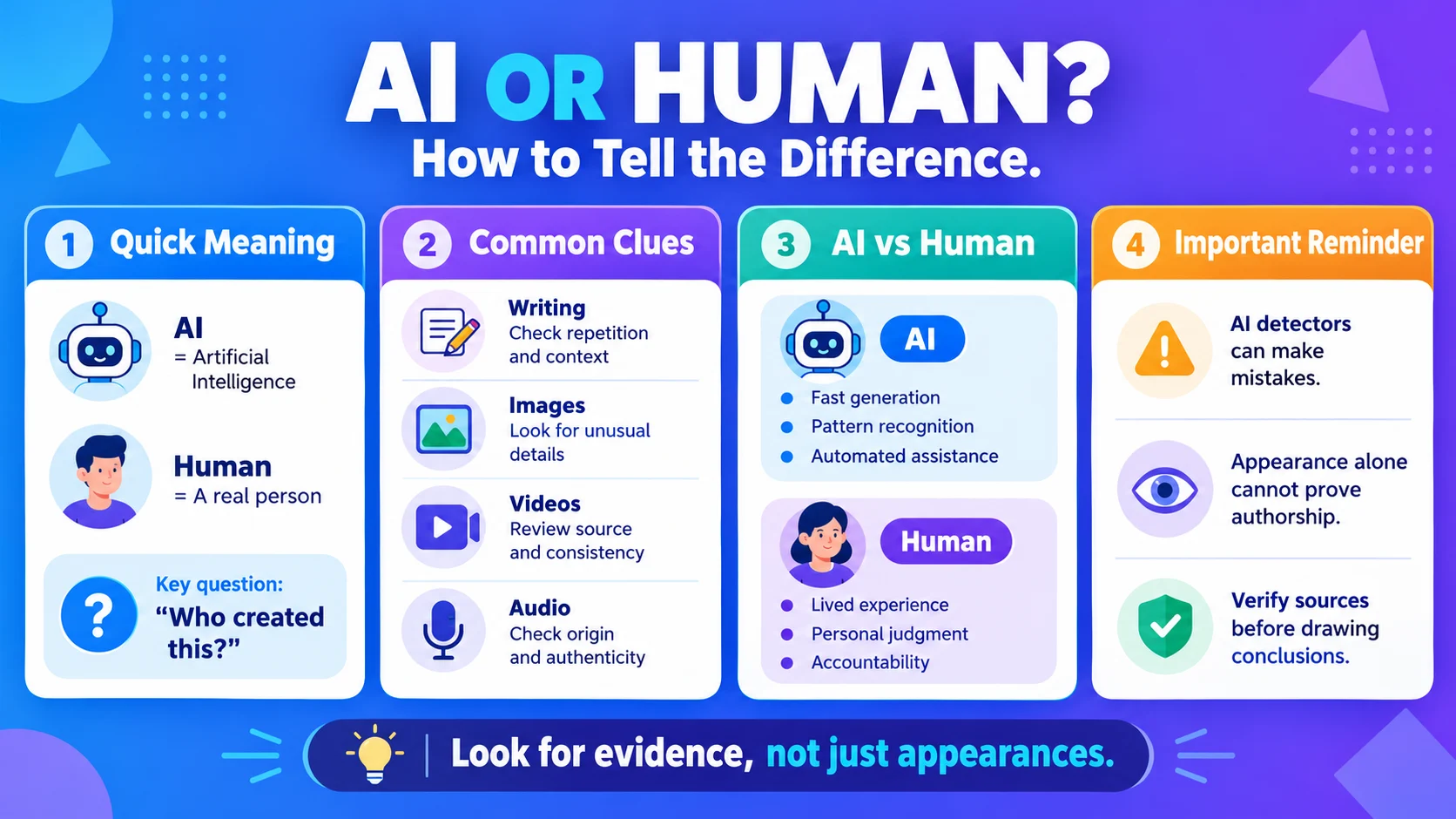
AI or human means identifying whether content or an activity comes from artificial intelligence or a person. The phrase commonly applies to writing, images, videos, voices, and online conversations. However, appearance alone cannot reliably reveal the source.
AI or human refers to the process of determining whether something was created, written, or performed by artificial intelligence or a real person. People commonly use this phrase when checking articles, images, videos, voices, social media posts, and online conversations. As AI tools become more advanced, telling the difference can be challenging.
For example, an article may sound natural even when AI generated it. Similarly, an AI-created image might look like an ordinary photograph. However, human work can also be polished, predictable, or imperfect.
Understanding the difference helps readers evaluate digital content more carefully. In this guide, you’ll learn what AI or human means, how the two differ, which clues to look for, and why no single sign can reliably reveal who created something.
What Does AI or Human Mean?
The phrase AI or human describes a comparison between work produced by artificial intelligence and work created by people.
Artificial intelligence uses computer systems to perform tasks such as generating text, answering questions, analyzing images, and producing audio. Humans, meanwhile, use personal experiences, knowledge, emotions, and judgment to create and interpret information.
For example, a writer might produce an article from personal research and experience. Alternatively, an AI tool might generate a draft from a written prompt. Both results can appear professional, but their creation processes differ.
The phrase also appears in online games where players chat with an unknown partner and guess whether that partner is human or AI. Therefore, its exact meaning depends on the context.
In everyday searches, however, people often want to know whether a piece of content was created by a person or generated with AI.
What Is the Difference Between AI and Human?
AI systems and humans can complete similar tasks, but they work in different ways.
AI generates outputs by processing information and learning patterns from data. Humans draw on biological cognition, lived experiences, personal goals, and social relationships.
The following table highlights some important differences.
| Feature | Artificial Intelligence | Human |
|---|---|---|
| Speed | Can generate responses quickly | Speed varies by task |
| Information | Processes learned patterns and available inputs | Uses knowledge, experience, and reasoning |
| Creativity | Combines patterns to produce new outputs | Creates through imagination, experience, and experimentation |
| Emotions | Can simulate emotional language | Experiences emotions |
| Personal experience | Can describe experiences but does not have human lived experiences | Has personal memories and lived experiences |
| Consistency | May repeat patterns or produce confident errors | May change opinions or make mistakes |
| Judgment | Can support decisions based on data and instructions | Can apply personal values, responsibility, and context |
| Availability | Can operate whenever its systems are available | Needs rest and depends on human circumstances |
Nevertheless, these differences do not mean AI always performs worse than humans. AI can process large amounts of information quickly, while people may excel at understanding personal context and taking responsibility for decisions.
The strongest results often come from combining useful AI capabilities with human review.
How to Tell If Writing Is AI or Human
Identifying AI-generated writing can be difficult because modern AI tools can produce fluent, natural-sounding text. Likewise, many human writers use structured language and consistent formatting.
Still, several clues can help you evaluate a piece of writing.
1. Look for Repetitive Language
AI-generated writing sometimes repeats the same ideas across multiple paragraphs. It may explain a point several times without adding useful information.
For example, an article might repeatedly say that exercise improves health without explaining how, why, or for whom.
However, repetition alone does not prove AI involvement. Human writers can also repeat themselves, especially when editing a draft poorly.
2. Check for Generic Statements
Some AI-generated content relies on broad statements that sound reasonable but provide little detail.
Consider this example:
“Technology continues to change the world in many important ways.”
The sentence is understandable, but it lacks specific information.
A stronger version might identify a particular technology, explain its effect, and provide evidence. Even so, generic writing can come from either humans or AI.
3. Examine the Details
AI systems can occasionally invent facts, misrepresent sources, or combine unrelated information. Therefore, check names, dates, quotations, statistics, and other important claims.
Human writers can also make mistakes. For this reason, fact-checking is more useful than trying to guess the author’s identity from style alone.
4. Notice Unnatural Context
An AI response may overlook a subtle detail, misunderstand a local reference, or provide an answer that does not fully address the question.
For instance, someone might ask for advice about a specific situation and receive a broad, generic response.
Still, people can misunderstand questions too. Contextual mistakes should raise questions about quality, not serve as automatic proof of AI authorship.
5. Look for Specific Experience
Human writing may include detailed observations, personal memories, or firsthand knowledge.
For example, a travel review might describe a confusing ticket machine, an unexpected delay, or a conversation with a local resident.
However, AI can generate convincing first-person stories without having lived through them. Therefore, personal-sounding details are not reliable proof that a human wrote the content.
The key takeaway: Look for evidence, context, and factual accuracy rather than relying on a single writing pattern.
How to Tell If an Image Is AI or Human-Made
AI image generators can create realistic portraits, landscapes, product images, and illustrations. Consequently, visual inspection alone may not always reveal whether an image is synthetic.
You can still look for possible warning signs.
Unusual Details
Some generated images contain inconsistent reflections, strange object shapes, distorted backgrounds, or details that do not fit the scene.
Hands, jewelry, signs, and small background objects may also contain errors. However, modern image generators can produce convincing details, while ordinary photographs may contain visual distortions.
Lighting and Shadows
Check whether the lighting appears consistent across the image. For example, an object may cast a shadow in the wrong direction or reflect light that does not match its surroundings.
These issues can indicate image manipulation or generation, but they do not prove AI created the image.
Text and Background Elements
AI-generated images sometimes include misspelled words, unusual lettering, or inconsistent background details.
Nevertheless, image editing, compression, and low resolution can produce similar problems.
Check the Image’s Origin
When possible, examine the original source, creator information, publication history, and available provenance data. Some platforms attach information that indicates whether an image was generated or edited using AI.
This evidence can be more useful than appearance alone. Even so, metadata may be missing, incomplete, or removed when an image is shared.
AI or Human in Videos and Voices
AI-generated video and audio have become increasingly realistic. Some tools can create synthetic voices, translate speech, animate faces, and produce scenes that never happened.
As a result, viewers should be careful when judging media by appearance or sound alone.
When reviewing a video, check for inconsistent lip movements, unusual transitions, unnatural facial details, or mismatched lighting. In audio, listen for abrupt changes in tone, strange pauses, or inconsistent pronunciation.
However, these clues are not conclusive. Real recordings can contain editing errors, background noise, and unusual movements.
Instead, verify where the media originated. Check whether reputable sources have published the same footage and whether the people involved have confirmed its authenticity.
This approach is especially important for political clips, breaking news, financial promotions, and videos that could damage someone’s reputation.
What Are AI Detection Tools?
AI detection tools analyze text or other content and estimate whether AI may have generated it. Depending on the tool, the system may examine language patterns, statistical features, or other characteristics.
For writing, a detector might look at how predictable the word choices and sentence structures appear. It then uses those signals to produce a score or classification.
However, an AI detector cannot guarantee that a piece of writing came from AI or a human.
Can AI Detectors Make Mistakes?
Yes. AI detectors can produce false positives, incorrectly labeling human writing as AI-generated. They can also produce false negatives, allowing AI-generated content to pass as human-written.
Results may vary depending on the language, writing style, length of the sample, editing, and detector design.
For example, short answers may not provide enough information for a meaningful assessment. Similarly, a human writer who uses simple, predictable sentences could receive a misleading result.
Therefore, avoid treating an AI detection score as definitive proof of authorship.
What Should You Do Instead?
Use several forms of evidence when authorship matters.
- Review the original document and available version history.
- Ask about the research and writing process.
- Check factual claims and source material.
- Compare the content with relevant drafts or documented work.
- Consider whether AI assistance was allowed or disclosed.
Most importantly, make decisions fairly. A detector result alone should not determine whether a student cheated, an employee violated a policy, or a writer created original work.
AI vs Human Writing: Which Is Better?
Neither AI nor human writing is automatically better in every situation. The best choice depends on the task, the required quality, and the role of human judgment.
| Task | AI Strength | Human Strength |
|---|---|---|
| Drafting | Generates a starting point quickly | Adds personal purpose and direction |
| Research support | Organizes information and suggests topics | Evaluates sources and context |
| Editing | Finds some grammar and clarity issues | Understands voice, intent, and audience |
| Storytelling | Suggests plots and variations | Draws on lived experience and emotional insight |
| Technical explanations | Summarizes complex material | Checks practical relevance and responsibility |
| Personal essays | Helps organize ideas | Supplies genuine personal experiences |
| Decision-making | Compares options and patterns | Takes responsibility and considers human consequences |
For example, a business might use AI to prepare a first draft of a product description. A human editor can then verify the details, remove unsupported claims, and make the wording fit the brand.
Similarly, a student may use AI to understand a difficult concept while completing their own permitted work.
Ultimately, quality depends on how the content is produced, checked, and used—not simply on whether AI was involved.
Is AI Replacing Human Creativity?
AI is changing creative work, but it does not make human creativity irrelevant.
AI tools can generate design concepts, suggest headlines, compose music, and help writers explore different ideas. As a result, creators can use them to experiment more quickly.
However, human creativity involves more than producing an attractive result. It can also involve choosing meaningful goals, drawing on personal experiences, understanding cultural context, and deciding what a work should communicate.
For instance, an AI tool might suggest ten slogans for a campaign. A human creative director can evaluate which slogan fits the audience, reflects the organization’s values, and communicates the intended message.
At the same time, people can create formulaic work, while AI can produce surprising combinations of ideas. The distinction is not simply that humans are creative and AI is not.
Instead, it is useful to consider the creative process, the source of the ideas, and the decisions made along the way.
Common Myths About AI or Human Content
Several common assumptions can make it harder to identify AI-generated work accurately.
Myth 1: Perfect Grammar Means AI
Reality: Many people write with excellent grammar. AI can also produce mistakes, so grammar alone cannot establish authorship.
Myth 2: Typos Prove a Human Wrote It
Reality: AI can generate spelling mistakes, and human writers may use editing tools. Therefore, typos are not reliable proof.
Myth 3: AI Writing Always Sounds Robotic
Reality: Modern AI can produce natural, conversational language. Meanwhile, human writing can sound formal or repetitive.
Myth 4: AI Detectors Are Always Accurate
Reality: Detection tools can misclassify both human and AI-generated content. Their results should be treated as estimates rather than final judgments.
Myth 5: AI and Human Work Cannot Be Combined
Reality: Many people use AI for brainstorming, drafting, translation, editing, or research support. Human review can remain an important part of that process.
When Should You Use AI or Human Help?
The right choice depends on your goal.
Use AI when you need help generating ideas, summarizing material, organizing information, or preparing a first draft. It can save time, especially when the task has a clear structure.
Choose human expertise when the work requires firsthand experience, personal accountability, sensitive judgment, or direct knowledge of a situation.
In many cases, a combination works best. For example, AI can help organize a report, while a qualified person verifies its claims and approves the final version.
Regardless of the method, check important details before publishing or acting on the result. Also, disclose AI involvement when required by the relevant school, employer, publisher, or platform.
Frequently Asked Questions
1. What does AI or human mean?
AI or human refers to determining whether content, media, or an activity was created or performed by artificial intelligence or a person. The phrase often appears in discussions about writing, images, videos, voices, and online conversations.
2. How can you tell if something is AI or human?
Examine the content’s context, accuracy, origin, and available creation records. Writing patterns and visual clues may help, but none proves authorship alone. When possible, combine several forms of evidence before reaching a conclusion.
3. Can AI writing look completely human?
Yes. AI can generate natural language, varied sentence structures, and conversational responses. Therefore, readers may not reliably distinguish AI-generated writing from human writing by reading a short passage alone.
4. Are AI detectors accurate?
AI detectors can offer estimates, but they can also make mistakes. They may label human writing as AI-generated or miss AI-generated text. For this reason, their scores should not be treated as conclusive evidence.
5. Can you identify AI-generated images by looking at them?
Sometimes, visual inconsistencies can provide clues, including unusual reflections, distorted details, or inconsistent lighting. However, modern generators can create realistic images, so checking the source and available provenance information is often more useful.
6. Is AI better than humans at writing?
AI can draft text quickly and organize information efficiently. Humans contribute judgment, lived experience, and an understanding of personal context. The better option depends on the task, and many projects benefit from both.
7. Can AI replace human creativity?
AI can support creative work by generating ideas, images, and drafts. However, people still provide goals, personal experiences, cultural understanding, and responsibility. AI can change creative workflows without making human creativity unnecessary.
8. Why is it important to know whether content is AI-generated?
Knowing how content was created can help people evaluate reliability, originality, and transparency. It is particularly important in education, journalism, research, and sensitive media. However, authorship should be assessed fairly rather than assumed from appearance alone.
Conclusion
AI or human is an increasingly important question as artificial intelligence creates realistic text, images, videos, and voices. Although writing patterns and visual details can provide clues, they cannot prove who created something. AI detectors also make mistakes, so their results need careful interpretation. Instead, examine the source, verify important facts, and consider the available evidence. AI can help people work faster, while humans contribute lived experience, judgment, and accountability. In many situations, the strongest results come from combining both. Ultimately, understanding the difference requires curiosity, critical thinking, and a willingness to check before making assumptions.

Andrew Morris is a writer at Meaninga.com who specializes in word meanings, slang, idioms and modern language trends. He creates clear, accurate and easy to understand content for everyday readers.