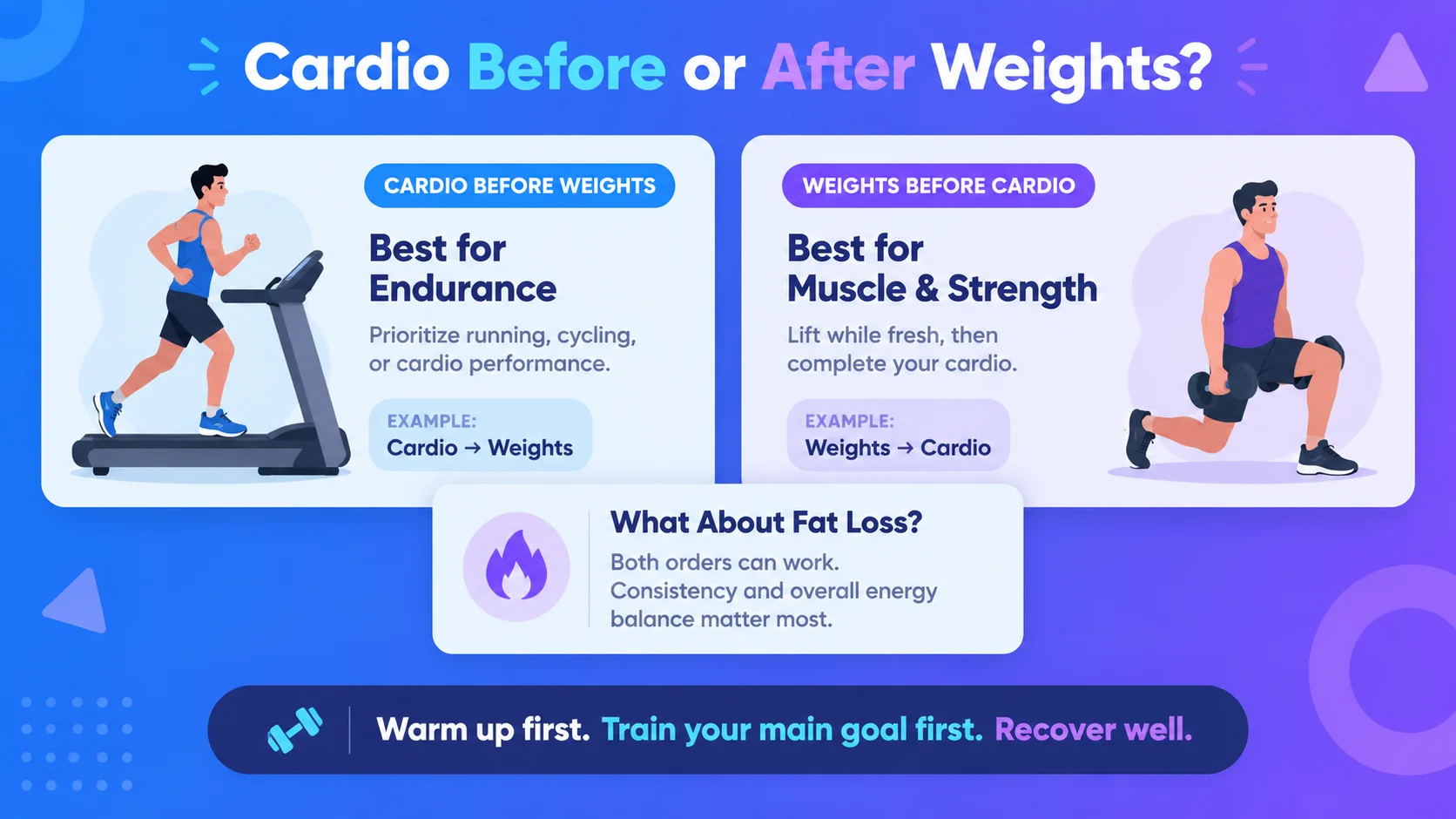
Cardio before or after weights is a common fitness question, especially if you want to build muscle, lose fat, or improve endurance. The best order depends on which result matters most to you.
Generally, lift weights before cardio if your main goal is building muscle or strength. On the other hand, perform cardio first if you want to improve your running, cycling, or other endurance performance. If your goal is general fitness, either order can work well.
However, you do not need to choose one type of exercise forever. A short warm-up before lifting, followed by your planned strength workout and cardio session, can be a practical routine. In addition, separating demanding cardio and weight training into different sessions may help you perform both at a higher level.
This guide explains the benefits of each order, how cardio affects muscle growth, and how to structure your workout for better results.
Should You Do Cardio Before or After Weights?
| Your Main Goal | Recommended Order | Why |
|---|---|---|
| Build muscle | Weights first | Helps preserve energy for lifting |
| Increase strength | Weights first | Supports better performance during demanding lifts |
| Improve endurance | Cardio first | Gives your main cardio workout priority |
| Lose body fat | Either order | Consistency and overall energy balance matter more |
| Improve general fitness | Either order | Both types of exercise provide benefits |
| Warm up before lifting | Light cardio first | Gradually prepares your body for exercise |
The simple rule: Do the exercise that matters most to your goal first, after a suitable warm-up.
1. Should You Do Cardio Before or After Weights?
For most people focused on muscle growth, strength, or maintaining muscle while losing fat, weights before cardio is a good starting point.
Strength training requires coordination, effort, and enough energy to perform each set with good technique. Therefore, starting with a demanding run or cycling session may leave your legs tired before squats, lunges, or deadlifts.
However, the opposite approach makes sense for endurance athletes. If your main goal is to improve your running pace or cycling performance, cardio should come first because you want to train those skills while relatively fresh.
For general health, the order matters less than completing both types of exercise consistently. You can also alternate the order across different training days when you have several goals.
When to do weights first
Choose weights first if you want to:
- Build muscle and improve muscle definition.
- Increase strength on major lifts.
- Maintain muscle while losing body fat.
- Improve your performance in resistance training.
- Focus on lifting with good technique.
When to do cardio first
Choose cardio first if you want to:
- Improve your running endurance.
- Prepare for a race or cycling event.
- Increase your aerobic performance.
- Complete an important cardio workout at a specific intensity.
- Develop endurance as your primary training goal.
Ultimately, the right order is the one that supports your most important training outcome.
2. Is Cardio Before Weights Bad for Muscle Growth?
No. Cardio before weights is not automatically bad for muscle growth. The main concern is whether the cardio session creates enough fatigue to reduce the quality of your lifting workout.
For example, an easy five-minute walk before lifting usually will not cause a major problem. In contrast, a long run or intense interval session may leave your legs tired before a demanding lower-body workout.
As a result, you might lift less weight, complete fewer repetitions, or struggle to maintain your usual technique. If this happens regularly, it may make it harder to achieve your strength and muscle-building goals.
However, moderate cardio can fit into a muscle-building program. You do not need to avoid running, cycling, or other aerobic exercise simply because you lift weights.
Instead, consider the duration and intensity of your cardio. Keep your warm-up easy, perform your resistance training while fresh, and complete more demanding cardio afterward or in a separate session.
3. Is Cardio After Weights Better for Fat Loss?
Cardio after weights can be a useful choice for people who want to lose body fat while preserving muscle. Nevertheless, the order itself does not guarantee greater fat loss.
Fat loss mainly depends on maintaining an appropriate calorie deficit over time, alongside regular physical activity, adequate nutrition, and recovery.
For example, lifting weights first allows you to focus on your strength workout. You can then walk, cycle, or use an elliptical machine to increase your overall activity.
On the other hand, doing cardio first can work just as well if it helps you complete your planned workout more consistently.
Here are the main factors to consider:
- Total activity: Both cardio and strength training contribute to your overall fitness routine.
- Nutrition: Your eating habits affect whether you maintain a calorie deficit.
- Muscle preservation: Resistance training helps maintain muscle during weight loss.
- Consistency: A sustainable routine is more useful than a perfect routine you rarely follow.
- Recovery: Adequate sleep and rest help you keep training regularly.
Therefore, do not rely on exercise order as a shortcut to fat loss. Choose the sequence that lets you train effectively and stay consistent.
4. Should You Do Cardio Before or After Weights to Build Muscle?
If muscle growth is your priority, start with resistance training after a brief warm-up.
Muscle growth depends on several factors, including progressive training, sufficient protein, appropriate calorie intake, and recovery. Workout order can help you get more from your lifting sessions, but it is only one part of the process.
For instance, imagine that you plan to train your legs with squats, leg presses, and lunges. A hard 30-minute run beforehand may fatigue the same muscles you need for those exercises.
Instead, begin with a few minutes of easy movement. Then complete your planned lifting session, followed by moderate cardio if you still have time and energy.
In addition, avoid increasing cardio volume so much that it consistently interferes with your strength training or recovery.
How much cardio can you do while building muscle?
There is no single amount that works for everyone. Your training experience, calorie intake, cardio intensity, and recovery all affect how much you can comfortably manage.
A practical starting point is to include a few manageable cardio sessions each week. Adjust the duration based on your lifting performance and how well you recover.
If your strength stops progressing and you constantly feel exhausted, consider reducing the intensity or separating demanding cardio from your hardest lifting sessions.
5. How Long Should You Do Cardio After Weights?
The ideal cardio duration depends on your fitness level, available time, and goals. You do not need to spend an hour on a treadmill after every lifting session.
Use the following ranges as practical starting points rather than strict rules.
| Goal | Example Cardio Session |
|---|---|
| General fitness | 10–20 minutes at a comfortable pace |
| Additional daily activity | 15–30 minutes of walking |
| Cardiovascular endurance | 20–40 minutes, adjusted to your training plan |
| Short workout | 5–10 minutes of easy cardio |
| Race preparation | Follow a structured endurance plan |
For example, you might complete a 45-minute strength workout followed by 15 minutes of brisk walking. This approach allows you to train your muscles first while still adding aerobic activity.
However, longer sessions may be appropriate when endurance is your main goal. In that case, plan your lifting around the cardio work rather than forcing both sessions into an exhausting routine.
Remember that weekly activity matters more than hitting an exact number of minutes after every workout.
6. Can You Build Muscle and Do Cardio on the Same Day?
Yes. You can combine strength training and cardio on the same day, and many people do so successfully.
This approach is often called concurrent training. It allows you to work on muscle strength and cardiovascular fitness without needing to visit the gym twice every day.
However, the best setup depends on the intensity of each session. A short walk after lifting is usually easier to recover from than a demanding interval workout or a long run.
Try one of these arrangements:
Option 1: Weights followed by cardio
This works well when muscle growth or strength is your priority.
- Start with an easy warm-up.
- Complete your strength workout.
- Finish with 10–20 minutes of suitable cardio.
Option 2: Cardio followed by weights
Choose this arrangement when endurance performance is your main focus.
- Warm up for your cardio session.
- Complete your planned running, cycling, or other endurance workout.
- Lift weights afterward if you can maintain good technique and effort.
Option 3: Separate the sessions
If your schedule allows, perform cardio in the morning and weights later in the day. Alternatively, place them on different days.
This arrangement can reduce immediate fatigue between sessions, especially when both workouts are demanding. Even so, your overall training load and recovery still matter.
7. What Is the Best Cardio to Do After Weights?
The best cardio depends on your preferences, fitness level, and training goals. You do not need a particular machine to get useful results.
Walking on a treadmill
Walking is a practical option after lifting because you can adjust the speed and incline. It also offers a relatively easy way to increase your daily activity.
For example, try 10–20 minutes at a pace that allows you to breathe comfortably.
Cycling
Stationary cycling provides aerobic exercise with relatively low impact on your joints. However, intense cycling can fatigue your legs, so keep the resistance and pace manageable after a hard leg workout.
Elliptical training
An elliptical machine provides continuous movement without the repeated impact of running. Therefore, it can be a convenient choice for a moderate cardio session.
Running
Running can improve cardiovascular fitness and endurance. Nevertheless, hard running may add significant fatigue after heavy lower-body training.
If you enjoy running, adjust its intensity and timing to match your recovery needs.
Rowing
Rowing engages several major muscle groups while raising your heart rate. Because it also demands muscular effort, consider using a moderate pace after a demanding strength workout.
The best option is one you enjoy, can perform safely, and can recover from consistently.
8. Should You Do a Warm-Up Before Lifting Weights?
Yes. Even if you plan to do cardio after weights, a brief warm-up before lifting can help prepare you for the session.
A warm-up should gradually increase your activity level without making you tired. For most workouts, a few minutes of easy walking, cycling, or similar movement can be enough to get started.
After that, perform warm-up sets for your first major lift. For example, if you plan to squat, begin with a lighter load before moving toward your working weight.
A useful warm-up might look like this:
- Walk or cycle easily for 3–5 minutes.
- Perform movements that prepare you for your planned exercises.
- Complete one or more lighter sets of your first major lift.
- Begin your working sets when you feel ready.
Avoid turning the warm-up into a hard cardio workout. The goal is to prepare your body, not exhaust yourself before the main session.
9. Common Mistakes When Combining Cardio and Weights
Combining the two types of exercise can be effective. However, a few common mistakes may make your routine harder to sustain.
Doing intense cardio before heavy lifting
A demanding cardio session can fatigue your muscles before strength training. If muscle growth is your priority, move the intense cardio to afterward or another session.
Believing cardio is necessary after every lifting workout
You do not need to finish every weight session with cardio. Instead, plan your aerobic activity across the week in a way that fits your goals and schedule.
Using exercise order as the only fat-loss strategy
Workout order matters less for fat loss than your overall activity, nutrition, and consistency. Therefore, focus on a balanced routine rather than trying to find a perfect sequence.
Doing too much too soon
Increasing lifting volume and cardio intensity at the same time can make recovery difficult. Start with a manageable workload, then increase it gradually.
Ignoring recovery
Rest, sleep, and adequate nutrition all support progress. If your performance keeps dropping or fatigue persists, review your training load and recovery habits.
10. How to Structure Your Weekly Cardio and Weight Training
A balanced schedule can include both types of exercise without making every workout overly long.
Here is an example for someone who wants to improve general fitness and build strength.
| Day | Workout |
|---|---|
| Monday | Full-body weights, followed by easy cardio |
| Tuesday | Moderate cardio or brisk walking |
| Wednesday | Full-body weights |
| Thursday | Easy cardio or active recovery |
| Friday | Full-body weights, followed by optional cardio |
| Saturday | Longer walk, cycling, or another enjoyable activity |
| Sunday | Rest or gentle movement |
This is only an example. Your ideal schedule depends on your experience, available time, and recovery needs.
For general adult health, widely used physical activity guidelines recommend at least 150 minutes of moderate-intensity aerobic activity per week, or 75 minutes of vigorous activity, alongside muscle-strengthening activity on at least two days each week.
You can spread your aerobic exercise across several days rather than completing it all after lifting. In addition, shorter sessions can contribute to your weekly total.
If you are new to exercise, start with a comfortable amount and build up gradually.
Frequently Asked Questions
Should I do cardio before or after weights to lose belly fat?
Either order can work. Belly fat cannot be selectively reduced through a specific exercise sequence. Instead, focus on overall fat loss through sustainable nutrition, regular activity, resistance training, and sufficient recovery.
Does cardio after weights burn more fat?
Doing cardio after weights does not guarantee greater body-fat loss. Although exercise uses energy, long-term results depend on your overall energy balance, activity levels, diet, and consistency.
Will cardio before weights reduce muscle growth?
It can affect your lifting performance if the cardio session causes significant fatigue. However, light cardio before lifting is generally useful as a warm-up. If muscle growth is your priority, perform demanding cardio afterward or separately.
How many minutes of cardio should I do after lifting weights?
A 10–20-minute session can be a practical starting point for general fitness. However, your ideal duration depends on your goals, training intensity, experience, and recovery. You can also complete cardio on separate days.
Is it okay to lift weights and run on the same day?
Yes. Many people combine running and weight training successfully. If strength is your priority, lift first. If running performance matters more, run first or schedule the sessions separately when possible.
Should beginners do cardio before or after weights?
Beginners can start with a brief, easy warm-up before lifting, followed by optional cardio. However, if endurance is the main goal, cardio can come first. Choose a manageable routine that allows you to learn good technique.
Can I do cardio every day and still build muscle?
It is possible, provided your total training load allows adequate recovery and nutrition. Nevertheless, frequent intense cardio can interfere with lifting performance. Adjust the duration and intensity if your strength or recovery starts to suffer.
Is walking after weights a good idea?
Yes. Walking is a convenient, low-intensity way to add activity after strength training. It can support cardiovascular health and help you reach your activity goals without requiring another demanding workout.
Conclusion
Choosing cardio before or after weights becomes easier when you identify your main goal. If you want to build muscle or increase strength, lift weights first and add cardio afterward. Conversely, if running, cycling, or endurance performance matters most, prioritize cardio. For fat loss and general fitness, either order can work well because consistency, nutrition, and total activity matter more than the sequence alone. Start with a short warm-up, choose exercises you enjoy, and allow enough time for recovery. Ultimately, the best workout order is one that helps you train effectively, stay consistent, and make steady progress toward your fitness goals.

Andrew Morris is a writer at Meaninga.com who specializes in word meanings, slang, idioms and modern language trends. He creates clear, accurate and easy to understand content for everyday readers.