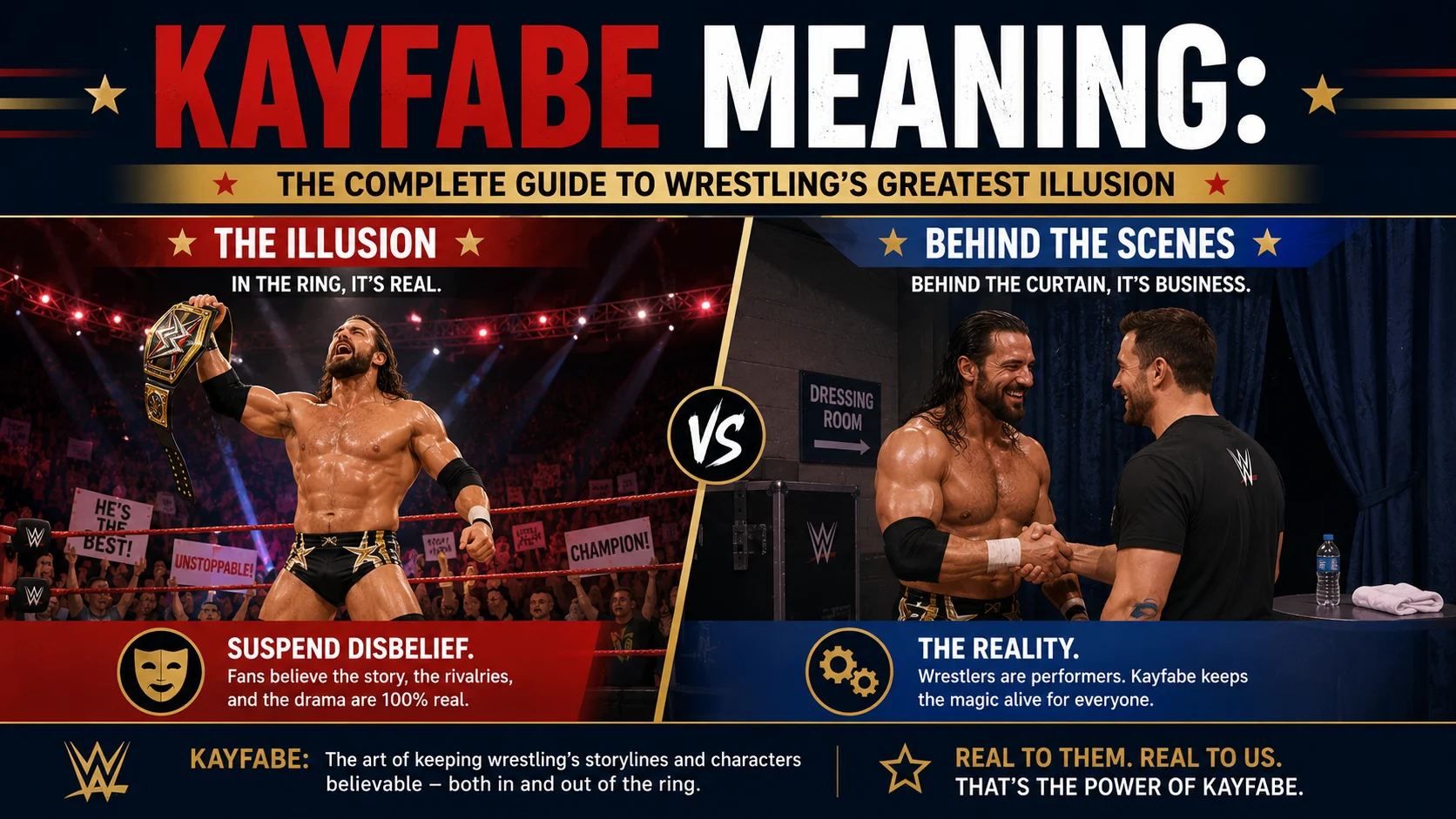
Kayfabe is the unwritten code and practice of maintaining the illusion that professional wrestling is real and unscripted . In professional wrestling, it refers to the portrayal of staged events, characters, and rivalries as if they were genuine . The term can also be used more broadly to describe any situation where people maintain a charade or pretend something is authentic when it is not .
Have you ever watched a wrestling match and wondered if the rivalries were real or just for show? The answer lies in a fascinating concept called kayfabe. This unique term captures the essence of the wrestling world’s most important unwritten rule: treating staged events as if they are completely authentic.
Understanding the kayfabe meaning is essential for anyone interested in professional wrestling, modern entertainment, or even the art of storytelling itself. The concept goes far beyond the ring, influencing how performers interact with fans, how storylines are developed, and how the entire industry operates behind the scenes.
The challenge with kayfabe is that it is a complex concept wrapped in carny slang. Its origins are mysterious, its rules are unwritten, and its application has evolved significantly over the decades. The term can be confusing even to long-time wrestling fans who may not fully understand its nuances.
This article clears up the confusion around kayfabe once and for all. You will learn its definition, origins, how it works in practice, and how the concept has evolved in the modern era. By the end, you will be an expert on the wrestling industry’s most important principle.
The main takeaway is that kayfabe is the wrestling industry’s term for maintaining the illusion that everything is real. It involves wrestlers staying in character, promoters protecting storylines, and fans willingly suspending their disbelief. The phrase “break kayfabe” means to reveal the truth or step out of character . While traditional kayfabe has faded in the internet age, the concept lives on through the suspension of disbelief that makes wrestling entertaining.
Definitions and Explanations
What Does “Kayfabe” Mean?
The kayfabe meaning is rooted in the wrestling industry’s need to protect its secrets. The Merriam-Webster Dictionary defines kayfabe as: “The tacit agreement between professional wrestlers and their fans to pretend that overtly staged wrestling events, stories, characters, etc., are genuine” .
In practice, kayfabe means several things:
- Maintaining the illusion: Presenting scripted events as real
- Staying in character: Wrestlers behaving according to their personas even outside the ring
- Protecting storylines: Not revealing that matches are predetermined
- The suspension of disbelief: The audience agreeing to treat wrestling as real
The term can also be used as a verb, as in “keep kayfabe” (maintain the illusion) or “break kayfabe” (reveal the truth) .
The Etymology of Kayfabe
The exact origin of kayfabe is unknown, and its etymology is considered obscure . However, there are several theories:
Carny Slang Theory: The term is widely believed to have originated in carnival jargon. Professional wrestling has roots in traveling carnivals and circuses, which had their own secret language to communicate without “rubes” (non-carnival people) understanding .
“Be Fake” Theory: One popular theory suggests kayfabe comes from the Pig Latin form of the phrase “be fake” or just “fake.” Some have also suggested it comes from the phrase “keep quiet” or “keep secret” . When spoken quickly, these phrases could sound like “kayfabe.”
| Theory | Origin | Explanation |
| Carnival Slang | Traveling circuses and carnivals | Secret language used by performers to communicate without outsiders understanding |
| Pig Latin | Slang transformation | “Be fake” becomes “akefay” or “kayfabe” |
| “Keep Quiet” | Carnival shorthand | “Keep” transformed through carny speech to become “kayfabe” |
The Core Principles of Kayfabe
For decades, kayfabe was the lifeblood of professional wrestling. The industry went to extraordinary lengths to maintain the illusion:
Wrestlers Stayed in Character: Heels and faces (villains and heroes) would avoid being seen together in public. They would maintain their personas even when injured or in social situations .
Injuries Were Faked or Real: Injuries were often used to explain a wrestler’s absence from storylines. Sometimes, real injuries would be “worked” into the story to maintain kayfabe .
Backstage Secrets Were Protected: The inner workings of the wrestling business, including predetermined outcomes and training, were kept secret from the public .
Romantic Relationships Were Staged: Many on-screen romantic relationships were purely for storylines. Conversely, some real-life relationships were hidden to maintain kayfabe .
Key Terms Related to Kayfabe
| Term | Meaning |
| Face | The “good guy” wrestler who fans cheer for |
| Heel | The “bad guy” wrestler who is booed |
| Shoot | A real, unscripted event |
| Work | A scripted, planned event |
| Worked Shoot | A scripted event that appears unscripted |
| Heat | Negative energy or boos directed at a heel |
| Over | Popular with the audience |
Advantages and Disadvantages
Advantages of Kayfabe
Enhanced Entertainment Value: Kayfabe made wrestling more engaging. When fans believed the action was real, the stakes felt higher, the rivalries more intense, and the outcomes more dramatic.
Protecting the Industry: By maintaining secrecy, wrestling promoters protected their business. Knowledge that outcomes were predetermined could have killed the industry’s appeal .
The Suspension of Disbelief: Kayfabe allowed audiences to willingly suspend their disbelief and enjoy the spectacle for what it was meant to be: entertainment .
Creating Memorable Characters: Kayfabe allowed wrestlers to create larger-than-life personas that became cultural icons. The Undertaker, Hulk Hogan, and Stone Cold Steve Austin all benefited from the kayfabe era.
Disadvantages and Challenges
Difficulty Maintaining the Illusion: With the rise of the internet, social media, and increased media scrutiny, maintaining kayfabe became nearly impossible.
Hypocrisy and Deception: Some argue that kayfabe involves deceiving the audience. While this is part of the entertainment, it can feel manipulative.
Pressure on Wrestlers: Maintaining a character 24/7 can be mentally and emotionally exhausting. The pressure to protect kayfabe has led to personal struggles for some wrestlers.
Historical Secrets: Some wrestling legends took secrets to their graves, meaning the full history of the industry may never be known.
Real-World Examples
Classic Kayfabe Examples
Example 1: Kayfabe Families
Wrestlers who may not look alike are often presented as family members. Examples include Edge and Christian, The Dudley Family, and various wrestlers presented as “brothers” .
Example 2: Kayfabe Injuries
Injuries are often used to explain a wrestler’s absence. For instance, Shawn Michaels was written out of storylines with a “crushed larynx” after being attacked by Kane, allowing him to take paternity leave .
Example 3: Kayfabe Romances
Many on-screen romantic relationships are purely storyline. However, some have developed into real-life relationships, such as Triple H and Stephanie McMahon, who got married after their kayfabe relationship ended .
Breaking Kayfabe
Breaking kayfabe refers to revealing the truth behind the illusion. A wrestler who breaks kayfabe might:
- Refer to a fellow wrestler by their real name instead of their ring name
- Acknowledge that matches are scripted
- Step out of character during an interview or appearance
- Reveal backstage information or secrets
One of the most famous examples of breaking kayfabe was when WWE owner Vince McMahon admitted during the 1990s that professional wrestling was like a soap opera or sitcom .
Kayfabe in Modern Wrestling
In modern professional wrestling, kayfabe has evolved significantly. Wrestlers are much more likely to break kayfabe, especially on social media. However, the concept still exists in a different form:
- Social media presence: Many wrestlers blend kayfabe and reality in their online personas
- Storyline consistency: While fans know the outcome is predetermined, they still expect consistent storytelling
- Shoot interviews: Wrestlers sometimes discuss behind-the-scenes elements while still maintaining some aspects of kayfabe
Kayfabe in Politics and Entertainment
The concept of kayfabe has been applied outside of wrestling:
Politics: Former wrestler Jesse Ventura, while Governor of Minnesota, noted that politicians “pretend to hate each other in public, then go out to dinner together” . Some have argued that political theatrics follow similar principles to kayfabe .
Entertainment: Comedians like Jack Benny and Fred Allen had a fake public feud while being close friends in real life. More recently, the rivalry between Jimmy Kimmel and Matt Damon is an example of kayfabe .
VTubing: Some have described VTubing (virtual YouTubing) as “digital kayfabe,” where creators maintain character personas similar to wrestling .
Regional and Global Usage
Global English
Kayfabe is a wrestling term used across English-speaking regions. Its meaning is consistent and widely understood within wrestling fandom. There is no significant regional variation in its definition or usage.
Formal Recognition
In 2023, Merriam-Webster Dictionary officially added “kayfabe” to its pages, giving it a formal definition and recognizing its cultural significance . The dictionary notes: “It’s still real to us” in response to criticism about defining the term .
Common Mistakes
Mistake 1: Using Kayfabe and “Work” Interchangeably
While both terms relate to scripted events, they are not identical. A “work” is a specific scripted event. Kayfabe is the broader culture of maintaining the illusion that the work is real.
Correction: Use “work” for scripted events or matches. Use “kayfabe” for the overall practice of maintaining the illusion.
Mistake 2: Thinking Kayfabe No Longer Exists
While traditional kayfabe has faded, it still exists in a different form. Wrestlers still stay in character for interviews and public appearances. The suspension of disbelief remains important to wrestling fans.
Correction: Modern kayfabe is less strict but still present. Wrestlers maintain certain aspects of their personas even if the “everything is real” illusion is gone.
Mistake 3: Confusing Kayfabe with “Breaking Character”
Breaking character is a specific action. Kayfabe is the broader system. Breaking kayfabe means revealing a secret or acting in a way that contradicts the illusion.
Correction: “Breaking kayfabe” can include breaking character, but it also includes revealing behind-the-scenes information or stepping out of the wrestling universe entirely.
Exercises
Exercise 1: Identify the Meaning
Determine whether each scenario involves maintaining or breaking kayfabe.
- A wrestler refers to another wrestler by their real name on live TV.
- A heel wrestler and a face wrestler are seen having dinner together in public.
- A wrestler posts on social media about being injured, in character.
- A wrestling documentary reveals the inner workings of the business.
Exercise 2: Fill in the Blank
Complete each sentence with the correct term.
- A ________ wrestler is the “good guy” who fans cheer for.
- A ________ is a scripted event or match.
- ________ is the practice of maintaining the illusion that wrestling is real.
- A ________ wrestler is the “bad guy” who fans boo.
Answer Key
Exercise 1 Answers:
- Breaking kayfabe (using a real name contradicts the character)
- Breaking kayfabe (heels and faces should not fraternize in kayfabe)
- Maintaining kayfabe (staying in character)
- Breaking kayfabe (revealing backstage secrets)
Exercise 2 Answers:
- Face (the good guy)
- Work (scripted event)
- Kayfabe (the illusion)
- Heel (the bad guy)
Related Concepts and Comparisons
Kayfabe vs. Work
| Term | Meaning | Usage |
| Kayfabe | The culture of maintaining the illusion | Broad, industry-wide |
| Work | A scripted event or action | Specific, event-level |
Shoot vs. Kayfabe
| Term | Meaning | Usage |
| Kayfabe | The illusion of reality | The normal state of wrestling |
| Shoot | A real, unscripted event | Rare, often controversial |
Suspension of Disbelief Vs. Kayfabe
| Term | Meaning | Usage |
| Kayfabe | The industry’s practice of maintaining the illusion | Wrestling-specific |
| Suspension of Disbelief | The audience’s willingness to accept the illusion | Broader entertainment concept |
Kayfabe in Politics vs. Wrestling
Kayfabe is sometimes used in politics to describe staged conflicts or manufactured dramas. However, the term remains primarily associated with professional wrestling.
FAQs
What does kayfabe mean in wrestling?
Kayfabe is the unwritten rule and commitment to the illusion that professional wrestling is real and unscripted. It involves wrestlers staying in character, maintaining storylines, and protecting the inner workings of the industry .
What does “break kayfabe” mean?
Breaking kayfabe means revealing the truth behind the illusion or stepping out of character. This can involve referring to a wrestler by their real name, acknowledging that matches are scripted, or revealing backstage information .
What is the origin of kayfabe?
The exact origin of kayfabe is unknown. It is believed to have originated in carnival jargon as a secret language. Some theories suggest it comes from the Pig Latin form of “be fake” or the phrase “keep quiet” .
What is a heel in wrestling?
A heel is a “bad guy” wrestler who is booed by the audience. Heels receive “heat” (negative energy) when they enter the ring and play the villain role in storylines .
What is a face in wrestling?
A face is a “good guy” wrestler who is cheered by the audience. Faces hold the moral high ground in wrestling and are usually the protagonists of storylines .
What is a shoot in wrestling?
A shoot is a real, unscripted event in professional wrestling. It is the opposite of a “work.” A shoot rarely happens and can be controversial when it does .
What is a worked shoot?
A worked shoot is a scripted segment that appears to be unscripted. It blends reality and fiction, often involving industry insider knowledge or breaking kayfabe .
Is kayfabe still used today?
Modern kayfabe has evolved. While traditional kayfabe has faded with the rise of the internet and social media, wrestlers still maintain elements of their personas. The suspension of disbelief remains important to wrestling fans .
What does “over” mean in wrestling?
Being “over” means the wrestler is popular with the audience. An “over” wrestler is well-liked and can generate a strong reaction from the crowd .
Can kayfabe apply outside of wrestling?
Yes, kayfabe can apply to any situation where people maintain a charade or pretend something is authentic when it is not. Examples include fake public feuds between celebrities and political theatrics .
Conclusion
This guide has explored the fascinating concept of kayfabe and its meaning in professional wrestling and beyond. Kayfabe is the unwritten rule and commitment to the illusion that staged events are real. It involves wrestlers staying in character, protecting storylines, and audiences willingly suspending their disbelief. The term can also apply to any situation where people maintain a charade or pretend something is authentic when it is not.
The best practical advice for understanding kayfabe is to recognize it as the industry’s most important principle: the protection of the illusion. Whether you are a wrestling fan looking to understand the business better or someone curious about the term’s broader applications, knowing kayfabe gives you insight into the art of professional wrestling and the nature of performance itself.
Good communication depends on understanding these nuanced concepts. Now you have the knowledge to interpret and use the term kayfabe correctly in any context.










1 thought on “Kayfabe Meaning| The Complete Guide to Wrestling’s Greatest Illusion”