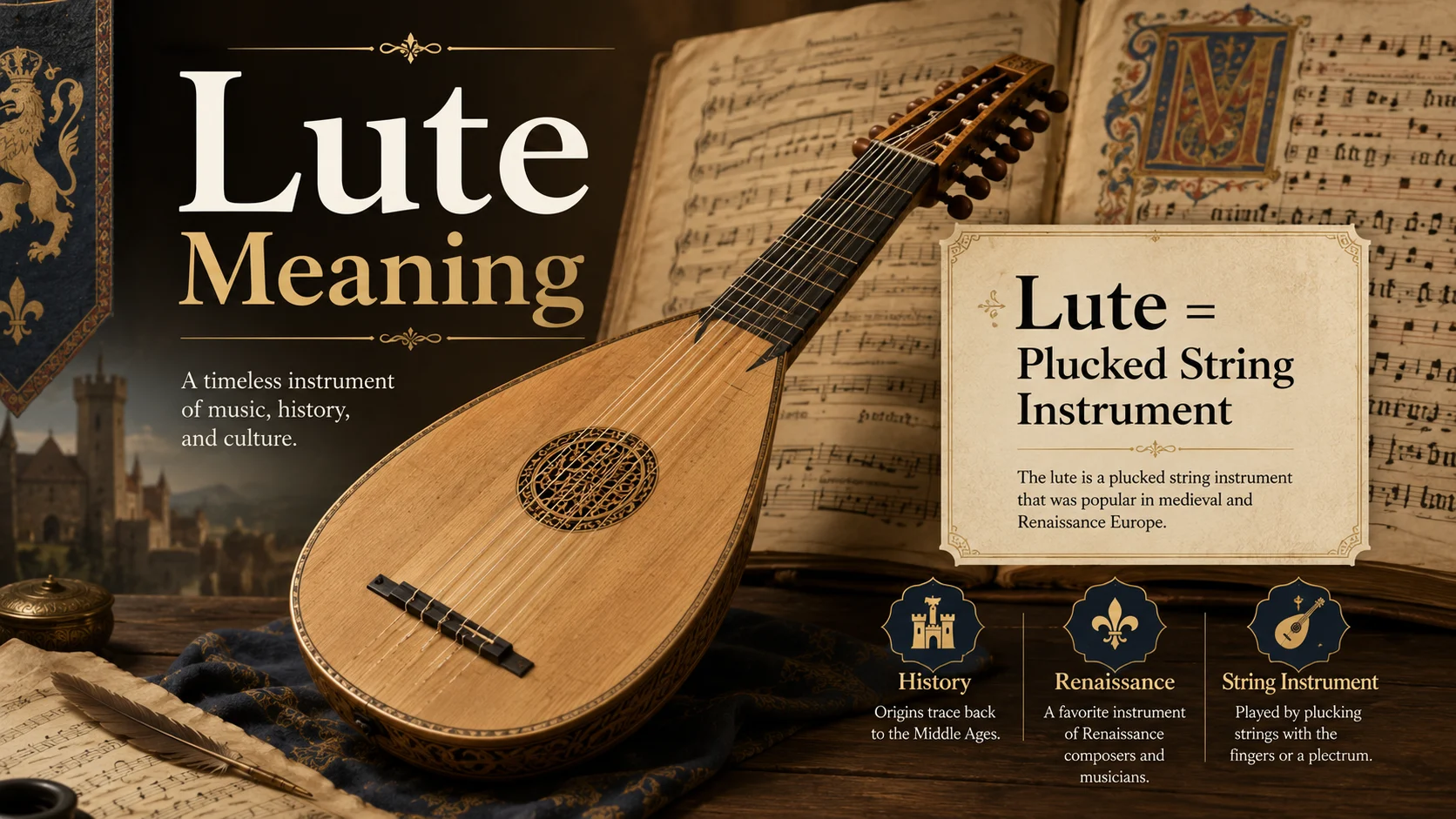
A lute is a plucked string instrument with a rounded body, neck, strings, and frets. Related instruments appeared across the Middle East, Asia, and Europe. The European lute became especially important during medieval and Renaissance music.
Lute meaning refers to a family of plucked string instruments with a distinctive rounded body, neck, and strings. The instrument has existed in various forms across several cultures and historical periods.
When people hear the word lute, they often picture the European instrument associated with medieval and Renaissance music. However, the broader lute family has a much longer and more geographically diverse history.
Furthermore, the lute influenced the development of several other string instruments. Related instruments include the oud, theorbo, archlute, and other long-necked or short-necked lutes.
Today, musicians continue to play historical lutes in early-music performances. Modern composers and performers also use lute-like instruments in new musical settings.
Quick Answer
| Question | Answer |
|---|---|
| What is a lute? | A plucked stringed musical instrument |
| What does it look like? | It usually has a rounded or pear-shaped body and a neck |
| How is it played? | Players pluck its strings with their fingers or a plectrum |
| Where did it originate? | Related lute-type instruments developed across ancient and medieval Eurasia |
| When was it popular in Europe? | Especially during the medieval and Renaissance periods |
| What does it sound like? | Warm, soft, resonant, and intimate |
| Is it a guitar? | No, although both belong to related families of string instruments |
| Is the lute still played? | Yes, especially in early music and historical performance |
What Does Lute Meaning Refer To?
The basic lute meaning is a stringed instrument that has a resonating body, a neck, and strings that the performer plucks.
The exact design varies considerably between cultures and historical periods.
A European Renaissance lute typically features:
- a rounded bowl-shaped back
- a flat soundboard
- a relatively short neck
- frets
- multiple strings
- tuning pegs
- a bridge
- a decorative sound hole or rosette
The body acts as a resonating chamber. Therefore, plucking a string creates vibrations that the body amplifies.
How Is a Lute Played?
Players traditionally pluck lute strings with their fingers.
Depending on the instrument and musical tradition, performers may use different techniques. They can play individual notes, chords, melodies, and accompanying harmonies.
Historical European lute players often developed sophisticated fingerstyle techniques. Consequently, composers wrote highly detailed solo and ensemble music for the instrument.
What Does a Lute Sound Like?
A lute generally produces a gentle and resonant sound.
Its tone can vary according to:
- instrument size
- string material
- tuning
- construction
- playing technique
- historical period
- room acoustics
Gut strings, commonly used on historical instruments, produce a particularly soft and nuanced tone.
However, modern replicas may use different materials depending on the performer and musical requirements.
The History and Origin of the Lute
The history behind the lute is extensive.
Related lute-type instruments appeared in different parts of the ancient world. Over centuries, musicians modified their shapes, tunings, strings, and playing methods.
Early Lute-Type Instruments
Ancient civilizations used instruments that shared important features with later lutes.
Archaeological and artistic evidence shows long-necked and short-necked string instruments in regions including:
- Mesopotamia
- Egypt
- Central Asia
- Persia
- South Asia
- China
- the Mediterranean
However, these instruments should not all be treated as identical versions of the European lute.
Instead, they represent different branches within the broader history of lute-type instruments.
The Oud Connection
One of the most important related instruments is the oud.
The oud developed within Middle Eastern musical traditions and has a rounded body, short neck, and strings. It became highly influential in Arabic, Persian, Turkish, and other musical traditions.
Historical interactions between Islamic and European cultures helped shape the development of European plucked-string instruments.
Consequently, the European lute shares important historical relationships with instruments from the Islamic world.
The Lute During the Middle Ages
The lute became increasingly important in medieval Europe.
Musicians used it for both accompaniment and melodic performance.
Medieval lutes differed from later Renaissance examples. Their construction, number of strings, tuning, and proportions changed over time.
Furthermore, medieval music involved many different regional traditions. Therefore, there was no single universal medieval lute design.
Medieval Musical Uses
Players could use the instrument to accompany:
- songs
- dances
- courtly performances
- religious or secular music
- poetry
- instrumental ensembles
The lute’s portability also made it practical for individual performers.
The Renaissance Lute
The Renaissance represented one of the lute’s most important periods in European history.
From roughly the 15th through 16th centuries, the instrument became central to sophisticated European musical culture.
Composers wrote extensive solo music for it.
Lute Music and the Renaissance
Renaissance composers explored the lute’s ability to perform multiple musical lines simultaneously.
This approach allowed performers to create intricate arrangements of:
- vocal melodies
- dances
- sacred compositions
- secular songs
- contrapuntal music
- instrumental pieces
The lute became particularly associated with educated courtly and domestic music-making.
Famous Renaissance Lute Composers
Several important composers wrote for the instrument.
Notable names include:
- John Dowland
- Francesco da Milano
- Adrian Le Roy
- Albert de Rippe
- Hans Newsidler
- Vincenzo Galilei
John Dowland became particularly famous for expressive lute songs and instrumental compositions.
His music remains widely performed today.
The Baroque Lute and Its Evolution
The lute did not disappear after the Renaissance.
Instead, musicians developed larger and more specialized versions.
Two important examples include the theorbo and archlute.
The Theorbo
The theorbo is a large lute-type instrument with an extended neck and additional bass strings.
Its design allowed performers to produce deeper bass notes.
As a result, theorbo players became important in Baroque continuo ensembles.
The Archlute
The archlute also features an extended neck and additional bass strings.
It could perform both harmonic accompaniment and more elaborate solo music.
Therefore, the instrument adapted to changing musical styles rather than simply becoming obsolete.
Why Did the Lute Decline in Popularity?
The lute gradually lost its dominant position as other instruments became more practical for changing musical styles.
The guitar became increasingly influential.
Furthermore, keyboard instruments and other string instruments offered different tonal possibilities.
Musical tastes also changed.
Large concert halls favored instruments capable of producing greater volume. Traditional gut-strung lutes were often better suited to intimate settings.
Consequently, the lute became less central to mainstream European music during later periods.
Nevertheless, it never completely disappeared.
Types of Lutes
There is no single type of lute.
The word covers a broad family of instruments.
| Type | Main Characteristics | Historical Association |
|---|---|---|
| European lute | Rounded body, short neck, frets | Medieval and Renaissance Europe |
| Renaissance lute | Multiple string courses and rounded body | Renaissance Europe |
| Baroque lute | More strings and complex tuning | Baroque Europe |
| Theorbo | Long extended neck and deep bass strings | Baroque period |
| Archlute | Extended neck with additional bass strings | Renaissance and Baroque traditions |
| Oud | Fretless, rounded body and short neck | Middle Eastern traditions |
| Chinese pipa | Pear-shaped body with frets | Chinese musical tradition |
| Japanese biwa | Short-necked lute family instrument | Japanese tradition |
These instruments share broad structural relationships, but their music and playing techniques can differ substantially.
The Parts of a Lute
Understanding the instrument’s anatomy makes its design easier to appreciate.
Soundboard
The soundboard is the flat wooden surface on the front of the instrument.
It vibrates when the strings are played.
Bowl
The bowl-shaped back creates the resonating chamber.
European lutes often have backs constructed from multiple curved wooden ribs.
Neck
The neck extends from the body and supports the fingerboard.
Players press strings against the frets or fingerboard to change their pitch.
Frets
Many European lutes use frets.
These help performers locate specific notes.
Historical lute frets were often made from tied gut rather than permanently installed metal frets like those found on many modern guitars.
Strings
A lute can have several strings arranged as individual strings or courses.
A course consists of one or more strings treated as a musical unit.
Pegbox and Tuning Pegs
The tuning mechanism allows musicians to adjust string pitch.
Different historical periods used different tuning systems.
Bridge
The bridge transfers string vibrations to the soundboard.
Its design contributes to the instrument’s response and tone.
Lute vs. Guitar
People often compare the lute with the guitar.
The instruments share some characteristics, but they are not the same.
| Feature | Lute | Guitar |
|---|---|---|
| Body | Usually rounded-backed | Usually flat-backed |
| Neck | Often relatively short | Generally longer |
| Strings | Often arranged in courses | Usually individual strings |
| Historical peak | Medieval, Renaissance, Baroque | Especially later historical periods |
| Sound | Soft and intimate | Wider tonal range and projection |
| Common playing style | Finger plucking | Fingerstyle or pick |
| Modern popularity | Specialized | Extremely widespread |
The comparison becomes more complicated because guitar design itself developed from several earlier stringed instruments.
Therefore, the lute should not simply be described as an old guitar.
Lute vs. Oud
The lute and oud have a close historical relationship, but they remain distinct instruments.
| Feature | Lute | Oud |
|---|---|---|
| Frets | European lutes commonly have frets | Oud is traditionally fretless |
| Body | Rounded bowl | Rounded bowl |
| Neck | Short relative to body | Short neck |
| Strings | Often arranged in courses | Commonly arranged in courses |
| Musical traditions | European early music | Middle Eastern and related traditions |
| Playing | Usually fingers | Often played with a plectrum called a risha |
The similarities are significant.
However, their tuning systems, repertoire, construction, and performance traditions differ.
Lute Meaning in Literature and Culture
The lute appears frequently in historical art, literature, and cultural imagery.
Paintings often show musicians holding lutes in:
- courts
- homes
- gardens
- theatrical scenes
- religious settings
- musical gatherings
The instrument became associated with refinement and artistic expression.
The Lute in Poetry
Poets have often used musical instruments symbolically.
The lute can represent:
- love
- melancholy
- creativity
- harmony
- courtship
- artistic expression
John Dowland’s music particularly demonstrates the relationship between lute performance and themes of melancholy.
The Lute in Renaissance Culture
During the Renaissance, music formed an important part of educated social life.
Learning an instrument could demonstrate cultural sophistication.
Therefore, the lute became more than a practical musical tool. It also became a cultural symbol.
Lute in Modern Music
Although the lute is no longer a mainstream popular instrument, it remains active today.
Modern performers use it in historical performance.
Early Music
Specialist musicians recreate medieval, Renaissance, and Baroque repertoire using historically informed instruments.
This movement helps audiences hear compositions using instruments closer to those originally intended.
Film and Television
Lutes frequently appear in historical or fantasy settings.
However, filmmakers sometimes use them simply as visual shorthand for the medieval period.
The instrument therefore has become strongly associated with historical imagery.
Contemporary Compositions
Some modern composers continue writing music for lute and related instruments.
Others combine lute sounds with:
- electronic music
- folk music
- experimental composition
- modern chamber music
- world music
Consequently, the instrument remains relevant beyond historical reconstruction.
Why Does the Lute Have a Rounded Back?
The rounded back helps create a resonating chamber.
Instead of using a flat box-like body, traditional lutes use a bowl-shaped construction.
European lutes often feature numerous wooden ribs joined together to form the bowl.
This construction gives the instrument its recognizable appearance.
Furthermore, the rounded body contributes to its acoustic characteristics.
How Difficult Is It to Learn the Lute?
Learning the lute can be challenging, especially for beginners unfamiliar with historical string instruments.
However, guitarists may already possess useful skills.
Skills That Transfer From Guitar
A guitarist may already understand:
- basic rhythm
- fretting
- chord concepts
- finger coordination
- reading music
- string maintenance
Nevertheless, lute technique differs.
Players must learn the instrument’s specific tuning, string courses, posture, and historical repertoire.
Reading Lute Tablature
Historical lute music frequently uses tablature rather than conventional staff notation alone.
Different countries developed different tablature systems.
These systems show players where to place their fingers rather than simply representing musical pitches.
Consequently, learning historical lute music often involves learning a specific notation system.
What Is Lute Tablature?
Lute tablature is a notation system designed specifically for plucked string instruments.
Instead of focusing entirely on pitch names, it provides information about where the performer places the fingers.
Several traditions existed.
For example:
- Italian tablature
- French tablature
- German tablature
Each system has its own conventions.
Therefore, someone learning historical lute music needs to identify which tablature system the composer used.
Common Words Associated With the Lute
| Term | Meaning |
|---|---|
| Lute | A family of plucked string instruments |
| Course | One or more strings treated as a unit |
| Soundboard | The vibrating front surface |
| Bowl | Rounded resonating back |
| Pegbox | Area holding tuning mechanisms |
| Rosette | Decorative sound-hole design |
| Tablature | Instrument-specific musical notation |
| Theorbo | Large lute with extended bass strings |
| Archlute | Extended-neck lute |
| Oud | Related Middle Eastern lute-type instrument |
Common Misunderstandings About the Lute
“The Lute Is Just a Medieval Guitar”
This description is convenient but inaccurate.
The two instruments share characteristics, but they have separate histories and construction traditions.
“All Lutes Look the Same”
They do not.
Lute-type instruments vary greatly across regions and periods.
“The Lute Is No Longer Used”
The instrument remains active in early-music performance.
Specialist musicians continue to study and perform historical repertoire.
“A Lute Always Has Frets”
Not necessarily.
European lutes commonly have frets, while related instruments such as the oud traditionally do not.
“The Lute Was Only Used for Classical Music”
Historical lute players performed many types of music.
The repertoire included secular songs, dances, instrumental pieces, and other forms.
Lute Meaning in Different Contexts
The word can appear in several contexts.
| Context | Meaning |
|---|---|
| Music | A plucked string instrument |
| History | A family of instruments with ancient and medieval roots |
| Renaissance studies | Important European instrument |
| Literature | Symbol of music, love, or melancholy |
| Art history | Commonly depicted musical instrument |
| Fantasy | Visual symbol of medieval or magical settings |
| Modern performance | Historical instrument used by specialist musicians |
Therefore, the surrounding topic can help determine which aspect of the word matters most.
Frequently Asked Questions
What is the simple meaning of lute?
A lute is a plucked string instrument with a rounded body, neck, and strings.
What does a lute sound like?
A lute generally produces a warm, soft, resonant sound. Its exact tone depends on its construction, strings, tuning, and playing technique.
Is a lute the same as a guitar?
No. Although they are related string instruments, lutes typically have rounded backs and different historical designs and tunings.
Where did the lute originate?
The broader lute family developed through multiple ancient and medieval musical traditions across Eurasia. The European lute also has important historical connections with the Middle Eastern oud.
Was the lute used in medieval times?
Yes. Lute-type instruments appeared in medieval Europe and became increasingly important in European musical traditions.
Why is the lute associated with the Renaissance?
The instrument became especially important in Renaissance Europe. Composers wrote extensive solo and vocal-accompaniment music for it.
What is a theorbo?
A theorbo is a large lute-type instrument with an extended neck and additional bass strings. It became particularly important during the Baroque period.
What is an oud?
An oud is a fretless lute-type instrument associated with Middle Eastern and neighboring musical traditions. It has a rounded body and short neck.
Is the lute still played today?
Yes. Musicians perform historical lute repertoire today, particularly within early-music and historically informed performance communities.
Why does the lute have a round back?
The rounded back forms a resonating chamber that helps amplify the vibration of the strings. It also gives the instrument its distinctive appearance.
Conclusion: Understanding the Lute
Lute meaning extends far beyond the simple definition of an old string instrument. The lute represents a broad family of plucked instruments with a complex history spanning different cultures and centuries.
In Europe, the instrument became especially significant during the medieval and Renaissance periods. Renaissance composers created sophisticated solo and ensemble music that demonstrated the lute’s expressive range. Later, instruments such as the theorbo and archlute adapted the basic concept for Baroque musical requirements.
At the same time, related instruments developed throughout Eurasia. The oud, pipa, and biwa illustrate how different cultures created their own forms of lute-type instruments.
Today, the lute remains an important part of historical performance. Musicians continue to recreate medieval, Renaissance, and Baroque repertoire while modern composers explore new possibilities for the instrument.
Ultimately, the lute is not simply a predecessor of the guitar. It is a diverse and historically significant family of instruments whose distinctive shape, sound, and musical traditions continue to influence how we understand the history of stringed music.











2 thoughts on “Lute Meaning| Definition, History, Types and Uses”