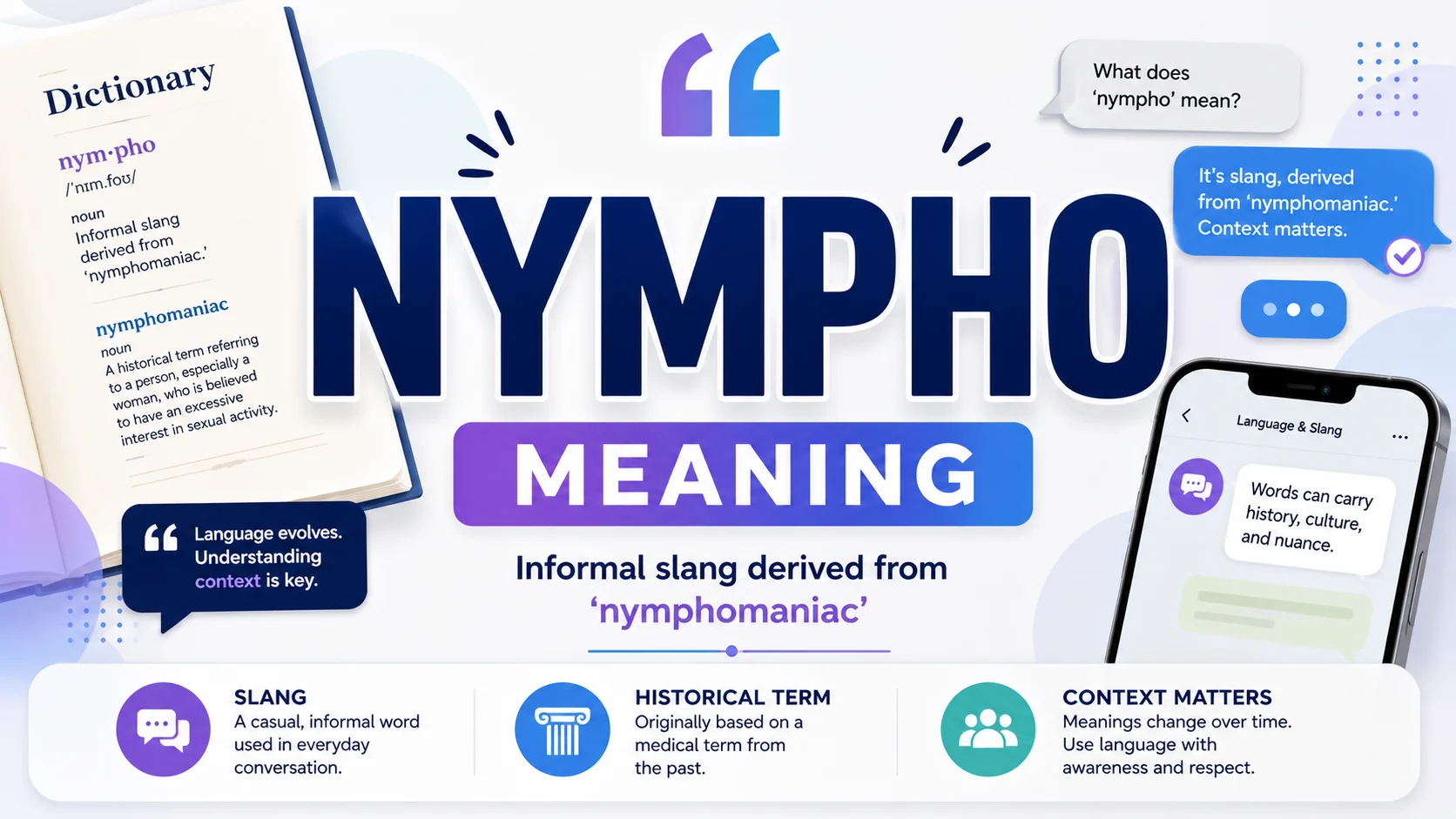
Nympho is an informal term derived from nymphomaniac. It traditionally describes someone perceived as having an unusually strong or excessive sexual desire. Today, people may use it jokingly, sexually, or negatively. The term is outdated and can sound judgmental.
Nympho meaning refers to an informal label for someone who is perceived as having an unusually strong interest in sex. The word comes from the older term nymphomaniac, which historically described women believed to have excessive sexual desire.
Today, however, the word has a broader slang use. Someone might call a fictional character a nympho, joke about themselves using the term, or use it as an insult toward another person. Therefore, the meaning depends heavily on context, tone, and the relationship between the speakers.
Importantly, nympho is not a medical diagnosis. Modern discussions of sexual behavior use more precise language and consider factors such as distress, loss of control, and impact on daily life rather than simply labeling someone as sexually active.
This guide explains the definition, origin, slang usage, examples, related terms, potential misunderstandings, and appropriate ways to respond.
Quick Answer
| Meaning | Context | Common Use | Example | Tone |
|---|---|---|---|---|
| A person perceived as excessively interested in sex | Casual conversation | Describing a person or character | “The character is portrayed as a nympho.” | Joking, sexual, critical, or insulting |
| Informal shorthand for “nymphomaniac” | Older or slang usage | Describing sexual behavior | “He jokingly called himself a nympho.” | Informal |
| A sexual stereotype or label | Pop culture and online slang | Humor or characterization | “The movie portrays her as a nympho.” | Context-dependent |
What Does Nympho Meaning Refer To?
The simplest nympho meaning is an informal description of a person who supposedly has an excessive interest in sex.
The word is usually treated as a shortened form of nymphomaniac.
However, the term carries more history than its short definition suggests. It has traditionally been associated with women and has often been used to judge sexual behavior. Consequently, calling someone a nympho can carry a negative or objectifying implication.
Nympho vs. Nymphomaniac
| Term | Description | Modern Consideration |
|---|---|---|
| Nympho | Informal shortened form | Slang and potentially judgmental |
| Nymphomaniac | Older term for supposedly excessive female sexual desire | Outdated |
| Hypersexuality | Modern descriptive term used in some clinical contexts | More neutral, but context matters |
| High sex drive | Describes strong sexual desire without necessarily implying a problem | Generally neutral |
The distinction matters because high sexual desire does not automatically indicate a psychological problem.
Someone can have a high libido and still have healthy relationships, boundaries, and control over their behavior.
Is Nympho a Medical Term?
No.
Nympho is not a formal medical diagnosis. Furthermore, nymphomania is an outdated concept rather than a current standalone diagnosis.
Modern professionals avoid assuming that frequent sexual thoughts or a strong libido automatically represent a disorder. Instead, assessment focuses on broader factors such as control, distress, impairment, and consequences.
The Origin and History of the Term
The history of nympho meaning connects to the word nymphomania.
The term combines historical ideas about nymphs with mania, reflecting older beliefs about supposedly excessive female sexual desire.
Historical Meaning
Historically, societies often judged women’s sexuality through strict cultural standards. As a result, women who displayed sexual behavior considered unusually assertive could receive labels such as nymphomaniac.
This history gives the word a strong gendered association.
How the Short Form Developed
Over time, nymphomaniac became shortened to nympho in informal speech.
The shortened form became especially useful in:
- casual conversations
- comedy
- movies
- television
- fictional characterization
- internet discussions
- sexual slang
Consequently, the word moved beyond its original historical context and became a general slang label.
Why the Historical Context Matters
Words can retain cultural baggage even after their meanings change.
Therefore, someone may hear nympho as harmless slang while another person may interpret it as insulting or sexist.
Context is essential.
Contextual Nuances of Nympho
The same word can communicate very different intentions.
Joking Usage
Friends sometimes use the term humorously.
For example:
“You two are such nymphos.”
The speaker may simply be teasing friends who frequently discuss dating or sex.
However, humor does not guarantee that everyone will appreciate the label.
Self Description
Some people use the term about themselves jokingly.
Example:
“I’m such a nympho when I’m dating someone.”
Here, the speaker may be exaggerating their sexual interest for comedic effect.
Even so, self-use does not mean the word is appropriate for describing someone else.
Insulting Usage
The term can also function as an insult.
Example:
“He called her a nympho just because she was openly dating.”
In this context, the word expresses judgment rather than neutral description.
Fictional Characters
Writers sometimes use the term to describe characters with highly sexual personalities.
For example:
“The comedy portrays the character as a nympho.”
This usage can describe a stereotype without applying the label to a real person.
Online Slang
Social media users sometimes use nympho casually when discussing relationships, attraction, dating, or sexual humor.
Nevertheless, online communication removes many vocal cues. A joke can therefore sound harsher in text than the sender intended.
Nympho Meaning in Modern Internet Slang
On social media, nympho often functions as exaggerated slang.
People may use it to mean:
- very sexually interested
- constantly thinking about sex
- highly flirtatious
- sexually adventurous
- unusually attracted to someone
- jokingly obsessed with sexual content
These meanings are not necessarily literal.
For example:
“This playlist is making me feel like a nympho 😂”
The speaker may simply be making an exaggerated joke about the mood created by the music.
Why Exaggeration Matters
Internet slang frequently uses hyperbole.
Someone might say:
“I’m addicted to this song.”
That does not necessarily mean literal addiction.
Similarly, someone calling themselves a nympho may simply be exaggerating their sexual mood or personality.
Therefore, readers should interpret the surrounding conversation before assuming a literal meaning.
Real Life Conversation Examples
Example 1: Casual Joke
Alex: You have another date tonight?
Jordan: Yep 😂
Alex: You’re such a nympho.
Jordan: Maybe I just like meeting people.
Here, the word functions as teasing.
Example 2: Self Description
Taylor: Why are you always flirting?
Morgan: I don’t know. Maybe I’m a nympho 😂
The speaker uses the term jokingly about themselves.
Example 3: Fictional Character
Sam: What do you think of that character?
Chris: She’s written as a total nympho.
Here, the term describes a fictional personality.
Example 4: Negative Usage
Jamie: Why did he call her a nympho?
Casey: He was judging her for talking openly about dating.
This example demonstrates the word’s potentially insulting nature.
Example 5: Online Humor
User 1: That romance novel is getting intense.
User 2: 😂 I’m turning into a nympho just reading these comments.
Here, the speaker uses exaggeration for humor.
How Nympho Is Used on Social Media
Snapchat
On Snapchat, the word can appear in private conversations, jokes, or flirting.
Because Snapchat often involves informal communication, slang is common.
For example:
“You two are acting like nymphos 😂”
However, the term may still offend someone if the relationship is not close.
TikTok
TikTok provides another environment where the term can appear in memes, comments, and humorous videos.
Creators might use it to describe:
- fictional characters
- exaggerated dating personalities
- romance content
- jokes about attraction
- sexual humor
However, TikTok content often relies on irony. Therefore, the intended meaning may be playful rather than literal.
Instagram users may use nympho in captions, comments, memes, or DMs.
For example:
“Romance book readers know 😂”
The term may also appear in discussions about fictional characters.
Text Messages
Texting provides perhaps the most context-dependent use.
A close friend might say:
“You’re such a nympho lol.”
A stranger saying the same thing can sound invasive or insulting.
Consequently, the relationship between the speakers matters greatly.
Nympho vs. Similar Terms
Understanding related words helps clarify the difference between slang and neutral descriptions.
| Term | Basic Meaning | Tone |
|---|---|---|
| Nympho | Informal label for someone perceived as excessively sexual | Often judgmental or joking |
| Nymphomaniac | Older version of the term | Outdated |
| Hypersexual | Describes unusually frequent or intense sexual thoughts or behavior in certain contexts | More clinical |
| High libido | Strong sexual desire | Generally neutral |
| Sexually active | Currently engages in sexual activity | Neutral |
| Flirtatious | Enjoys playful romantic or suggestive interaction | Usually neutral |
| Horny | Informal term for feeling sexually aroused | Very casual |
| Promiscuous | Having multiple sexual partners, often with a judgmental implication | Potentially negative |
These words are not interchangeable.
For example, someone can have a high libido without behaving promiscuously. Similarly, someone can be flirtatious without having unusually strong sexual desire.
Is Nympho Offensive?
It can be.
The word becomes especially problematic when someone uses it to shame another person’s sexuality.
For example:
“She’s a nympho because she dates a lot.”
This statement makes a judgment about someone’s personality based on limited information.
Furthermore, the historical association with female sexuality can make the term particularly loaded.
When It May Be Harmless
It may be relatively harmless when:
- someone uses it about themselves
- close friends use it jokingly
- the context clearly signals humor
- it describes a fictional character
- everyone involved understands the joke
Even then, sensitivity matters.
When to Avoid It
Avoid calling someone a nympho when:
- you barely know them
- you’re discussing a coworker
- you’re speaking to a professional audience
- the person has not invited sexual comments
- the term could embarrass them
- you’re using it to shame their behavior
When in doubt, choose neutral language.
Misinterpretations and Common Mistakes
Mistake 1: Assuming High Libido Equals a Disorder
A strong sex drive does not automatically indicate a psychological condition.
People naturally differ in sexual desire.
Mistake 2: Treating Nympho as a Diagnosis
The term is slang, not a formal diagnosis.
Therefore, it should not be used to diagnose another person.
Mistake 3: Assuming the Word Is Always Sexual in Intent
Sometimes people use it for exaggerated humor.
The surrounding conversation provides important clues.
Mistake 4: Using It With Strangers
Calling a stranger a nympho can quickly cross a personal boundary.
A neutral description is safer.
Mistake 5: Ignoring Gendered History
The term has historically been associated with judging women for sexual behavior.
Therefore, some people may find it particularly offensive.
How to Respond When Someone Calls You a Nympho
Your response depends on how the word was used.
If You Think It’s a Joke
You can respond playfully:
“Lol, that’s one way to put it.”
If You Want Clarification
Ask:
“What makes you say that?”
This puts the responsibility back on the speaker.
If You Dislike the Label
Say:
“I’d rather you not call me that.”
A direct boundary is perfectly reasonable.
If You Want a Neutral Response
Try:
“I just have a healthy interest in dating.”
This corrects the assumption without escalating the conversation.
If Someone Is Insulting You
You can simply say:
“That’s not an appropriate way to describe me.”
You do not need to defend your personal life.
How to Use the Word Appropriately
Because nympho carries sexual and potentially judgmental connotations, use it carefully.
Appropriate Casual Context
A close friend says:
“I’m such a nympho for this fictional character.”
That is clearly self-directed slang.
Appropriate Fictional Context
A review says:
“The show portrays the character as a nympho.”
This describes the characterization rather than making a claim about a real person.
Less Appropriate Context
A coworker says:
“She’s a nympho.”
This can create an uncomfortable and unprofessional environment.
Better Neutral Alternatives
Instead of labeling someone, describe the specific behavior.
For example:
“The character frequently talks about sex.”
That statement provides information without attaching a stigmatizing label.
Nympho in Pop Culture and Fiction
The term has appeared in entertainment for decades.
Writers have sometimes used it as shorthand for a sexually confident or highly sexualized character. However, this portrayal can reinforce stereotypes.
Modern audiences increasingly distinguish between:
- sexual confidence
- sexual activity
- sexual desire
- compulsive behavior
- objectification
- comedic exaggeration
This distinction produces more nuanced characters.
Why Fictional Usage Can Be Different
A fictional character cannot experience embarrassment in the same way a real person can.
Consequently, writers may use exaggerated labels for comedic effect.
Still, audiences may criticize such portrayals when they rely heavily on stereotypes.
Linguistic Breakdown
The word nympho demonstrates a common feature of slang: shortening a longer expression.
| Original Term | Short Form |
|---|---|
| Nymphomaniac | Nympho |
Similar shortening occurs throughout internet language.
For example:
| Full Expression | Informal Form |
|---|---|
| Conversation | Convo |
| Professional | Pro |
| Information | Info |
| Examination | Exam |
| Photograph | Pic |
The difference is that nympho also carries historical and cultural associations.
Therefore, its linguistic simplicity does not make its social meaning simple.
Nympho Meaning in American English
In the United States, nympho is generally understood as informal sexual slang.
It is not typically appropriate for formal writing.
You may encounter it in:
- social media
- movies
- television
- online forums
- casual conversations
- comedy
- dating discussions
- romance communities
However, usage varies by age and community.
Some people immediately recognize the word. Others may consider it outdated.
Formal Alternatives
For professional or educational writing, consider phrases such as:
- high sexual desire
- strong libido
- sexually active
- sexually preoccupied
- compulsive sexual behavior, when clinically appropriate
- persistent sexual thoughts or behaviors
The best alternative depends on what you actually want to communicate.
Frequently Asked Questions
What does nympho mean in texting?
In texting, nympho usually refers informally to someone perceived as being very interested in sex. The sender may use it jokingly, flirtatiously, or critically.
Is nympho a bad word?
It is not necessarily a profanity, but it can be offensive. Its effect depends on context, tone, and whether someone uses it to shame another person’s sexuality.
Is nympho short for nymphomaniac?
Yes. Nympho is an informal shortened form of nymphomaniac, an older term associated with supposedly excessive female sexual desire.
Is nympho a medical diagnosis?
No. It is slang and should not be treated as a diagnosis.
Does having a high libido make someone a nympho?
No. A high libido simply means someone experiences strong sexual desire. The slang label adds a judgment about that desire.
What does nympho mean on social media?
On social media, it often functions as humorous or exaggerated slang. People may use it when discussing dating, attraction, romance, fictional characters, or sexual humor.
Can men be called nymphos?
Yes. Although the historical term was strongly associated with women, modern informal usage can apply the slang to people of any gender.
Is nympho the same as horny?
No. Horny generally describes a temporary state of sexual arousal. Nympho labels someone as supposedly having an unusually strong or persistent interest in sex.
What is a more respectful alternative to nympho?
Use a specific, neutral description instead. Depending on context, you might say high libido, sexually active, flirtatious, or sexually interested.
Should I call someone a nympho?
Generally, avoid labeling another person that way unless you know they are comfortable with the term. Because it can sound judgmental, neutral language is usually safer.
Conclusion
Nympho meaning centers on an informal label for someone perceived as having an unusually strong interest in sex. The word comes from the older term nymphomaniac, which historically carried strong gendered and judgmental associations.
Today, people use nympho in several ways. It can appear as a joke between friends, a self-description, a fictional characterization, or an insult. Consequently, the surrounding context matters just as much as the dictionary definition.
The most important distinction is between sexual desire and a judgment about sexual desire. Having a high libido does not automatically mean that someone has a problem. Likewise, being sexually active does not justify assigning a stigmatizing label.
For casual online conversations, the word may be recognizable. However, professional and sensitive situations call for more neutral language. Instead of labeling someone, describe the specific behavior or characteristic you mean.
Ultimately, understanding slang requires more than memorizing definitions. You also need to understand tone, history, audience, and social context. That approach makes it easier to recognize what nympho means when you encounter it while also knowing when the term may be inappropriate or offensive.

Andrew Morris is a writer at Meaninga.com who specializes in word meanings, slang, idioms and modern language trends. He creates clear, accurate and easy to understand content for everyday readers.







4 thoughts on “Nympho Meaning| Definition, Slang, Examples and Usage”