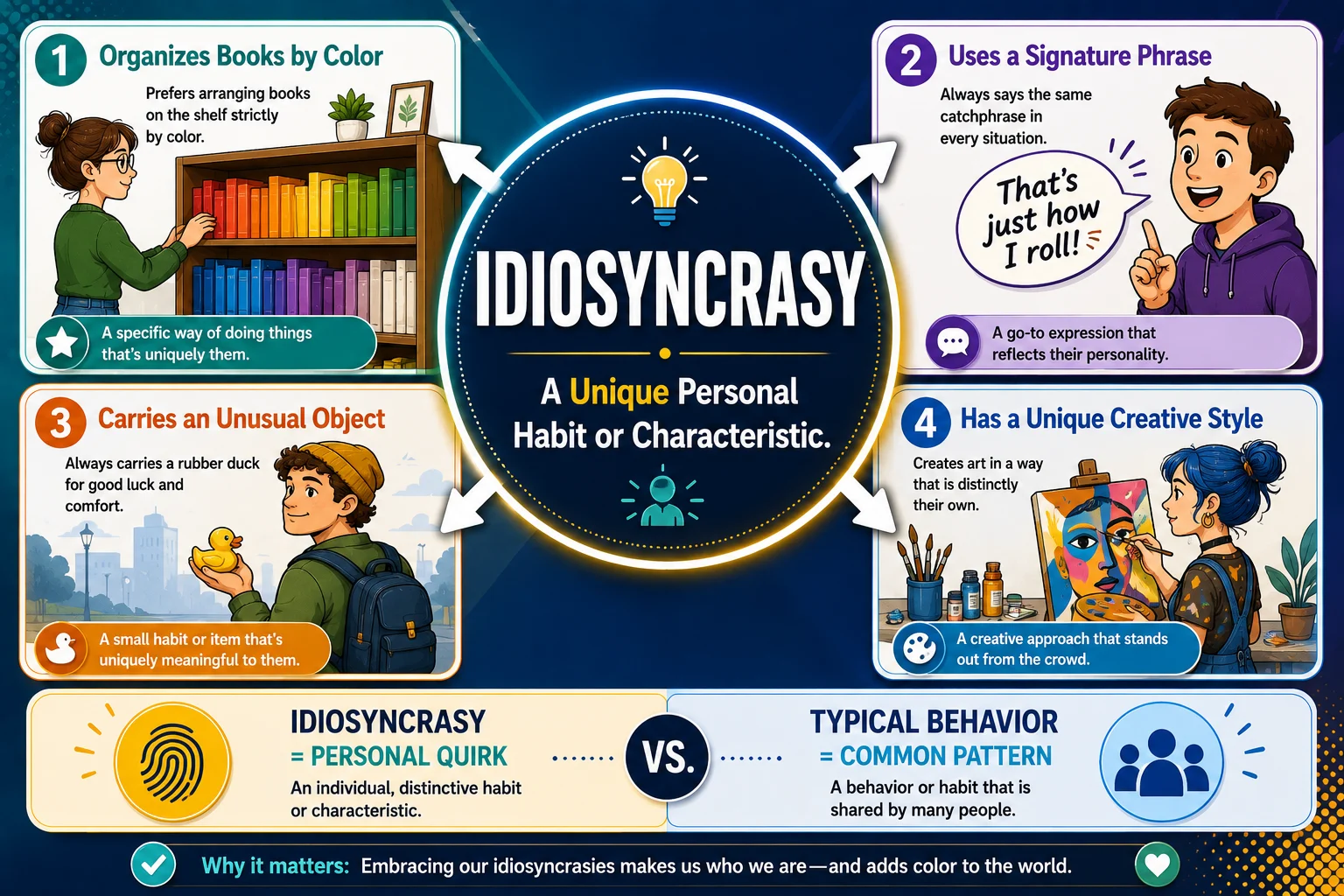
Idiosyncrasy means a distinctive or unusual habit, behavior, characteristic, or way of thinking that belongs to a particular person or group. It often describes something that makes someone noticeably different from others. The word can sound neutral, affectionate, humorous, or mildly critical depending on context.
Idiosyncrasy meaning refers to a unique or unusual characteristic, habit, preference, or behavior associated with a particular person or group. It can describe something as simple as always arranging books in a specific order or something more noticeable, such as using an unusual phrase in everyday conversation.
For example, someone might say, “Her idiosyncrasy is carrying three different notebooks everywhere she goes.”
The word does not automatically describe something negative. In fact, people often use it to highlight the distinctive qualities that make someone memorable.
Furthermore, an idiosyncrasy can involve behavior, speech, personality, routines, preferences, or even a particular style of thinking. Understanding the surrounding context helps determine whether the word sounds complimentary, neutral, humorous, or critical.
Quick Answer
| Element | Explanation |
|---|---|
| Meaning | A distinctive or unusual characteristic or habit |
| Simple definition | A personal quirk or unusual trait |
| Part of speech | Noun |
| Plural | Idiosyncrasies |
| Common context | Personality, habits, behavior, writing, speech |
| Example | “His idiosyncrasy is checking the door three times.” |
| Tone | Usually neutral, sometimes humorous or mildly critical |
| Synonyms | Quirk, peculiarity, trait, mannerism, eccentricity |
| Opposite idea | Conventional behavior or typicality |
What Does Idiosyncrasy Mean?
An idiosyncrasy is a characteristic that is particularly distinctive to an individual or group.
In simple English, you can think of it as a personal quirk.
For example:
“One of his idiosyncrasies is talking to his plants.”
The speaker is pointing out a behavior that seems unusual and characteristic of that person.
Another example is:
“Her habit of taking notes on napkins is one of her idiosyncrasies.”
The behavior makes her distinctive.
However, an idiosyncrasy does not have to be bizarre. It can be relatively small or ordinary as long as it is distinctive enough to be associated with someone.
For example:
“His idiosyncrasy is drinking coffee from the same mug every morning.”
That habit may not seem extremely unusual. Yet, if it is a recognizable personal trait, the word can still apply.
Idiosyncrasy in Simple Words
The easiest way to understand idiosyncrasy is:
An idiosyncrasy is a person’s unique little habit or characteristic.
Some informal alternatives include:
- quirk
- odd habit
- personal trait
- unusual behavior
- peculiarity
- distinctive habit
For example:
“She has a quirky habit of humming while she works.”
You could describe that habit as one of her idiosyncrasies.
Therefore, when someone says, “That’s just one of his idiosyncrasies,” they usually mean:
“That’s one of his distinctive personal habits or quirks.”
What Is an Idiosyncratic Person?
The adjective idiosyncratic describes someone or something that has distinctive characteristics.
For example:
“He has an idiosyncratic sense of humor.”
This means his sense of humor is unusual or distinctly his own.
Another example:
“The artist developed an idiosyncratic style.”
Here, the artist’s style is distinctive and recognizable.
The distinction is simple:
| Word | Meaning |
|---|---|
| Idiosyncrasy | A distinctive characteristic or habit |
| Idiosyncratic | Having distinctive or unusual characteristics |
Examples of Idiosyncrasies
Idiosyncrasies can appear in many areas of everyday life.
Personal Habits
Someone might:
- arrange food in a particular order
- always sit in the same chair
- organize possessions by color
- tap a desk while thinking
- carry an unusual object everywhere
- reread the same page several times
These can become recognizable personal quirks.
Speech
A person’s unique way of speaking can also involve idiosyncrasies.
For example:
“His tendency to invent new expressions is one of his idiosyncrasies.”
Someone might repeatedly use a particular phrase or pronounce certain words in an unusual way.
Work Habits
Workplaces can reveal plenty of personal quirks.
For example:
“Her idiosyncrasy is keeping every document perfectly aligned on her desk.”
This describes a distinctive working habit.
Fashion
A person’s unusual clothing preference can also be an idiosyncrasy.
For example:
“His collection of colorful socks is one of his idiosyncrasies.”
The statement does not necessarily criticize the person. It simply identifies something distinctive about them.
Idiosyncrasy Meaning in Psychology
The term can appear in psychology and related academic writing when discussing distinctive individual characteristics.
However, idiosyncrasy itself is not a diagnosis.
It simply describes an individual characteristic that differs from what is typical.
For example, a researcher might discuss differences in people’s responses, preferences, or behaviors.
An individual’s response could be described as idiosyncratic if it differs noticeably from the usual pattern.
This does not automatically mean the response is unhealthy or problematic.
Idiosyncrasy in Literature
Writers often use idiosyncrasies to make characters more memorable.
A fictional character might have a distinctive:
- laugh
- phrase
- gesture
- routine
- preference
- fear
- hobby
- manner of speaking
For example:
“The detective’s habit of arranging pencils before every interview became one of his most recognizable idiosyncrasies.”
This small characteristic can make a character feel more individual.
Consequently, authors often use quirks as part of characterization.
Idiosyncrasy in Writing
An author’s distinctive writing style can also be described as idiosyncratic.
For example:
“The novelist has an idiosyncratic approach to punctuation.”
This means the author’s punctuation habits are unusual and characteristic of their style.
Similarly:
“Her idiosyncratic prose makes the novel immediately recognizable.”
The word emphasizes individuality rather than simply saying the writing is strange.
Idiosyncrasy in Art
Artists often develop recognizable characteristics.
These might involve:
- unusual color combinations
- recurring symbols
- distinctive brushwork
- unconventional compositions
- unusual subject matter
A critic might write:
“The artist’s idiosyncratic use of color became a signature feature.”
Here, idiosyncratic means distinctive and characteristic of the artist.
Idiosyncrasy in Music
Musicians can also have recognizable quirks.
These might involve:
- vocal techniques
- unusual rhythms
- performance habits
- songwriting structures
- distinctive instrument choices
For example:
“The singer’s idiosyncratic vocal style became part of her identity.”
The word emphasizes uniqueness.
Idiosyncrasy vs. Quirk
Quirk is the closest everyday synonym.
Both words can describe an unusual personal habit.
However, quirk sounds more casual.
Idiosyncrasy sounds more formal or analytical.
| Quirk | Idiosyncrasy |
|---|---|
| Casual | More formal |
| Common in conversation | Common in writing |
| Often lighthearted | Can be neutral or analytical |
| “That’s his little quirk.” | “That’s one of his idiosyncrasies.” |
For everyday conversation, quirk may sound more natural.
For essays, articles, reviews, and professional writing, idiosyncrasy can provide more precision.
Idiosyncrasy vs. Eccentricity
These words overlap but are not identical.
Eccentricity usually suggests behavior that significantly differs from conventional expectations.
Idiosyncrasy simply means something distinctive or unusual.
For example:
“Her habit of writing with three different pens is an idiosyncrasy.”
That does not necessarily make her eccentric.
However:
“His eccentric behavior attracted attention.”
This suggests a stronger departure from conventional behavior.
Therefore, eccentricity often sounds stronger than idiosyncrasy.
Idiosyncrasy vs. Peculiarity
Peculiarity means a strange, unusual, or distinctive characteristic.
It can be very close to idiosyncrasy.
However, peculiarity often emphasizes the fact that something is unusual.
Idiosyncrasy emphasizes that the characteristic is associated with a particular person or group.
For example:
“His preference for silent meetings is an idiosyncrasy.”
The focus is on the person’s distinctive behavior.
Idiosyncrasy vs. Mannerism
A mannerism is a distinctive behavior, gesture, or speech habit.
For example:
“She has a habit of raising one eyebrow when she disagrees.”
That could be called a mannerism.
An idiosyncrasy is broader.
It can include habits, preferences, beliefs, routines, and other distinctive characteristics.
Therefore, a mannerism can be an idiosyncrasy, but not every idiosyncrasy is a mannerism.
Idiosyncrasy vs. Eccentricity vs. Quirk
| Word | Main Idea | Typical Tone |
|---|---|---|
| Idiosyncrasy | Distinctive personal characteristic | Neutral |
| Quirk | Small unusual personal habit | Casual |
| Eccentricity | Strong departure from conventional behavior | More noticeable |
| Peculiarity | Something unusual or distinctive | Neutral to negative |
| Mannerism | Repeated distinctive gesture or behavior | Neutral |
Is Idiosyncrasy Positive or Negative?
The word itself is generally neutral.
Context determines the emotional meaning.
Positive Context
“Her creativity is one of her most charming idiosyncrasies.”
Here, the characteristic is appreciated.
Neutral Context
“His habit of arriving early is an idiosyncrasy.”
The sentence simply identifies a distinctive habit.
Mildly Negative Context
“His constant interruptions are one of his more frustrating idiosyncrasies.”
Here, the behavior is criticized.
Therefore, the word does not automatically mean something bad.
Real Life Conversation Examples
Conversation 1: Coffee
Mia: Why does Daniel always use that tiny coffee cup?
Alex: That’s one of his idiosyncrasies.
Mia: Even when he orders a huge coffee?
Alex: Especially then.
Here, the word describes a humorous personal habit.
Conversation 2: Work
Sam: Why does your manager arrange every pen by size?
Taylor: It’s one of her little idiosyncrasies.
Sam: Honestly, the desk looks pretty organized.
Here, the word has a neutral or slightly affectionate tone.
Conversation 3: Writing
Editor: I noticed you use unusually short paragraphs.
Writer: Yes, I’ve always written that way.
Editor: It’s an idiosyncrasy, but it gives your work a distinctive rhythm.
Here, the characteristic contributes to the writer’s style.
Conversation 4: Friendships
Jake: Why does Chris always bring a notebook to dinner?
Ryan: That’s just one of his idiosyncrasies.
Jake: I guess he’s prepared for anything.
Here, the word describes a harmless personal quirk.
Conversation 5: Family
Emma: Grandma still labels every container in the refrigerator.
Nora: That’s one of her classic idiosyncrasies.
Emma: At least we always know what’s inside.
Here, the term carries an affectionate tone.
How to Use Idiosyncrasy in a Sentence
The most common structure is:
“One of his/her/their idiosyncrasies is…”
Examples:
“One of her idiosyncrasies is collecting unusual postcards.”
“One of his idiosyncrasies is speaking to himself while cooking.”
Another useful structure is:
“X is an idiosyncrasy.”
“His habit of arriving an hour early is an idiosyncrasy.”
You can also use the plural:
“The author’s idiosyncrasies make her writing distinctive.”
Common Grammar Patterns
One of My Idiosyncrasies
“One of my idiosyncrasies is checking the weather before bed.”
His Idiosyncrasy
“His idiosyncrasy is wearing the same style of hat every day.”
Her Idiosyncrasies
“Her idiosyncrasies make her memorable.”
Personal Idiosyncrasy
“Everyone has a personal idiosyncrasy.”
Cultural Idiosyncrasy
The word can also describe characteristics associated with a group.
“The study examines cultural idiosyncrasies in communication.”
However, this use requires care because cultures contain enormous internal diversity.
Can Groups Have Idiosyncrasies?
Yes.
Although the word frequently describes individuals, it can also describe distinctive characteristics of organizations, cultures, industries, or systems.
For example:
“The company has several idiosyncrasies in its management style.”
Here, the word refers to unusual organizational characteristics.
Similarly:
“The software has several idiosyncrasies that developers need to understand.”
This means the software behaves in distinctive ways.
Idiosyncrasy in Technology
Technology writers sometimes use idiosyncrasy to describe unusual behavior in software or systems.
For example:
“The application has an idiosyncrasy that causes the menu to appear differently on older devices.”
In this context, the word means a distinctive behavior or peculiarity.
It does not necessarily mean the system is defective.
Idiosyncratic Meaning
The adjective idiosyncratic means distinctive, unusual, or characteristic of a particular person, group, or system.
Examples include:
“She has an idiosyncratic sense of humor.”
“The director has an idiosyncratic filmmaking style.”
“The program has an idiosyncratic interface.”
The adjective can describe positive originality, neutral uniqueness, or unusual behavior.
Origin of the Word Idiosyncrasy
The word idiosyncrasy comes from Greek roots.
It combines elements associated with:
- idios, meaning “one’s own” or “private”
- synkrasis, meaning “mixture” or “combination”
The original concept related to an individual’s particular constitution or temperament.
Over time, the word developed its modern sense of a distinctive personal characteristic or unusual habit.
This history explains why the word focuses strongly on individuality.
Pronunciation of Idiosyncrasy
In American English, idiosyncrasy is commonly pronounced approximately:
id ee oh SING kruh see
Its pronunciation is:
/ˌɪdiəˈsɪŋkrəsi/
The plural form, idiosyncrasies, is pronounced approximately:
id ee oh SING kruh seez
The spelling can look intimidating, but the pronunciation becomes easier when broken into smaller parts.
Plural of Idiosyncrasy
The plural form is:
idiosyncrasies
For example:
“The author’s idiosyncrasies became part of her public image.”
The spelling changes from y to ies, following the standard English plural pattern.
Common Synonyms
Depending on the context, synonyms include:
- quirk
- peculiarity
- eccentricity
- characteristic
- trait
- mannerism
- oddity
- individuality
- distinctiveness
- habit
However, these words are not perfect replacements in every sentence.
Best Casual Synonym
Quirk is usually the most natural casual alternative.
Best Formal Synonym
Peculiarity or distinctive characteristic can work well in formal writing.
Stronger Alternative
Eccentricity suggests behavior that departs more strongly from social norms.
Antonyms
There is no perfect one word opposite of idiosyncrasy.
Depending on the context, useful contrasts include:
- conformity
- normality
- conventionality
- uniformity
- typicality
- common behavior
For example:
“The company’s approach is notable for its lack of conventionality.”
The opposite concept depends on what aspect of idiosyncrasy you want to contrast.
Common Mistakes
Mistake 1: Assuming It Always Means Weird
An idiosyncrasy can be unusual without being extremely strange.
Someone’s small personal preference can qualify.
Mistake 2: Treating It as an Insult
The word is generally neutral.
The surrounding sentence determines whether it sounds positive or negative.
Mistake 3: Confusing It With Eccentricity
Eccentricity usually suggests a stronger departure from conventional behavior.
Idiosyncrasy can describe something much milder.
Mistake 4: Using It for Every Habit
A completely ordinary habit is not necessarily an idiosyncrasy.
The characteristic usually needs to be distinctive in some way.
When Should You Use Idiosyncrasy?
Use idiosyncrasy when you want to describe a characteristic that feels particularly associated with someone or something.
It works especially well when discussing:
- personality
- writing
- art
- behavior
- speech
- work habits
- cultural patterns
- technology
- organizations
For casual conversation, however, quirk may sound more natural.
Compare:
“That’s one of his quirks.”
with:
“That’s one of his idiosyncrasies.”
Both are correct. The second sounds more formal.
Frequently Asked Questions
What does idiosyncrasy mean in simple terms?
An idiosyncrasy is a unique or unusual personal habit, characteristic, or way of behaving. In everyday language, you can often call it a “quirk.”
Is idiosyncrasy a positive or negative word?
It is generally neutral. Context determines whether the characteristic sounds charming, funny, harmless, unusual, or frustrating.
What is an example of an idiosyncrasy?
Someone always organizing their books by color could have this as an idiosyncrasy. It is a distinctive habit associated with that person.
What is the difference between an idiosyncrasy and a quirk?
They are very similar. Quirk sounds more casual, while idiosyncrasy sounds more formal and can work better in academic or professional writing.
What does idiosyncratic mean?
Idiosyncratic means distinctive, unusual, or characteristic of a particular person, group, or system.
What is the plural of idiosyncrasy?
The plural is idiosyncrasies.
Can an idiosyncrasy be a good thing?
Yes. A distinctive habit can be charming, creative, memorable, or useful. The word itself does not imply something negative.
Is eccentricity the same as idiosyncrasy?
Not exactly. Eccentricity usually suggests stronger or more unusual behavior. An idiosyncrasy can be a small and harmless personal characteristic.
Can a group have an idiosyncrasy?
Yes. The word can describe distinctive characteristics of groups, organizations, cultures, industries, or systems, although context matters.
What is the best synonym for idiosyncrasy?
Quirk is usually the closest everyday synonym. Other possibilities include peculiarity, mannerism, trait, oddity, and distinctive characteristic.
Conclusion
The word idiosyncrasy describes a distinctive characteristic, habit, behavior, or way of thinking associated with a particular person or group.
In simple terms, it often means a personal quirk. However, the word has a broader and more formal meaning than quirk. It can describe distinctive features of people, writers, artists, organizations, technologies, and even broader groups.
Importantly, an idiosyncrasy is not automatically negative. Someone’s unusual habit might be charming, funny, creative, neutral, or frustrating. The surrounding context determines the tone.
The closest everyday synonym is quirk, while eccentricity generally suggests a stronger departure from conventional behavior. Peculiarity emphasizes unusualness, whereas mannerism often refers to a repeated gesture or behavior.
The adjective idiosyncratic describes something distinctive or unusual. For example, an author can have an idiosyncratic writing style, while a person can have an idiosyncratic sense of humor.
Ultimately, the concept behind the word is individuality. An idiosyncrasy is one of those distinctive details that makes a person, style, or system recognizable as uniquely its own.










18 thoughts on “Idiosyncrasy Meaning| Definition, Examples, Synonyms and Usage”