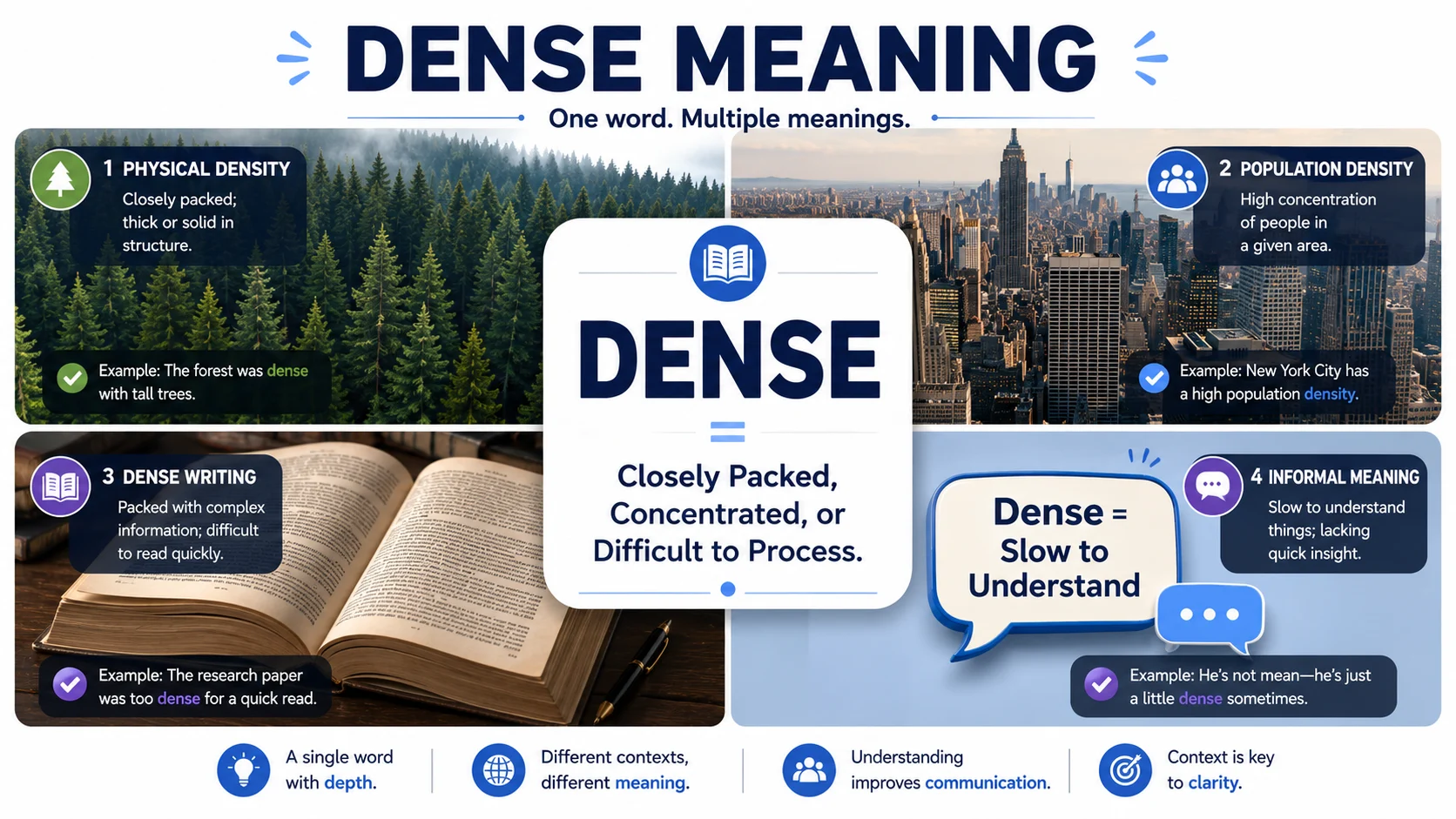
Dense means closely packed, crowded, or containing a large amount of something in a limited space. It can describe physical objects, forests, populations, writing, food, and ideas. When describing a person, dense can mean slow to understand or unaware of something obvious.
Dense meaning changes slightly depending on the context, but its central idea involves something being closely packed or difficult to penetrate. You might describe a forest as dense because its trees grow closely together. Similarly, you can call a book dense when it contains a large amount of complex information.
The word also has important scientific uses. In physics, for example, density describes how much mass exists within a given volume. In everyday conversation, however, dense can describe someone who fails to understand something that seems obvious.
Therefore, context matters when interpreting the word. A dense material, dense population, dense paragraph, and dense person all involve different ideas.
This guide explains the different meanings of dense, its origins, synonyms, examples, common expressions, scientific uses, and modern slang.
Quick Answer
| Category | Meaning | Example |
|---|---|---|
| Physical | Closely packed or compact | “The material is dense.” |
| Vegetation | Thick and closely grown | “The forest is dense.” |
| Population | Many people in a limited area | “The city has a dense population.” |
| Writing | Full of information or difficult to process | “The article is dense.” |
| Ideas | Complex or concentrated | “The theory is dense.” |
| Food | Heavy or compact in texture | “The bread is dense.” |
| Person | Slow to understand or notice something | “I was being dense.” |
| Science | Having considerable mass relative to volume | “Gold is denser than aluminum.” |
What Does Dense Meaning Refer To?
The most basic dense meaning is closely packed together.
If objects occupy a small amount of space while remaining close together, you can describe the arrangement as dense.
For example:
“The trees formed a dense canopy.”
The trees grow close together, creating a thick layer of branches and leaves.
The word can also describe concentration.
“The city has a dense population.”
Here, many people live within a relatively small geographical area.
However, the word can move from physical descriptions to abstract ones.
“The textbook is dense.”
This means the book contains a lot of information and may require considerable effort to understand.
A Simple Way to Remember It
Think of dense as meaning “a lot packed into a limited space.”
That space can be physical or conceptual.
| Type | What Is Packed Together? |
|---|---|
| Dense forest | Trees and vegetation |
| Dense crowd | People |
| Dense material | Matter |
| Dense writing | Information |
| Dense argument | Ideas |
| Dense food | Ingredients or structure |
Consequently, the same basic concept connects many different uses of the word.
Dense as a Physical Description
One of the most common uses describes something that is compact or closely packed.
For example:
“The clay is dense and difficult to break.”
Here, the material has substantial matter packed into a relatively small volume.
You can also describe objects as dense when comparing their weight and size.
For example:
“This stone feels surprisingly dense.”
The object may feel heavy relative to its size.
Dense Materials
Many materials can have relatively high density.
Examples include:
- metals
- certain rocks
- glass
- some ceramics
- compacted soil
However, density does not simply mean “heavy.”
A large object can be heavy while having relatively low density. Conversely, a small object can be surprisingly heavy because its matter is packed into a small volume.
Therefore, size and density are different concepts.
Dense in Science
The scientific use of dense meaning is especially important in physics and chemistry.
What Is Density?
Density describes the amount of mass contained within a particular volume.
The basic formula is:
Density = Mass ÷ Volume
Scientists commonly express density using units such as kilograms per cubic meter or grams per cubic centimeter.
For example, if two objects occupy the same volume, the object with greater mass has greater density.
Density Example
Imagine two blocks of identical size.
Block A weighs 1 kilogram.
Block B weighs 3 kilograms.
Because both blocks have the same volume, Block B has three times the density of Block A.
Consequently, density provides more useful information than weight alone.
Dense vs. Heavy
These words are related but not identical.
Heavy describes how much something weighs.
Dense describes how much mass exists within a particular amount of space.
For example, a large foam cushion may weigh more than a small metal object. Nevertheless, the metal can have much greater density.
Dense in Geography
Geographers often use the word to describe populations.
Population Density
Population density refers to the number of people living within a particular area.
A densely populated location has many residents relative to its size.
For example:
“The neighborhood has a dense population.”
This means many people live within a relatively limited area.
Dense Urban Areas
Large cities often contain dense neighborhoods.
These areas may have:
- apartment buildings
- businesses
- public transportation
- busy streets
- limited open space
- large numbers of residents
Consequently, urban density can influence housing, transportation, infrastructure, and public services.
Dense vs. Crowded
These terms overlap, but they are not identical.
Dense describes concentration.
Crowded usually describes the experience of having many people or objects occupying a space.
For example:
“The neighborhood is densely populated.”
This describes population distribution.
Meanwhile:
“The train is crowded.”
This describes the immediate experience of many people occupying the train.
Dense Forest Meaning
A dense forest contains trees and vegetation growing closely together.
Such forests may have limited open space and little direct sunlight reaching the ground.
For example:
“The hikers disappeared into the dense forest.”
The description creates an image of thick vegetation surrounding the hikers.
Similar Expressions
You may also encounter:
- thick forest
- dense woodland
- heavy vegetation
- thick undergrowth
- dense foliage
However, these expressions are not always interchangeable.
Foliage, for example, refers specifically to leaves and vegetation.
Dense Writing Meaning
When someone calls writing dense, they usually mean it contains a large amount of information, complex ideas, or closely packed arguments.
For example:
“The research paper is dense but informative.”
The writer is not necessarily criticizing the paper. Instead, the sentence suggests that the reader needs concentration to process the information.
Dense vs. Difficult
A dense text is not automatically poorly written.
A scientific paper can be dense because the subject requires technical detail.
Similarly, a legal document can be dense because it contains precise definitions and conditions.
However, unnecessarily dense writing can become difficult to read.
Example
Compare these two sentences:
“The policy establishes several interconnected procedures governing eligibility, documentation, review, appeals, and compliance.”
This is relatively dense.
A simpler version might say:
“The policy explains eligibility, documents, reviews, appeals, and compliance.”
The second sentence communicates the same general idea with less complexity.
Therefore, dense writing can be useful when precision matters, but writers should avoid unnecessary complexity.
Dense Meaning in Literature
In literary criticism, a passage may be called dense when it contains several layers of meaning.
For example:
“The poem is dense with symbolism.”
This means the poem contains many symbolic elements within a relatively short text.
A dense literary passage may require readers to consider:
- imagery
- symbolism
- historical context
- word choice
- cultural references
- themes
- metaphors
Consequently, literary density can encourage deeper analysis.
Dense Meaning in Food
The word dense also describes food texture.
A food is dense when it feels compact, heavy, or tightly structured.
For example:
“The cake was dense and moist.”
This could mean the cake has a compact crumb rather than a light, airy texture.
Dense vs. Light Food
| Dense | Light |
|---|---|
| Compact texture | Airy texture |
| Often heavier | Often less substantial |
| Closely packed structure | More open structure |
| Example: some brownies | Example: sponge cake |
However, dense food is not necessarily bad.
Some foods are intentionally dense.
Examples include:
- brownies
- cheesecake
- certain breads
- fudge
- rich pastries
Therefore, the meaning depends on the food and the speaker’s intention.
Dense Meaning When Describing a Person
One of the most interesting everyday uses describes someone’s ability to understand something.
When someone calls another person dense, they may mean that person is slow to understand, unaware, or unable to recognize something obvious.
For example:
“I was being dense and didn’t realize she was joking.”
Here, dense means the speaker failed to understand the situation.
Is Calling Someone Dense an Insult?
It can be.
The word may sound playful among friends.
For example:
“You’re so dense! She was obviously flirting with you.”
The speaker may be teasing.
However, saying:
“You’re dense.”
to someone during a serious discussion can sound insulting.
The tone and relationship therefore matter.
Dense vs. Stupid
These words are not exactly the same.
Stupid broadly attacks someone’s intelligence.
Dense usually describes a specific failure to understand or notice something.
For example:
“I was dense and missed the hint.”
This does not necessarily mean the person lacks intelligence. It means they failed to recognize something in that particular situation.
Dense Meaning in Slang
In informal conversation, dense can mean:
- clueless
- slow to catch on
- oblivious
- unperceptive
- slow to understand
For example:
“He’s being dense. She already told him she likes him.”
The speaker means that the person has failed to recognize an obvious romantic signal.
Why Context Matters
Slang meanings often depend on tone.
A friend might say:
“Don’t be dense 😂.”
This could be playful.
A stranger might say:
“You’re dense.”
That could sound insulting.
Therefore, avoid assuming that every use carries the same emotional meaning.
Dense vs. Clueless
Dense and clueless can overlap.
However, they emphasize slightly different ideas.
Clueless usually means lacking awareness or knowledge.
Dense often suggests that the answer should have been easier to recognize.
For example:
“I’m clueless about car repairs.”
This means the person does not know how car repairs work.
Meanwhile:
“I’m being dense. I didn’t realize the meeting was today.”
This suggests the information should have been obvious to the speaker.
Dense vs. Obtuse
Obtuse can also mean slow to understand.
However, it often sounds more formal or literary.
Compare:
“You’re being dense.”
with:
“His response was rather obtuse.”
The first sounds conversational.
The second sounds more formal.
Furthermore, obtuse can sometimes imply deliberate refusal to understand, depending on context.
Dense vs. Concentrated
These words can overlap when describing physical or conceptual material.
Concentrated often emphasizes a high amount of something in a particular area.
Dense emphasizes close packing or high concentration within a space.
For example:
“A dense population lives in the area.”
“The solution contains a highly concentrated chemical.”
The two words describe related but different concepts.
Dense vs. Thick
When describing forests or vegetation, dense and thick can both mean abundant or closely packed.
For example:
“Dense vegetation covered the hillside.”
“Thick vegetation covered the hillside.”
Both sentences work.
However, thick has a wider range of physical meanings.
You can describe something as thick based on its depth, while dense emphasizes concentration or packing.
Common Synonyms for Dense
The best synonym depends on the context.
| Context | Synonyms |
|---|---|
| Physical | Compact, solid, concentrated |
| Forest | Thick, lush, crowded |
| Population | Crowded, concentrated, highly populated |
| Writing | Complex, packed, information-rich |
| Ideas | Complex, intricate, concentrated |
| Food | Compact, heavy, rich |
| Person | Clueless, oblivious, slow, unperceptive |
| Scientific | High-density, concentrated |
No single synonym works in every situation.
Consequently, always consider what the word describes before replacing it.
Antonyms of Dense
The opposite of dense also changes with context.
| Context | Opposite |
|---|---|
| Physical material | Sparse, loose |
| Forest | Open, sparse |
| Population | Sparsely populated |
| Writing | Simple, concise |
| Information | Basic, limited |
| Food | Light, airy |
| Person | Perceptive, sharp, quick-witted |
For example:
“The forest is dense.”
The opposite could be:
“The forest is sparse.”
But if you say:
“The article is dense.”
the opposite might be:
“The article is concise and easy to read.”
Therefore, context determines the best antonym.
Common Expressions With Dense
Several phrases commonly use the word.
Dense Forest
A forest with closely packed trees and vegetation.
Dense Population
A large number of people living within a relatively small area.
Dense Material
A material with substantial mass relative to its volume.
Dense Fog
Fog that is thick enough to significantly reduce visibility.
Dense Writing
Writing containing substantial information or complex ideas.
Dense Texture
A compact physical structure, often used for food or materials.
Dense Network
A system containing many closely connected elements.
For example:
“The city has a dense transportation network.”
This indicates many interconnected routes or services.
Real Life Examples of Dense
Example 1: Physical Object
“The rock is surprisingly dense for its size.”
The speaker refers to the object’s high mass relative to its volume.
Example 2: Forest
“We couldn’t see the trail through the dense vegetation.”
The plants are closely packed.
Example 3: City
“The downtown area has a dense population.”
Many people live or work within the area.
Example 4: Writing
“This chapter is dense, so read it slowly.”
The chapter contains a lot of information.
Example 5: Food
“The bread came out dense instead of fluffy.”
The bread has a compact texture.
Example 6: Person
“I was being dense and completely missed the joke.”
The speaker failed to understand something.
Example 7: Science
“The metal is denser than the surrounding material.”
The statement concerns physical density.
Example 8: Fog
“Dense fog covered the highway.”
The fog substantially limits visibility.
How to Use Dense in a Sentence
The word works as an adjective.
Here are several sentence patterns.
Before a Noun
“They walked through a dense forest.”
After a Linking Verb
“The forest became dense.”
Abstract Use
“The report contains dense technical information.”
Informal Personal Use
“I was being dense.”
Scientific Use
“The substance is denser than water.”
The comparative form denser means more dense.
The superlative form densest means the most dense.
Dense, Denser, and Densest
The word changes when comparing levels of density.
| Form | Example |
|---|---|
| Dense | “This material is dense.” |
| Denser | “This material is denser than wood.” |
| Densest | “This is the densest material in the group.” |
The same pattern works for abstract uses.
“This chapter is dense.”
“The next chapter is denser.”
“The final section is the densest.”
Why Dense Can Have Positive or Negative Meaning
The word itself is not always positive or negative.
Its meaning depends on the noun and context.
Positive
“The book is dense with useful information.”
Here, density suggests richness.
Negative
“The instructions are too dense to follow easily.”
Here, density creates difficulty.
Neutral
“The city has a dense population.”
This is simply descriptive.
Insulting
“He’s being dense.”
This can criticize someone’s understanding.
Therefore, dense is a context-dependent adjective.
Frequently Asked Questions
What is the simple dense meaning?
The simplest definition is closely packed, concentrated, or containing a lot within a limited space. The word can describe physical objects, people, populations, writing, food, and ideas.
What does dense mean when describing a person?
When describing a person, dense usually means slow to understand, unaware, clueless, or unable to recognize something obvious.
Is dense an insult?
It can be. When applied to a person, it may sound insulting or mocking. However, friends sometimes use it playfully to mean someone missed an obvious point.
What does dense mean in science?
In science, density describes how much mass exists within a particular volume. The basic formula is density equals mass divided by volume.
What does dense mean in writing?
A dense piece of writing contains a lot of information, complex ideas, technical terminology, or closely packed arguments.
What does dense mean in food?
Dense food has a compact or heavy texture. For example, a brownie can be dense because its interior has a tightly packed structure.
What does a dense forest mean?
A dense forest has trees, plants, branches, or foliage growing closely together. Such vegetation can make the area difficult to move through or see across.
What is the opposite of dense?
The opposite depends on context. Common choices include sparse, loose, light, open, simple, concise, and perceptive.
What is a synonym for dense?
Possible synonyms include compact, thick, concentrated, crowded, complex, packed, and solid. For a person, informal alternatives include clueless, oblivious, and unperceptive.
Is dense the same as heavy?
No. Heavy refers to weight, while dense describes how much mass exists relative to volume. A small object can be dense without being especially heavy overall.
Conclusion
Dense meaning depends strongly on context, but the central concept remains the same: something is packed closely together, concentrated, or difficult to process.
In physical descriptions, dense can describe materials, forests, fog, and objects. It commonly refers to areas containing many people within a limited space in geography. In science, density has a precise mathematical meaning involving mass and volume.
The word also appears frequently in discussions about writing and information. A dense book or article may contain substantial information, complex concepts, or closely packed arguments. This usage does not necessarily criticize the writing. Sometimes density reflects the complexity of the subject.
Food provides another familiar meaning. A dense cake or bread has a compact texture rather than a light and airy structure. Meanwhile, in casual conversation, calling someone dense usually means that they are slow to understand or have missed something obvious.
That final usage requires care because it can sound insulting. Between close friends, the word may function as playful teasing. In a serious or unfamiliar interaction, however, a more neutral expression may be better.
Ultimately, understanding dense requires looking beyond a single dictionary definition. The word can describe physical concentration, population, information, texture, scientific properties, or human perception. Once you recognize the surrounding context, its intended meaning becomes much easier to identify.

Andrew Morris is a writer at Meaninga.com who specializes in word meanings, slang, idioms and modern language trends. He creates clear, accurate and easy to understand content for everyday readers.








2 thoughts on “Dense Meaning| Definition, Synonyms, Examples and Usage”