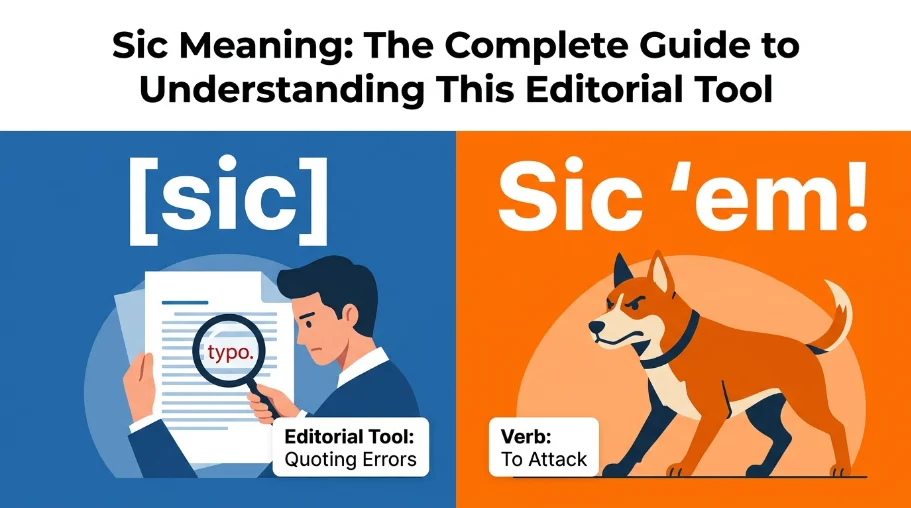
Sic meaning in writing refers to a Latin term meaning “thus” or “so.” Writers place [sic] after a word or passage in a quotation to show that the wording appears in the original source, even if it contains an error or unusual spelling.
Have you ever read a quotation containing an unexpected spelling mistake followed by [sic]? That small editorial marker has a specific purpose: it tells readers that the quoted wording matches the source rather than reflecting an error introduced by the person quoting it.
For example, a writer might quote a sign that reads, “Please do not park hear [sic].” The marker indicates that “hear” appeared in the original sign, even though “here” would normally be correct in that sentence.
Understanding sic meaning can help you read news reports, academic papers, historical documents, and other quoted material more accurately. The term comes from Latin and roughly means “thus” or “so,” signaling that the text should be understood as it appears.
Although [sic] is most familiar in quotations, sic has other uses as a word or verb in different contexts. Recognizing where it appears—and how it functions in the sentence—helps you identify the intended meaning.
Key Takeaway
The main takeaway is that [sic] in a quotation means “intentionally so written . It indicates the preceding word or phrase is an exact reproduction of the original text, errors and all . The purpose is to show readers that the mistake was made by the original author, not by the person quoting them . However, sic can also function as a verb meaning to command a dog to attack or to set someone against another person .
Definitions and Explanations
What Does “Sic” Mean as an Editorial Tool?
The most common sic meaning in modern writing is an editorial notation used in quotations. It is a Latin adverb that translates to “thus” or “so” . It is the abbreviated form of the full Latin phrase sic erat scriptum, which means “thus it was written .
When you place [sic] in brackets after a quoted word, you are telling your reader, “This is exactly how it appeared in the original source.” This is crucial when the original text contains a spelling mistake, a grammatical error, or an unconventional usage that might otherwise look like you made a mistake .
There is an important distinction to make: [sic] is not a correction. It is a flag. It draws attention to the fact that something is off, but it does not fix the issue. It is a way of saying, “The mistake is not mine; it belongs to the person I am quoting.”
| Feature | Description |
| Part of Speech | Adverb (in this context) |
| Origin | Latin, meaning “thus” or “so” |
| Full Phrase | Sic erat scriptum (“thus it was written”) |
| Pronunciation | /sɪk/ (rhymes with “sick”) |
| Purpose | To indicate a verbatim quote, errors included |
What Does “Sic” Mean as a Verb?
The sic meaning as a verb is very different. It is pronounced the same way but has a separate origin and meaning. In this context, sic is a verb that means “to chase or attack” or “to incite to attack .
This usage is most famous in the command “sic ’em!” which people use to urge a dog to pursue or attack someone or something . This variant likely comes from a dialectal pronunciation of the word “seek” .
You can also “sic” someone on another person. This means you are setting someone in authority against them to cause trouble or punishment . For example, an angry person might threaten, “If you don’t pay me back, I’ll sic the lawyers on you.”
| Feature | Description |
| Part of Speech | Verb |
| Meaning | To chase, attack, or incite an attack |
| Origin | A dialectal variant of the word “seek” |
| Common Phrase | “Sic ’em!” |
| Example | “He sicced his dog on me.” |
The Scottish Usage of “Sic”
There is a third, less common usage of sic. In some Scottish dialects, sic is used as an alternative word for “such” . This is a regional variation and is not common in standard English.
False Acronyms
You may come across people who claim sic is an acronym for “spelled incorrectly,” “said in context,” or “spelling is correct.” These are “backronyms”—phrases created to fit an existing word. They are incorrect explanations. The word has a genuine Latin origin, and it does not stand for anything .
| False Acronym | Real Meaning? |
| Spelled Incorrectly | False |
| Said in Context | False |
| Spelling Is Correct | False |
| Latin Adverb Meaning “Thus | True |
Advantages and Disadvantages
Advantages of Using “[sic]”
- Maintains Accuracy: It allows you to quote a source verbatim without altering the original text .
- Protects Your Reputation: It prevents readers from thinking that you are the one who made the spelling or grammar error .
- Provides Transparency: It shows that you are a careful and honest writer who is faithful to the original source.
- Preserves Historical Documents: It can be used to reproduce old-fashioned or non-standard spellings exactly as they appeared .
- Highlights Intentional Errors: It can show that a non-standard spelling is deliberate, as in the case of a brand name like “Aminals” for a funny animal comic .
Disadvantages and Criticisms
- Appears Condescending: Critics argue that using [sic] can make you seem smug or snotty by drawing unnecessary attention to someone else’s mistake . Some editors actively discourage its use for this reason.
- Potential for Ridicule: It can be used as a subtle way to mock the original author .
- Linguistic Discrimination: Overusing [sic] on the work of non-native English speakers can be seen as discriminatory .
- Unnecessary Interruption: It can disrupt the flow of reading for the audience.
Real-World Examples
Examples of “[sic]” in Action
Here are examples showing how to use [sic] in sentences to indicate an error in a quotation .
Example 1: Spelling Error
“The website’s login page read, ‘Please enter your passowrd [sic] to continue.'” Here, [sic] shows the original misspelling of the word “password” is being quoted exactly.Example 2: Grammatical Error
“The company CEO wrote in an email, ‘We need to focus on the customer’s [sic] needs.'” This example shows the incorrect use of an apostrophe in the original.Example 3: Unconventional Usage
“The cartoonist cast back to another strip he had drawn in 1972 as a contribution to a compendium called Funny Aminals [sic]” . This indicates that the unusual spelling is not an error introduced by the writer.Example 4: Name Confusion
“The share price of Maple Leaf Gardens, which owns the Toronto Maple Leafs [sic] hockey team, has risen sharply…” . This confirms that the hockey team is indeed called the “Maple Leafs,” not the “Maple Leaves.”
Examples of “Sic” as a Verb
Example 1: Dog Command
“The police officer commanded the K-9 unit to sic the fleeing suspect.”
Example 2: Setting Someone On Someone
“She threatened to sic the debt collectors on her ex-husband.”
Common Mistakes
Mistake 1: Using “[sic]” Instead of Correcting
Sometimes, writers use [sic] when they should just correct the text. If a quote is full of errors, it is often better to paraphrase the content or silently correct minor typos . The Chicago Manual of Style recommends silently correcting obvious typos without using [sic] .
Correction: Use [sic] sparingly. For minor errors, simply correcting the text is often a better choice.
Mistake 2: Assuming “[sic]” Means “Spelled Incorrectly”
As mentioned earlier, sic is a Latin word, not an acronym. It does not mean “spelled incorrectly.” It means “thus.
Correction: Understand the true meaning: “intentionally so written.” It signals the error is in the original source .
Mistake 3: Using “[sic]” to Correct Regional Spellings
Do not use [sic] to point out a difference in spelling between American and British English (e.g., “color” vs. “colour”) . These are not errors; they are legitimate regional variations.
Correction: Be aware of linguistic differences. Do not use [sic] on legitimate dialect or regional spellings.
Mistake 4: Using “[sic]” Without Brackets
Sic should almost always be placed in brackets [sic] to show it is an editorial addition to the text . Without brackets, it can be confused with the verb or the Scottish adjective.
Correction: Always use brackets when using sic as an editorial note.
Exercises
Exercise 1: Fill in the Blank
Choose the correct form of sic to complete each sentence.
- “The witness said he saw the suspect with a ‘knive [sic].'”
- The homeowner commanded his dog to ______ the intruder.
- She threatened to ______ her legal team on the contractor.
- The sign read, “No tresspassing [sic].”
Exercise 2: Identify the Meaning
Determine whether sic is being used as an editorial notation, a verb, or as a Scottish adjective.
- The report stated, “The company’s profits were down by 20 percent [sic].”
- “If you don’t clean your room, I’ll sic your mother on you.”
- “He was a sic [such] a kind man.”
Answer Key
Exercise 1 Answers:
- sic (editorial, noting a spelling mistake)
- sic (verb, commanding a dog to attack)
- sic (verb, setting someone on another)
- sic (editorial, noting a spelling mistake)
Exercise 2 Answers:
- Editorial notation (pointing out an error in a quote)
- Verb (threatening to set someone on another person)
- Scottish adjective (meaning “such”)
Related Concepts and Comparisons
[Sic] vs. Recte
Recte is another Latin word meaning “rightly” or “correctly.” It is sometimes used as an alternative to [sic]. Instead of just noting an error, recte allows the editor to provide the correction. For example: “He said he was going to ‘recieve [recte receive]’ the package.”
| Term | Meaning | Usage |
| [Sic] | Thus, intentionally so written | Points out an error without correcting it |
| Recte | Rightly, correctly | Provides the correct word or spelling |
[Sic] vs. Silent Correction
Silent correction is the practice of fixing minor errors in a quote without marking them. Many editors prefer this for clarity. For example, you might just change “recieve” to “receive.”
| Method | Meaning | Best For |
| [Sic] | Highlights the error | When the error is important to preserve |
| Silent Correction | Fixes the error | For minor typos to improve readability |
[Sic] vs. Paraphrasing
Paraphrasing is when you restate a quote in your own words. This allows you to avoid errors entirely.
| Method | Meaning | Best For |
| [Sic] | Reproduces verbatim with errors | When accuracy is paramount |
| Paraphrase | Restates the idea | When the exact wording is not important |
Other Uses of “Sic”
The Latin adverb sic is also used in a few common Latin phrases:
- Sic transit gloria mundi: “Thus passes the glory of the world” .
- Sic semper tyrannis: “Thus always to tyrants” .
FAQs
What does “[sic]” mean in writing?
[Sic] means “intentionally so written” . It indicates that the preceding word or passage is an exact reproduction of the original text, including any errors. It tells the reader the mistake was not made by the person quoting it .
What does “[sic]” stand for?
[Sic] does not stand for anything. It is a Latin adverb meaning “thus” or “so . It is not an acronym like “spelled incorrectly.”
How do you pronounce “sic”?
Sic is pronounced “sik,” rhyming with the word “sick” .
When should I use “[sic]”?
Use [sic] when you are quoting text that contains a spelling mistake, a grammatical error, or an unconventional usage that might otherwise look like a mistake on your part . However, use it sparingly to avoid seeming condescending.
Is it rude to use “[sic]”?
It can be. Some people view it as a condescending way to point out another person’s mistake . It is often better to paraphrase or silently correct minor errors rather than using [sic].
What does “sic” mean as a verb?
As a verb, sic means to chase or attack or to incite an attack . It is often used in the command “sic ’em!” to tell a dog to attack.
What is “recte”?
Recte is a Latin word meaning “rightly” or “correctly.” It can be used as an alternative to [sic] to provide the correct word in a quotation .
How do I use “[sic]” properly?
Place [sic] in square brackets directly after the word or phrase in question . Some style guides recommend italicizing it. It should be used sparingly and only when necessary.
Does “[sic]” mean “spelled incorrectly”?
No, that is a common misconception. [Sic] is a Latin word meaning “thus . It does not mean “spelled incorrectly.” The word itself is simply a flag for the reader.
Can I use “[sic]” for a missed word?
Yes, [sic] can be used to indicate any type of error in a quotation, including a missed or incorrect word . For example, you might quote someone who said, “We are go [sic] to the store,” missing the word “going.”
Conclusion
This guide has explored the various meanings of the word sic. As an editorial tool, [sic] means “thus” or “intentionally so written,” and it is used to indicate that a quoted text, errors and all, is exactly as it appeared in the original source . It also has a separate meaning as a verb, “to attack” , and a regional meaning in Scotland as “such.”
The best practical advice is to use [sic] sparingly and with care. While it is a valuable tool for ensuring accuracy in journalism, academia, and legal writing, it should not be used to mock people or to draw unnecessary attention to every minor typo. If you want to be clear and professional, consider alternatives like paraphrasing or silent correction when appropriate. Understanding the true sic meaning will help you become a more careful and credible writer.

Andrew Morris is a writer at Meaninga.com who specializes in word meanings, slang, idioms and modern language trends. He creates clear, accurate and easy to understand content for everyday readers.









22 thoughts on “Sic Meaning in Writing| Why “[Sic]” Appears in Quotes”