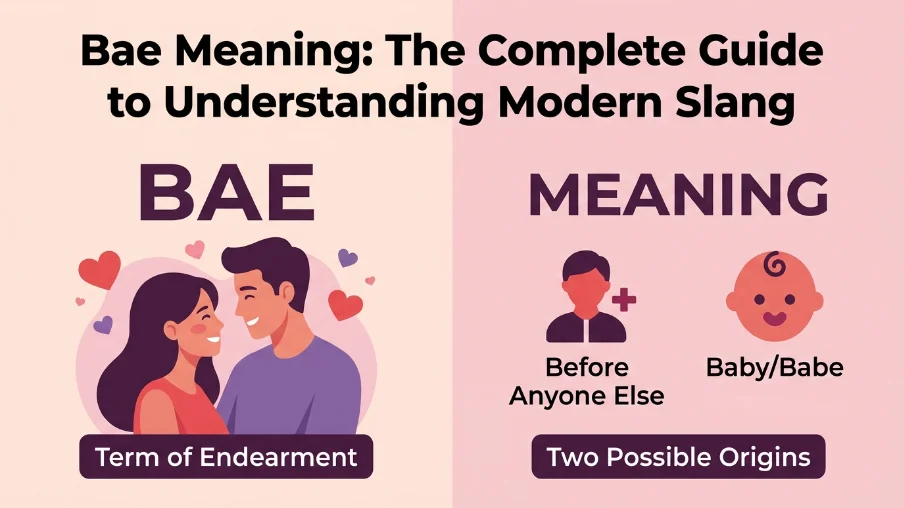
The word “bae” is a slang term of endearment for a romantic partner or significant other . It originated as a shortened form of “baby” or “babe” and became popular in the early 2010s through hip-hop music, social media, and internet memes . While some interpret it as an acronym for “before anyone else,” this is considered a backronym rather than the true origin .
Have you ever scrolled through social media and seen the word “bae” pop up in a post or comment? This three-letter word appears everywhere, from Instagram captions to Twitter threads. However, if you are not familiar with it, the meaning might not be obvious. You might wonder if it is an acronym, a misspelling, or something else entirely.
Understanding the bae meaning matters because this word has become a staple of modern communication. You will see it in text messages, song lyrics, and social media posts. Using it correctly helps you connect with younger audiences and stay current with language trends. It also helps you avoid embarrassing mistakes, like using it in the wrong context.
The challenge with slang terms is that they evolve quickly. What starts as a niche expression can become mainstream in a matter of months. The bae meaning has shifted and expanded since its emergence. Different people use it in different ways. This can create confusion for anyone trying to keep up.
This article clears up the confusion about the bae meaning. You will learn its definition, origins, and how to use it correctly. By the end, you will understand this modern term completely and use it with confidence. Good communication depends on understanding the words you use.
Key Takeaway
The main takeaway is that “bae” is a modern slang term for a romantic partner or someone you love deeply . It has two possible origins: as a shortened form of “baby” or “babe,” or as a backronym for “before anyone else” . The term gained popularity in the early 2010s and remains widely used, particularly among younger generations .
Definitions and Explanation
What Does “Bae” Mean?
The bae meaning is a term of endearment for a significant other, similar to “baby” or “babe . People use it to refer to their girlfriend, boyfriend, spouse, or someone they love deeply. It expresses affection and closeness.
For example, someone might say “I love you, bae!” to their partner in a text message. They might post a photo with the caption “Date night with my bae.” The word conveys warmth and intimacy. It is a casual, affectionate way to address someone important.
The term can also extend beyond people. Some use the bae meaning to describe anything they love. This could include food, pets, or even a favorite hobby. Saying “This pizza is my bae” expresses extreme fondness for pizza.
Is “Bae” an Acronym?
This is a common question about the bae meaning. Many people believe “bae” stands for “before anyone else.” This interpretation is widespread, but it is not the original meaning .
The evidence points to “bae” as a shortened form of “baby” or “babe.” This is the most likely origin . The “before anyone else” interpretation is a “backronym.” This means people created the meaning after the word became popular .
Despite this, the “before anyone else” meaning has become associated with the term. Some people use it intentionally to emphasize that their partner comes first. Both meanings coexist, but the “baby” origin is the more linguistically sound explanation.
| Explanation | Type | Accuracy |
| Shortened from “baby” or “babe” | Origin | Most likely correct |
| “Before anyone else” | Backronym | Not the original, but commonly believed |
The Evolution of the Term
The bae meaning has evolved significantly over time. The term first appeared in Urban Dictionary in 2003, defined as a “bastardization of the term ‘babe'” . It remained a niche term for nearly a decade.
The word gained mainstream popularity in the early 2010s. Several factors contributed to this:
- Hip-hop and R&B music: Artists began using “bae” in their lyrics. This gave the term cultural credibility and exposure .
- Social media: Platforms like Twitter and Instagram spread the term rapidly .
- Internet memes: “Bae caught me slippin'” and “Cooking for bae” memes went viral .
- Mainstream media: Pharrell Williams released the song “Come Get It Bae” in 2014 .
In 2014, “bae” was a runner-up for Oxford Dictionaries’ Word of the Year . This recognition cemented its place in popular culture.
Advantages and Disadvantages
Understanding the bae meaning and how to use it offers advantages. However, there are also potential drawbacks to consider.
Advantages of Using “Bae”
- Connecting with younger audiences: Using modern slang can help you relate to younger generations. It shows you understand their culture and communication style.
- Expressing affection casually: The bae meaning allows you to show affection without sounding overly serious. It is a lighthearted way to express love.
- Staying current: Language evolves constantly. Using current slang helps you stay relevant and engaged with modern communication.
- Social media engagement: Using terms like “bae” can increase engagement on social media. Posts that use current slang often resonate better with audiences.
Disadvantages of Using “Bae”
- Perception of being out of touch: Older generations might not understand the bae meaning. Using it incorrectly can make you seem out of touch or trying too hard.
- Limited to informal contexts: The term is slang and is not appropriate for formal writing. You should not use it in business documents, academic papers, or professional emails.
- Potential for misunderstanding: People may interpret the term differently. Some might see it as affectionate, while others might find it overly casual or even cringeworthy.
- Fading popularity: Slang terms have a limited lifespan. The popularity of “bae” peaked in the mid-2010s. It is now sometimes viewed as slightly dated .
| Aspect | Advantage | Disadvantage |
| Context | Casual, social | Inappropriate for formal writing |
| Audience | Young adults, social media users | May confuse older generations |
| Relevance | Currently widely used | Possibly becoming dated |
| Expression | Affectionate, warm | Can seem overly casual |
Real-World Examples
Seeing the bae meaning in action helps solidify understanding. These examples show how people use the term in real life.
Examples of “Bae” in Romantic Contexts
- “Can’t wait to see my bae tonight.” This expresses excitement about seeing a partner.
- “I love you, bae!” This is a simple, affectionate statement to a significant other.
- “My bae surprised me with flowers today.” This describes an action by a romantic partner.
- “He is my bae and my best friend.” This shows that the person is both a partner and a friend.
Examples of “Bae” for Things
- “This coffee is my bae.” This expresses extreme fondness for coffee.
- “My cat is the only bae I need.” This shows love for a pet.
- This dress is so bae.” This uses “bae” as an adjective meaning “great” or “admirable .
Examples in Media
- Pharrell Williams released a song called “Come Get It Bae” in 2014 .
- The term appeared in JoJo’s song “Leave (Get Out)” as early as 2004 .
- The meme “Bae caught me slippin'” featured people pretending to be asleep in photos posted by their partners .
Common Phrases with “Bae”
| Phrase | Meaning | Context |
| “My bae” | My significant other | Romantic |
| “I love you, bae” | Expressing love | Affectionate |
| “You’re my bae” | You are my loved one | Romantic |
| “This is bae” | This is great | Enthusiasm |
Regional and Global Usage
The bae meaning is understood across many English-speaking regions. However, its usage varies.
United States
The term originated and gained popularity in the United States. It is particularly associated with African-American Vernacular English (AAVE) . In the US, “bae” is most commonly used among young adults and teenagers.
Global English
The bae meaning has spread to other English-speaking countries, including the UK, Australia, and Canada . Its global spread has been facilitated by social media and international music.
A Note on Danish
In Danish, “bae” has an entirely different meaning. It translates to “poop” . This can create amusing misunderstandings between Danish speakers and English speakers.
| Region | Meaning | Context |
| United States | Term of endearment | Standard slang |
| UK | Term of endearment | Less common but understood |
| Denmark | “Poop” | Danish language |
| Australia | Term of endearment | Used in casual contexts |
Common Mistakes
This section highlights frequent errors people make with the bae meaning. Learning about them will help you avoid them.
Mistake 1: Using “Bae” in Formal Writing
The bae meaning is inherently informal. Using it in a professional email, business report, or academic paper is inappropriate. It can make you appear unprofessional or immature.
Correction: Reserve “bae” for casual contexts like text messages, social media, and informal conversations. In formal writing, use terms like “partner,” “significant other,” or the person’s name.
Mistake 2: Using “Bae” Incorrectly as a Noun
“Bae” is a noun. It refers to a person or thing. Some people mistakenly use it as a verb or adjective incorrectly.
Correction: Use “bae” as a noun, as in “He is my bae.” Some also use it as an adjective meaning “great” or “admirable,” as in “This pizza is bae . This usage is acceptable but less common.
Mistake 3: Assuming Everyone Knows the Meaning
Not everyone is familiar with the bae meaning. Using it with someone who does not understand can create confusion.
Correction: Consider your audience before using slang. If you are unsure whether someone will understand the term, use a more common term like “baby” or “partner.”
Mistake 4: Overusing the Term
Like any slang, overusing “bae” can make you sound repetitive or insincere. It can also make you appear less sophisticated.
Correction: Use the term sparingly. Reserve it for moments when you want to express genuine affection or connection.
| Mistake | Incorrect | Correct |
| Formal use | “The report is on my bae’s desk.” | “The report is on my partner’s desk.” |
| Incorrect form | “I bae’d him.” | “He is my bae.” |
| Overuse | “My bae texted me, my bae called me.” | “My bae texted me.” |
Related Concepts and Comparisons
Understanding how “bae” relates to other terms helps build a complete picture.
Bae vs. Baby
Both “bae” and “baby” are terms of endearment. However, they differ in formality and usage.
- Baby is the more traditional and universally understood term. It is suitable for most romantic contexts. It can also address children or pets.
- Bae is a more modern slang term. It is less formal and more casual than “baby.” It is primarily used among younger generations.
| Term | Formality | Age Group | Meaning |
| Baby | Standard | All ages | Term of endearment |
| Bae | Slang | Younger generations | Term of endearment |
Bae vs. Boo
“Boo” is another slang term for a romantic partner. It has been in use since the 1990s and early 2000s. “Boo” is considered somewhat older slang than “bae.” Both terms express affection.
Bae vs. BFF
“BFF” stands for “best friends forever.” It refers to a close friend, not necessarily a romantic partner. The bae meaning is typically romantic, while “BFF” is platonic. However, some use “bae” to refer to close friends in a non-romantic way.
| Term | Meaning | Relationship Type |
| BAE | Before anyone else (often romantic) | Romantic |
| BFF | Best friends forever | Platonic |
| Bae | Term of endearment | Romantic or platonic |
Bae as a Backronym
A backronym is an acronym created after the word already exists. The “before anyone else” interpretation of “bae” is a backronym . It is not the original meaning, but it has become associated with the term. This is a common phenomenon with slang terms. People often create new meanings for words based on their sound or appearance.
Exercises
Test your understanding of the bae meaning with these exercises.
Exercise 1: Fill in the Blank
Choose the correct term to complete each sentence.
- “I can’t wait to see my _________ tonight.” (bae/baby)
- “This pizza is so _________.” (bae/formal)
- “He is my one and only _________.” (bae/bff)
- “_________ is a term of endearment.” (Bae/BFF)
- “I love you, _________!” (bae/partner)
Exercise 2: Identify the Context
Determine whether using “bae” is appropriate in each context.
- A text message to your girlfriend: Appropriate or inappropriate?
- A business report to your boss: Appropriate or inappropriate?
- A social media post about your partner: Appropriate or inappropriate?
- An academic paper on modern slang: Appropriate or inappropriate?
- A casual conversation with friends: Appropriate or inappropriate?
Exercise 3: Correct the Errors
Identify and correct the mistakes in these sentences.
- “I bae’d my partner yesterday.”
- “The report is on my bae’s desk.” (Formal context)
- “My bae, my bae, my bae, I love you my bae!”
Answer Key
Exercise 1 Answers:
- Bae or Baby (both acceptable in casual contexts)
- Bae (adjective form)
- Bae (term of endearment)
- Bae (the subject of the article)
- Bae (casual, affectionate)
Exercise 2 Answers:
- Appropriate (casual, romantic)
- Inappropriate (formal context)
- Appropriate (social media)
- Inappropriate (should use “slang” or “term” instead)
- Appropriate (casual conversation)
Exercise 3 Corrections:
- “I love my bae.” or “I bae’d him” is not standard.
- “The report is on my partner’s desk.” (Formal context)
- “I love you, my bae!” (Avoid overuse)
FAQs
What does bae mean in slang?
“Bae” is a slang term of endearment for a romantic partner or significant other . It expresses affection and closeness. Some also use it to describe things they love, such as food or pets.
Where did the word bae come from?
The bae meaning originated as a shortened form of “baby” or “babe . It first appeared in Urban Dictionary in 2003. The term gained mainstream popularity in the early 2010s through social media, hip-hop music, and viral memes .
Is bae short for anything?
Bae is likely a shortened form of “babe” or “baby” . Many people believe it stands for “before anyone else,” but this is considered a backronym. It was created after the term became popular .
What does bae mean in Danish?
In Danish, “bae” means “poop . This is a completely different meaning from the English usage. It can create amusing misunderstandings between Danish and English speakers.
Is bae still used in 2024?
Yes, bae is still used in 2024, though its popularity has declined since its peak in the mid-2010s . It is now sometimes viewed as slightly dated. However, it remains widely understood and used, especially among younger generations.
Can you call a girl bae?
Yes, you can call a girl bae. The bae meaning is commonly used for female partners. It is also used for male partners, friends, or objects of affection. The term is gender-neutral in practice.
Can you call a guy bae?
Yes, you can call a guy bae. The bae meaning applies to anyone you love or care about. It is commonly used for male partners, female partners, and sometimes close friends.
Is bae a boyfriend or girlfriend?
“Bae” can refer to either a boyfriend or girlfriend. It is a gender-neutral term for a significant other . It does not specify the gender of the person being referred to.
What does bae stand for?
Common interpretations include “before anyone else” and “baby” or “babe” . The “before anyone else” interpretation is considered a backronym, not the original meaning. The most likely origin is a shortened form of “baby” or “babe” .
Is bae used in the UK?
Yes, the bae meaning is understood and used in the UK . It is less common than in the US but still appears in casual contexts. Its usage in the UK has been influenced by American social media and music.
How do you pronounce bae?
“Bae” is pronounced “bay” (rhymes with “say” or “day”) . It has one syllable. The pronunciation is consistent across different dialects.
What does bae mean in a relationship?
In a relationship, “bae” is a term of endearment for a partner . It signifies that the person is special, loved, and prioritized. It is a casual way to express affection.
Conclusion
This guide has clarified the bae meaning and its usage. “Bae” is a modern slang term of endearment for a significant other or something you love deeply. It originated as a shortened form of “baby” or “babe” and gained popularity in the 2010s . While some interpret it as an acronym for “before anyone else,” this is a backronym rather than the true origin .
The best practical advice is to use “bae” sparingly and only in informal contexts. Consider your audience before using it. If you are communicating with younger generations or on social media, the term is appropriate. In formal writing, use more traditional terms like “partner” or “significant other.” Always be mindful of the term’s casual nature and potential to seem dated.
Language evolves constantly, and slang terms come and go. Understanding the bae meaning helps you stay current and communicate effectively with different audiences. Now you have the knowledge to use this modern term confidently and correctly. Good communication depends on understanding the words you choose.




21 thoughts on “Bae Meaning | The Complete Guide to Understanding Modern Slang For 2026”