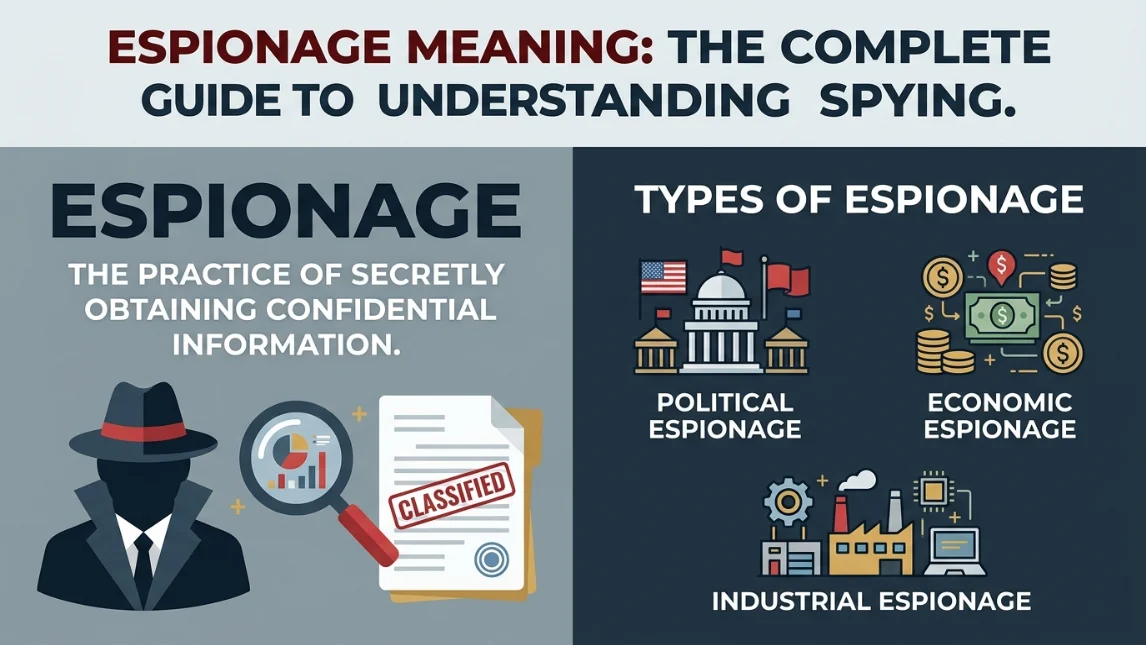
Espionage is the practice of secretly obtaining confidential or classified information without permission. It is often carried out by spies working for governments or corporations to gain military, political, or economic advantages. Espionage is a criminal offense in most countries and carries severe penalties.
Have you ever wondered what espionage really means beyond what you see in spy movies? The term appears in news headlines, legal documents, and international relations discussions. Understanding its meaning helps you grasp how nations and businesses protect their secrets.
Espionage is more common than you might think. Governments around the world use spies to gather information about potential threats and rivals . Companies engage in industrial espionage to steal trade secrets from competitors . The practice has existed for thousands of years and continues to shape global politics and business today .
The confusion around espionage often comes from its portrayal in popular culture. James Bond movies and spy novels dramatize the practice, but real espionage is more complex and less glamorous. Many people also confuse espionage with intelligence, not realizing the terms have distinct meanings .
This article clears up the confusion around espionage once and for all. You will learn the definitions, see real examples, and discover how espionage operates in the modern world. By the end, you will understand this important concept and its role in international affairs.
The main takeaway is that espionage is the clandestine practice of obtaining secret information without permission . It typically involves spies working for governments or corporations to gain military, political, or economic advantages . While espionage is illegal and carries severe penalties, most nations conduct it against each other . The practice differs from intelligence, which is the broader process of gathering and analyzing information .
Definitions and Explanations
What Is Espionage?
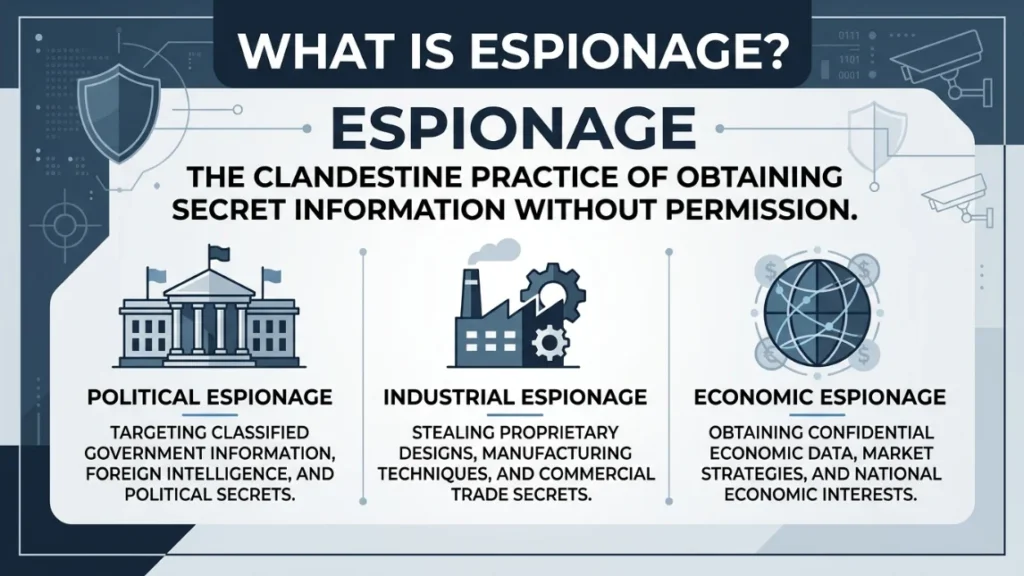
Espionage is the act of secretly obtaining, delivering, or transmitting confidential information without authorization . It is often called spying, and the person who commits espionage is known as a spy or espionage agent .
The practice is clandestine by nature. It involves infiltrating organizations, stealing documents, or using surveillance to gather information. The information obtained can be military, political, economic, or commercial in nature .
One of the most effective ways to gather information is by infiltrating an organization . Spies can return information such as the size and strength of enemy forces. They can also identify dissidents and influence them to provide further information or defect .
Espionage vs. Intelligence
Many people confuse espionage with intelligence, but they are different concepts.
- Espionage traditionally refers to human spies and spying. It involves the covert collection of information through human sources .
- Intelligence is much broader. It encompasses human intelligence, signals intelligence (code-breaking), imagery intelligence, and other technical means .
The purpose of intelligence is to provide policymakers with something extra they cannot obtain from public sources. It helps them know about enemies’ intentions, capabilities, and threats on the horizon .
| Term | Definition | Scope |
| Espionage | Clandestine collection of secret information | Human spies, spying |
| Intelligence | Broader information gathering and analysis | Includes technical and human sources |
Key Characteristics of Espionage
Espionage has several defining characteristics:
- Clandestine: It is secret and covert by nature
- Non-consensual: It involves obtaining information without the owner’s permission
- Confidential: The information targeted is secret or classified
- Intentional: The information is used to benefit the spy’s employer
Types of Espionage
There are several distinct types of espionage :
| Type | Target | Perpetrator |
| Political Espionage | State secrets, military information | Governments |
| Economic Espionage | Trade secrets, proprietary data | States (state-sponsored) |
| Industrial Espionage | Competitors’ confidential information | Corporations (non-state) |
Political espionage involves states obtaining confidential information about other states or non-state actors. Its purpose is to understand capabilities and intentions .
Economic espionage involves states stealing trade secrets from companies in foreign jurisdictions. The information is often passed to domestic companies for competitive advantage .
Industrial espionage involves companies stealing competitors’ confidential information without state support . This is typically a commercial crime.
The Etymology of Espionage
The word “espionage” comes from the French espionnage, meaning the practice of spying . It traces back to the Old French espion (spy) and ultimately to the Old Italian spione . The word has been used in English since the late 18th century.
Advantages and Disadvantages
Advantages of Espionage (From the Perpetrator’s Perspective)
- Strategic advantage: Espionage provides information about enemies’ capabilities and intentions
- Economic benefit: Companies and nations can gain competitive advantages through stolen secrets
- National security: Governments can identify and neutralize threats before they materialize
- Cost-effective: Compared to military action, espionage is a relatively cheap way to gather information
Disadvantages of Espionage (For the Target)
- Loss of secrets: Confidential information falls into the wrong hands
- Economic damage: Companies can lose competitive advantages to rivals
- National security risks: Military secrets can be exploited by enemies
- Trust erosion: Espionage can damage relationships between nations or organizations
Real-World Examples
Historical Espionage Cases
The U-2 Incident (1960)
A US surveillance aircraft was shot down over the Soviet Union while conducting espionage . The pilot was captured and convicted of espionage. This incident highlighted the risks of aerial surveillance and damaged US-Soviet relations.
The Pueblo Incident (1968)
A US Navy intelligence vessel was boarded and captured by North Korean military . The crew was held for 11 months, and the ship remains in North Korean possession. This case demonstrates the dangers of naval espionage.
Modern Espionage Cases
Russian Intelligence Activities
In recent years, Russian intelligence officers have been accused of poisoning former spies using nerve agents . A Russian woman acting as a graduate student also admitted to being an agent while infiltrating political organizations .
The Snowden Revelations
Former NSA contractor Edward Snowden revealed that governments engage in mass surveillance of communications . This raised significant privacy concerns and sparked debates about the limits of espionage.
Corporate Espionage
Trade Secret Theft
Companies often engage in industrial espionage to steal competitors’ trade secrets . For example, Company A might send employees to infiltrate Company B and steal confidential designs. This is criminalized under the Economic Espionage Act of 1996 .
Regional and Global Usage
Global Practice of Espionage
Espionage is practiced by almost all nations worldwide . It is considered a necessary tool for pursuing foreign policy and security interests . States are cautious not to restrict their freedom of action in this field.
United States
The United States defines espionage as obtaining, delivering, or transmitting information about national defense with intent to injure the US or benefit a foreign nation . Espionage is a violation of US law under 18 U.S.C. §§ 792–798 . The US conducts espionage against other nations through the National Clandestine Service .
International Law
There is no general prohibition of espionage in international law . However, espionage activities can violate:
- Sovereignty: Covert intrusion into foreign territory
- Diplomatic relations: Diplomats involved in espionage can be declared persona non grata
- Human rights: Mass surveillance and forced interrogations can violate privacy rights
| Legal Framework | Impact on Espionage |
| International Law | No general prohibition, but rules apply |
| Domestic Law | Criminal offense in most countries |
| Law of Armed Conflict | Spies may lose POW status |
Common Mistakes
Mistake 1: Confusing Espionage with Intelligence
Many people use the terms interchangeably, but they are different. Intelligence is the broader field of gathering and analyzing information. Espionage specifically refers to human spying and clandestine collection .
Correction: Use “espionage” when referring to human spies and spying. Use “intelligence” for the broader field of information gathering, including technical means.
Mistake 2: Thinking Espionage Is Always Legal
Some people believe that because governments conduct espionage, it must be legal. This is false. Espionage is a criminal offense in most countries . Governments prosecute foreign spies under domestic law, even while conducting espionage themselves .
Correction: Understand that espionage is illegal under domestic law. Even when governments conduct it, they do so secretly and face prosecution if caught.
Mistake 3: Confusing Industrial and Economic Espionage
These terms are often used interchangeably, but they have different meanings.
- Economic espionage: State-sponsored theft of trade secrets from foreign companies
- Industrial espionage: Corporate theft of competitors’ confidential information without state support
Correction: Use “economic espionage” for state-backed operations and “industrial espionage” for corporate activities.
Mistake 4: Mispronouncing Espionage
The correct pronunciation is /ˈɛspiəˌnɑːʒ/ or /ˌɛspiəˈnɑːʒ/ . Common mispronunciations include “es-pyon-age” and “es-pee-oh-nage.”
Correction: The emphasis is on the first syllable. It rhymes with “espionage” (ES-pee-uh-nahzh) or (es-pee-uh-NAHZH).
Related Concepts and Comparisons
Espionage vs. Spying
These terms are synonyms. Spying is the act of conducting espionage . The main difference is that espionage is often used for the practice or profession, while spying is the act itself.
| Term | Meaning |
| Espionage | The practice of spying |
| Spying | The act of gathering secret information |
Espionage vs. Counterintelligence
Counterintelligence is the practice of thwarting enemy espionage . While espionage involves gathering secrets, counterintelligence involves protecting secrets and catching spies.
| Term | Purpose |
| Espionage | Gather secret information |
| Counterintelligence | Prevent espionage |
Espionage vs. Reconnaissance
Reconnaissance involves gathering information openly, usually by military units . Unlike espionage, reconnaissance is not clandestine and is considered a legitimate military activity.
| Term | Method | Legality |
| Espionage | Clandestine | Illegal |
| Reconnaissance | Open | Legal |
Exercises
Exercise 1: Fill in the Blank
Choose the correct word to complete each sentence.
- The government accused the diplomat of committing _________.
- _________ is the broader field of gathering and analyzing information.
- _________ espionage involves states stealing trade secrets from foreign companies.
- _________ espionage involves companies stealing competitors’ secrets.
Exercise 2: Identify the Type
Identify the type of espionage described in each scenario.
- A government agent steals military plans from an enemy country.
- A Chinese company steals technology from an American competitor.
- The Russian government steals trade secrets from a US company.
Exercise 3: True or False
- Espionage is legal under international law.
- Intelligence and espionage are the same thing.
- Industrial espionage is a commercial crime.
- Most nations conduct espionage against each other.
Answer Key
Answers of Exercise 1:
- Espionage
- Intelligence
- Economic
- Industrial
Exercise 2 Answers:
- Political espionage (state-sponsored, military)
- Industrial espionage (corporate, non-state)
- Economic espionage (state-sponsored, trade secrets)
Exercise 3 Answers:
- False (It is illegal under domestic law, though no general international prohibition exists )
- False (They are related but distinct concepts )
- True (It is a commercial crime )
- True (Almost all nations conduct espionage )
FAQs
What is the meaning of espionage?
Espionage means the practice of secretly obtaining confidential or classified information without permission . It is often carried out by spies working for governments or corporations to gain military, political, or economic advantages .
What is the difference between espionage and spying?
They are synonyms. Spying is the act of conducting espionage . Espionage is often used for the practice or profession, while spying is the action itself.
What is the difference between espionage and intelligence?
Espionage traditionally refers to human spies and spying . Intelligence is broader and includes technical means like signals intelligence and imagery intelligence .
Is espionage illegal?
Yes, espionage is a criminal offense in most countries . In the United States, it is a federal offense under 18 U.S.C. §§ 792–798 . Penalties can include imprisonment or death .
What is industrial espionage?
Industrial espionage involves companies stealing confidential information from competitors for commercial advantage . It is a commercial crime and is criminalized under the Economic Espionage Act of 1996 .
What is economic espionage?
Economic espionage involves states stealing trade secrets from companies in foreign jurisdictions . The information is often passed to domestic companies for competitive advantage .
Do all countries conduct espionage?
Almost all nations conduct espionage against other nations . It is considered a necessary tool for pursuing foreign policy and security interests .
What happens to spies if they are caught?
Spies captured while engaging in espionage may be prosecuted under domestic law . Under the law of armed conflict, they may lose prisoner-of-war status . However, they must be treated humanely and cannot be punished without a fair trial .
What is counterintelligence?
Counterintelligence is the practice of thwarting enemy espionage and intelligence-gathering . It involves protecting secrets and catching spies.
Is espionage covered by international law?
There is no general prohibition of espionage in international law . However, espionage activities can violate sovereignty, diplomatic relations, and human rights .
Conclusion
This guide has clarified the meaning and importance of espionage in modern society. Espionage is the clandestine practice of obtaining secret information without permission. It is carried out by governments and corporations to gain military, political, or economic advantages. While espionage is illegal in most countries, it remains a common practice in international relations.
The best practical advice is to understand the different types of espionage and their implications. Political espionage involves state secrets and national security. Economic espionage involves state-sponsored theft of trade secrets. Industrial espionage involves corporate theft of competitors’ information. Each type has distinct legal and ethical considerations.
Understanding espionage helps you grasp how nations and businesses operate in the modern world. It sheds light on international conflicts, corporate competition, and the balance of power. Now you have the knowledge to understand this complex topic. Use this guide as a reference whenever you encounter the term in news, legal documents, or business discussions.

Andrew Morris is a writer at Meaninga.com who specializes in word meanings, slang, idioms and modern language trends. He creates clear, accurate and easy to understand content for everyday readers.










14 thoughts on “Espionage Meaning| The Complete Guide to Understanding Spying in 2026”