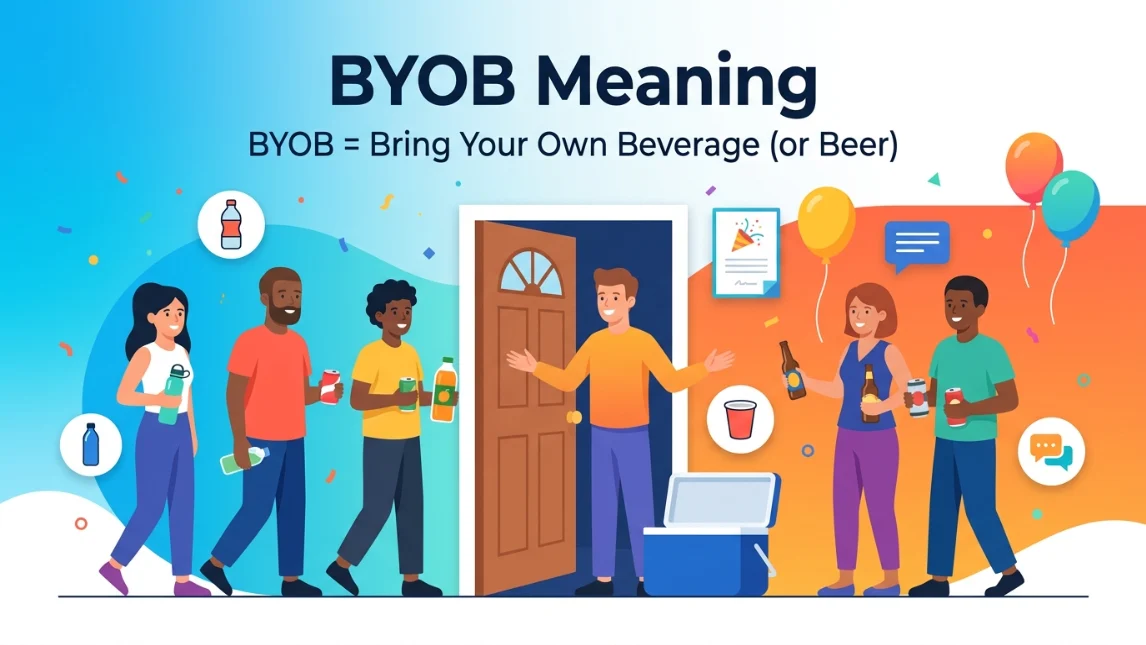
The BYOB meaning stands for “Bring Your Own Beverage” or “Bring Your Own Beer.” Hosts use this acronym on event invitations to notify guests that they must supply their own drinks, such as alcohol, soda, or water, for the gathering.
Understanding the BYOB meaning helps you navigate social invitations, house parties, and casual events without experiencing awkward misunderstandings. When you receive an invitation with these four letters, the host communicates a clear expectation regarding drink supplies. While the phrase historically referred specifically to alcoholic beverages, modern social standards apply the term broadly to any personal drink preference. Consequently, knowing how to interpret this rule ensures you show up as a polite, prepared, and welcome guest.
Quick Answer Summary
| Metric | Details |
| Meaning | Bring Your Own Beverage / Bring Your Own Beer |
| Context | House parties, casual dinners, outdoor barbecues, and budget weddings |
| Primary Platforms | iMessage, Snapchat, TikTok, Instagram, and paper invitations |
| Example | “Party at my house on Saturday at 8 PM! It is BYOB, so grab whatever you want to drink.” |
| Tone | Casual, direct, informative, and economical |
What Does BYOB Meaning Signal to Event Guests?
The acronym BYOB originated in the mid-twentieth century as casual social gatherings became popular across American suburban culture. Originally, the term served as a practical note on written invitations to let guests know that alcohol would not be provided by the host. Over time, the phrase secured its spot in standard American English as a universal social policy.
Understanding the core BYOB meaning requires recognizing both its literal definition and its cultural function. Literally, the acronym translates to one of three common variations:
- Bring Your Own Beverage: The broadest and most modern interpretation, covering everything from craft beer to seltzer, soda, and juice.
- Bring Your Own Beer: The traditional variation commonly used among college students and casual partygoers.
- Bring Your Own Bottle: A variation often applied to wine-centric dinners or spirits-based gatherings.
Beyond the literal words, the term serves as a practical social boundary. Organizers set clear expectations about party finances, catering limits, and personal consumption. When hosts include this acronym, they remove the guesswork surrounding drink availability. Furthermore, it protects hosts from the high costs of stocking a full bar for a large group of people.
Contextual Dynamics & Nuances of the Term
While the foundational BYOB meaning remains consistent, its practical application shifts based on the event context, age demographic, and location. Knowing how to read between the lines keeps you from making social faux pas.
| Event Type | Invitation States BYOB | Invitation Does Not Mention BYOB |
| Casual House Party | Bring your own drinks, extra ice, and a portable cooler if needed. | The host typically provides drinks, but bringing a small gift or extra drinks to share is polite. |
| Seated Dinner Party | Bring a bottle of wine or your preferred drink and hand it to the host upon arrival. | The host pairs drinks with dinner, but bringing a bottle of wine as a host gift is standard. |
| Restaurant Meal | Venue allows you to bring personal wine or beer; check for potential corkage fees. | Restaurant serves its own drinks from a licensed bar; outside drinks are strictly prohibited. |
| Outdoor Barbecue | Guests supply their own drink cans, seltzers, and personal ice supplies. | Host provides basic drinks like water and soda, but guests often bring extra beverages to share. |
Casual House Parties vs. Formal Dinners
At a casual house party, guests bring multi-packs of beer, hard seltzers, or canned cocktails. Guests usually store their drinks in a shared cooler or main kitchen refrigerator. However, at a seated dinner party, bringing your own bottle of wine requires a different protocol. You should hand the wine directly to the host as a gesture of appreciation, even if you intend to consume it during the meal.
Restaurant Policy Standards
In the restaurant industry, the BYOB meaning takes on a legal and financial dimension. A restaurant labeled as a BYOB establishment allows patrons to bring their own wine or beer from home because the venue lacks a liquor license. However, restaurants often charge a small service fee known as a corkage fee to open and serve your personal bottles. Always call ahead to verify if the establishment permits liquor or only beer and wine.
Weddings and Large Events
Budget-friendly weddings frequently utilize this approach to cut down on catering expenses. When a wedding invitation uses this phrasing, guests should follow strict guidelines regarding what containers are allowed. Glass bottles may be restricted at outdoor venues, making cans or boxed wine a safer option.
Real-Life Conversation Examples Using BYOB
Understanding how people use the phrase in daily text messaging makes communication seamless. Here are five distinct, realistic conversation scenarios demonstrating natural usage.
1: Planning a Weekend House Party
- Alex: “Hey Mark! Are you coming to the bonfire at my place this Saturday around 7 PM?”
- Mark: “Definitely! Do I need to bring anything, or are you covering drinks?”
- Alex: “We have plenty of food and snacks, but the event is BYOB. Bring whatever you want to sip on!”
- Mark: “Sounds great, I will grab a six-pack of IPA on my way over.”
2: Casual Friday Night Game Night
- Sarah: “Game night starts at 8! We are ordering pizza.”
- Jessica: “Awesome! Should I bring wine?”
- Sarah: “Yes please! It is BYOB night. I have plenty of water and sodas, but bring your favorite wine.”
- Jessica: “Perfect, I will bring a bottle of Pinot Noir.”
3: Checking Restaurant Rules
- David: “Have you tried that new Italian spot downtown yet?”
- Chris: “Yeah, the food is incredible! Just remember it is a BYOB restaurant, so grab a bottle of red wine before we go.”
- David: “Good call! Do they charge a corkage fee?”
- Chris: “Just five dollars per bottle, which is totally worth it.”
4: Outdoor Park Barbecue
- Taylor: “Setting up the grill at the park right now. Come through whenever!”
- Jordan: “On my way! Is it BYOB or did you buy group drinks?”
- Taylor: “Total BYOB situation today. Make sure to bring your own ice cooler if you can.”
- Jordan: “Got it. Bringing a cooler and extra seltzers for everyone.”
5: College Campus Gathering
- Sam: “Study group is wrapping up. Anyone heading to the apartment party on Elm Street?”
- Morgan: “I am! Is it open bar or BYOB?”
- Sam: “Definitely BYOB. Grab your own drinks before heading over!”
- Morgan: “Thanks for the heads up. Stopping by the store now.”
Platform-Specific Breakdown
Online communication platforms feature distinct styles for event planning and casual text slang. The core BYOB meaning stays the same, but the delivery changes across apps.
| Social Platform | Primary Format | Typical Usage & Style |
| Snapchat | Image & Video Snaps | Added as text overlays on photos of party locations alongside drink emojis. |
| TikTok | Short Videos & Reels | Featured in host budget tutorials, party etiquette guides, and event prep clips. |
| Posts & Stories | Printed on visual digital invitations, event flyers, and broadcast announcements. | |
| Texting / iMessage | Direct Messages | Used as quick shorthand in group chats to inform guests of drink policies instantly. |
How It Is Used on Snapchat
Snapchat users frequently leverage quick photo invites, story updates, and group chats to plan spontaneous get-togethers. On Snapchat, users drop the term into image captions or text overlays on photos of party setups.
Because Snapchat relies heavily on visual speed, the acronym communicates rules instantly without cluttering the screen image. Furthermore, group snaps use the term alongside emojis like beer mugs or party poppers to keep the tone light and welcoming.
The Role of BYOB on TikTok
TikTok creators often use the term in party planning tutorials, budget hosting hacks, and comedic social commentary videos. Hashtags like #BYOB trend around holiday weekends and graduation seasons.
Creators share videos explaining proper guest etiquette, such as:
- Never drinking someone else’s brought stash without asking.
- Leaving unused drinks behind as a host tip.
- Packing proper coolers for outdoor festivals.
Consequently, TikTok serves as an educational hub for younger generations learning how to navigate social gathering rules.
Instagram and Texting Dynamics
On Instagram, event flyers posted to main feeds or Stories feature the term prominently in the lower details section. Event organizers use clean typography to list essential information: Date, Time, Location, and BYOB status.
In direct SMS texting or iMessage group chats, the phrase acts as a shorthand code. It sets clear boundaries without requiring lengthy explanations about catering budgets or shopping trips.
Alternative Meanings & Semantic Variations
While drink-related definitions dominate social usage, alternative contexts exist where the acronym stands for different phrases. Knowing these variations prevents confusion in specialized professional environments.
| Acronym Variation | Context / Industry | Meaning & Definition |
| Bring Your Own Bottle | Wine & Dining | Refers specifically to wine or liquor bottles brought to meals. |
| Bring Your Own Beverage | General Social | Universal term covering all non-alcoholic and alcoholic drinks. |
| Bring Your Own Beer | Casual Parties | Traditional variation focused primarily on beer consumption. |
| Bring Your Own Bag | Retail & Environment | Environmental policy encouraging reusable shopping bags. |
| Be Your Own Boss | Entrepreneurship | Business motto promoting self-employment and freelancing. |
In corporate settings, consultants sometimes use “Be Your Own Boss” to promote independent contracting. Similarly, environmental retail initiatives use “Bring Your Own Bag” to reduce single-use plastic waste at grocery checkout lanes. Always consider the surrounding context to determine which variation applies.
Misinterpretations: When NOT to Use BYOB
Using the term incorrectly can create social awkwardness or breach formal etiquette standards. Avoid using this phrase in the following scenarios:
High-End Formal Events
Including the term on invitations for formal galas, upscale weddings, or corporate award dinners appears unprofessional. Formal events require hosts to provide full beverage service or offer a clearly defined paid cash bar.
Events Without Alcohol Clearances
If you host an event at a rented hall or public park that strictly prohibits alcohol, putting this phrase on the invite creates legal risks. Guests will assume alcohol is permitted, which might lead to fines or event shutdown by park rangers or security staff.
Events Focused on Children
Never use the phrase for kids’ birthday parties or family-oriented daytime events unless you specifically clarify that it applies strictly to non-alcoholic beverages like sodas or iced tea.
How to Respond in Chat Comfortably
When a friend or host sends you an invitation containing the term, responding appropriately shows good communication skills and polite etiquette. Here are several natural ways to reply depending on your plans:
1: Confirming You Will Bring Drinks
“Got it! Thanks for letting me know. I will grab a pack of seltzers on my way over. Need me to pick up extra ice too?”
2: Offering to Share
“Sounds great! I am bringing a bottle of wine and extra beers to share with the group. See you at 8!”
3: Asking for Clarification
“Perfect! Are glass bottles okay, or should I stick to cans for the backyard pool?”
4: Non-Alcoholic Response
“Understood! I will bring my own flavored waters and sodas. Excited for tonight!”
FAQs
What is the primary BYOB meaning on party invitations?
The primary BYOB meaning on an invitation is “Bring Your Own Beverage” or “Bring Your Own Beer.” It informs attending guests that the host will not supply personal drinks, so guests must bring whatever beverages they plan to consume.
Do I have to bring alcohol if an event is labeled BYOB?
No, you do not have to bring alcohol. You can bring soda, juice, sparkling water, or iced tea. The rule simply means the host is not supplying individual drinks, so you should bring whatever you personally prefer to drink.
Is it polite to drink other people’s drinks at a BYOB party?
No, it is considered poor party etiquette to consume drinks brought by other guests without explicit permission. Always ask before taking a beverage from someone else’s personal cooler or bag.
Should I leave leftover drinks at the host’s house?
Yes, leaving unopened leftover drinks behind is standard polite etiquette. It acts as a small thank-you gift to the host for opening up their home and providing venue space, food, or entertainment.
What does BYOB mean when applied to restaurants?
In a restaurant context, it means the venue allows customers to bring their own wine or beer to pair with their meal. This usually happens when a restaurant does not hold a commercial liquor license.
What is a corkage fee at a BYOB restaurant?
A corkage fee is a small service charge assessed by a restaurant to open, pour, and serve the wine or beer you brought from home. The fee covers glass rental and service staff effort.
How does the BYOB meaning differ from BYO?
The terms are virtually identical in practice. BYO stands for “Bring Your Own,” while adding the “B” specifies “Beverage,” “Beer,” or “Bottle.” Both phrases convey the exact same host expectation.
Can I bring liquor to a BYOB event?
It depends on the venue and host. Casual house parties usually allow hard liquor, but many BYOB restaurants restrict guests strictly to beer and wine due to local insurance regulations.
What should I transport my drinks in when attending?
Bring your drinks in a small portable cooler, insulated bag, or sturdy cardboard carrier. If you bring items that require refrigeration, ask the host where to store them upon arrival.
Is using BYOB on wedding invitations considered acceptable?
It is acceptable for casual, rustic, or budget-friendly outdoor weddings. However, formal weddings usually avoid the term, opting instead for a hosted bar or a clearly stated cash bar setup.
Conclusion
The BYOB meaning has evolved from an old-fashioned party acronym into a permanent staple of modern communication across texting, social media, and hospitality. By clearly defining roles between hosts and attendees, the phrase eliminates social confusion and keeps event planning budget-friendly. Whether you are typing a quick Snapchat caption, reading an Instagram event flyer, or heading to a local neighborhood restaurant, knowing these social rules ensures you remain a thoughtful and prepared guest every time.



1 thought on “BYOB Meaning| The Ultimate Guide to Meaning for 2026”