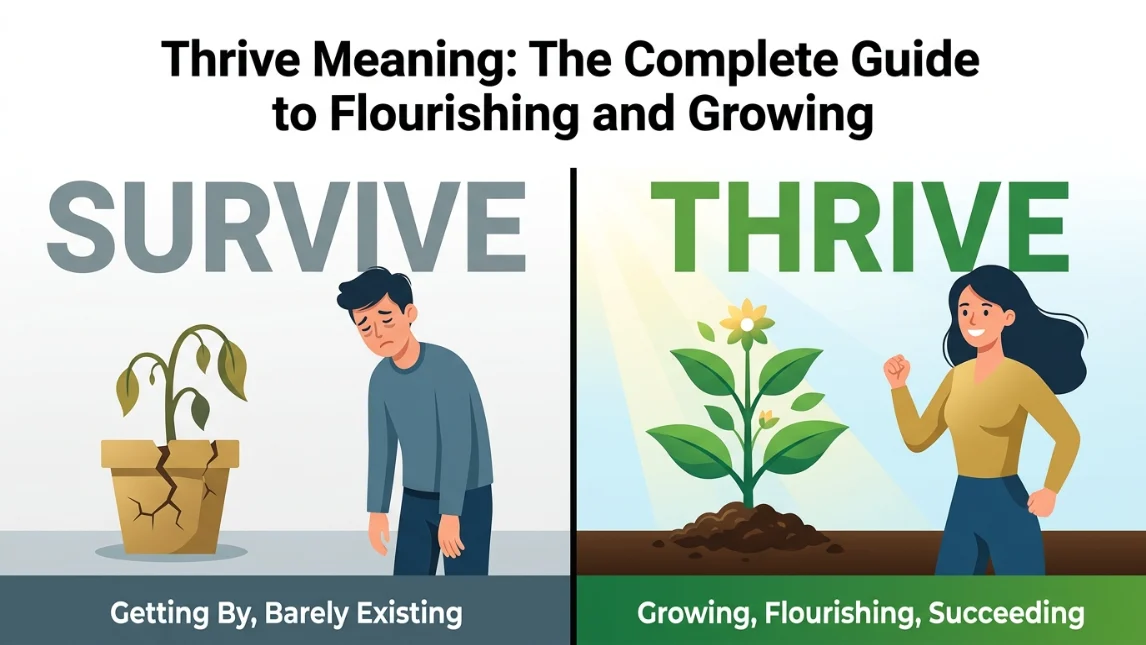
The meaning of thrive is to grow vigorously, develop successfully, or prosper. It describes doing more than just surviving — thriving means to flourish, excel, and reach a state of healthy, active success . While survival is about getting by, thriving is about living life to its fullest potential.
Have you ever felt like you are just getting through the day rather than truly living? This feeling is common, but it points to a deeper distinction. Many people confuse surviving with thriving, but the two are fundamentally different. The word “thrive” represents a state of flourishing, growth, and success that goes far beyond basic existence.
Understanding the thrive meaning is important because it changes how you approach life. It shifts your focus from merely coping to actively creating a life of purpose and fulfillment. This concept applies to plants, businesses, and people . When you understand what it means to thrive, you can begin to move from a survival mindset to one of growth and possibility.
The confusion often comes from thinking that thriving requires perfect circumstances. However, as Tony Robbins explains, thriving isn’t about waiting for perfect conditions . It is about choosing to become the creator of your life, no matter what is happening around you. This article explores the thrive meaning, its contrasts with surviving, and how you can apply it to your own life.
The main takeaway is that “thrive” means to grow, develop, and succeed vigorously . It is a verb that describes a state of flourishing and prosperity, whether for a plant, a business, or a person . The contrast with “survive” is crucial: surviving means staying alive, while thriving means living well and reaching your full potential . To thrive is to not just exist, but to excel.
Definitions and Explanations
What Is the Thrive Meaning?
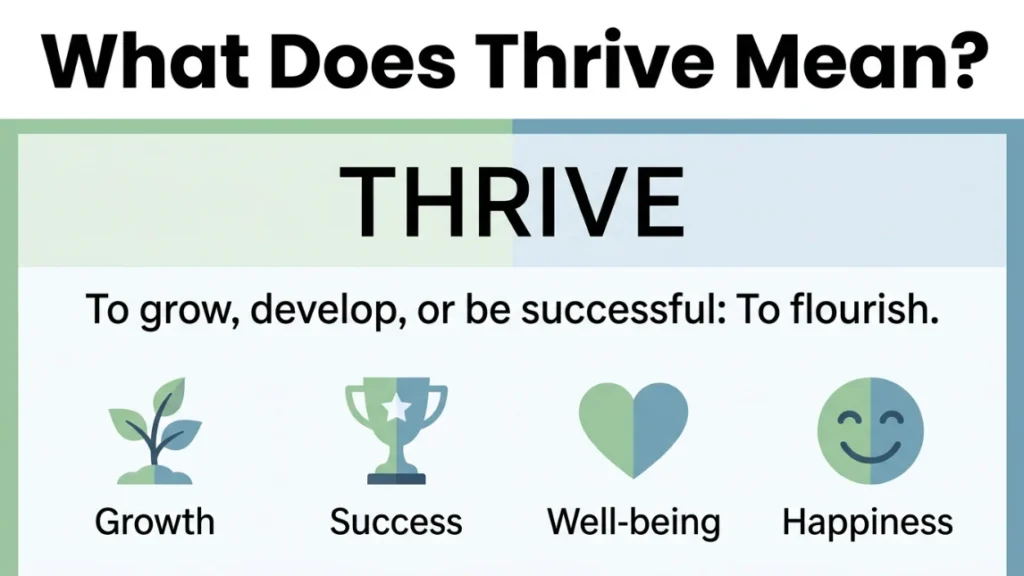
The core thrive meaning is to grow or develop successfully, to flourish, or to prosper . The word “thrive” is a verb, and it can be applied to a person, a business, a community, or even a plant. For example, you might say a business is thriving because it is growing and making money. Similarly, you might say a child is thriving because they are healthy and developing well.
The thrive meaning also includes the idea of doing well in a specific environment. This is often expressed with the phrase “thrive on.” For instance, some plants thrive in the desert , and some people actually thrive on stress . This means they do particularly well in those conditions, even if others might find them difficult.
| Aspect | Thrive Meaning |
| Core Definition | To grow or develop vigorously and successfully |
| Synonyms | Flourish, prosper, succeed, bloom, boom |
| Antonyms | Decline, languish, wither, fail |
| Part of Speech | Verb |
Thrive vs. Survive
To understand the thrive meaning, it is helpful to compare it to its opposite: “survive.” The most important distinction between the two is the level of fulfillment and growth.
- Survive means to continue to live or exist, often in spite of difficult conditions . It is about getting by, managing to stay alive, and not failing. Survival focuses on meeting basic needs.
- Thrive goes far beyond survival. It means to not just live, but to live well . It is about growing, developing, and prospering. Thriving means you are healthy, successful, and flourishing in your environment .
Think of a plant. A plant that just gets enough water to stay alive is surviving . A plant that grows tall, produces flowers, and spreads its seeds is thriving . Similarly, a person who is just getting through their day is surviving, while a person who is pursuing their passions, building relationships, and feeling fulfilled is thriving .
The Verb “Thrive” and Its Forms
The verb “thrive” has a few different forms. Understanding these can help you use the word correctly in different tenses. The base form is “thrive,” and the third-person singular present tense is “thrives” .
- Base Form: thrive
- Past Tense: thrived or throve
- Past Participle: thrived or thriven
- Present Participle: thriving
| Base Form | Past Tense | Past Participle | Present Participle |
| Thrive | Thrived / Throve | Thrived / Thriven | Thriving |
Advantages and Disadvantages
Advantages of a Thriving Life
Choosing to thrive rather than just survive offers many advantages. It leads to a life that feels more meaningful and fulfilling.
Purpose and fulfillment: When you thrive, you are often pursuing a purpose or a vision. This gives your life a sense of direction. It allows you to feel like you are making a difference in the world .
Resilience and growth: Thriving people develop resilience. They can face challenges and use them as opportunities to grow. Adversity becomes a catalyst for progress, not a roadblock .
Stronger relationships: Thriving involves building strong, high-quality relationships. These relationships provide support, joy, and satisfaction . A support network is a key component of a thriving life.
Better mental and emotional well-being: Thriving is directly linked to improved mental health. Intentional practices like stress management and cultivating a positive outlook are part of thriving . It helps you feel more engaged, connected, and capable .
Disadvantages of a Survival Mindset
A survival mindset has its place in a crisis. However, it can become a disadvantage if you stay in it for too long.
Limited growth: A survival focus means you are always reacting to immediate threats. You may take the highest paying job instead of the one with better long-term potential . It can prevent you from making choices that lead to growth and fulfillment.
Missed opportunities: When you are focused on just getting by, you can miss opportunities for connection and contribution. Survival can make you more selfish, whereas thriving often involves helping others .
Stress and burnout: The survival mindset is inherently stressful. It is a constant state of alert. Thriving, on the other hand, involves managing stress and building resilience to avoid burnout .
Comparison of Thrive vs. Survive
| Aspect | Survive | Thrive |
| Goal | To continue existing | To live well and achieve potential |
| Mindset | Reactive, managing crisis | Proactive, creating purpose |
| Energy | Depleted, focused on basic needs | Abundant, focused on growth |
| Relationships | Less important | Essential for connection |
| Outcome | Getting by | Flourishing and success |
Real-World Examples
Examples of “Thrive” in Different Contexts
Business:
- The company is thriving under its new leadership.” This means the company is successful and growing.
- “Since expanding, the business has really thrived” . This shows an increase in health and success.
Nature:
- “Plants that thrive in the desert” . This means the plants grow well in that specific environment.
- “The deer population in this town is thriving” . This means the population is growing and healthy.
Personal Life:
- “Children can thrive if they eat well and exercise” . This describes healthy development.
- “He thrives on stress” . This means he does particularly well in high-pressure situations.
Health and Wellness:
- The baby is thriving.” This means the baby is growing and developing at a healthy rate .
- Thriving isn’t about the absence of stress, but having the capacity to meet life’s challenges with resilience .
Famous Quotes and Usage
Many thinkers and leaders have spoken about the concept of thriving. Their words capture the power of the thrive meaning.
- Tony Robbins: “We are meant to be the creators of our lives… We’re not made to merely survive – we’re made to thrive.”
- Albert Einstein: “Crisis is the greatest blessing for people and nations, because crisis brings on progress… It’s in crisis that inventive discoveries and great strategies rise.” This supports the idea that thriving involves growing through adversity.
Regional and Global Usage
Global Consistency
The thrive meaning is consistent across all English-speaking regions. Whether you are in the United States, the United Kingdom, Australia, or Canada, the word “thrive” carries the same core definition: to grow, prosper, and flourish . The uses and contexts are also universally understood. A thriving business in London is the same as a thriving business in New York.
Formal and Informal Usage
“Thrive” is a versatile word used in both formal and informal contexts . In formal writing, it appears in academic papers, business reports, and health literature. For instance, “the business is thriving” is a professional statement. In informal conversation, it is used to describe personal growth and success. “I’m thriving at my new job” is a casual and positive statement.
Common Mistakes
Mistake 1: Confusing “Thrive” with “Survive”
The most common mistake is using “thrive” when you really mean “survive,” or vice versa. Surviving is about getting by, while thriving is about flourishing. If you say a company is surviving, it is struggling to stay open. If you say it is thriving, it is successful and growing. The difference is crucial . Use “thrive” only when you are talking about a state of active, positive growth.
Mistake 2: Using “Thrive” Incorrectly in Tenses
“Thrive” is an irregular verb, which can lead to errors in tense. The correct past tenses are “thrived” or “throve” . Many people incorrectly use “thriven” for the simple past, but it is actually a past participle . For example, you should say, “The plant thrived in the sun,” not “The plant thriven in the sun.”
Mistake 3: Missing the Phrasal Verb “Thrive On”
A key part of the thrive meaning is the phrasal verb “thrive on.” It means to do very well because of a specific situation. Incorrectly using “thrive in” or “thrive with” when you mean “thrive on” can change the meaning. For example, “She thrives on challenges” is correct if challenges make her better . “She thrives with challenges” is less specific and less powerful.
Exercises
Exercise 1: Identify the Meaning
Determine whether the sentence describes “thriving” or “surviving.”
- A business that is struggling to pay its bills.
- A garden that is full of blooming flowers.
- A person who is just getting through the day.
- An economy that is growing and creating new jobs.
- A student who is learning, making friends, and feeling engaged.
Exercise 2: Fill in the Blank
Complete each sentence with the correct word: thrive, thrives, thrived, or thriving.
- The new restaurant is _________ because of its great reviews.
- The company _________ under the new CEO’s leadership last year.
- Many people _________ on a busy and challenging schedule.
- It is a pleasure to see the children _________ at their new school.
Exercise 3: Choose the Best Synonym
Select the most appropriate synonym for “thrive” in each sentence. Choose from: Flourish, Survive, or Decline.
- The local economy is beginning to _________. (Hint: New businesses are opening.)
- The old tree is starting to _________. (Hint: It is losing its leaves.)
- The rescue team was able to _________ in the wilderness. (Hint: They found food and water.)
Answer Key
Answers of Exercise 1:
- Surviving (struggling)
- Thriving (blooming)
- Surviving (just getting through)
- Thriving (growing)
- Thriving (engaged, active growth)
Exercise 2 Answers:
- thriving (present participle)
- thrived (or throve) (simple past)
- thrive (base form)
- thrive (base form)
Exercise 3 Answers:
- Flourish (new businesses indicate success)
- Decline (losing leaves shows weakening)
- Survive (finding food and water is about staying alive)
Related Concepts and Comparisons
Thrive vs. Flourish
The words “thrive” and “flourish” are often used interchangeably. Both describe a state of growing and doing well . However, “flourish” sometimes has a more artistic or beautiful connotation, like a plant blooming . “Thrive” is a broader term that includes financial success, health, and development. In practice, they are very similar and can usually be used in the same contexts.
Thrive vs. Prosper
“Prosper” and “thrive” are also closely related. “Prosper” often has a strong financial or material focus. A business prospers when it makes a lot of money . Thrive” has a more holistic meaning, encompassing emotional, physical, and social well-being . While a person can prosper financially, they thrive when they are also healthy and happy. The thrive meaning is more about overall fulfillment.
| Term | Focus | Connotation |
| Thrive | Overall well-being and growth | Holistic and broad |
| Flourish | Vigorous and healthy development | Often artistic or natural |
| Prosper | Financial or material success | Economic and business-focused |
| Survive | Continuing to exist | Bare minimum for staying alive |
FAQs
What is the exact meaning of “thrive”?
The exact thrive meaning is to grow, develop, or be successful . It means to flourish and prosper, going beyond just surviving to live a full and healthy life .
How do you use “thrive” in a sentence?
You can use “thrive” in many ways. For example, “Children thrive in a loving environment.” You can also say, “The business is thriving” or “She thrives on challenges.” It is a verb that describes active and successful growth .
What is the difference between “thrive” and “survive”?
The key difference is the level of success. Survive means to stay alive or continue to exist . Thrive means to do more than survive, to flourish and grow . Thriving is about living well, while surviving is about just getting by.
Is “thrive” a positive word?
Yes, “thrive” is a very positive word. It always describes a good outcome. It is used to talk about success, health, growth, and well-being. The thrive meaning is inherently optimistic and aspirational .
What does it mean to thrive on something?
To thrive on something means to do particularly well in a specific situation. For example, “Some plants thrive on neglect,” meaning they grow well even when not cared for intensely . It also means a person can “thrive on stress,” meaning they perform best under pressure .
What are the synonyms for thrive?
There are many synonyms for “thrive.” Common ones include: flourish, prosper, succeed, boom, grow, and bloom . These words all describe a state of active and successful development.
What is the past tense of thrive?
The past tense of “thrive” can be either thrived or throve . Both are considered correct. The past participle can be thrived or thriven .
Can a person thrive in difficult circumstances?
Yes, a person can thrive in difficult circumstances. Thriving is about having the resilience to grow through challenges, not avoiding them . Adversity can be a catalyst for growth and lead to thriving .
How is thriving different from just being successful?
Thriving is broader than just being successful. Success can be a financial achievement, like making a lot of money. Thriving includes that, but also includes emotional, social, and physical well-being . It is about overall fulfillment and health, not just one aspect of life.
Conclusion
This guide has explained the full thrive meaning and its importance in life. To thrive is to flourish, grow vigorously, and be successful . It is about more than just surviving; it is about living with purpose, building resilience, and making a positive contribution to the world .
The best practical advice is to focus on thriving, not just surviving. Start by shifting your mindset. Move from a reactive, fear-based approach to a proactive, purpose-driven one . Build strong relationships and take care of your well-being . Resilience and growth are skills you can learn . Embrace challenges as opportunities to grow and create a life of meaning .
Good living depends on moving from surviving to thriving. It is a choice to live with passion and purpose . Use this guide as a reference to understand and apply the thrive meaning to your own life. Over time, cultivating a thriving mindset will become second nature.











14 thoughts on “Thrive Meaning| The Complete Guide to Flourishing and Growing”