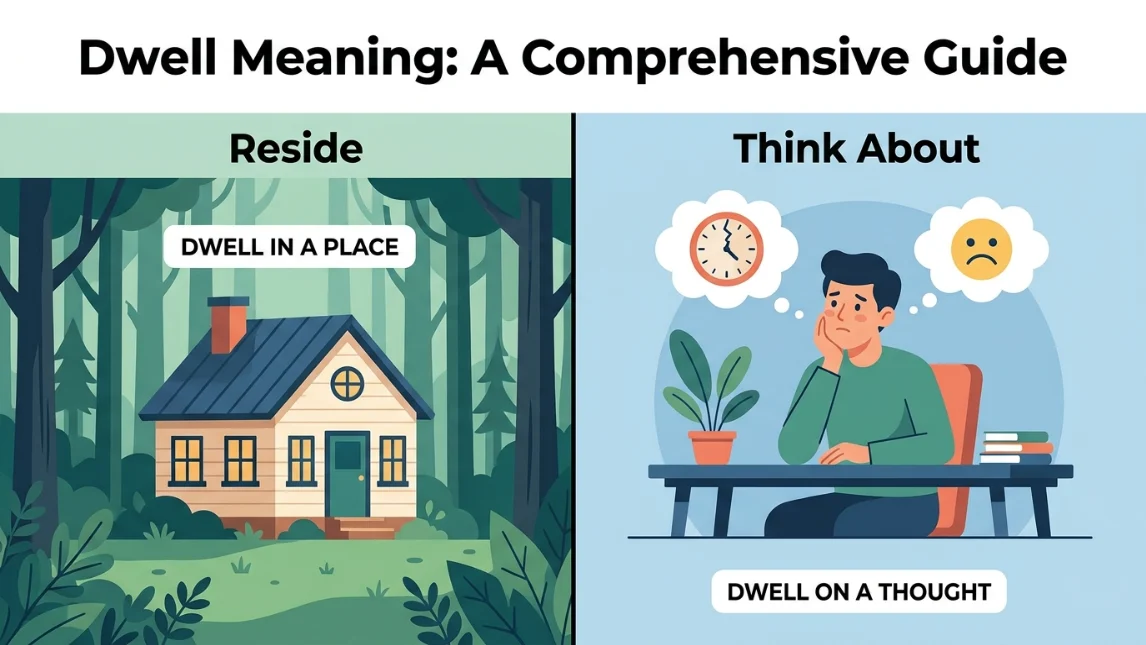
The word “dwell” has two primary meanings. It can mean to live or reside in a particular place, as in “They dwell in the countryside.” More commonly, it means to think or speak about something at length, often in a negative or obsessive way, as in “Don’t dwell on your mistakes.”
Have you ever read a sentence and wondered exactly what the word “dwell” meant? You are not alone. This versatile word appears in many contexts, and its meaning can vary significantly. Understanding “dwell” will help you improve your reading comprehension and writing skills.
The word “dwell” is used in both formal and literary English. It has been part of the language for over a thousand years and has developed several nuances of meaning . Whether you are reading classic literature, news articles, or having a thoughtful conversation, you will likely encounter this word.
The challenge with “dwell” is that it has two main meanings. Firstly, it can mean to live or reside in a specific location. Secondly, it can mean to think, speak, or write about something for a long time, often focusing on negative or upsetting topics . This duality can be confusing if you only know one definition.
This article explains the meaning of “dwell” in detail. You will learn about its definitions, discover how to use it correctly, and see real-world examples. By the end, you will be able to use “dwell” confidently and accurately in your own communication.
The word “dwell” is a formal verb with two primary definitions. The first definition is to live or reside in a place, as in “to dwell in a house” . The second, and perhaps more common, definition is to think, speak, or write about something at length, especially a negative or worrying topic, as in “to dwell on a problem” . Understanding the context is key to interpreting the word correctly.
Definitions and Explanation
Dwelling as a Physical Residence
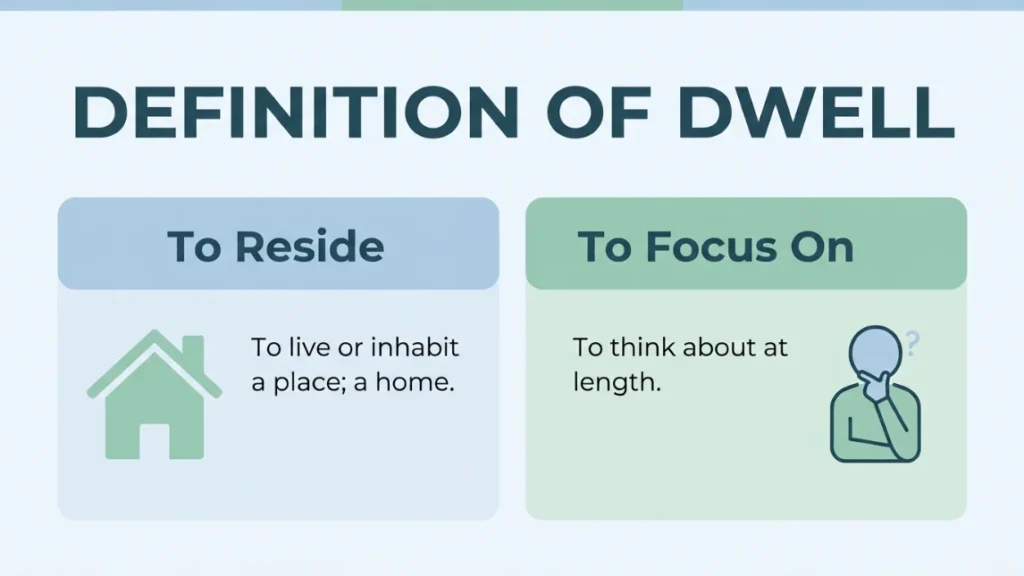
In its most literal sense, “dwell” means to live in a place. It is a formal and somewhat literary synonym for “live” or “reside.” When you use “dwell” in this way, you are describing someone’s home or habitat.
Key characteristics of this definition :
- Formal Tone: It is considered more formal than everyday words like “live.” You are more likely to find it in literature, official documents, or formal speeches.
- Place-specific: It is always followed by a location or a description of a location.
- Inanimate Subjects: It can also be used for animals, or even abstract ideas like a “spirit” or “god.”
For example, you could say, “The ancient guild dwells in the mountains.” This is a more formal way of saying, “The ancient guild lives in the mountains.” Similarly, “Legends say that a spirit dwells in the old oak tree” is a poetic way of saying a spirit resides there.
Dwelling on a Thought
The second, very common, definition of “dwell” is used with the prepositions “on” or “upon.” Here, it means to think, speak, or write about a particular topic for a long time . This definition often carries a negative connotation, suggesting that a person is obsessing, worrying, or unable to let go of something.
Key characteristics of this definition :
- Obsessive Thinking: It often implies an unhealthy preoccupation with a subject.
- Negative Focus: The subject of the thought is frequently something negative like a mistake, a failure, a loss, or a worry.
- Phrasal Verb: It is used as the phrasal verb “dwell on/upon.”
For example, if you say, “Stop dwelling on the past,” you are telling someone to stop thinking about past events, which are likely negative or painful. In her speech, the politician dwelt on the issue of unemployment, meaning she spent a lot of time talking about it.
Advantages and Disadvantages
Advantages of Using the Word “Dwell”
Using “dwell” provides nuance and specificity to your language. It is a more sophisticated word than “live” or “think” and can elevate your writing. It allows you to express that someone is not just living in a place but inhabiting it, or that someone is not just thinking but deeply and perhaps problematically focusing on something .
Disadvantages or Risks of “Dwelling”
The primary risk of “dwelling” is the negative mental health impact. When you dwell on negative thoughts, you can get stuck in a cycle of worry and unhappiness . You may become unable to move forward and may miss opportunities for positive change . As the famous quote from Harry Potter says, “It does not do to dwell on dreams and forget to live, remember that” .
| Aspect | Living/Residing | Thinking/Speaking at Length |
| Definition | To live, inhabit, or reside in a place. | To think, speak, or write about something for a long time . |
| Common Usage | Formal or literary descriptions of where someone or something lives. | Often used for obsessing, worrying, or overthinking negative events . |
| Example | “A rare species of bird dwells in this forest.” | “There’s no need to dwell on the problem.” |
| Mental Impact | Neutral, descriptive. | Can be negative, leading to anxiety or depression . |
Real-World Examples
Examples of “Dwell” Meaning to Reside
- “The new policy aims to help those who dwell in poverty-stricken areas.”
- “In the novel, the protagonist dwells in a small, isolated cottage by the sea.”
- “Scientists are studying the creatures that dwell at the bottom of the ocean.”
Examples of “Dwell On” Meaning to Think or Speak at Length
- “It’s best not to dwell upon the past too much.”
- “The boss dwelled on the need for better communication in the meeting.”
- “Ruth let her eyes dwell on the forest.”
- “She tried not to dwell on why it was that she hadn’t been invited.”
- “I’ve got better things to do than dwell on the past.”
Common Phrases with “Dwell”
- Dwell in an ivory tower: To be disconnected from the realities of life, often used for academics or intellectuals who are out of touch with everyday problems .
- Dwell on the past: To spend too much time thinking about past events, often with regret or sadness .
Regional and Global Usage
“Dwell” is a standard word in English, but its usage varies by formality and region. It is generally more common in British English and other formal writing styles than in casual American English. In the UK, it might be used more frequently in everyday speech. In the US, “live” is almost always preferred in informal contexts. Even in the UK, “live” is the more common word.
Common Mistakes
Mistake 1: Forgetting “On” or “Upon”
The Error: Using “dwell” alone to mean “think about.” For example, saying “Don’t dwell your mistakes” or “I dwell my past.
The Correction: The phrasal verb requires the preposition “on” or “upon.” Always say “dwell on” or “dwell upon” something.
Mistake 2: Using the Wrong Meaning
The Error: Misunderstanding the meaning of “dwell” due to context. For instance, thinking “He dwells in London” means “He is obsessed with London.
The Correction: Look at the words around it. If you see a place (like “London,” “cave,” “forest”), it means “reside.” If you see a topic (like “mistakes,” “problem,” “past”), it means “think about.
Exercises
Exercise 1: Fill in the Blank
Choose “dwell” or “dwell on” to complete each sentence.
- The sharks _________ in the deep sea.
- It’s not healthy to _________ your anxiety.
- I wish you wouldn’t _________ such trivial things.
- The immigrants came to _________ in a new land.
Exercise 2: Identify the Meaning
Determine if “dwell” means “reside” or “think about” in each sentence.
- “The family dwells in a beautiful house on the hill.”
- “The professor dwelt on the main ideas of his lecture.”
- “Some birds dwell in the city.”
Answer Key
Exercise 1 Answers:
- dwell (reside)
- dwell on (think about)
- dwell on (think about)
- dwell (reside)
Exercise 2 Answers:
- Reside (a location is mentioned: “house,” “hill”)
- Think about (a topic is mentioned: “ideas”)
- Reside (a location is mentioned: “city”)
Related Concepts and Comparisons
Live vs. Dwell
- “Live” is the most common, neutral word for having a home.
- “Dwell” is a more formal, literary, or poetic alternative. It can also refer to inhabiting a place, not just a home .
Dwell vs. Reside
- “Reside” is also formal and typically used when talking about where someone has a legal or permanent residence.
- “Dwell” is similar but often has a more emotional or descriptive tone.
Dwell vs. Brood
- Dwell on” means to think about something for a long time, usually a problem or worry .
- “Brood” is a more intense and negative word, implying sulking, worrying, or being deeply unhappy about a specific issue. It is used when you “brood over” something.
FAQs
What is the meaning of dwell?
Dwell” means to live in a place or to think about something at length . It is a formal and sometimes literary verb.
What does it mean to dwell on something?
To dwell on something means to think, speak, or write about a particular subject for a long time . This is often used to describe an unhealthy obsession or worry, especially about negative events .
What is another word for dwell?
Common synonyms for “dwell” include: live, reside, inhabit, and abide . For “dwell on,” synonyms include: linger on, brood over, elaborate on, and harp on about .
What is the past tense of dwell?
The past tense can be either “dwelled” or “dwelt.” Both are correct . “Dwelt” is often more common in British English.
Where does the word dwell come from?
“Dwell” comes from Old English “dwellan,” which originally meant “to lead astray” or “to hinder” . Its meaning evolved over time.
How do you use dwell in a sentence?
For residence: “We dwell in a small town.” For thinking: “Don’t dwell on your mistakes.”
Is dwell a formal word?
Yes, “dwell” is generally considered a formal or literary word. In informal conversation, you would usually say “live” or “think about.”
Why is dwelling bad?
Dwelling on negative thoughts can prevent you from moving on and can lead to anxiety and depression . It is often unproductive to obsess over past mistakes.
Conclusion
This guide explored the meaning of the versatile word “dwell.” It showed that “dwell” has two primary and distinct uses. First, it formally means to live or reside in a specific place. Second, and more commonly, it means to think, speak, or write about a topic for a long period, often focusing on something negative.
The key to mastering this word is recognizing the context. If you see a location, it is about residence. If you see a subject, it is about persistent thought. The best practical advice is to be mindful of your own “dwelling.” While it is fine to use the word “dwell” to describe where someone lives, you should be careful not to dwell on problems too much in your personal life.
Now you have the knowledge to understand and use “dwell” correctly. Use this guide as a reference whenever you encounter this word, and soon its correct meaning will become second nature to you.











6 thoughts on “Dwell Meaning| A Comprehensive Guide to Understanding This Versatile Word”