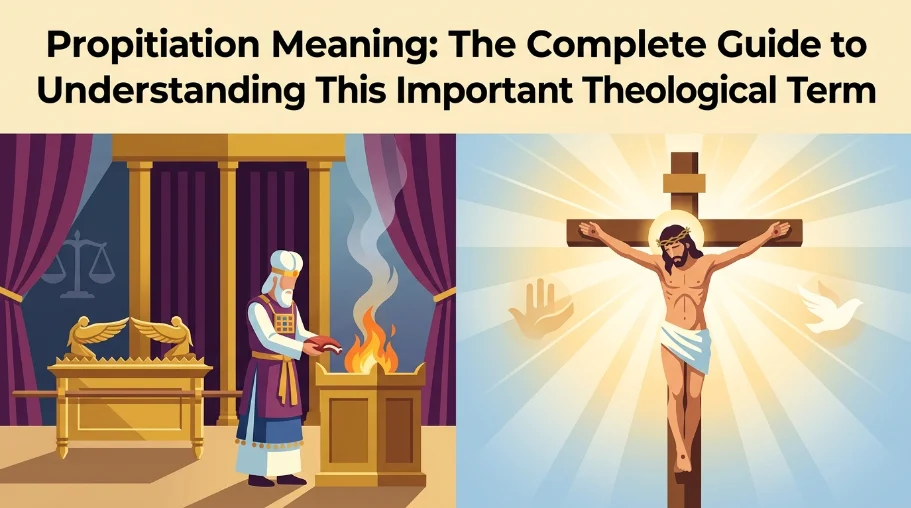
Propitiation refers to the act of appeasing or satisfying the wrath and justice of a deity, particularly in a religious context. In Christian theology, it specifically describes how Jesus Christ’s sacrificial death satisfied God’s righteous anger against sin and made forgiveness possible for believers .
Have you ever encountered the word “propitiation” while reading and wondered what it means? This rich theological term appears frequently in religious texts and scholarly discussions. Its meaning carries profound significance for understanding concepts of forgiveness, sacrifice, and divine justice.
The challenge with propitiation is its specialized nature. Many people confuse it with similar words like “expiation” or “reconciliation.” Others struggle to understand how the concept applies to their own understanding of faith and forgiveness. The term’s Latin roots and theological complexity can make it feel distant and difficult to grasp.
This article demystifies the propitiation meaning once and for all. You will learn its definition, see how it differs from related concepts, and discover its significance in both biblical and general contexts. By the end, you will confidently understand what propitiation means and why it matters. Good theological understanding depends on knowing these important distinctions.
Key Takeaway
The main takeaway is that propitiation means satisfying or appeasing the righteous anger or justice of God against sin . In Christian theology, Jesus Christ’s death on the cross serves as the propitiation for sin, turning away God’s wrath and making forgiveness available to believers . This is distinct from expiation, which focuses on removing sin’s guilt rather than appeasing divine wrath.
Definitions and Explanations
What Does “Propitiation” Mean?
The propitiation meaning centers on the idea of appeasing or satisfying an offended party. In general usage, propitiation is an action meant to regain someone’s favor or make up for something you did wrong . For example, you might offer an apology or a gift in propitiation for a mistake.
However, the term carries special weight in religious and theological contexts. Propitiation comes from the Latin word “propitiare,” which means “to appease . In ancient pagan religions, propitiation referred to offering gifts or sacrifices to calm the anger of the gods .
| Aspect | General Meaning | Theological Meaning |
| Core Idea | Appeasing an offended person | Appeasing divine wrath against sin |
| Action | Offering apology or gift | Christ’s sacrificial death |
| Goal | Regaining favor | Restoring relationship with God |
Propitiation in Christian Theology
In Christian theology, propitiation is one of the most important concepts for understanding what Jesus accomplished on the cross . The term appears in key New Testament passages:
- Romans 3:25 – “God put forward [Christ] as a propitiation by his blood”
- 1 John 2:2 – “He is the propitiation for our sins”
- 1 John 4:10 – “God sent his Son to be the propitiation for our sins”
- Hebrews 2:17 – Christ became a merciful high priest “to make propitiation for the sins of the people”
Theologically, propitiation means that Christ, through His perfect life and substitutionary death, satisfied the wrath of God against sin . This is not about God being angry and needing to be bribed. Rather, it reflects God’s holy nature and His righteous opposition to sin .
Propitiation vs. Expiation: Understanding the Difference
One of the most common sources of confusion is the difference between propitiation and expiation .
| Term | Focus | What Is Addressed |
| Propitiation | Person | The wrath or anger of God |
| Expiation | Sin or guilt | The removal or cleansing of sin |
Propitiation is something done to a person. It turns away wrath and satisfies justice . Christ propitiated God by enduring the penalty for sin in our place.
Expiation is something done to sins or evil deeds. It provides a means to cancel or cleanse them . Christ’s death expiated sins by removing their guilt.
The difference can be summarized as: propitiation deals with the offended party (God), while expiation deals with the offense itself (sin) .
The Background in the Old Testament
The concept of propitiation has deep roots in the Old Testament sacrificial system . The Hebrew sacrificial system taught that sin leads to death and that a substitute could die in the sinner’s place.
Key elements include:
- Burnt offerings (Leviticus 1) – Expressing devotion and atonement
- Sin offerings (Leviticus 4) – Dealing with unintentional sin
- The Day of Atonement (Leviticus 16) – The high point of the sacrificial year, when the high priest entered the Holy of Holies and sprinkled blood on the mercy seat
The “mercy seat” (hilasterion in Greek) was the cover of the Ark of the Covenant where the high priest sprinkled blood to make atonement . This same Greek word appears in Romans 3:25, where Paul describes Christ as the “mercy seat” or “propitiation” for believers .
Advantages and Disadvantages
Advantages of the Propitiation Concept
Provides a complete understanding of salvation: The concept of propitiation helps believers understand that God’s justice and mercy both find fulfillment in Christ’s death .
Honors God’s holiness: Propitiation acknowledges that God is holy and must judge sin, without compromising His love .
Provides assurance: Knowing that Christ fully satisfied God’s wrath gives believers confidence in their forgiveness .
Connects Old and New Testaments: Propitiation provides a clear link between the Old Testament sacrificial system and the New Testament understanding of Christ’s work .
Challenges and Criticisms
Misunderstanding God’s nature: Some critics argue that propitiation portrays God as angry and needing to be appeased, which they see as incompatible with His love .
Translation difficulties: Different Bible translations render the Greek words differently, leading to confusion about whether propitiation or expiation is the correct understanding .
Pagan associations: Because propitiation was a pagan concept (appeasing angry gods with gifts), some scholars prefer the term “expiation” to avoid pagan connotations .
Theological debates: Scholars continue to debate whether propitiation correctly describes God’s action or whether it distorts His character .
How Believers Respond to God’s Propitiation
The correct response to God’s propitiation is faith . Believers do not earn forgiveness; they receive it through trusting in Christ’s finished work. This is different from pagan religions, where the worshiper offered the sacrifice. In Christianity, God Himself provides the sacrifice .
Real-World Examples
Examples in Biblical Context
Example 1: Romans 3:25
Paul writes that God “put forward [Christ] as a propitiation by his blood, to be received by faith” . This demonstrates that God Himself provided the means of appeasing His own wrath against sin.
Example 2: 1 John 2:2
John writes that Christ “is the propitiation for our sins, and not for ours only but also for the sins of the whole world” . This extends the scope of Christ’s work beyond just believers.
Example 3: Hebrews 2:17
The author explains that Christ became like His brothers “to make propitiation for the sins of the people” . This emphasizes Christ’s role as High Priest who offers the perfect sacrifice.
Examples in General Usage
Example 1: Everyday Usage
According to Vocabulary.com, “You might offer your mom a plate of chocolate chip cookies in propitiation for killing all her houseplants while she was away” .
Example 2: Dictionary Definitions
The American Heritage Dictionary defines propitiation as “the act of propitiating” or “something that propitiates, especially a conciliatory offering to a god” .
Examples in Theological Discourse
Example 1: Explaining the Difference
“Theologians distinguish between propitiation, which turns away God’s wrath, and expiation, which removes sin’s guilt” .
Example 2: The Initiative of God
“God Himself placates His wrath against sin so that His love may go out to embrace and fully save the sinner” .
Regional and Global Usage
Christian Theology Worldwide
The concept of propitiation appears in Christian theology across all traditions and regions. However, different denominations emphasize it differently. Evangelical and Reformed traditions often highlight propitiation as central to understanding the atonement . Other traditions may use alternative language like “atonement” or “reconciliation.”
Translation Variations
Different Bible translations handle the Greek words for propitiation differently :
| Translation | Romans 3:25 | 1 John 2:2 |
| KJV, NASB | Propitiation | Propitiation |
| RSV, NEB | Expiation | Expiation |
| NIV, NRSV | Sacrifice of Atonement | Atoning Sacrifice |
| TEV | Means of forgiveness | Means of forgiveness |
These variations reflect ongoing debates about whether propitiation or expiation better captures the original meaning .
Academic and Scholarly Usage
In academic theology, propitiation remains an important term for discussing the atonement. Scholars debate whether the concept presents God as an angry deity needing appeasement or whether it reflects God’s holy justice and love working together .
Common Mistakes
Mistake 1: Confusing Propitiation with Expiation
The most common error is using propitiation and expiation interchangeably . While related, they focus on different things. Propitiation deals with appeasing a person’s wrath. Expiation deals with removing sin’s guilt.
Correction: Remember that propitiation is about satisfying God’s righteous anger. Expiation is about cleansing or removing sin. Christ’s death accomplished both .
Mistake 2: Thinking God Is Angry and Needs Appeasement
Some people misunderstand propitiation as meaning God is angry and needs to be bribed or placated by human efforts. This misrepresents Christian theology .
Correction: In Christianity, God Himself provides the propitiation. It is not humans trying to appease an angry deity. Rather, God, out of love, provides the sacrifice that satisfies His own justice .
Mistake 3: Missing the Old Testament Connection
Some people fail to connect propitiation to the Old Testament sacrificial system. This makes the concept seem abstract and disconnected.
Correction: Propitiation connects directly to the Day of Atonement and the mercy seat in the tabernacle . Understanding this background clarifies the concept significantly.
Mistake 4: Overlooking the Role of Faith
Some people think propitiation is automatic or universal. However, it is received through faith .
Correction: Propitiation is God’s provision, but it must be received by faith. It is not a mechanical transaction that applies to everyone regardless of belief.
Exercises
Exercise 1: Fill in the Blank
Choose the correct word: propitiation, expiation, reconciliation, or atonement.
- The act of satisfying God’s wrath against sin is called _________.
- The removal or cleansing of sin’s guilt is called _________.
- Christ’s death was both a _________ for sin and an _________ of sin.
- The Old Testament Day of Atonement pointed toward the ultimate _________ in Christ.
Exercise 2: Identify the Concept
Determine whether each description refers to propitiation or expiation.
- “Christ satisfied the wrath of God against sin.”
- “Christ removed the guilt of sin from believers.”
- “God’s justice was fully satisfied by Christ’s sacrifice.”
- “Sin was cleansed and forgiven through Christ’s death.”
Exercise 3: Correct the Mistake
Each sentence has a theological error. Identify and correct it.
- Propitiation means humans must offer sacrifices to make God love them.
- “In Christianity, believers must earn God’s favor through good works.”
- “Propitiation and expiation are exactly the same thing.”
Answer Key
Exercise 1 Answers:
- Propitiation (satisfying wrath)
- Expiation (removing guilt)
- Propitiation and expiation (both aspects of Christ’s work)
- Propitiation or atonement (the ultimate sacrifice)
Exercise 2 Answers:
- Propitiation (deals with God’s wrath)
- Expiation (deals with sin’s guilt)
- Propitiation (deals with satisfying justice)
- Expiation (deals with cleansing sin)
Exercise 3 Corrections:
- Propitiation means God Himself provides the sacrifice to satisfy His own justice.
- “In Christianity, believers receive forgiveness as a gift through faith, not through good works.”
- “Propitiation and expiation are related but different. Propitiation satisfies God’s wrath; expiation removes sin’s guilt.”
Related Concepts and Comparisons
Propitiation vs. Reconciliation
These concepts are closely related but distinct. Reconciliation is the restoration of relationship. Propitiation is the removal of the obstacle to that relationship .
| Term | Focus | Meaning |
| Propitiation | God’s wrath | Satisfying God’s justice |
| Reconciliation | Relationship | Restoring peace between God and humanity |
Propitiation vs. Substitution
Substitution is the idea that Christ died in the place of sinners. Propitiation is the outcome of that substitution. Christ’s substitutionary death resulted in propitiation .
Propitiation vs. Atonement
Atonement is a broader term covering the entire work of Christ in reconciling humanity to God . Propitiation is one aspect of atonement.
Propitiation vs. Sacrifice
Sacrifice refers to the offering itself. Propitiation refers to the result of that offering. Christ’s sacrifice was offered, and the result was propitiation .
FAQs
What is the meaning of propitiation in simple terms?
Propitiation means satisfying or appeasing someone who is offended. In Christian theology, it refers to Christ satisfying God’s righteous anger against sin .
What is the difference between propitiation and expiation?
Propitiation deals with satisfying God’s wrath. Expiation deals with removing sin’s guilt. Propitiation is something done to a person. Expiation is something done to sin .
Is propitiation a biblical word?
Yes, propitiation appears in the New Testament. The Greek words hilasmos and hilasterion are translated as “propitiation” in many Bible versions .
Why is propitiation important in Christianity?
Propitiation is important because it explains how God can be both just and loving. Christ’s death satisfied divine justice while demonstrating divine love .
Does propitiation mean God is angry?
Not in the sense of being capricious or vindictive. God’s “wrath” describes His holy opposition to sin. Propitiation addresses that opposition in a way that honors God’s justice .
Did Jesus propitiate God’s wrath?
In Christian theology, yes. Christ’s death satisfied God’s righteous anger against sin. This is what is meant by Jesus being our “propitiation” .
What is the Old Testament background of propitiation?
The Old Testament sacrificial system, especially the Day of Atonement, provided the background for propitiation. The “mercy seat” was where blood was sprinkled to make atonement .
What is the difference between propitiation and reconciliation?
Propitiation addresses God’s wrath against sin. Reconciliation addresses the relationship between God and humanity. Propitiation removes the obstacle; reconciliation restores the relationship .
Is propitiation only for believers?
In Christian theology, propitiation is available for all. 1 John 2:2 says Christ is “the propitiation for our sins, and not for ours only but also for the sins of the whole world” . However, it is received through faith .
How do I respond to propitiation in my life?
The proper response is faith. Believers receive forgiveness not by earning it but by trusting in Christ’s finished work. This is the heart of the gospel .
Conclusion
This guide has explored the rich meaning of propitiation. Propitiation means satisfying or appeasing God’s righteous anger against sin . In Christian theology, Jesus Christ’s death on the cross serves as the propitiation for sin, turning away God’s wrath and making forgiveness available to believers . This is distinct from expiation, which focuses on removing sin’s guilt rather than appeasing divine wrath .
The best practical advice is to understand propitiation as God’s loving provision, not human effort to earn favor . God Himself provides the sacrifice that satisfies His own justice. This demonstrates both His holiness and His love. Understanding propitiation helps believers appreciate the depth of God’s love and the completeness of Christ’s work.
Good theological understanding depends on knowing these important distinctions. Now you have the knowledge to understand and explain propitiation correctly. Use this guide as a reference whenever you encounter this rich theological term.

Andrew Morris is a writer at Meaninga.com who specializes in word meanings, slang, idioms and modern language trends. He creates clear, accurate and easy to understand content for everyday readers.









25 thoughts on “Propitiation Meaning | Definition, Theology and Biblical Significance”