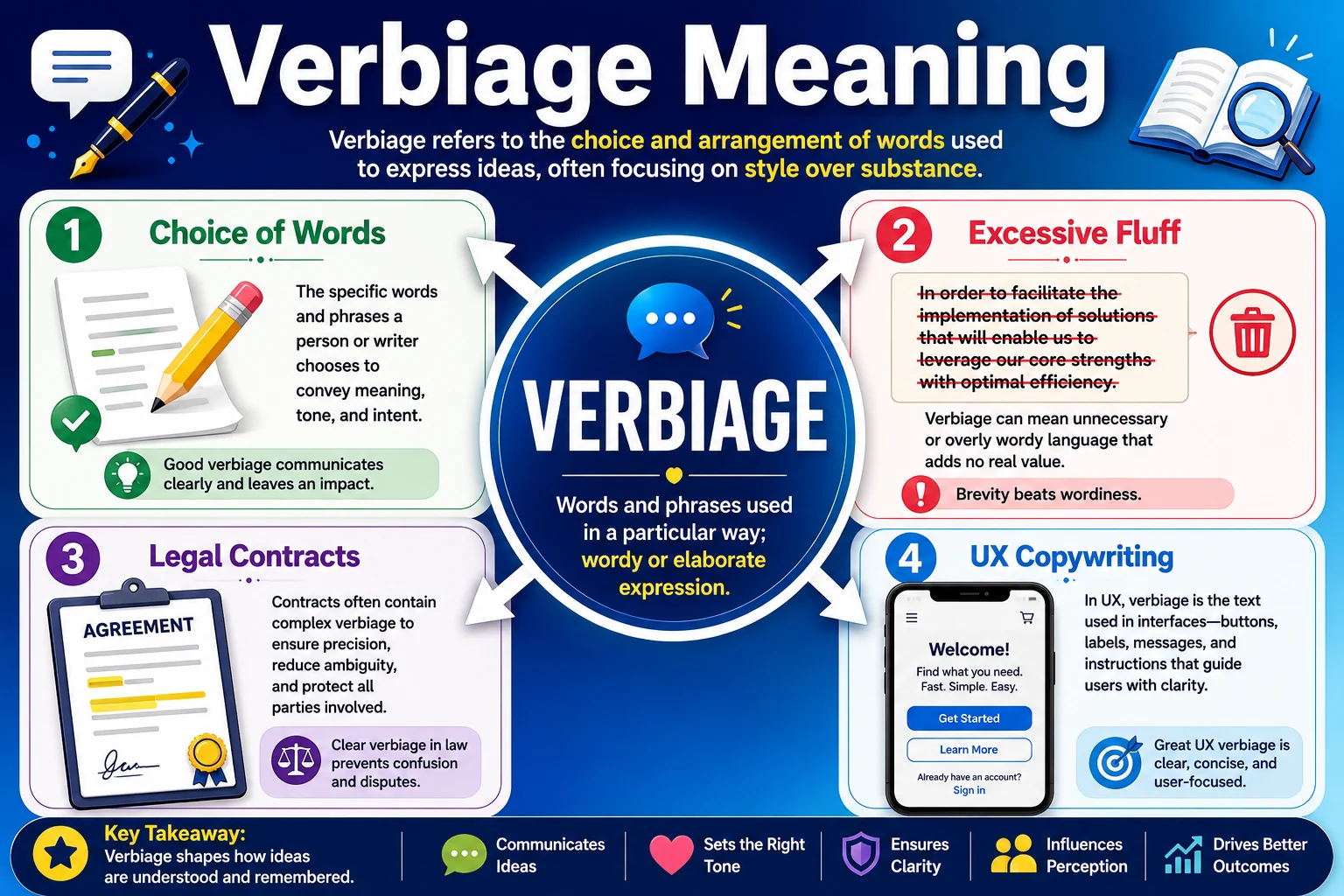
Verbiage refers to the specific choice of words, phrasing, or diction used to express an idea. While it often describes excessive, overly wordy, or inflated language, it also serves as a neutral term in professional and legal settings to denote formal written wording or clause structure.
Understanding the complete verbiage meaning helps you navigate professional writing, legal documentation, content editing, and everyday communication. Furthermore, this versatile linguistic term carries a fascinating dual nature that shifts depending on whether you are editing a draft, reviewing a legal contract, or chatting with colleagues. Consequently, when people search for this phrase, they usually want to uncover whether it implies unnecessary wordiness, formal legal language, or simply a choice of words.
Additionally, language evolves rapidly as modern workplaces and digital platforms emphasize clear, concise messaging. For example, business communicators frequently refine their document phrasing to cut unnecessary fluff. Similarly, legal professionals carefully construct contract clauses to ensure precise interpretation. Therefore, grasping every dimension of the definition elevates your vocabulary and enhances your writing efficiency.
Quick Answer Box
| Aspect | Details |
| Primary Meaning | Choice of words/phrasing; excessive or overly wordy language |
| Context | Business writing, legal contracts, grammar, rhetoric, copywriting |
| Primary Uses | Editing drafts, reviewing contracts, simplifying complex text |
| Example | The lawyer revised the contract verbiage to eliminate ambiguity |
| Tone | Professional, analytical, corrective, precise, objective |
What Does Verbiage Meaning Represent in Grammar and History?
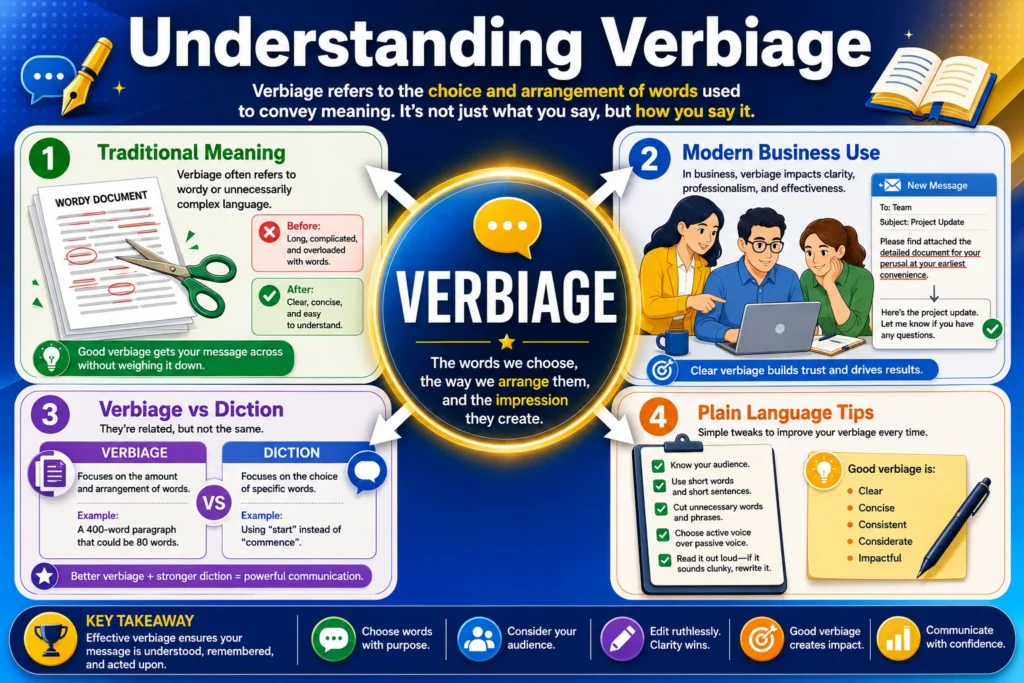
To understand the core verbiage meaning, one must examine its etymological roots. Historically, the word entered the English language in the early eighteenth century, borrowing directly from the French word verbiage, which stems from verbier (meaning to chatter or to warble). Specifically, the root traces back to the Latin verbum, meaning word. Over time, the term developed two distinct primary usages in modern English.
Furthermore, traditional grammarians and style guides historically treated the word with a negative connotation. For example, classic writing handbooks defined it strictly as an overabundance of words with little actual substance—commonly known as verbosity or “padding.” Consequently, writers were cautioned to trim unnecessary clutter to improve readability and punchiness.
Moreover, the word expanded its functional definition within modern professional and legal spheres. Indeed, in modern business, technical, and legal drafting, people frequently use the term in a neutral sense to mean “written wording” or “phrasing.” Thus, the definition seamlessly bridged the gap between stylistic criticism and formal documentation.
Contextual Dynamics & Nuances of the Term
However, the practical usage of the word shifts drastically depending on your immediate environment. For instance, if you stand in an editorial office, the term often points toward cutting fluff. On the other hand, if you enter a legal office or corporate boardroom, the term describes specific contractual wording.
1. The Critical View: Wordiness and Volubility
In literary criticism, rhetoric, and plain-language editing, the term highlights bloated or overly complex writing. Specifically, when a document uses fifty words to explain an idea that needs only ten, editors identify it as unnecessary clutter.
- Redundancy: Using repetitive phrases (e.g., “past history” or “future plans”). Furthermore, redundant wording slows down the reader without adding new value.
- Jargon & Inflation: Relying on overly technical buzzwords or complex sentence structures to sound sophisticated.
- Passive Bloat: Structuring sentences with passive phrasing that unnecessarily inflates word count.
2. The Neutral View: Choice of Words and Phrasing
Meanwhile, in corporate communications, software development, and legal drafting, the word functions neutrally. For instance, teams frequently discuss adjusting the “verbiage” on a website button or refining the “verbiage” of a policy statement to ensure clarity.
Legal and Contractual Contexts
Similarly, legal professionals carefully scrutinize every clause within contracts, warranties, and terms of service. However, in legal environments, changing a single word can alter liability or rights. Therefore, attorneys treat contract wording with extreme precision to prevent misinterpretation or costly disputes.
Real-Life Conversation Examples Using Verbiage Meaning Concepts
Indeed, understanding conversational contexts helps you use the term naturally in everyday professional dialogue. Below are five real-life messaging scenarios that show how people use the word across different settings.
1. Editing a Corporate Presentation
Alex: Hey Sarah! Have you had a chance to review the slide deck for tomorrow’s client meeting?
Sarah: Yes! I love the design, but we need to simplify the verbiage on slide four because it feels too wordy.
Alex: That makes sense! Should I trim the bullet points to focus on key metrics?
Sarah: Perfect! Consequently, the audience will grasp the main takeaway much faster.
2. Reviewing a Legal Agreement
Jordan: I’m reading over the new vendor contract, but section three seems a bit ambiguous.
Taylor: Indeed, I agree! Let’s ask legal to update the specific verbiage so our liability terms are crystal clear.
Jordan: That sounds brilliant! Furthermore, clear contract terms protect both parties down the road.
Taylor: Exactly, because precise language prevents future disputes.
3. Updating Website User Interface (UI)
Maya: Look at the sign-up button on our new landing page. Does “Submit Application Form” sound too formal?
Chloe: Actually, changing the verbiage to “Get Started Now” might boost conversion rates significantly.
Maya: Oh, that explains why shorter action verbs work so well! Therefore, I will update the button text right now.
Chloe: Naturally, it feels much more inviting to new users!
4. Refining a Marketing Email Campaign
Liam: Our email click-through rates dropped slightly this week.
Emma: However, don’t worry! We can test different subject line verbiage to see what resonates with subscribers.
Liam: Good catch. Consequently, I will draft three alternative options for an A/B test.
Emma: Trust me, because clearer headlines usually drive much better engagement!
5. Polishing a Resume or Cover Letter
Noah: What do you think of my job application essay draft?
Sophia: Meanwhile, your experience is impressive, but you should cut out some of the corporate jargon and fluff verbiage.
Noah: Is it making my key achievements harder to read?
Sophia: Yes! In fact, concise bullet points highlight your skills much more effectively.
Platform-Specific Breakdown
Additionally, professional platforms and online writing communities discuss editing techniques through distinct formats and visual guides. Consequently, analyzing how writers discuss the topic across platforms reveals how modern communication standards evolve.
How It Is Used on LinkedIn and Business Blogs
For instance, business thought leaders and copywriters on LinkedIn lean heavily into infographics, writing checklists, and before-and-after edits. Furthermore, creators frequently share practical strategies for eliminating fluff in professional emails.
- Editing Case Studies: Specifically, creators post side-by-side comparisons showing how cutting bloated text improves response rates.
- Copywriting Frameworks: Similarly, posts highlight how replacing weak phrasing with strong action verbs creates high-converting landing pages.
- Policy Simplification: Meanwhile, HR and legal specialists discuss translating complex policy documents into plain language.
The Role of Writing Forums and Reddit
On the other hand, writing communities like r/writing, r/copywriting, and English grammar forums offer space for deeper linguistic debates. Therefore, community threads frequently explore nuance, sentence structure, and style guidelines.
In fact, forum members often debate whether using the term neutrally is technically correct according to strict dictionary standards. Consequently, writers find helpful tips for streamlining their prose without sacrificing meaning.
- Style Debates: Threads discussing traditional vs. modern dictionary definitions.
- Fluff Elimination: Community challenges where writers edit complex academic paragraphs into concise sentences.
- Micro-Copy Writing: In addition, discussions focusing on UX writing and app button text.
- Grammar Guides: Finally, posts breaking down the differences between verbosity, prolixity, and diction.
Alternative Meanings & NLP Variations of the Phrase
Additionally, search engines use Natural Language Processing (NLP) to connect related terms, grammatical concepts, and stylistic keywords. Therefore, understanding the broader lexical web surrounding the topic helps clarify how AI engines categorize the phrase.
Lexical Entities and Synonyms
To fully grasp the verbiage meaning in modern English, consider these primary semantic variations and contextual synonyms:
- Diction: Specifically, the choice and use of words and phrases in speech or writing.
- Verbosity: Namely, the quality of using more words than needed; excessive wordiness.
- Phrasing / Wording: For example, the specific arrangement of words used to express a statement or clause.
- Prolixity: Similarly, the state of being tedious, overly lengthy, or drawn out in writing.
- Circumlocution: In contrast, the use of unnecessarily many words to express an idea, often to evade a direct statement.
- Plain Language: Furthermore, communication that your audience can understand the first time they read or hear it.
Misinterpretations: When NOT to Misuse the Term
Because the term carries dual meanings, people sometimes confuse it with related grammatical concepts or use it incorrectly in professional dialogue. However, understanding proper context prevents simple misunderstandings.
1. Confusing Verbiage with Foliage or Non-Linguistic Words
However, a surprisingly common phonetic mix-up occurs when people accidentally confuse verbiage with foliage (plant leaves) or verbalize (speaking out loud). Although they share similar sound patterns, verbiage applies exclusively to written or spoken words and sentence structure.
2. Assuming the Term Is Always Negative
Similarly, strict traditionalists sometimes insist that the word only means negative wordiness or fluff. However, in modern corporate, tech, and legal environments, using it neutrally to mean “written phrasing” is widely accepted. Consequently, insisting on the purely negative definition in a contract review meeting can cause unnecessary confusion.
3. Conflating Verbiage with Vocabulary
In addition, people occasionally treat verbiage and vocabulary as identical synonyms. However, vocabulary refers to the collection of words known by a person or language, whereas verbiage refers to the specific arrangement or excessive amount of words in a concrete text.
| Term | Primary Focus | Visual & Conceptual Character |
| Verbiage | Phrasing / Word Count | Specific word selection or excessive text length |
| Diction | Word Choice | Style and clarity of specific word selections |
| Verbosity | Excess Wordiness | Overly bloated, unnecessarily long sentence structure |
| Vocabulary | Word Bank | The total inventory of words a speaker or system knows |
How to Respond in Chat Comfortably
Furthermore, when someone mentions this topic in text messages, work chat applications (like Slack or Teams), or casual conversation, responding naturally keeps the dialogue flowing smoothly. Below are tailored guidelines for replying depending on the context.
If Someone Mentions Editing or Copywriting
When a colleague texts you about streamlining a document or cutting wordy text, acknowledge the goal of clarity and offer a quick practical tip.
- Option 1: “Nice! However, just make sure you keep the core message intact while trimming the extra fluff!”
- Option 2: “That sounds like a great plan! For example, focus on using active verbs to make the text punchier.”
- Option 3: “Indeed, shortening long paragraphs makes the document so much easier for clients to read!”
If Someone Mentions Legal Contracts or Business Proposals
If the conversation turns to contract wording or policy updates, focus your reply on precision, risk reduction, and clear alignment.
- Option 1: “I love that idea! Because precise contract phrasing prevents any confusion down the road.”
- Option 2: “Updating that clause makes so much sense since it protects both teams effortlessly.”
- Option 3: “Your revised proposal will look absolutely professional, bringing instant clarity without feeling overly dense.”
FAQs
What is the primary verbiage meaning in professional writing?
In professional writing, the primary verbiage meaning refers to the specific choice of words, phrasing, or text layout. While it can imply excessive wordiness, business professionals often use it neutrally to describe written wording in emails, policies, or presentation slides.
Is verbiage a negative word?
In fact, traditional grammar rules treated it negatively, defining it strictly as wordiness or unnecessary fluff. However, modern business, technical, and legal usage accepts the term neutrally as a synonym for “phrasing” or “written text.
What is the difference between verbiage and diction?
Specifically, diction refers to the purposeful choice and pronunciation of words for clarity and tone. Conversely, verbiage focuses on the overall wording, phrasing structure, or excessive word length within a passage.
How do you reduce excessive verbiage in a document?
For example, you can reduce wordiness by removing redundant words, replacing passive phrases with active verbs, cutting corporate jargon, and breaking long sentences into shorter, direct points.
What is the legal definition of verbiage?
In legal contexts, the term refers to the precise written wording, terms, and conditions contained within contracts or agreements. Consequently, legal teams review text carefully to eliminate ambiguity and specify rights accurately.
What does the original French root mean historically?
Historically, the word comes from the French verbiage and Latin verbum (word). Indeed, the original French root verbier translated to to chatter or warble, giving birth to its association with excessive talking.
How do UX writers use the term in software design?
For example, UX (User Experience) writers refine button text, error messages, and onboarding prompts—often called “micro-copy verbiage”—to guide users through apps effortlessly.
Can verbiage refer to spoken speech?
Because the term primarily applies to written text, people occasionally use it to describe lengthy, roundabout speeches or presentations that contain too much filler language.
Why do editors dislike bloated text?
Specifically, bloated text increases cognitive load for readers, making key information harder to find. On the other hand, clear, concise text improves comprehension, engagement, and retention.
What is the difference between verbiage and verbosity?
Verbosity always means negative, excessive wordiness and fluff. Conversely, verbiage can mean either excessive wordiness or simply the neutral choice of words in a document.
Conclusion
Ultimately, language continuously shifts as modern workplaces prioritize clarity, efficiency, and concise communication. The evolution of the term demonstrates how a traditional rhetorical criticism successfully adapted into a standard business and legal editing concept. Today, whether you encounter the word in a editorial review, in a legal contract, or across corporate chat channels, its core message remains consistent: wording matters, and refining it builds clearer connections.
Additionally, digital platforms and collaborative editing tools keep plain-language principles accessible for newer generations. Therefore, by understanding every dimension of the definition, you can effortlessly navigate writing projects, polish contracts, and communicate ideas with total confidence.

Andrew Morris is a writer at Meaninga.com who specializes in word meanings, slang, idioms and modern language trends. He creates clear, accurate and easy to understand content for everyday readers.