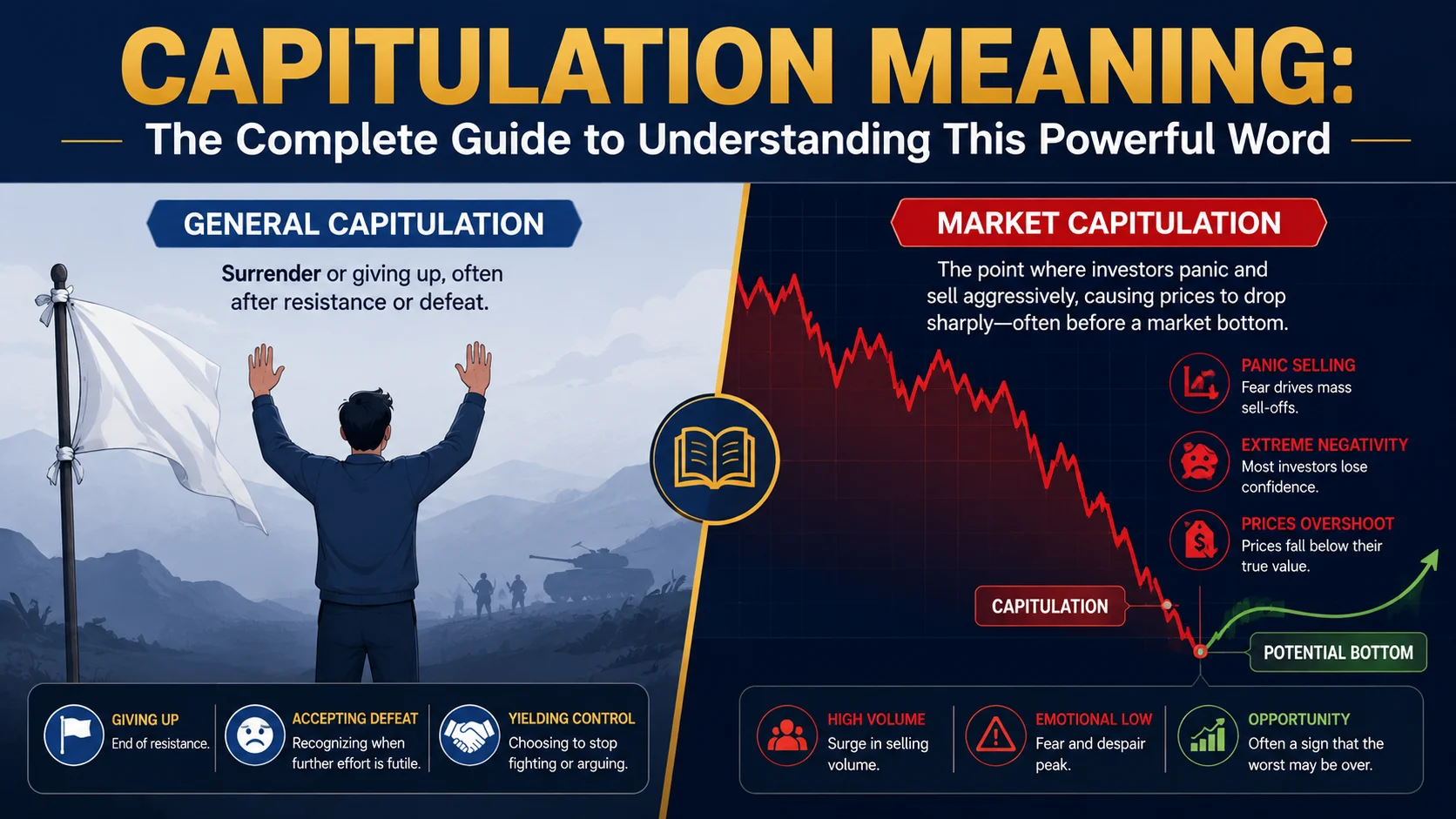
Capitulation means surrendering, yielding, or stopping resistance after pressure or conflict. It often describes accepting defeat or another party’s demands. In financial markets, capitulation refers to widespread panic selling when investors lose confidence and rush to sell their assets.
Sometimes, a long struggle reaches a point where continuing no longer seems possible. When a person or group stops resisting and accepts defeat, the word capitulation captures that moment.
The term usually describes surrender after pressure, conflict, or repeated attempts to resist. For example, a team might face capitulation after falling far behind in a competition. Similarly, a leader may refuse an opponent’s demands for weeks before finally agreeing to them.
However, capitulation has a specific meaning in finance, too. When investors lose confidence after a prolonged market decline, they may sell their investments rapidly to avoid further losses. This wave of fear-driven selling is known as market capitulation.
Although the word often suggests defeat, its meaning depends on the situation. In military history, it may describe a formal surrender. In negotiations, it can mean yielding to demands, while in investing, it describes a sharp loss of confidence. Understanding these distinctions helps you recognize the word in news reports, financial discussions, and everyday writing.
The main takeaway is that capitulation means surrendering or giving up completely . In everyday language, it describes the act of ceasing resistance and accepting defeat . In finance, it describes a market event where investors panic and sell all their holdings after a prolonged decline, often marking a market bottom . The word comes from the Latin capitulare, meaning “to draw up terms or conditions” .
Definitions and Explanations
What Does “Capitulation” Mean in General English?
The capitulation meaning in general English is straightforward. It is the act of surrendering or giving up . According to the Oxford Advanced Learner’s Dictionary, it is “the act of accepting that you have been defeated by an enemy or opponent” . It can also mean “agreement to do something that you have been refusing to do for a long time .
The Cambridge Dictionary defines capitulation as “the act of accepting defeat” or “an occasion when someone accepts something they have been opposing” . It describes a complete surrender, not a tactical retreat with plans to return .
| Aspect | Description |
| Part of speech | Noun |
| Meaning | The act of surrendering or giving up completely |
| Pronunciation | /kəˌpɪtʃuˈleɪʃn/ |
| Synonyms | Surrender, yielding, submission |
| Opposite | Resistance, defiance, perseverance |
What Is “Capitulation” in Finance?
In financial markets, capitulation has a more specific meaning. It refers to a period when investors abandon their positions en masse, typically during a sustained decline . Holders who have watched prices fall for extended periods finally give up hope of recovery and sell, often at substantial losses .
The term is often associated with “panic selling” or “giving up on the market” . When investors believe their stocks will only fall further, they sell to avoid even greater losses, thereby giving up potential future gains .
This behavior reflects a psychological breaking point. Investors who previously held firm, believing prices would recover, reach a moment where the pain of continuing to hold outweighs their conviction .
Key Differences: General vs. Financial Usage
| Aspect | General English | Financial Markets |
| Meaning | Surrendering or giving up | Panic selling of investments |
| Context | Military, personal, negotiations | Stock markets, trading |
| Trigger | Defeat, overwhelming pressure | Sustained price declines |
| Outcome | Acceptance of defeat | Potential market bottom |
Etymology of Capitulation
Understanding the origin of capitulation helps you remember its meaning. The word comes from the Latin capitulare, meaning “to draw up terms or conditions” . It entered English in the 1525–1535 period from Medieval Latin capitulātiōn- .
The root of the word is capitulum, a diminutive of caput, meaning “head.” This connects to the idea of organizing a surrender agreement “under headings” or “by chapters.” Originally, it referred to a formal agreement or document containing terms of surrender .
Over time, the meaning shifted from the document to the act of surrendering itself .
The Verb Form: Capitulate
The verb form is capitulate (pronounced kə-PIH-chuh-layt). It means “to surrender usually on agreed conditions . Merriam-Webster defines it as “to cease resistance and accept defeat” .
Synonyms for capitulate include:
- Give up
- Surrender
- Concede
- Yield
- Submit
- Fold
- Cave in
- Relent
| Verb Form | Meaning | Example |
| Capitulate | To surrender or give up | “The government refused to capitulate to the demands.” |
| Capitulating | Present participle | “The company is capitulating to pressure.” |
| Capitulated | Past tense | “They capitulated after weeks of negotiation.” |
Pronunciation of Capitulation
Capitulation is pronounced /kəˌpɪtʃuˈleɪʃn/ in both American and British English . It has five syllables: ca-pit-u-la-tion. The stress falls on the fourth syllable (“la”).
| Syllable | Pronunciation |
| ca | /kə/ (like “kuh”) |
| pit | /pɪt/ (like “pit”) |
| u | /uː/ (like “oo”) |
| la | /ˈleɪ/ (like “lay”) |
| tion | /ʃn/ (like “shun”) |
Advantages and Disadvantages
Advantages of Understanding “Capitulation”
Precision in communication: Using capitulation allows you to describe a complete surrender with precision. It conveys that resistance has ended, not just paused.
Financial insight: Understanding market capitulation can help investors identify potential buying opportunities. Many analysts see capitulation as a sign of a market bottom .
Historical and literary understanding: The word appears in historical accounts and literature. Knowing it helps you understand these contexts better.
Potential Disadvantages
Negative connotation: Capitulation is almost always negative. It implies defeat and giving up. Using it to describe someone’s actions can be insulting.
Misunderstanding: In casual conversation, simpler synonyms like “giving up” might be more appropriate. The word can sound overly formal or dramatic.
Complexity: The word is long and has an unusual spelling and pronunciation. Some people might not understand it without explanation.
Real-World Examples
Examples in General English
1: Political
“The government’s decision was widely criticized as a capitulation to terrorist organizations” .
2: Military
“The fort’s capitulation after a long siege marked the end of the war” .
3: Personal
“His capitulation to his children’s demands was predictable” .
4: Sports
“The team capitulated in the final quarter, allowing 21 unanswered points” .
Examples in Finance
1: Market event
“The stock market experienced a capitulation as investors panic-sold their holdings after weeks of decline” .
2: Investor behavior
“The investor’s capitulation came after watching his portfolio lose 40% of its value” .
3: Buying opportunity
“Many financial analysts see capitulation as a sign that a market bottom has been reached, presenting a potential buying opportunity” .
Examples of “Capitulate” in Sentences
| Context | Example Sentence |
| Political | “The teacher refused to capitulate: no calculators were to be used during the exam” . |
| Military | “The country still refuses to capitulate despite its weakening army and dwindling resources” . |
| Business | “Now the union has forced Sanders to capitulate on wages and health care” . |
| Negotiation | Putin won’t capitulate; that would mean the end of his rule . |
Idioms and Phrases
- “Humbled capitulation”: A surrender that is humiliating or shameful
- “Complete capitulation”: A total, unconditional surrender
- “Capitulation to pressure”: Giving in to demands or pressure
Regional and Global Usage
Global English
Capitulation is a standard English word used across all English-speaking regions. Its meaning is consistent and widely understood. There is no significant regional variation in its definition or usage .
Formal vs. Informal Usage
Capitulation is primarily a formal or literary word. It appears in:
- Political and military discussions
- Financial news and analysis
- Historical writing
- Formal negotiations
- Academic writing
In informal conversation, people often use simpler alternatives like “giving up,” “surrendering,” or “caving in.”
| Context | Preferred Usage |
| Formal | “The capitulation of the forces was inevitable.” |
| Informal | “They finally gave up after a long fight.” |
| Financial | “Market capitulation may signal a bottom.” |
Common Mistakes
Mistake 1: Using “Capitulation” When You Mean “Compromise”
A compromise involves both sides giving something up to reach an agreement. Capitulation is a complete surrender where one side gives everything up.
Correction: Use compromise for mutual concessions. Use capitulation for complete surrender.
Mistake 2: Confusing “Capitulation” with “Concession”
A concession is a small or partial giving in. Capitulation is total and complete.
Correction: Use concession for partial giving in. Use capitulation for total surrender .
| Term | Meaning |
| Capitulation | Complete surrender |
| Concession | Partial or limited giving in |
| Compromise | Mutual giving and taking |
Mistake 3: Misspelling the Word
Capitulation is often misspelled. Common errors include “capitulation,” “capitalation,” and “capitulation.” The correct spelling is c-a-p-i-t-u-l-a-t-i-o-n.
Correction: Practice the spelling. Remember the pattern: capitul + ation.
Mistake 4: Using “Capitulation” Casually
Because capitulation implies complete surrender, using it casually for minor concessions can be overdramatic.
Correction: Use capitulation for significant surrenders or defeats. Use simpler words for everyday situations.
Exercises
Exercise 1: Fill in the Blank
Choose the correct word to complete each sentence.
- “The general ordered the _________ of the fort after a long siege.”
- “The government’s _________ to terrorist demands was heavily criticized.”
- “Investors experienced _________ as they panic-sold their holdings.”
- “The team’s _________ in the final quarter cost them the game.”
Exercise 2: Identify the Meaning
Determine what “capitulation” means in each context.
- “The capitulation of the fortress came after three months of siege.”
- “Market capitulation may signal that a bottom has been reached.”
- “His capitulation to his boss’s demands was inevitable.”
Exercise 3: Choose the Correct Form
Select the correct word to complete each sentence.
- “The company refused to _________ to union demands.” (Capitulate/Capitulation)
- “The _________ of the rebels ended the conflict.” (capitulate/capitulation)
- “He finally _________ after weeks of negotiation.” (capitulated/capitulation)
Answer Key
Exercise 1 Answers:
- Capitulation (military surrender)
- Capitulation (political surrender)
- Capitulation (financial surrender)
- Capitulation (sports surrender)
Answers of Exercise 2:
- Military surrender (fortress context)
- Market surrender (financial context)
- Personal surrender (workplace context)
Exercise 3 Answers:
- Capitulate (verb form)
- Capitulation (noun form)
- Capitulated (past tense verb)
Related Concepts and Comparisons
Capitulation vs. Surrender
| Term | Meaning | Usage |
| Capitulation | Formal, often implies agreement or terms | More formal, literary |
| Surrender | General, can be unconditional | More common in everyday language |
Capitulation vs. Submission
| Term | Meaning | Usage |
| Capitulation | Complete surrender, often after resistance | Accepting defeat |
| Submission | Accepting authority or control | Ongoing subordination |
Yielding vs. Capitulation
| Term | Meaning | Usage |
| Capitulation | Complete and unconditional | Ending all resistance |
| Yielding | Can be partial or gradual | Giving way under pressure |
Capitulation vs. Acquiescence
| Term | Meaning | Usage |
| Capitulation | Active surrender | Complete defeat |
| Acquiescence | Passive acceptance | Without protest |
FAQs
What does capitulation mean in simple terms?
Capitulation means surrendering or giving up completely. It describes the act of ceasing resistance and accepting defeat, usually after a long struggle .
What is capitulation in finance?
In finance, capitulation describes a period when investors panic and sell their holdings after a sustained price decline. It marks a moment when investors give up hope of recovery and exit their positions, often at substantial losses .
How do you pronounce capitulation?
Capitulation is pronounced /kəˌpɪtʃuˈleɪʃn/ . It has five syllables: ca-pit-u-la-tion. The stress falls on the “la” syllable.
What is the verb form of capitulation?
The verb form is capitulate, meaning “to surrender or give up.” For example, “The government capitulated to the rebels’ demands .
Is capitulation a positive or negative word?
Capitulation is generally negative. It implies defeat and giving up. However, in financial markets, capitulation can be seen positively as a sign that a market bottom has been reached, presenting a buying opportunity .
What are synonyms for capitulation?
Common synonyms include surrender, yielding, submission, concession, and acquiescence . Synonyms for the verb form capitulate include give up, surrender, concede, yield, submit, fold, and cave in .
What is the origin of the word capitulation?
The word comes from the Latin capitulare, meaning “to draw up terms or conditions.” It entered English in the 1525–1535 period .
Is capitulation the same as compromise?
No. A compromise involves both sides giving something up to reach agreement. Capitulation is a complete surrender where one side gives everything up .
How can I identify market capitulation?
Signs of market capitulation include: high trading volume, accelerated price declines, extreme pessimism, and exhaustion of selling pressure . However, capitulation can only be identified with certainty in hindsight .
What happens after capitulation in financial markets?
After capitulation, markets often see a rebound as selling pressure exhausts itself and buyers are attracted by lower prices . Many analysts see capitulation as a potential buying opportunity .
Conclusion
This guide has explored the meaning and usage of the word capitulation. It is a noun that means the act of surrendering or giving up completely. In general English, it describes ceasing resistance and accepting defeat. In finance, it describes a market event where investors panic and sell their holdings after a sustained price decline.
The best practical advice for using capitulation is to consider your audience and context. It is a formal word best used in political, military, financial, and literary contexts. Reserve it for situations involving complete surrender, not minor concessions. Understanding the financial meaning of capitulation can also help investors identify potential market opportunities.
Good vocabulary depends on understanding these subtle distinctions. Now you have the knowledge to use capitulation correctly in any context.

Andrew Morris is a writer at Meaninga.com who specializes in word meanings, slang, idioms and modern language trends. He creates clear, accurate and easy to understand content for everyday readers.









2 thoughts on “Capitulation Meaning| When Giving Up Becomes Surrender”