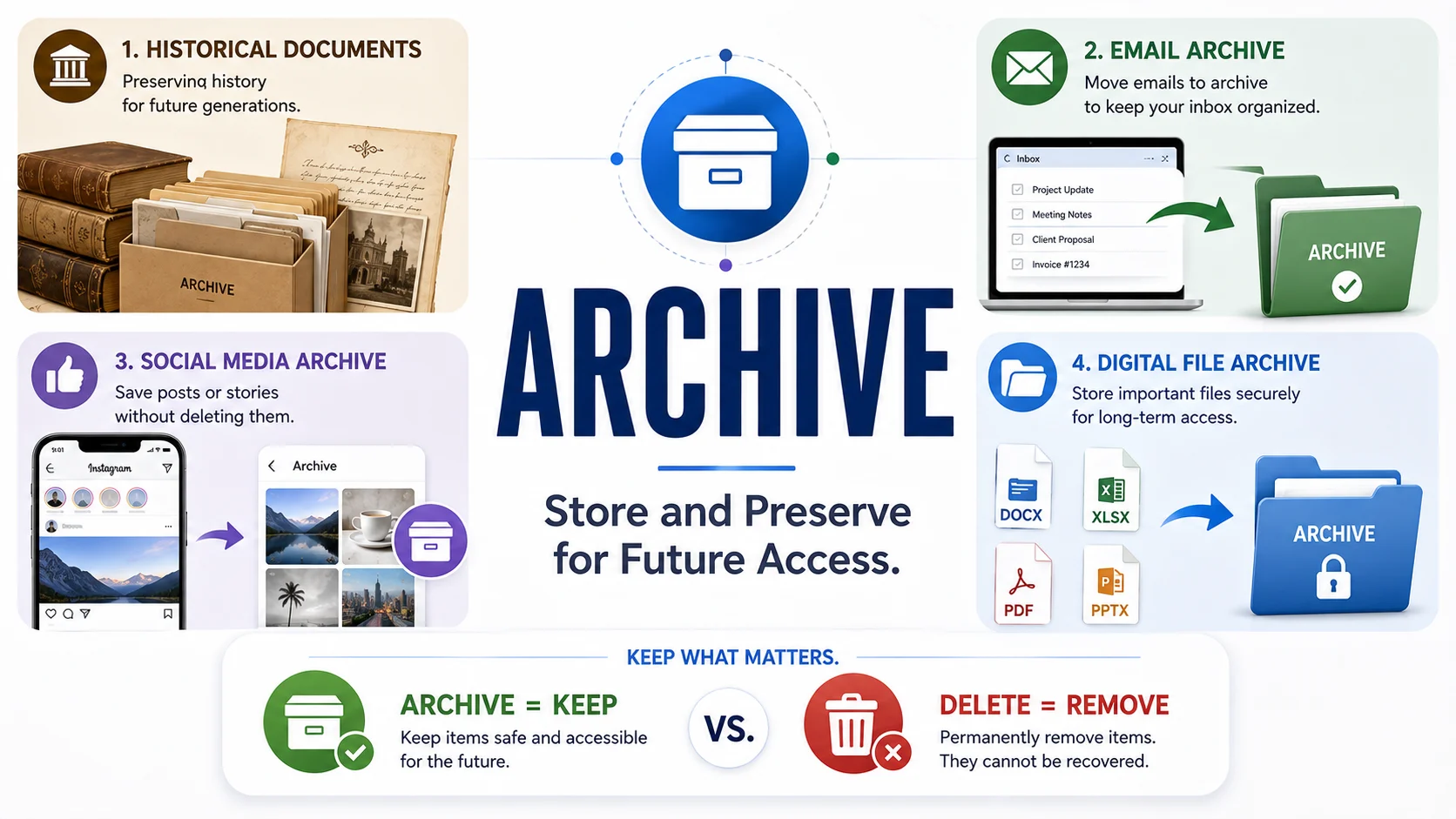
An archive is a collection or storage location for records, documents, files, messages, or other information kept for future reference. As a verb, archive means to preserve or move something into long term storage rather than actively using or deleting it.
Archive meaning centers on the idea of keeping information for future access rather than removing it permanently. The word can describe a physical collection of historical records, a digital folder, an email feature, or a social media tool.
For example, a museum might maintain an archive of photographs. Likewise, you might archive an email when you want to remove it from your inbox without deleting it.
Today, the term appears across technology, business, history, libraries, journalism, and social media. However, its basic concept remains consistent: preserve something so you can access it later.
The word can function as both a noun and a verb. Understanding that distinction makes its many modern uses much easier to recognize.
Quick Answer
| Meaning | Context | Primary Use | Example | Tone |
|---|---|---|---|---|
| Stored records | History | Preserve information | “The archive contains old letters.” | Neutral |
| Storage collection | Business | Keep records | “Check the company archive.” | Professional |
| Remove from active view | Organize messages | “I archived the email.” | Casual | |
| Hide while retaining | Social media | Manage content | “She archived the post.” | Casual |
| Long term file storage | Computing | Manage data | “Archive the old files.” | Technical |
| Historical collection | Research | Study the past | “Researchers visited the archive.” | Academic |
What Does Archive Mean?
The simplest definition of archive is a collection of information preserved for future use or reference.
For example:
“The library has an extensive archive of newspapers.”
The archive contains older newspapers that people can consult later.
As a verb, archive means to place something into such storage.
“The library archived the old newspapers.”
Here, archived describes the action of preserving the newspapers.
Therefore, the word has two closely related forms:
| Form | Meaning | Example |
|---|---|---|
| Noun | A collection of preserved material | “The archive is extensive.” |
| Verb | To preserve or store material | “We archived the records.” |
| Adjective | Stored or preserved | “The archived files remain available.” |
Archive as a Noun
When archive functions as a noun, it usually refers to a collection of preserved information.
The material can exist physically or digitally.
Examples include:
- historical documents
- photographs
- letters
- newspapers
- emails
- videos
- audio recordings
- financial records
- digital files
- websites
For example:
“The newspaper has a searchable online archive.”
This means readers can access previously published material through the newspaper’s digital collection.
Archive Can Also Mean a Storage Place
An archive can refer to the location where records are kept.
For example:
“The documents are stored in the archive.”
That archive could be a physical room, a library collection, a server, or a digital platform.
Consequently, the word can describe both the collection and the place or system that stores it.
Archive as a Verb
When archive functions as a verb, it means to move, store, or preserve something for future access.
For example:
“We archived the old reports.”
The reports are no longer part of the active working material, but they remain preserved.
You might also hear:
“The system automatically archives older messages.”
Here, the system moves older content into storage according to a particular rule.
Common Verb Forms
| Form | Example |
|---|---|
| Archive | “Please archive these files.” |
| Archives | “The system archives old messages.” |
| Archived | “The files were archived.” |
| Archiving | “We are archiving older records.” |
Archive Meaning in Email
One of the most familiar modern uses appears in email services.
When you archive an email, you generally remove it from the inbox while keeping the message stored.
For example:
“I archived the email because I don’t need it in my inbox anymore.”
The message can usually remain searchable or accessible elsewhere within the email account.
This makes archiving useful for inbox organization.
Why Archive an Email?
People commonly archive messages when they:
- have finished reading them
- do not need them immediately
- want a cleaner inbox
- may need them later
- want to distinguish active messages from older ones
Therefore, archiving does not necessarily mean the information has become irrelevant. It simply means the message no longer needs to occupy an active position.
Archive vs. Delete in Email
These actions have different purposes.
| Archive | Delete |
|---|---|
| Removes an email from the active inbox | Removes an email from normal storage |
| Usually retains the message | Usually moves it toward deletion |
| Useful for organization | Useful for removing unwanted messages |
| Message may remain searchable | Message may eventually disappear permanently |
However, exact behavior varies between email services.
Therefore, if a message is important, do not assume that every platform handles archived or deleted content identically.
Archive Meaning on Social Media
Social media platforms have made archive part of everyday vocabulary.
When you archive a social media post, the platform may remove it from your public profile while retaining it for you.
For example:
“I archived my old photos because I wanted a cleaner profile.”
The content remains preserved instead of being permanently deleted.
Why Users Archive Posts
Someone might archive content because they:
- want to change their profile appearance
- no longer want a post publicly visible
- want to preserve an old memory
- are temporarily hiding content
- want to reorganize their profile
- are updating their personal brand
Thus, archive often works as a middle ground between public display and permanent deletion.
Archive vs. Delete on Social Media
| Archive | Delete |
|---|---|
| Usually preserves the content | Removes the content |
| May hide it from public view | Usually removes it from the account |
| Often allows restoration | Restoration may be limited or unavailable |
| Useful for temporary hiding | Useful for permanent removal |
Platform features can change, so users should check the specific service’s current rules.
Archive Meaning in Computing
In computing, an archive is a collection of files stored together.
For example, an archive might contain:
- documents
- images
- folders
- application files
- logs
- backups
- older project materials
An archive can also use compression.
Common archive formats include ZIP and TAR based formats.
However, archiving and compression are technically different concepts.
Archiving vs. Compression
Archiving organizes or collects files for storage.
Compression reduces the amount of storage space the files require.
Therefore, a file archive can be compressed, but compression itself does not automatically mean archiving.
For example, a ZIP file can function as an archive containing multiple files. Its compression feature is a separate property.
Archive vs. Backup
People often confuse an archive with a backup.
Both involve stored information, but their purposes differ.
| Archive | Backup |
|---|---|
| Preserves information for future reference | Protects against data loss |
| Often focuses on older or inactive data | Often copies current important data |
| Supports long term retention | Supports recovery |
| May be accessed occasionally | Often exists for restoration |
For example, a company might archive five year old financial reports.
At the same time, it might back up its current accounting system every night.
Consequently, the two systems can work together without serving the same purpose.
Archive Meaning in History
Archives play a major role in historical research.
A historical archive can contain original records from earlier periods.
Examples include:
- government documents
- personal letters
- diaries
- maps
- photographs
- newspapers
- legal records
- business documents
- manuscripts
Researchers can use these materials to investigate historical events and social changes.
For example:
“The historian examined letters from the archive.”
The letters may provide first hand evidence about the period being studied.
Why Historical Archives Matter
Archives help preserve information that might otherwise disappear.
They can provide evidence about:
- political events
- cultural practices
- family histories
- scientific discoveries
- economic changes
- social movements
- everyday life
Furthermore, archives allow later generations to examine original records rather than relying only on modern summaries.
Archive Meaning in Libraries
Libraries frequently maintain specialized archives.
These collections may include rare books, manuscripts, newspapers, photographs, or records associated with a particular organization or individual.
For example:
“The university library maintains an archive of local newspapers.”
Such collections can support academic research.
They may also preserve materials that are too valuable, rare, or fragile for ordinary circulation.
Archive Meaning in Museums
Museums can also maintain archives.
A museum archive may contain photographs, research notes, acquisition records, correspondence, exhibition documents, and historical materials.
For example:
“The museum’s archive contains photographs from its earliest exhibitions.”
These records can help curators and researchers understand the institution’s history.
Archive Meaning in Journalism
News organizations often maintain archives of previously published content.
A newspaper archive might contain decades of:
- articles
- photographs
- editorials
- interviews
- advertisements
- announcements
Readers can search these collections to find older reporting.
Journalists can also use archives when researching historical events.
For example:
“The reporter searched the newspaper archive for earlier coverage.”
This demonstrates how archives remain useful even when their original content is no longer current.
Archive Meaning on Websites
Many websites have an archive section.
A blog archive may organize older posts by:
- date
- category
- topic
- author
- publication year
For example:
“Visit our archive to read older articles.”
The content remains accessible even though it may not appear on the site’s homepage.
Common Website Archives
| Archive Type | Typical Content |
|---|---|
| Blog archive | Older posts |
| News archive | Previous news stories |
| Podcast archive | Earlier episodes |
| Video archive | Previous videos |
| Photo archive | Historical images |
| Document archive | Reports and publications |
Archive Meaning in Business
Businesses archive information for many reasons.
Companies may preserve:
- contracts
- invoices
- tax records
- financial reports
- project files
- customer documents
- meeting records
- correspondence
For example:
“The accounting department archived last year’s reports.”
The reports no longer support daily operations, but the company may need them later.
Why Businesses Archive Records
Archiving can help organizations:
- Reduce clutter.
- Preserve historical information.
- Meet retention requirements.
- Support future research.
- Improve access to older records.
- Separate active data from inactive data.
However, organizations should follow applicable laws and internal retention policies when handling sensitive records.
Archive Meaning in Legal Contexts
Legal organizations often retain large collections of records.
These may include:
- contracts
- court documents
- case files
- correspondence
- property records
- evidence documentation
Archiving allows organizations to preserve records that may remain relevant after a case or transaction ends.
For example:
“The firm archived the closed case files.”
The files are no longer active, but they remain preserved according to the organization’s retention practices.
Archive Meaning in Genealogy
Family historians and genealogists frequently use archives.
They may search archived:
- birth records
- marriage records
- death records
- census materials
- newspapers
- photographs
- immigration documents
- property records
These sources can help people reconstruct family histories.
Therefore, archives are not limited to government or academic research. They can also support personal historical projects.
Archive vs. Store
Store has a broader meaning than archive.
You can store something temporarily, permanently, actively, or passively.
For example:
“I stored the document on my computer.”
This does not indicate why or how long the document will remain there.
By contrast:
“I archived the document.”
usually suggests that the document has moved into less active or long term storage.
| Store | Archive |
|---|---|
| Broad concept | More specific concept |
| Can be temporary | Often long term |
| Can involve active files | Usually involves inactive or historical material |
| Focuses on keeping something | Often emphasizes preservation and future reference |
Archive vs. Save
Save usually means preserving something so you do not lose your current work.
For example:
“Save the document before closing the program.”
Archive usually implies moving information into a separate storage state.
For example:
“Archive the completed project files.”
Therefore, you might save a document while working on it and archive it after completing the project.
Archive vs. Hide
These terms can overlap, particularly on social media.
Hide focuses primarily on visibility.
Archive generally emphasizes preservation while reducing active visibility or use.
For example:
“I hid the comment.”
focuses on who can see it.
Meanwhile:
“I archived the post.”
often suggests that the post remains stored but is no longer displayed normally.
Archived Meaning
Archived is the past tense and past participle of archive.
It means something has been placed into storage or preserved for future access.
Examples include:
“The email was archived.”
“The old files were archived.”
“The article was archived online.”
The exact implications depend on the system.
Archive Meaning in Digital Communication
Digital communication has expanded the use of the term considerably.
You may encounter:
- archived messages
- archived emails
- archived chats
- archived posts
- archived stories
- archived files
- archived conversations
In each case, the general idea involves moving information away from active use while retaining it.
Consequently, archive has become a standard part of digital organization.
Is an Archive Permanent?
Not necessarily.
The term suggests preservation, but it does not guarantee permanent availability.
An organization may eventually remove archived records.
A website may disappear.
A digital file may become corrupted.
A service may change its storage policies.
Therefore, archived generally means retained for later access, not necessarily protected forever.
Can You Access Archived Information?
Usually, yes.
The purpose of an archive is generally to preserve information so it can be retrieved later.
However, accessibility depends on the system.
For example:
- an email archive may be searchable
- a historical archive may require an appointment
- a website archive may have a search function
- a social media archive may be accessible only through account settings
- a company archive may require authorization
Therefore, archive does not necessarily mean public.
Can an Archive Be Private?
Yes.
Archives can be public, restricted, or completely private.
For example:
“The museum maintains a public archive.”
Anyone may be able to access it.
Meanwhile:
“The company keeps a private archive.”
Only authorized employees may access the records.
Similarly, a personal digital archive can remain accessible only to its owner.
Common Phrases With Archive
Digital Archive
A collection of digitally preserved information.
“The university created a digital archive.”
Online Archive
An archive that users can access through the internet.
“The newspaper’s online archive contains decades of articles.”
Historical Archive
A collection focused on records from the past.
“The researcher visited the historical archive.”
Email Archive
Stored email messages that have been removed from the active inbox.
“Search the email archive for the old invoice.”
Archive Folder
A folder used to store inactive or older information.
“Move the completed reports to the archive folder.”
Personal Archive
A collection preserved by an individual.
“She keeps a personal archive of family photographs.”
Public Archive
A collection that members of the public can access.
“The organization maintains a public archive of documents.”
Archive Record
A preserved record kept for future reference.
“The archive record contains the original document.”
Real Life Conversation Examples
Conversation 1: Email
Maya: Did you delete the email?
Jordan: No, I archived it.
Maya: So you can still find it?
Jordan: Yes. I just didn’t want it sitting in my inbox.
Here, archive means removing an email from the active inbox while retaining it.
Conversation 2: Social Media
Alex: Why isn’t your old photo on your profile anymore?
Sam: I archived it.
Alex: Did you delete it?
Sam: No. I can still access it privately.
Here, archive means removing content from normal public display without necessarily deleting it.
Conversation 3: Business Records
Manager: Where are last year’s invoices?
Employee: They’re in the archive.
Manager: Can we still access them?
Employee: Yes. They’re stored digitally.
Here, archive refers to older business records.
Conversation 4: Historical Research
Student: Where did you find those old photographs?
Researcher: They’re from the city’s historical archive.
Student: Can anyone view them?
Researcher: Some collections are publicly accessible.
Here, archive refers to a historical collection.
Conversation 5: Computer Files
Developer: We have too many old project files on the main server.
Manager: Let’s archive the inactive projects.
Developer: I’ll move them into long term storage.
Here, archive means moving inactive digital material into storage.
Synonyms for Archive
The best synonym depends on the context.
For a Collection
Possible alternatives include:
- repository
- records
- collection
- database
- storage
- file
- historical collection
For the Verb
Possible alternatives include:
- preserve
- store
- retain
- save
- catalog
- record
- keep
However, these words do not always carry exactly the same meaning.
For example, preserve emphasizes protection, while archive emphasizes organized long term storage or retention.
Antonyms of Archive
There is no universal opposite.
Depending on the context, possible contrasts include:
- delete
- erase
- discard
- destroy
- remove
- purge
For digital content, delete is usually the clearest contrast.
For historical preservation, destroy or discard may provide a stronger opposite.
Word Forms Related to Archive
| Word | Part of Speech | Meaning |
|---|---|---|
| Archive | Noun/verb | Stored collection or act of storing |
| Archives | Noun/verb | Collections or stores |
| Archived | Verb/adjective | Stored or preserved |
| Archiving | Noun/verb form | Process of storing information |
| Archivist | Noun | Person who manages archives |
| Archival | Adjective | Related to archives |
What Is an Archivist?
An archivist is a professional who manages records and archival collections.
Archivists may work in:
- libraries
- museums
- universities
- government institutions
- corporations
- historical organizations
Their work can involve organizing, preserving, describing, and providing access to records.
What Does Archival Mean?
Archival means related to archives or suitable for preservation in an archive.
For example:
“The museum uses archival materials.”
This refers to materials connected with long term preservation or historical records.
Frequently Asked Questions
What does archive mean in simple words?
Archive means to keep something stored so you can access it later. It can also refer to the collection or storage location containing preserved information.
Does archive mean delete?
No. Archive generally means keep and store, while delete means remove. However, the exact behavior depends on the platform or system.
What does archive mean in email?
Archiving an email generally removes it from the active inbox while retaining the message so you can access it later.
What does archive mean on social media?
On social media, archiving usually means removing content from its normal public display while keeping the content stored for future access or restoration.
What is an archive?
An archive is a collection, location, or system used to preserve records, documents, files, messages, photographs, or other information.
What does archived mean?
Archived means something has been moved into storage or preserved for future reference rather than remaining in active use.
What is a digital archive?
A digital archive is an electronically stored collection of information. It may contain documents, photographs, videos, audio, websites, emails, or other digital records.
What is the difference between an archive and a backup?
An archive generally preserves older or inactive information for future reference. A backup primarily creates a copy that can help restore information after loss or damage.
Can archived files be accessed?
Usually, yes. Archives are generally designed for future retrieval. However, access may depend on the system, permissions, or storage method.
What is the opposite of archive?
There is no single opposite in every situation. In digital contexts, delete, erase, or discard can serve as practical opposites.
Conclusion
The word archive revolves around one central idea: keeping information for future access.
Historically, archives preserved letters, manuscripts, newspapers, photographs, government records, and other documents. Today, the same concept applies to emails, social media posts, websites, databases, and computer files.
In everyday technology, archiving provides a practical way to reduce clutter without necessarily losing information. You can archive an email instead of deleting it. You can archive social media content instead of removing it permanently. Likewise, businesses can archive completed records while keeping active systems focused on current work.
The term also differs from related words. Save usually means preserving current work. Backup focuses on recovery. Delete focuses on removal. Hide emphasizes visibility. Archive generally combines retention with reduced activity or accessibility.
Furthermore, an archive does not have to be public. A museum may operate a public collection, while a company can maintain restricted records. A person can also maintain a private digital archive.
Ultimately, understanding archive meaning is about recognizing the distinction between keeping something and actively using it. Whether the information sits in a historical collection, email account, social media profile, or computer system, archiving usually means placing it safely aside so it remains available when needed.
:::










15 thoughts on “Archive Meaning| Definition, Uses, Examples and Digital Contexts”