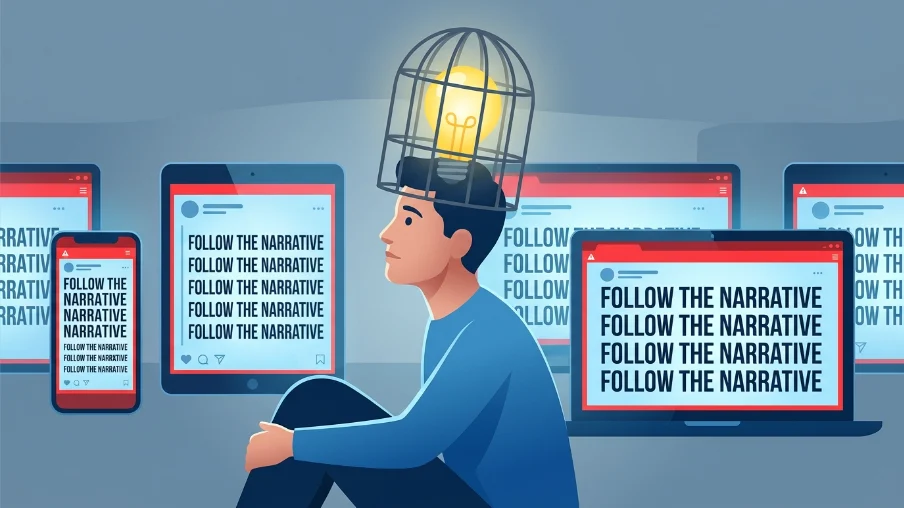
Indoctrination meaning is the process of teaching a person or group to accept a set of beliefs uncritically, without allowing questioning or critical examination. It involves systematic instruction that shapes thoughts and behaviors according to a specific ideology, often through repetition and emotional manipulation. Unlike education, indoctrination discourages independent thinking.
Understanding indoctrination meaning is essential in today’s information-saturated world. This term describes how beliefs get implanted without room for debate. It appears everywhere from political rallies to corporate training sessions. Many people encounter it daily without recognizing the signs. This guide breaks down everything you need to know about this powerful concept.
QUICK ANSWER BOX
What Does Indoctrination Mean? (Full Semantic Definition and Origin)
Indoctrination meaning centers on the uncritical acceptance of beliefs. The Merriam-Webster dictionary defines it as “the act or process of indoctrinating or the state of being indoctrinated”. Oxford Learner’s Dictionary adds that it is “the act or process of forcing somebody to accept a particular belief or set of beliefs and not allowing them to consider any others”.
The term originates from Latin. It combines the prefix “in-” (meaning “into”) with “doctrina” (meaning “teaching” or “instruction”). Originally, it simply meant “to teach.” However, by the 1830s, the word shifted to describe forcing ideas on someone who cannot question them.
Today, indoctrination meaning carries a heavy negative weight. It implies manipulation, closed-mindedness, and a lack of intellectual freedom. It stands in stark contrast to education, which encourages open inquiry and critical thinking.
Contextual Dynamics & Nuances of the Term
Indoctrination meaning shifts depending on the context. In religious settings, it often refers to teaching dogma without encouraging doubt. In political spheres, it describes propaganda efforts to shape public opinion. In corporate environments, orientation programs can feel like indoctrination when they demand robotic loyalty.
A key nuance is the distinction between indoctrination and education. Education seeks to “lead out” knowledge and encourages skepticism. Indoctrination “pushes in” beliefs and forbids inappropriate examinations. Education relies on the learner’s willingness; indoctrination often involves coercion.
Furthermore, indoctrination meaning is not always absolute. Some philosophers argue that the line between education and indoctrination can blur. However, the critical difference remains: indoctrination aims to create unquestioning adherence, while education aims to create independent thinkers.
Real-Life Conversation Examples Using Indoctrination Meaning
Here are five distinct chat dialogue scripts showing how indoctrination meaning appears in everyday talk.
Example 1: Political Debate
Alex: “Did you see that new documentary? It totally changed my view on the whole issue.”
Jordan: “Be careful. That film felt more like indoctrination than actual journalism. It didn’t present both sides.”
Alex: “Maybe, but it made some powerful points.”
Example 2: Workplace Concerns
Sam: “Our new manager keeps making us chant the company mission statement every morning.”
Taylor: “That sounds like straight-up indoctrination. Are we employees or cult members?”
Sam: “Exactly! I’m here to work, not to get brainwashed.”
Example 3: Parenting Discussion
Chris: “My parents sent me to that summer camp again. It’s all about their political views.”
Morgan: “Honestly, that sounds like religious or political indoctrination. You should be able to form your own opinions.”
Chris: “I know, but they won’t listen.”
Example 4: Social Media Rant
Drew: “My feed is full of posts saying the exact same thing about the election. It’s crazy.”
Casey: “That’s the algorithm. It’s a form of indoctrination through repetition. It shows you what you already agree with.”
Drew: “So how do I break out of it?”
Example 5: Academic Setting
Professor: “Today, we will discuss the theory without considering any counterarguments.”
Student: “Isn’t that just indoctrination, professor? Shouldn’t we explore all perspectives?”
Professor: “An interesting point. Let’s examine that critique.”
Platform-Specific Breakdown
How It Is Used on Snapchat
Snapchat plays a significant role in modern indoctrination meaning discussions. Critics argue that Snapchat’s Discover section curates content that can indoctrinate young users. The platform’s ephemeral nature makes it difficult to track and challenge misleading information.
Furthermore, Snapchat’s algorithm can create echo chambers. Users see content that reinforces their existing beliefs, a subtle form of indoctrination. This repeated exposure to slanted viewpoints shapes opinions without open debate. For parents and educators, understanding this dynamic is crucial.
The Role of Indoctrination Meaning on TikTok
TikTok has become a central hub for conversations about indoctrination meaning. The hashtag #indoctrinationfail captures moments where attempts to impose views backfire humorously. These viral moments highlight resistance to imposed narratives.
However, TikTok also faces serious criticism. Extremist groups use the platform to indoctrinate young people. The algorithm’s power to shape beliefs is immense. Consequently, many view TikTok as a modern tool for mass indoctrination. Understanding this helps users navigate the platform critically.
Instagram and Texting Dynamics
On Instagram, indoctrination meaning often relates to recruitment and radicalization. Terrorist groups use Instagram to establish contact and introduce extremist narratives. The platform’s visual nature makes propaganda more engaging and shareable.
In texting, the term appears more casually. Friends might accuse each other of indoctrination when someone repeats a catchy slogan or meme uncritically. The slang “drink the Kool-Aid” captures this idea perfectly. Overall, Instagram and texting serve as both tools for and subjects of indoctrination discussions.
Alternative Meanings & NLP Variations of the Phrase
Indoctrination meaning extends beyond its core definition. Natural Language Processing (NLP) reveals several semantic variations:
- Brainwashing: A more extreme form involving forcible attitude change
- Propaganda: Information used to promote a political cause or point of view
- Inculcation: Teaching through frequent repetition
- Conditioning: A behavioral process that can lead to uncritical acceptance
- Catechization: Formal religious instruction
Synonyms include instruction, pedagogy, and indoctrination itself in milder forms. Antonyms highlight the opposite approach: education, enlightenment, critical thinking, and questioning.
Moreover, modern internet slang has created related terms. “Blue-pilled” describes mindless acceptance of an illusory reality. The suffix “-pilled” now humorously indicates sudden fixation or indoctrination. These variations show how indoctrination meaning continues to evolve in digital culture.
Misinterpretations: When NOT to Use Indoctrination Meaning
Many people misuse indoctrination meaning in everyday conversation. Understanding when NOT to use it is just as important as knowing the definition.
Do not use it for normal teaching. Teaching someone a new skill, like cooking or coding, is not indoctrination. It becomes indoctrination only when it discourages questioning.
Avoid using it for healthy persuasion. Convincing a friend to see a movie or try a new restaurant is not indoctrination. It lacks the systematic, uncritical element.
Do not confuse it with grooming. While related, grooming specifically refers to behaviors that prepare a child for sexual abuse. Indoctrination focuses on ideas and beliefs, not sexual exploitation.
Steer clear in casual disagreements. Calling every opposing viewpoint “indoctrination” dilutes the term’s power. Reserve it for situations involving forced, uncritical belief acceptance.
How to Respond in Chat Comfortably
When someone uses indoctrination meaning in a chat, respond thoughtfully. Here are some strategies:
- Ask clarifying questions. “What makes you say that’s indoctrination?” This opens a dialogue.
- Acknowledge their concern. “I see why you’d think that. It does seem one-sided.”
- Offer alternative perspectives. “Maybe it’s just a strong opinion, not full indoctrination.”
- Use humor to defuse. “Haha, are you saying I’ve been brainwashed by my favorite podcast?”
- Set boundaries. “I’m not comfortable with that label. Let’s agree to disagree.”
- Redirect to facts. “Instead of debating indoctrination, let’s look at the actual data.”
- Stay calm. Accusations of indoctrination can feel personal. Respond with patience.
- Educate gently. Share the definition if they seem to misunderstand the term.
- Change the subject. If the conversation becomes too heated, pivot to a lighter topic.
- Exit gracefully. “I think we’ve gone down a rabbit hole. Let’s talk later.”
FAQs
What does indoctrination mean in simple terms?
It means teaching someone to accept beliefs without questioning them.
Is indoctrination the same as education?
No. Education encourages critical thinking; indoctrination discourages it.
Can indoctrination be positive?
Sometimes, but the term usually carries a negative connotation.
How is indoctrination used on social media?
Platforms like TikTok and Instagram can spread ideologies through repeated exposure.
What is the difference between brainwashing and indoctrination?
Brainwashing is a more extreme, forcible form of indoctrination.
Why is indoctrination considered harmful?
It limits critical thinking and can lead to blind adherence to harmful ideologies.
How can I recognize indoctrination?
Look for repetition, suppression of alternative views, and emotional manipulation.
What are common examples of indoctrination?
Cults, political propaganda, and some religious teachings.
Is teaching children about values a form of indoctrination?
It can be, if it discourages questioning. However, many see it as normal socialization.
How do I avoid being indoctrinated?
Practice critical thinking, seek diverse perspectives, and question everything.
Conclusion
Indoctrination meaning has traveled far from its Latin roots. It evolved from a neutral term for teaching into a powerful warning against uncritical belief. Today, it sits at the heart of debates about education, politics, and social media.
The digital age has amplified its relevance. Algorithms, echo chambers, and viral content make indoctrination easier than ever. However, awareness is the first line of defense. By understanding indoctrination meaning, we can spot manipulation and protect our critical thinking.
Furthermore, the term’s evolution reflects broader cultural shifts. As internet slang continues to develop, words like “blue-pilled” and “-pilled” show how language adapts. Ultimately, the story of indoctrination is a story about freedom. It reminds us that the ability to question is what makes us truly educated. Stay curious. Stay skeptical. And never stop asking “why?”

Andrew Morris is a writer at Meaninga.com who specializes in word meanings, slang, idioms and modern language trends. He creates clear, accurate and easy to understand content for everyday readers.



1 thought on “Indoctrination Meaning | The Ultimate Guide and Definition For 2026”