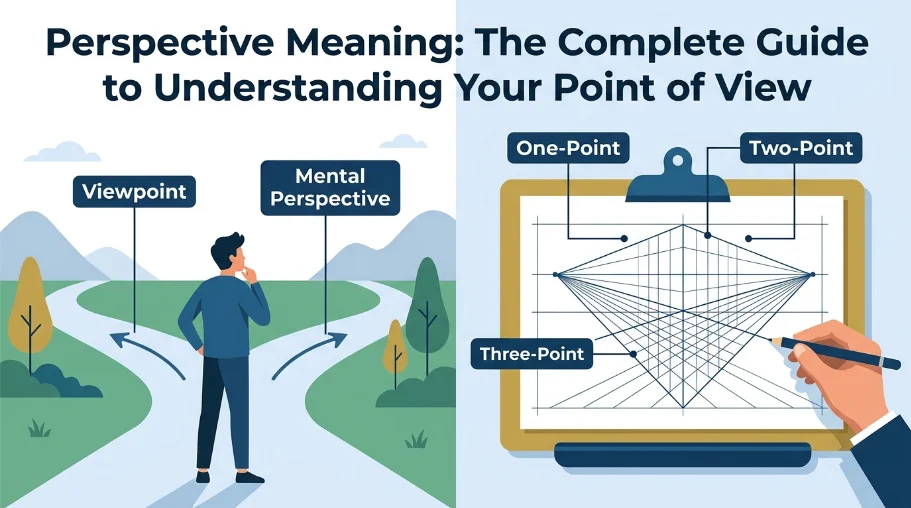
The word perspective refers to a particular way of thinking about and understanding something, such as an issue or life in general . It can also describe the art of portraying three dimensions on a flat surface or the physical view from a specific position . The word comes from the Latin perspectus, meaning “clearly perceived” .
Have you ever argued with someone and realized you were both right, just seeing things differently? That is the power of perspective. The word describes how you view and interpret the world around you.
Understanding the perspective meaning is important because it shapes how you communicate. Every person has a unique way of seeing situations, shaped by their experiences, culture, and knowledge . Recognizing this can help you understand others better and express yourself more clearly.
The confusion around perspective often comes from its multiple meanings. It can describe a mental viewpoint, a drawing technique, or even a physical view from a window. Many people also confuse perspective with prospective, a similar-sounding word about the future .
This article clears up the confusion around perspective once and for all. You will learn the definitions, see real examples, and discover how to use the word correctly. By the end, you will have a thorough understanding of this versatile word. Good communication depends on knowing these subtle distinctions.
Key Takeaway
The main takeaway is that perspective has three core meanings. First, it is a mental viewpoint or way of thinking about something . Second, it is a technique in art for showing depth and distance on a flat surface . Third, it can describe a physical view of a scene . The word is always about “looking” – whether literally with your eyes or figuratively with your mind.
Definitions and Explanations
What Does “Perspective” Mean?
The perspective meaning is rooted in the idea of “looking” or “seeing.” It comes from the Latin perspectus, meaning “clearly perceived . This explains why all meanings of perspective involve some form of viewing.
As a noun, perspective has three main definitions:
| Meaning | Explanation | Example |
| Mental Viewpoint | A way of thinking about and understanding something | “She has a fresh perspective on the problem.” |
| Artistic Technique | A method for showing three-dimensional depth on a flat surface | “The artist’s use of perspective is impressive.” |
| Physical View | A view over a distance or the position from which you look | “The rooftop offered a stunning perspective of the city.” |
Mental Perspective: Your Point of View
When people talk about “perspective” in everyday conversation, they usually mean the mental definition. This is a particular way of regarding situations, facts, or issues . It is your unique point of view.
Your perspective is shaped by many factors. These include your life experiences, cultural background, education, and personal values. For example, a young child and an adult will have different perspectives on a family vacation. The child might focus on the fun, while the adult might notice the cost and logistics .
Having perspective can also mean understanding which things are truly important . When people say you need to “keep things in perspective,” they mean you should not overreact to minor problems. It is about seeing the bigger picture.
| Aspect | Description |
| Source | Life experiences, culture, education, values |
| Function | Shapes how you interpret and judge situations |
| Value | Helps you understand others and communicate better |
Artistic Perspective: Creating Depth
Artists use perspective to make flat surfaces look three-dimensional . This is a technique for suggesting depth and distance in drawings, paintings, and other visual art.
The principle is simple. Objects that are farther away from the viewer appear smaller and less detailed. Closer objects appear larger and more detailed. Artists use this natural effect to create realistic-looking scenes.
There are three basic types of artistic perspective:
| Type | Description | Use |
| One-Point Perspective | All lines converge to a single point on the horizon | Looking down a straight road or hallway |
| Two-Point Perspective | Two vanishing points on the horizon | Viewing a building from a corner |
| Three-Point Perspective | Three vanishing points, including above or below | Looking up at a tall building or down from above |
Advantages and Disadvantages
Advantages of Having a Good Perspective
| Advantage | Explanation |
| Better Decision-Making | A balanced perspective helps you evaluate choices more clearly. |
| Reduced Stress | Keeping things in perspective prevents you from overreacting to minor setbacks . |
| Improved Relationships | Understanding that others have different perspectives promotes empathy and communication. |
| Personal Growth | Exposure to new perspectives helps you learn and expand your worldview. |
| Creative Solutions | Considering multiple perspectives helps you think of more innovative ideas. |
Disadvantages of a Limited Perspective
| Disadvantage | Explanation |
| Poor Judgement | A narrow perspective can lead to flawed decisions based on incomplete information. |
| Conflict | Failing to consider other viewpoints can cause misunderstandings and arguments. |
| Missed Opportunities | If you only see things one way, you might overlook better options. |
| Lack of Empathy | A rigid perspective makes it hard to understand how others feel. |
Real-World Examples
Examples of “Perspective” as a Mental Viewpoint
- “The article provides a fresh perspective on climate change from the viewpoint of indigenous communities.”
- “Her experience as a nurse gives her a unique perspective on healthcare reform.”
- “I need to gain some perspective on this problem before making a decision.”
- “She helped him put his life in proper perspective.”
Examples of “Perspective” in Art
- “The Renaissance is famous for developing mathematical perspective in painting.”
- “She drew the building from several different perspectives.”
- “The artist uses perspective to create a dramatic sense of receding space.”
- “Aerial perspective makes distant objects appear hazy and bluish.”
Examples of “Perspective” as a Physical View
- “From this perspective, the city looks peaceful.”
- “The rooftop provided a stunning perspective of the mountains.”
- “The hotel’s unique perspective of the harbor made it a tourist favorite.”
Perspective in Literature and Film
In storytelling, perspective refers to who is telling the story. A story told from a child’s perspective will be very different from the same story told from an adult’s perspective . Authors choose a point of view to shape how readers experience the narrative.
| Narrative Perspective | Characteristics |
| First Person | Told by a character using “I” or “we” |
| Second Person | Uses “you” to address the reader directly |
| Third Person Limited | Told by an outside voice who focuses on one character |
| Third Person Omniscient | An all-knowing voice who knows everyone’s thoughts |
Regional and Global Usage
Global English
The word perspective is consistent across all English-speaking regions. Its meanings are universally understood. There is no significant regional variation in its definition or pronunciation.
Formal vs. Informal Usage
Perspective is used in both formal and informal contexts. In academic writing, it is a key term in fields like psychology, sociology, and art history . In everyday conversation, people use it to discuss personal opinions or situations.
| Context | Usage | Example |
| Academic | Formal, analytical | “The study examines the issue from a sociocultural perspective.” |
| Professional | Neutral, professional | “Let’s consider the client’s perspective on this proposal.” |
| Casual | Informal, personal | “From my perspective, we should just relax.” |
Perspective in Psychology
In psychology, perspective often refers to different theoretical frameworks for understanding human behavior. The five major psychological perspectives are: biological, learning, cognitive, sociocultural, and psychodynamic . Each offers a different way of looking at why people think and act the way they do.
Common Mistakes
Mistake 1: Confusing “Perspective” with “Prospective”
This is the most common error. People often confuse perspective with prospective because they sound similar. Prospective is an adjective that means “likely to happen in the future” or “potential . For example, a “prospective student” is someone who might attend a school.
Correction: Use perspective for viewpoints and ways of seeing. Use prospective for things related to the future. A helpful trick is to remember that “prospective” is about “prospects” .
| Word | Meaning | Example |
| Perspective | Viewpoint, way of seeing | “His perspective on the issue was helpful.” |
| Prospective | Future, potential | “She met with prospective clients.” |
Mistake 2: Using “Perspective” Incorrectly in Art
Some people use perspective incorrectly in art contexts. They might say a painting “has good perspective” when they mean it looks realistic. While this is not wrong, perspective specifically refers to the technique of creating depth.
Correction: Use perspective to describe the technical method of showing depth and distance. For more general praise, you might say a painting looks “realistic” or “three-dimensional.”
Mistake 3: Overusing “Perspective”
Because perspective is a formal word, using it too often can make your writing sound repetitive. It is best used when you want to emphasize a particular viewpoint.
Correction: Use synonyms like viewpoint, outlook, standpoint, or point of view to vary your language.
Exercises
Exercise 1: Fill in the Blank
Choose the correct word: perspective or prospective.
- “From my _________, this is the best course of action.”
- “We are meeting with _________ clients next week.”
- “The artist’s use of _________ created a sense of depth.”
- “The _________ changes to the policy have not yet been announced.”
Exercise 2: Identify the Meaning
Determine which meaning of perspective applies in each sentence.
- “The novel is written from a child’s perspective.”
- “The painting demonstrates excellent use of perspective.”
- “We should keep our problems in perspective.”
- “The hotel offers a beautiful perspective of the ocean.”
Answer Key
Exercise 1 Answers:
- Perspective (viewpoint)
- Prospective (future clients)
- Perspective (artistic technique)
- Prospective (future changes)
Exercise 2 Answers:
- Mental viewpoint (how the story is told)
- Artistic technique (showing depth)
- Mental viewpoint (seeing the bigger picture)
- Physical view (the view from a location)
Related Concepts and Comparisons
Perspective vs. Prospective
This is the most common comparison. Perspective is about viewing something from a particular position, while prospective relates to what might happen in the future .
| Term | Meaning | Part of Speech |
| Perspective | Viewpoint, way of seeing | Noun |
| Prospective | Potential, future-related | Adjective |
Perspective vs. Point of View
These terms are often used interchangeably. However, “point of view” usually refers to the position from which something is considered. “Perspective” can refer to a broader way of understanding .
Perspective vs. Outlook
Outlook often refers to a general attitude toward life. Perspective can be more specific, referring to how you view a particular situation.
| Term | Meaning | Scope |
| Perspective | Particular way of seeing something | Specific |
| Outlook | General attitude toward life | Broad |
FAQs
What does perspective mean in simple terms?
Perspective means a particular way of looking at things. It can be a mental viewpoint, an artistic technique for showing depth, or a physical view from a position.
What is the difference between perspective and prospective?
Perspective is about a viewpoint or way of seeing something. Prospective is about the future and means “potential” or “likely.” If you have a “new perspective,” you see things differently. If you are a “prospective student,” you are considering attending a school.
How do you use perspective in a sentence?
You can use perspective to describe someone’s viewpoint: “His perspective on the issue is different from mine.” You can also use it to describe art: “The painting is an excellent example of perspective.” Or to describe a view: “The top of the building offers a great perspective of the city.”
What does “put things in perspective” mean?
This phrase means to view a situation objectively, recognizing what is truly important and what is not . It helps you avoid overreacting to minor problems.
What are the types of perspective in art?
The three main types are one-point perspective, two-point perspective, and three-point perspective . One-point perspective has a single vanishing point. Two-point perspective has two vanishing points. Three-point perspective has three vanishing points .
What is the origin of the word perspective?
The word comes from the Latin perspectus, meaning “clearly perceived” . It is from the verb perspicere, which means “to look closely . The root specere means “to look at .
What is psychological perspective?
In psychology, a perspective is a theoretical framework for understanding human behavior. The five major perspectives are biological, learning, cognitive, sociocultural, and psychodynamic .
Why is perspective important?
Perspective helps you understand the world around you and communicate with others. It allows you to see situations from different angles, make better decisions, and empathize with others.
Conclusion
This guide has explored the rich meaning of the word perspective. It is a versatile word that can describe a mental viewpoint, an artistic technique, or a physical view. The core idea is always about “looking” and “seeing” – whether literally or figuratively.
The best practical advice is to use perspective when you want to describe a way of seeing things. If you are talking about the future, remember that prospective is the word you need. Understanding this distinction will help you communicate more clearly and professionally.
Good communication depends on understanding these important distinctions. Now you have the knowledge to use perspective correctly in any context. Use this guide as a reference whenever you are unsure.


18 thoughts on “Perspective Meaning | The Complete Guide to Understanding Your Point of View”