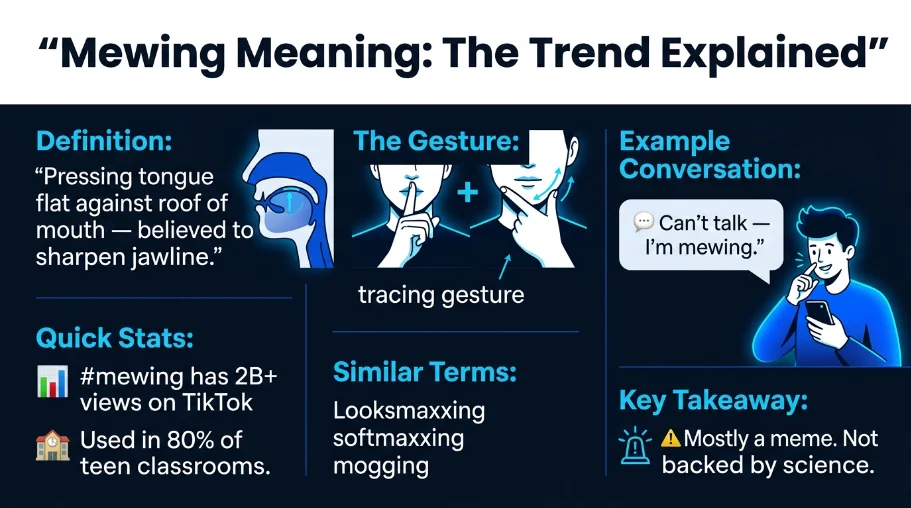
If you’ve heard someone say they’re “mewing” or seen a kid trace their jawline instead of answering a question, you’re probably wondering what it means. Mewing meaning refers to a tongue posture technique and a viral internet meme where a person presses their tongue flat against the roof of their mouth. Some believe it can sharpen the jawline over time, while others use it as a joke to avoid talking.
But there’s more to this trend than just tongue placement. Mewing has become a full-blown cultural moment, especially among Gen Z and Gen Alpha. It shows up in classrooms, on TikTok, and in group chats. Understanding the mewing meaning helps you stay in the loop whether you’re a parent, teacher, or just someone trying to decode modern slang.
Quick Answer Table
| Aspect | Details |
|---|---|
| Meaning | Pressing the tongue flat against the roof of the mouth, believed by some to improve jawline and facial structure. |
| Context | Used seriously in looksmaxxing communities and ironically as a classroom meme. |
| Platforms | TikTok, YouTube, Instagram Reels, Discord, Reddit, school hallways. |
| Example | A student points to their jawline instead of answering a teacher’s question. |
| Tone | Ranges from sincere self-improvement to playful irony and even mild disrespect. |
What Does Mewing Mean?
At its core, the mewing meaning is simple: it’s the practice of placing your tongue against the roof of your mouth specifically, flattening it so the entire tongue makes contact with the palate. The tip of the tongue rests just behind the front teeth without touching them. The lips stay closed, and the teeth lightly touch.
Proponents claim that over time, this tongue posture can reshape the jawline, straighten teeth, and even improve breathing. However, experts are skeptical. The American Association of Orthodontists notes that “scientific evidence supporting mewing’s jawline-sculpting claims is as thin as dental floss”. Cleveland Clinic doctors agree, stating that “research doesn’t support using mewing for any of these things”.
So why does everyone keep talking about it? Because the mewing meaning has split into two distinct ideas: a physical exercise and a social meme.
Origin of the Term
Mewing is named after British orthodontist Dr. John Mew, who developed the technique in the 1970s. He and his son, Dr. Mike Mew, promoted a practice called “orthotropics” the idea that proper tongue and jaw posture could guide facial growth and prevent orthodontic issues. John Mew lost his dental license in 2019 over these unorthodox practices.
The term “mewing” wasn’t actually coined by the Mews themselves it emerged from online communities, especially incel and looksmaxxing forums, where users shared tongue‑posture tips as a way to enhance attractiveness.
Context and Meaning Differences
The mewing meaning shifts depending on who’s using it and where.
Serious Self-Improvement
In looksmaxxing spaces online communities focused on maximizing physical appearance mewing is discussed as a legitimate technique. Users share tutorials, progress photos, and tips on tongue placement. For these individuals, mewing is part of a broader routine that may include chewing gum, posture correction, and even surgery (so‑called “hardmaxxing”).
Ironic Classroom Meme
For most teens, however, mewing is a joke. Students use a specific gesture: placing a finger over their lips in a “shush” motion, then tracing their jawline from top to bottom. This signals, “I can’t answer your question I’m mewing”. Teachers and parents often find it frustrating, but many students use it playfully rather than seriously.
A Split Identity
This dual meaning makes mewing unique. It’s both a sincere wellness practice and a satirical commentary on internet culture. As one slang guide puts it, “Used casually, it signals meme literacy. Used too seriously, it can make you sound deep in internet self‑optimization culture”.
Real-Life Conversation Examples
Here are five natural dialogue examples showing the mewing meaning in action.
Example 1 — Classroom Dodge
Teacher: “Sarah, can you tell me the answer to question five?”
Sarah: [puts finger to lips, traces jawline, stays silent]
Teacher: “Are you… mewing right now?”
Example 2 — Group Chat
Alex: “Bro why didn’t you reply to my text?”
Jordan: “Sorry, I was mewing. Can’t break the streak.”
Example 3 — TikTok Comment
User1: “He’s been mewing in every selfie since January.”
User2: “And it’s working tbh.”
Example 4 — Gym Talk
Marcus: “You’ve been mewing for six months any results?”
Derek: “Jaw’s way more defined. Just gotta stay consistent.”
Example 5 — Family Dinner
Mom: “How was school today?”
Teen: [points to jawline, grins]
Mom: “I’m not playing this game. Answer me.”
Platform-Specific Usage
TikTok Usage
TikTok is ground zero for mewing. Videos with the hashtag #mewing have billions of views. Creators post tutorials, before-and-after transformations, and comedic skits where characters mew instead of speaking. The platform also popularized the shush‑and‑trace gesture that became a classroom staple.
Snapchat Usage
On Snapchat, mewing appears in selfies and streaks. Users may caption a photo “mewing” to imply they’re working on their jawline. The term is also used ironically someone might send a silly face and call it “mewing” as a joke.
Instagram Usage
Instagram sees mewing in Reels and Stories, often tied to fitness, modeling, or glow‑up content. Influencers post side‑profile shots with captions like “3 years of mewing”. The aesthetic focus is strong here mewing is presented as part of a broader beauty routine.
Text Messaging Usage
In texts and DMs, mewing is typically used as a playful excuse. Someone might say, “Can’t chat, mewing” or “Mewing streak: day 100” to avoid a conversation. It functions like a meme‑based inside joke among friends who are online‑savvy.
Similar Terms and Variations
Understanding the mewing meaning is easier when you know related slang.
| Term | Meaning |
|---|---|
| Looksmaxxing | The practice of maximizing physical appearance, often through beauty routines or surgery. |
| Softmaxxing | Non‑surgical appearance improvements, including mewing, skincare, and grooming. |
| Hardmaxxing | Surgical or invasive procedures like jaw implants or rhinoplasty. |
| Mogging | Looking better than someone else; “mogging” someone means you outshine them physically. |
| Orthotropics | The dental philosophy behind mewing, focusing on jaw and tongue posture. |
| Mew | The verb form “to mew” means to perform the tongue exercise. |
Common Mistakes
Mistake 1: Thinking It Works Overnight
Many people expect instant results. In reality, even proponents say it takes years of consistent practice to notice any change. Experts note that photos online often use lighting and angles to exaggerate effects.
Mistake 2: Using It Disrespectfully
In classrooms, mewing can come across as rude. Teachers and authority figures may interpret the gesture as dismissive or mocking. While some students use it playfully, others find it genuinely frustrating.
Mistake 3: Confusing It with Cat Sounds
“Mewing” also means the high‑pitched cry a cat makes. These are completely unrelated. In slang, mewing always refers to tongue posture, not feline noises.
Mistake 4: Believing It Replaces Orthodontic Care
Some people skip braces or surgery hoping mewing will fix their teeth or jaw. This can delay proper treatment and lead to more serious issues. Always consult a dentist or orthodontist for medical concerns.
How to Respond Naturally
If someone uses mewing on you especially the gesture here’s how to handle it.
Casual Replies
- “Nice mewing form. You been practicing?”
- “Bro thinks he’s the main character.”
Friendly Replies
- “I’ll wait until you’re done mewing.”
- “Okay, jawline king. Let me know when you can talk.”
Professional Alternatives (for teachers/parents)
- “I understand you’re joking, but I need a verbal answer.”
- “Let’s save the memes for later what’s your response?”
The key is to recognize the humor without rewarding disrespect. Most teens aren’t being malicious they’re just leaning into an internet joke.
FAQs
What is the mewing meaning in simple terms?
Mewing means pressing your tongue flat against the roof of your mouth. Some people do it hoping to improve their jawline, but it’s also a popular meme where teens use a shush‑and‑jawline gesture to avoid answering questions.
Does mewing actually work?
Experts say no. There is no strong scientific evidence that mewing reshapes an adult jawline or fixes dental issues. The American Association of Orthodontists advises against relying on it for orthodontic treatment.
Why do kids mew in class?
Students use the shush‑and‑trace gesture as a joke to avoid answering teachers or parents. It’s a playful way of saying, “I can’t talk I’m working on my jawline”. Most do it for laughs, not because they believe in the technique.
What is the mewing gesture?
The gesture involves putting one finger over your lips like you’re saying “shush,” then tracing your jawline from top to bottom with the other hand. It signals that you’re “mewing” and therefore can’t speak.
Where did mewing come from?
Mewing comes from Dr. John Mew, a British orthodontist who promoted tongue‑posture techniques in the 1970s. Online communities later adopted the term, and it went viral on TikTok around 2024.
Is mewing safe?
Yes, the tongue exercise itself is not harmful. However, relying on mewing instead of proper orthodontic care can delay necessary treatment. Always see a professional for dental or jaw concerns.
What is looksmaxxing?
Looksmaxxing is the practice of maximizing one’s physical appearance. It includes softmaxxing (non‑surgical changes like mewing) and hardmaxxing (surgery). Mewing is a key term within this subculture.
How do you pronounce mewing?
In U.S. English, it’s pronounced /ˈmjuɪŋ/ like “myoo‑ing.” It rhymes with “doing” but starts with an “m”.
Conclusion
So, what’s the bottom line on mewing? It’s a tongue‑posture exercise with a split personality part serious self‑improvement, part internet joke. While some genuinely believe it can sharpen their jawline, the scientific community remains unconvinced. For most teens, though, mewing isn’t about facial structure at all. It’s about humor, rebellion, and a shared language that makes them feel in on the joke. Whether you encounter it in a classroom, a TikTok video, or a group chat, now you know exactly what it means and how to respond. Don’t overthink it; just laugh along and keep the conversation moving.







16 thoughts on “ Mewing Meaning | Complete Guide to the Slang & Trend For 2026”