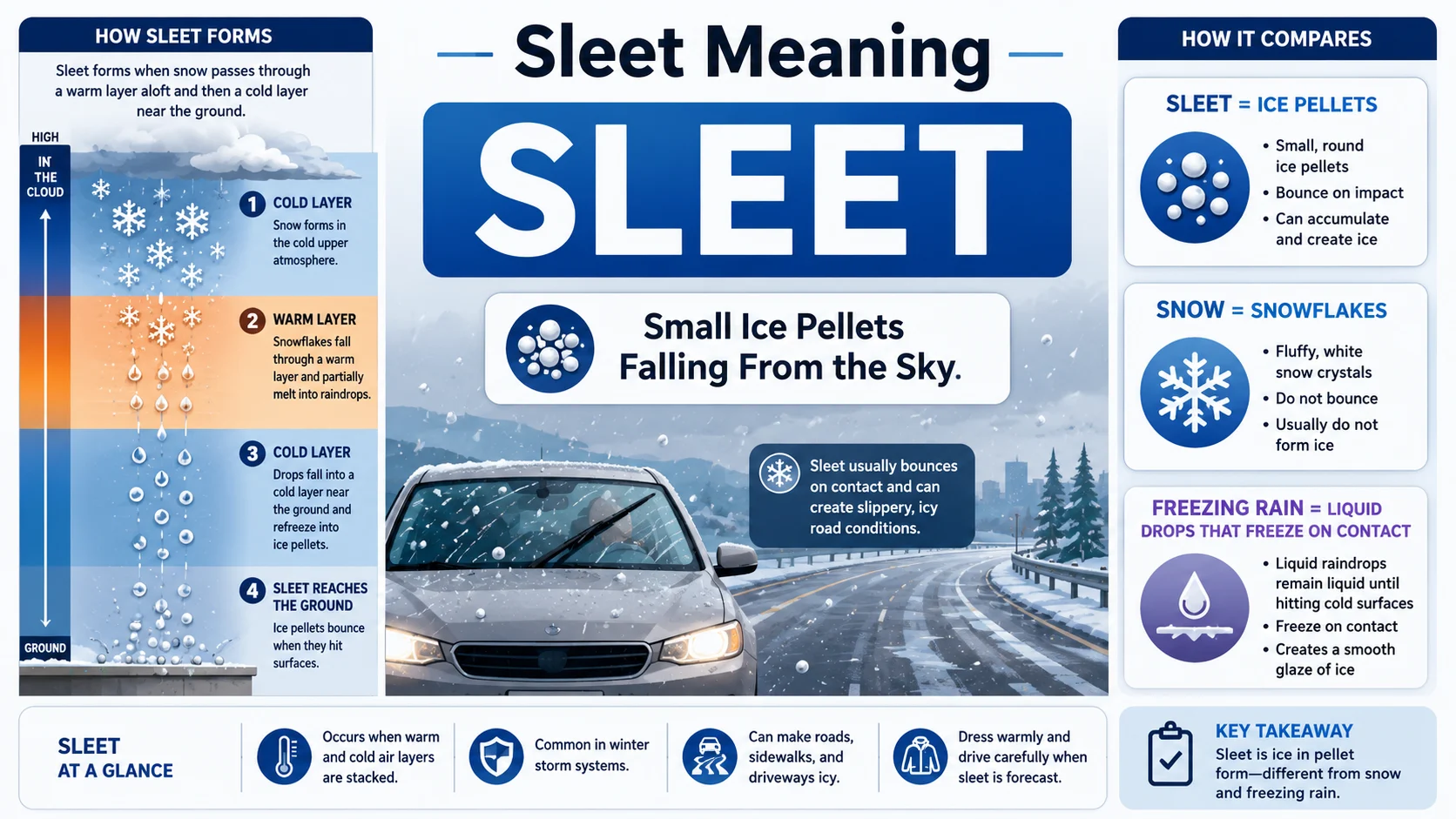
Sleet is a type of winter precipitation made of small ice pellets that fall from clouds to the ground. It forms when snow partially melts into rain while falling, then refreezes before reaching the surface. Sleet can make roads and sidewalks slippery.
Sleet meaning refers to small balls or pellets of ice that fall from the sky during certain winter weather conditions.
Unlike ordinary snow, sleet consists of solid ice pellets. Unlike freezing rain, sleet usually freezes before it reaches the ground. As a result, you may hear tiny pellets bouncing against windows, roofs, cars, and pavement during a sleet storm.
Sleet commonly develops when different layers of warm and cold air exist above the ground. Snow begins falling from a cloud. It then passes through a warmer layer and partially or completely melts. Finally, it enters a colder layer near the surface and freezes again into ice pellets.
The result is precipitation that looks different from both snow and rain.
Sleet can also create dangerous travel conditions. The pellets may accumulate on roads, bridges, sidewalks, and driveways. Consequently, drivers and pedestrians should take extra care during sleet events.
This guide explains what sleet is, how it forms, what it looks like, how Americans use the word, and how sleet differs from snow, hail, and freezing rain.
Quick Answer
| Question | Answer |
|---|---|
| Meaning | Small ice pellets falling from the sky |
| Weather type | Winter precipitation |
| How it forms | Snow melts and then refreezes before reaching the ground |
| Appearance | Small, hard, translucent or white pellets |
| Temperature | Usually associated with freezing or near-freezing conditions |
| Effect | Can make roads and surfaces slippery |
| Different from snow? | Yes. Sleet consists of ice pellets rather than snowflakes |
| Different from freezing rain? | Yes. Sleet freezes before reaching the ground; freezing rain freezes on contact |
What Does Sleet Mean?
The sleet meaning is straightforward: sleet is frozen precipitation that falls as small ice pellets.
These pellets are generally much smaller than hail.
When sleet falls, you may hear a distinct tapping sound.
For example:
“The forecast says sleet will begin this afternoon.”
This means meteorologists expect small ice pellets rather than ordinary rain or snow.
Sleet can fall alone. However, it can also occur alongside snow or freezing rain.
The exact mixture depends on the temperature structure between the clouds and the ground.
What Is Sleet in Simple Terms?
In simple terms, sleet is rain or melted snow that freezes into tiny ice pellets before reaching the ground.
Think of the process like this:
Snow falls → enters warmer air → melts → enters colder air → freezes → falls as sleet
This differs from freezing rain.
With freezing rain, liquid droplets remain liquid while falling. They freeze only when they hit a cold surface.
Therefore:
Sleet = freezes before reaching the ground
Freezing rain = freezes when it reaches a surface
That distinction is one of the easiest ways to understand sleet.
What Does Sleet Look Like?
Sleet usually looks like tiny grains or pellets of ice.
The pellets can appear:
- clear
- translucent
- white
- slightly cloudy
- rounded
- irregular
They are generally harder than snowflakes.
When sleet hits a surface, it may bounce.
You might notice the pellets collecting on:
- windshields
- roofs
- sidewalks
- roads
- lawns
- outdoor furniture
Unlike soft snow, sleet can create a layer of hard pellets.
How Does Sleet Form?
Sleet requires a particular temperature pattern in the atmosphere.
The process typically begins high in the atmosphere.
Step 1: Snow Forms
Inside a sufficiently cold cloud, precipitation begins as snow.
The snowflakes start their journey toward the ground.
Step 2: Snow Enters Warmer Air
As the snow falls, it may encounter a layer of air above freezing.
The snowflakes begin to melt.
Depending on the depth and temperature of this warm layer, the snow may melt partially or completely.
Step 3: The Precipitation Enters Cold Air
The melted precipitation then moves into a colder layer closer to the surface.
If this cold layer is sufficiently deep, the droplets freeze before reaching the ground.
Step 4: Ice Pellets Reach the Surface
The frozen droplets fall as sleet.
Therefore, sleet requires more than simply “cold weather.” It requires a particular arrangement of warm and cold atmospheric layers.
Sleet vs. Snow
Snow consists of ice crystals that form directly in clouds and reach the ground as snowflakes.
Sleet consists of ice pellets that typically form when melted precipitation refreezes before reaching the surface.
| Feature | Snow | Sleet |
|---|---|---|
| Form | Ice crystals | Ice pellets |
| Texture | Soft and flaky | Hard and granular |
| Sound | Usually quiet | Often makes a tapping sound |
| Formation | Remains frozen | Melts and refreezes |
| Accumulation | Can form a snow layer | Can form an icy pellet layer |
Both are forms of frozen precipitation.
However, their atmospheric formation differs.
Sleet vs. Freezing Rain
This distinction causes frequent confusion.
Sleet
Sleet freezes before reaching the ground.
It falls as solid ice pellets.
Freezing Rain
Freezing rain remains liquid while falling.
It freezes when it touches a surface that is at or below freezing.
| Feature | Sleet | Freezing Rain |
|---|---|---|
| Falls as | Ice pellets | Liquid droplets |
| Freezes | Before reaching ground | On contact |
| Surface effect | Pellets may accumulate | Creates an ice coating |
| Typical hazard | Slippery surfaces | Glaze ice |
Freezing rain can create significant ice accumulation on roads, trees, power lines, and other surfaces.
Sleet vs. Hail
Similarly, sleet and hail are different types of frozen precipitation. Typically, sleet forms during winter weather when falling snow melts into rain and then refreezes into small ice pellets before reaching the ground.
Hail forms inside strong thunderstorms through powerful updrafts.
Hailstones can become much larger than sleet pellets.
| Feature | Sleet | Hail |
|---|---|---|
| Typical season | Winter | Often spring or summer |
| Formation | Melting and refreezing precipitation | Thunderstorm updrafts |
| Size | Usually small pellets | Can range from small to very large |
| Associated weather | Winter storms | Thunderstorms |
| Main concern | Slippery surfaces | Property and crop damage |
Therefore, calling every piece of falling ice “hail” is inaccurate.
Sleet vs. Graupel
Sleet can also be confused with graupel.
Graupel forms when supercooled water droplets freeze onto snow crystals.
It often looks like small, soft, white pellets.
Sleet, by contrast, typically consists of refrozen melted precipitation.
| Feature | Sleet | Graupel |
|---|---|---|
| Appearance | Hard ice pellets | Soft, snow-like pellets |
| Formation | Melted precipitation refreezes | Water freezes onto snow crystals |
| Texture | Harder | Softer |
| Weather context | Winter mixed precipitation | Snow showers and convective winter weather |
The two may look similar from a distance.
Is Sleet the Same as Ice?
Not exactly.
Sleet consists of small pieces of ice, but “ice” is a much broader term.
Ice can refer to:
- frozen water
- ice cubes
- glaze ice
- ice sheets
- frozen precipitation
- ice pellets
Sleet specifically refers to a type of falling precipitation.
Therefore, all sleet is ice, but not all ice is sleet.
Is Sleet Dangerous?
Sleet can create hazardous conditions.
The biggest concern is often slipperiness.
Sleet can make:
- roads slick
- bridges dangerous
- sidewalks slippery
- driveways difficult to walk on
- visibility worse
Furthermore, sleet can combine with snow and freezing rain.
That combination can make winter storms particularly difficult.
Drivers should reduce speed and allow additional stopping distance when sleet affects road conditions.
Sleet and Driving
Sleet can create challenging driving conditions.
The pellets may accumulate on pavement and reduce traction.
They can also bounce off windshields, potentially making visibility more difficult.
Therefore, during a sleet event:
- slow down
- increase following distance
- avoid sudden braking
- use appropriate headlights
- watch for icy bridges
- follow local weather and transportation warnings
Road conditions can change quickly during winter precipitation.
Sleet and Walking
Sleet can also affect pedestrians.
A layer of pellets can make sidewalks slippery.
The risk becomes greater if the pellets melt and then refreeze.
Therefore, people walking during sleet should use caution, particularly on:
- stairs
- sidewalks
- driveways
- parking lots
- bridges
- untreated paths
Sleet in Weather Forecasts
Meteorologists may mention sleet when atmospheric conditions support mixed winter precipitation.
A forecast might say:
“Rain will change to sleet overnight.”
This means temperatures and atmospheric layers are expected to change enough for precipitation to begin freezing before reaching the surface.
You might also see:
“A wintry mix of snow, sleet, and freezing rain is possible.”
The phrase wintry mix describes a combination of winter precipitation types.
What Does a Sleet Storm Mean?
A sleet storm is an informal description for a weather event involving significant sleet.
Meteorological terminology can vary depending on the weather service and region.
A major winter storm may produce several precipitation types during its lifetime.
For example:
Snow → sleet → freezing rain → rain
This sequence can occur when warmer air moves into the region.
Alternatively, temperatures can fall and cause precipitation to transition in the opposite direction.
Sleet Meaning in American English
In the United States, sleet usually means small ice pellets that fall as precipitation.
This is especially important because the word can have different meanings in British English.
In some British usage, sleet can refer to a mixture of rain and snow.
Therefore, American and British weather terminology does not always use “sleet” in exactly the same way.
For a US audience, the ice-pellet definition is the most relevant.
Sleet in a Sentence
Here are several natural examples.
1
“The roads became slippery after the sleet started.”
2
“We woke up to sleet instead of snow.”
3
“The forecast calls for rain and sleet tonight.”
4
“Sleet was bouncing off the windshield.”
5
“The storm may produce snow, sleet, and freezing rain.”
Each sentence uses sleet as a type of weather precipitation.
Sleet as a Verb
The word sleet can also function as a verb.
For example:
“It started to sleet around midnight.”
Here, “sleet” describes the action of falling ice pellets.
This usage is common in weather descriptions.
Sleet as a Noun
Sleet is most commonly used as a noun.
For example:
“The sleet covered the driveway.”
Here, sleet refers to the precipitation itself.
It can also describe an event:
“Heavy sleet moved through the area.”
Sleet as an Adjective
The word can appear in compound descriptions such as:
- sleet storm
- sleet pellets
- sleet accumulation
- sleet forecast
- sleet warning
These expressions describe weather conditions involving sleet.
What Temperature Does It Sleet?
There is no single surface temperature that guarantees sleet.
Atmospheric temperature layers matter more than the thermometer reading at ground level alone.
For sleet to reach the ground, precipitation generally needs to encounter a sufficiently cold layer near the surface after passing through warmer air.
Therefore, sleet can occur when the surface temperature is near freezing.
The exact atmospheric profile determines whether precipitation falls as:
- snow
- sleet
- freezing rain
- ordinary rain
Why Does It Sleet Instead of Snow?
It sleets instead of snow when snowflakes encounter a warm enough atmospheric layer to melt and then enter a cold enough layer to refreeze before reaching the ground.
This is why a small change in atmospheric temperature can dramatically change the precipitation type.
For example, a winter storm might begin with snow.
As warmer air moves in, the snow may melt into rain.
If a cold layer remains near the surface, that rain can freeze into sleet.
If the cold layer is too shallow, the rain may remain liquid until it reaches the ground, producing freezing rain.
Why Does Sleet Bounce?
Sleet pellets are solid pieces of ice.
When they hit a hard surface, they can bounce rather than immediately flatten or melt.
This is one useful visual clue.
If you hear small hard pellets tapping against a window during a winter storm, you may be hearing sleet.
Snowflakes, by comparison, generally land softly.
Can Sleet Accumulate?
Yes.
Sleet can accumulate on surfaces, particularly during prolonged or intense precipitation.
It may form a layer on:
- roads
- roofs
- sidewalks
- vehicles
- lawns
The accumulation can make surfaces slippery.
If temperatures rise above freezing, the pellets may melt. Later, falling temperatures can cause the water to freeze again.
This can create additional hazards.
Sleet and Winter Storms
Sleet frequently appears as part of larger winter weather systems.
A single storm can produce different precipitation types in different locations.
For example, one city may receive snow while another receives sleet.
A third location may receive freezing rain.
This happens because atmospheric temperature profiles vary across relatively short distances.
Consequently, two nearby communities can experience very different winter conditions during the same storm.
Why Sleet Matters for Forecasting
Precipitation type is important for weather forecasting.
A difference of only a few degrees across an atmospheric layer can change the expected precipitation.
That distinction matters because snow, sleet, and freezing rain produce different hazards.
For example:
- snow can reduce visibility and traction
- sleet can create slippery roads
- freezing rain can create dangerous ice coatings
- rain generally creates different winter travel conditions
Therefore, meteorologists closely examine temperature profiles when forecasting winter storms.
Common Misunderstandings About Sleet
Sleet Is Frozen Rain
This explanation is useful as a shortcut, but it can be incomplete.
Sleet often forms when melted snow or precipitation refreezes before reaching the ground.
Sleet Is the Same as Freezing Rain
It isn’t.
Sleet freezes before reaching the surface.
Freezing rain freezes after touching the surface.
Sleet Is Small Hail
It isn’t.
Sleet and hail form through different atmospheric processes.
Sleet Is Always White
Not necessarily.
Sleet pellets can appear clear, translucent, or white.
Sleet Only Happens During Snowstorms
Not necessarily.
Sleet can occur during mixed precipitation events without substantial snow accumulation.
Sleet Vocabulary
Several related terms commonly appear with sleet.
| Term | Meaning |
|---|---|
| Sleet pellets | Small pieces of frozen precipitation |
| Sleet accumulation | Sleet collected on a surface |
| Wintry mix | Combination of winter precipitation types |
| Freezing rain | Liquid rain that freezes on contact |
| Graupel | Soft pellets formed when water freezes onto snow crystals |
| Hail | Ice produced within thunderstorms |
| Snow | Ice crystals that fall from clouds |
Understanding these terms makes winter forecasts easier to interpret.
Frequently Asked Questions
What does sleet mean?
Sleet means small ice pellets that fall from the sky as frozen precipitation. In US weather terminology, it usually forms when snow melts and then refreezes before reaching the ground.
Is sleet rain or snow?
Sleet is neither ordinary rain nor ordinary snow. It is frozen precipitation that falls as small ice pellets. It can begin as snow before melting and refreezing.
What does sleet look like?
Sleet looks like small, hard ice pellets. The pellets can be clear, translucent, or white, and they may bounce when they hit hard surfaces.
What is the difference between sleet and freezing rain?
Sleet freezes before reaching the ground and falls as ice pellets. Freezing rain remains liquid while falling and freezes when it touches a sufficiently cold surface.
Is sleet dangerous?
Sleet can make roads, sidewalks, and other surfaces slippery. It can therefore create hazardous travel and walking conditions.
Can it sleet when the temperature is above freezing?
Yes, under certain atmospheric conditions. The temperature near the ground does not tell the entire story. Sleet depends on the temperature structure throughout the atmosphere.
Is sleet the same as hail?
No. Sleet typically forms when precipitation melts and refreezes during a winter weather system. Hail forms inside thunderstorms through strong atmospheric updrafts.
Why does sleet bounce?
Sleet consists of hard ice pellets. When the pellets hit hard surfaces such as pavement or windows, they can bounce.
Can sleet accumulate?
Yes. During sustained or heavy precipitation, sleet can accumulate on roads, roofs, sidewalks, vehicles, and other surfaces.
What is a wintry mix?
A wintry mix is a combination of winter precipitation types. It can include snow, sleet, freezing rain, or ordinary rain, depending on atmospheric conditions.
Conclusion
The sleet meaning is simple: sleet is a type of winter precipitation that falls as small ice pellets.
It commonly forms when snow falls through a warmer layer of air, melts, and then enters a colder layer before reaching the ground. The precipitation freezes again and arrives as small pellets of ice.
That process makes sleet different from both snow and freezing rain.
Snow falls as ice crystals.
Sleet falls as ice pellets.
Freezing rain falls as liquid droplets and freezes when it reaches a cold surface.
Sleet can also differ from hail and graupel. Hail typically forms inside thunderstorms, while graupel forms when supercooled water freezes onto snow crystals.
For people in the United States, understanding the distinction is particularly useful during winter weather. Sleet can reduce traction, make sidewalks slippery, and contribute to hazardous travel conditions.
Furthermore, the term can appear in everyday conversation, weather forecasts, news reports, and emergency alerts.
So, when a forecast says “sleet is possible,” expect small pellets of ice rather than ordinary snowflakes or liquid rain. The precipitation type may change as atmospheric temperatures shift, making winter storms dynamic and sometimes difficult to predict.
Ultimately, sleet is best understood as frozen precipitation that reaches the ground in the form of small ice pellets.











1 thought on “Sleet Meaning| Definition, Weather Examples and Differences”