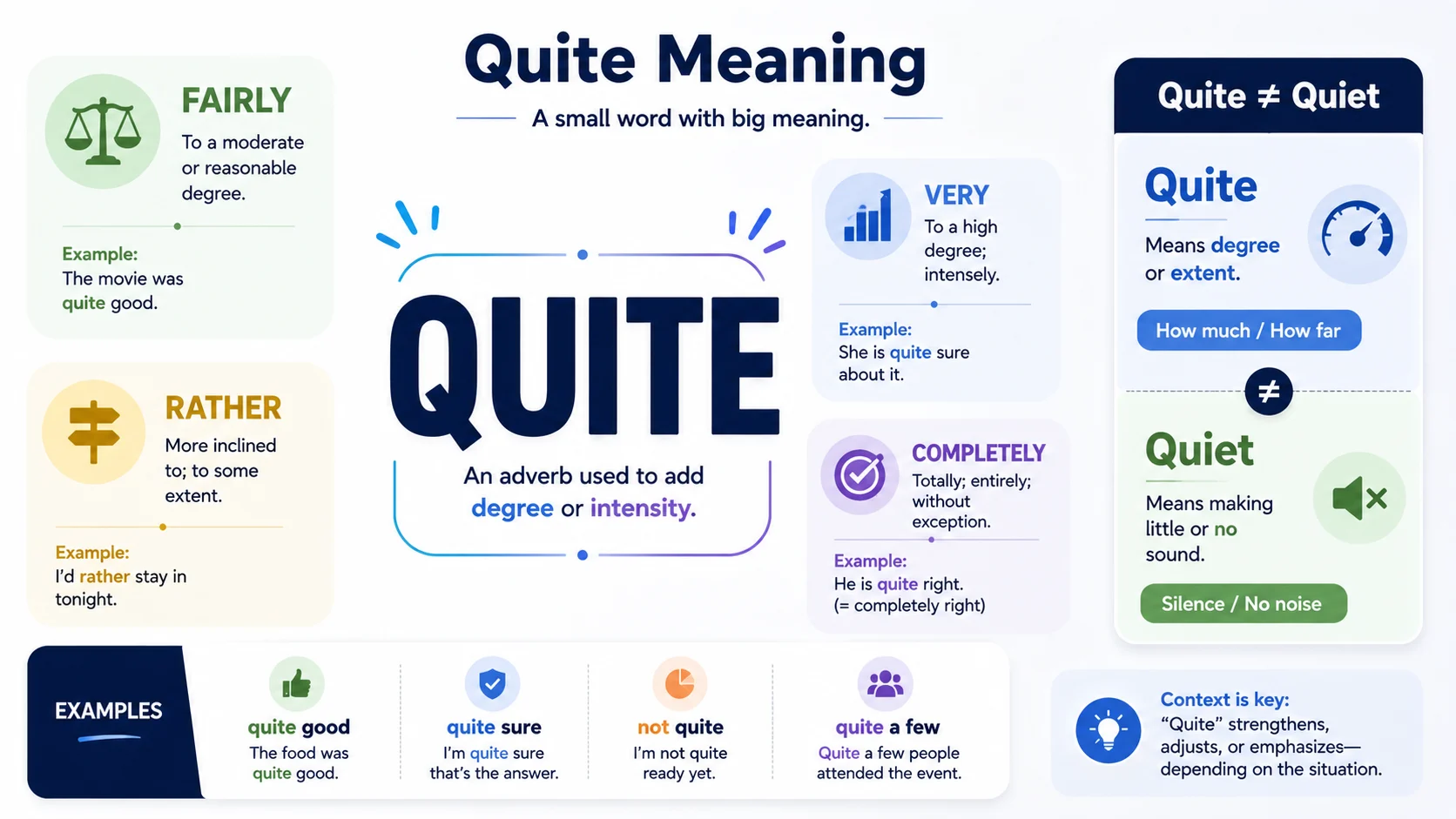
Quite is an adverb that changes the strength of an adjective, adverb, or statement. Depending on context, it can mean “fairly,” “rather,” “very,” “completely,” or “entirely.” Its exact meaning often depends on the word that follows it and the variety of English being used.
Quite meaning depends on context, because this small word can express different degrees of intensity. In one sentence, quite can mean “fairly,” while in another, it can mean “completely” or “very.”
For example, “The movie was quite good” may mean the movie was fairly good. However, “I’m quite certain” can mean that the speaker is completely certain.
This variation makes quite an interesting English word. Furthermore, British and American English can use it somewhat differently. The meaning can also change depending on whether quite modifies a gradable adjective, an absolute adjective, or another adverb.
This guide explains the meaning of quite, its different uses, examples, synonyms, common mistakes, pronunciation, and the important difference between quite and quiet.
Quick Answer
| Element | Explanation |
|---|---|
| Part of speech | Adverb |
| Basic function | Changes the degree or intensity of another word or statement |
| Common meanings | Fairly, rather, very, completely, entirely |
| Example | “The movie was quite interesting.” |
| Formal use | Common and grammatically standard |
| British English | Often means “fairly” or “rather,” depending on context |
| American English | Often means “very” or “rather,” though context still matters |
| Common confusion | Quite ≠ quiet |
What Does Quite Meaning Refer To?
The basic quite meaning is related to degree or completeness.
As an adverb, quite modifies another word or expression.
For example:
“The test was quite difficult.”
Here, quite modifies difficult.
It tells the reader that the test had a significant level of difficulty.
However, the exact strength varies.
Compare:
“The test was somewhat difficult.”
“The test was quite difficult.”
“The test was extremely difficult.”
These expressions communicate different degrees of intensity.
Quite Can Have More Than One Degree
One reason quite can be confusing is that it does not always represent exactly the same level of intensity.
Depending on context, it can mean:
- fairly
- rather
- somewhat
- very
- completely
- entirely
Therefore, you should interpret it together with the rest of the sentence.
Examples
“The restaurant is quite good.”
This could mean fairly good or very good.
“That is quite impossible.”
Here, quite can strengthen the idea toward completely or entirely impossible.
“She is quite certain.”
This can mean completely certain.
Consequently, the adjective following quite provides an important clue.
Quite as an Adverb
Quite is an adverb.
An adverb can modify a verb, adjective, another adverb, or sometimes an entire statement.
With quite, the most common function is modifying an adjective or adverb.
Modifying an Adjective
“It was quite expensive.”
Here, quite modifies expensive.
Modifying an Adverb
“She runs quite quickly.”
Here, quite modifies quickly.
Modifying a Statement
“Quite honestly, I expected something different.”
Here, the word helps modify the speaker’s attitude toward the statement.
Therefore, quite has several grammatical roles within ordinary English.
Quite Meaning: “Fairly” or “Rather”
One common use of quite means fairly, reasonably, or rather.
For example:
“The apartment is quite small.”
This can mean the apartment is fairly small.
Similarly:
“The weather is quite cold.”
This suggests that the weather is noticeably cold, although it may not indicate an extreme temperature.
Other examples include:
- “The book is quite interesting.”
- “The restaurant is quite expensive.”
- “The lesson was quite difficult.”
- “The road is quite narrow.”
- “The movie was quite enjoyable.”
In these examples, quite increases the strength of the adjective without necessarily making it extreme.
Quite Meaning: “Very”
In some contexts, quite can function similarly to very.
For example:
“She is quite talented.”
The speaker may mean:
“She is very talented.”
Similarly:
“That was quite impressive.”
can communicate strong approval.
This usage appears in both British and American English, although interpretation can vary.
Why Context Matters
Tone can change the perceived strength of quite.
For example:
“The food was quite good.”
Depending on the speaker, this could mean:
- The food was reasonably good.
- The food was surprisingly good.
- The food was very good.
Listeners often rely on voice, facial expression, surrounding words, and cultural expectations.
Written communication removes some of these clues.
Therefore, quite can sometimes create ambiguity.
Quite Meaning: “Completely” or “Entirely”
Another important use occurs when quite modifies words that express an absolute or complete state.
For example:
“The answer is quite correct.”
Here, quite can emphasize complete correctness.
Another example:
“The idea is quite impossible.”
This suggests that the idea is completely impossible.
You can also see this meaning in expressions such as:
“I quite agree.”
This generally means:
“I completely agree.”
Why the Adjective Matters
Compare these examples:
“The room is quite warm.”
“The answer is quite correct.”
The first often suggests a degree of warmth.
The second can emphasize completeness.
Consequently, the type of adjective helps determine the meaning.
Quite With Gradable Adjectives
A gradable adjective describes something that can exist at different levels.
Examples include:
- cold
- warm
- expensive
- interesting
- difficult
- large
- attractive
- useful
You can say:
slightly cold
fairly cold
quite cold
very cold
extremely cold
Here, quite usually indicates a noticeable degree.
Examples
“The room is quite warm.”
“The assignment was quite difficult.”
“The movie was quite entertaining.”
“The hotel was quite expensive.”
The precise intensity depends on context.
Quite With Absolute Adjectives
Some adjectives describe conditions that are more absolute.
Examples include:
- impossible
- perfect
- certain
- complete
- unique
- essential
With these words, quite can sometimes approach the meaning completely or entirely.
For example:
“I am quite certain.”
This means the speaker feels completely certain.
Likewise:
“The statement is quite impossible.”
This emphasizes that the statement cannot be true or achieved.
However, English speakers do not always use adjective categories consistently. Context remains important.
Quite in British English
British English often uses quite in ways that can confuse American English speakers.
For example:
“The film was quite good.”
A British speaker may intend fairly good rather than excellent.
However, that does not mean British speakers always use quite to weaken praise.
Consider:
“She is quite brilliant.”
This can express strong admiration.
Therefore, the surrounding adjective and context matter.
A Useful British English Comparison
| SentencePossible Meaning | |
|---|---|
| Quite good | Fairly good or very good |
| Quite interesting | Fairly interesting or strongly interesting |
| Quite difficult | Fairly difficult or noticeably difficult |
| Quite certain | Completely certain |
| Quite impossible | Completely impossible |
The distinction often depends on whether the adjective describes something measurable by degree or something closer to an absolute state.
Quite in American English
American English also uses quite, although speakers may favor words such as very, really, or pretty in informal conversation.
For example:
“That movie was really good.”
may sound more natural in casual American speech than:
“That movie was quite good.”
However, quite remains completely standard American English.
You may encounter it frequently in:
- academic writing
- professional communication
- journalism
- literature
- formal conversation
- everyday speech
Its meaning still depends on context.
Quite vs. Very
Quite and very can both increase intensity, but they are not always interchangeable.
| Word | Typical Function |
|---|---|
| Quite | Fairly, rather, very, or completely depending on context |
| Very | Strongly increases the degree of an adjective or adverb |
Compare:
“The movie was quite interesting.”
“The movie was very interesting.”
The second statement generally gives a stronger and clearer impression of intensity.
However, quite can carry additional nuance.
For example:
“I quite agree.”
does not normally mean merely:
“I very agree.”
It means:
“I completely agree.”
Therefore, replacing quite with very can change the grammatical or semantic meaning.
Quite vs. Rather
Quite and rather frequently overlap.
For example:
“The room is quite cold.”
“The room is rather cold.”
Both can mean the room is noticeably cold.
However, rather may sometimes sound more subjective or expressive.
Furthermore, quite often sounds more neutral.
Quite vs. Fairly
Both words can indicate a moderate degree.
Compare:
“The test was fairly easy.”
“The test was quite easy.”
These can have similar meanings.
However, quite can sometimes suggest stronger intensity than fairly.
Therefore, they are not always perfect substitutes.
Quite vs. Really
In informal American English, really often replaces quite.
For example:
“That was really interesting.”
instead of:
“That was quite interesting.”
The two sentences can communicate similar enthusiasm.
Nevertheless, quite often sounds slightly more formal or measured.
Quite vs. Pretty
In informal American English, pretty can mean fairly or very.
For example:
“It’s pretty cold today.”
This does not mean the weather is attractive. Instead, pretty functions as an informal intensifier.
Similarly:
“It’s quite cold today.”
Both sentences indicate noticeable cold.
However, quite generally sounds more neutral and formal.
Quite vs. Quiet
One of the most common mistakes involves confusing quite with quiet.
They have different spellings, pronunciations, and meanings.
| Word | Meaning | Example |
|---|---|---|
| Quite | Fairly, very, rather, or completely | “The movie was quite good.” |
| Quiet | Making little or no noise | “The room is quiet.” |
Quite
“She is quite talented.”
Meaning: She is fairly or very talented.
Quiet
“She is quiet.”
Meaning: She does not speak much or make much noise.
The difference is important because these words are not interchangeable.
Memory Trick
Think:
Quite = degree
Quiet = silence
The extra e in quite can help you remember that it modifies the strength or degree of something.
Quite vs. Quit
Another word that can cause confusion is quit.
| Word | Meaning | Example |
|---|---|---|
| Quite | Fairly, very, rather, completely | “It is quite cold.” |
| Quiet | Not noisy | “Please be quiet.” |
| Quit | Stop doing something | “He decided to quit.” |
These three words look similar but have completely different meanings.
Common Expressions With Quite
Several phrases use quite naturally.
Quite Good
“The restaurant was quite good.”
Meaning: The restaurant was fairly or very good.
Quite Interesting
“The documentary was quite interesting.”
Meaning: The documentary was noticeably interesting.
Quite Sure
“Are you quite sure?”
This often means:
“Are you completely sure?”
Quite Right
“You’re quite right.”
This commonly means:
“You are completely correct.”
Quite a
Quite a has a special grammatical pattern.
For example:
“That’s quite a story.”
This means the story is notable, impressive, unusual, or substantial.
Other examples include:
“She’s quite a character.”
“That was quite a surprise.”
“He’s quite a musician.”
The expression can carry admiration, surprise, criticism, or simple emphasis depending on context.
The Phrase “Quite a”
The construction quite a + noun deserves special attention.
Compare:
“It was a good movie.”
with:
“It was quite a good movie.”
The second sentence emphasizes the quality of the movie.
Similarly:
“He is quite a talented musician.”
Here, quite strengthens the overall description.
More Examples
- “That’s quite a challenge.”
- “What quite a surprise!”
- “She’s quite a professional.”
- “That was quite an experience.”
- “He has quite a collection.”
This construction is common in both speech and writing.
“Quite a Lot” Meaning
Quite a lot means a considerable amount or number.
For example:
“She has quite a lot of experience.”
This means she has a considerable amount of experience.
Another example:
“We spent quite a lot of money.”
This indicates a significant amount of money.
Similar Expressions
- a great deal
- a considerable amount
- a lot
- a substantial amount
- plenty
The exact strength depends on context.
“Quite Often” Meaning
Quite often means fairly frequently or rather frequently.
For example:
“I quite often work late.”
This means the speaker works late relatively frequently.
It does not necessarily mean every day.
Examples
“She quite often visits her parents.”
“We quite often eat there.”
“He quite often travels for work.”
The expression is common in everyday English.
“Quite Well” Meaning
Quite well means fairly well, very well, or to a considerable degree, depending on context.
For example:
“She speaks Spanish quite well.”
This means she speaks Spanish with a reasonably high level of ability.
Similarly:
“The project went quite well.”
This indicates a generally successful result.
“Quite a Few” Meaning
Quite a few means a fairly large number.
For example:
“Quite a few people attended the event.”
This means many people attended.
Interestingly, quite a few does not mean a small number.
Compare:
a few people
with:
quite a few people
The second expression indicates a noticeably larger number.
“Quite Some Time” Meaning
The expression quite some time refers to a considerable period.
For example:
“I haven’t seen him for quite some time.”
This means the speaker has not seen him for a long time.
Similarly:
“We’ve been waiting for quite some time.”
The expression emphasizes duration.
“Not Quite” Meaning
Not quite is another extremely common expression.
It usually means not completely, almost but not exactly, or not exactly.
For example:
“Are you finished?”
“Not quite.”
This means the person is almost finished but still has something left.
More Examples
“That’s not quite what I meant.”
- Meaning: That is close to what I meant, but not exactly.
“The answer isn’t quite correct.”
2. Meaning: The answer is close, but it is not completely correct.
“I’m not quite ready.”
3. Meaning: I am almost ready, but not completely ready.
Consequently, not quite often communicates a small gap between the current situation and the desired or expected one.
“Quite Enough” Meaning
Quite enough means sufficient to the required degree.
For example:
“That’s quite enough.”
Depending on tone, this can mean:
- that is sufficient
- stop now
- no more is needed
The phrase can therefore sound neutral or forceful.
For example:
“That’s quite enough food for everyone.”
This is simply descriptive.
But:
“That’s quite enough!”
may communicate frustration and mean:
“Stop!”
Tone matters greatly.
“Quite Right” Meaning
Quite right commonly means completely correct.
For example:
“You were quite right about the schedule.”
This means the person was completely correct.
In British English, quite right can also function as an emphatic response.
“Quite right!”
This means:
“Absolutely correct!”
“Quite Sure” Meaning
When someone asks:
“Are you quite sure?”
they are generally asking whether the other person is completely certain.
For example:
“Are you quite sure this is the correct address?”
The phrase may communicate genuine concern or simply request confirmation.
Quite in Questions
Quite appears naturally in questions.
Examples include:
“Are you quite sure?”
“Is that quite necessary?”
“Did you quite understand the instructions?”
The word can add emphasis or ask about completeness.
For example:
“Did you quite understand?”
can ask whether the person understood the situation fully.
Quite in Negative Sentences
Quite can appear with negative constructions.
Examples include:
“I’m not quite ready.”
“That’s not quite correct.”
“She didn’t quite understand.”
These expressions often communicate partial completion or partial accuracy.
This is especially useful because not quite sounds softer than a direct negative.
Compare:
“That’s wrong.”
with:
“That’s not quite correct.”
The second version sounds more diplomatic.
Quite in Polite Communication
Quite can help soften or qualify a statement.
For example:
“I’m not quite sure.”
This sounds less absolute than:
“I don’t know.”
Similarly:
“That’s not quite what I had in mind.”
sounds more diplomatic than:
“That’s not what I wanted.”
Therefore, quite can play an important role in polite communication.
Common Mistakes With Quite
Mistake 1: Confusing Quite With Quiet
Incorrect:
“Please be quite.”
Correct:
“Please be quiet.”
If you want to describe silence, use quiet.
Mistake 2: Assuming Quite Always Means Very
Quite can mean very in some contexts, but it can also mean fairly or completely.
Therefore, context determines the meaning.
Mistake 3: Assuming Quite Always Means Fairly
The opposite mistake is also possible.
For example:
“I quite agree.”
usually means I completely agree, not merely I fairly agree.
Mistake 4: Using Quite as a Direct Synonym for Extremely
Quite generally does not communicate the same level of intensity as extremely.
Compare:
“The weather is quite cold.”
“The weather is extremely cold.”
The second statement usually indicates a much stronger degree.
How to Pronounce Quite
Quite is pronounced approximately like:
kwाइट
In standard English pronunciation, it is commonly represented as /kwaɪt/.
It rhymes with:
- night
- light
- right
- white
- sight
Quite and Quiet Pronunciation
Although their spellings look similar, quite and quiet are pronounced differently.
Quite: /kwaɪt/
Quiet: /ˈkwaɪ.ət/
Quiet has two syllables, while quite has one.
This distinction can help learners avoid confusion.
Synonyms for Quite
The best synonym depends on the intended meaning.
When Quite Means Fairly
Possible alternatives include:
- fairly
- rather
- somewhat
- reasonably
- moderately
When Quite Means Very
Possible alternatives include:
- very
- really
- extremely
- highly
- remarkably
However, these words are not always interchangeable.
When Quite Means Completely
Possible alternatives include:
- completely
- entirely
- absolutely
- fully
- totally
Again, context determines which replacement sounds natural.
Antonyms of Quite
There is no single opposite because quite has several meanings.
Depending on context, possible contrasts include:
- slightly
- barely
- hardly
- somewhat
- incompletely
- partially
For example:
“The answer is quite correct.”
The opposite could be:
“The answer is only partially correct.”
Meanwhile:
“The movie was quite interesting.”
could contrast with:
“The movie was barely interesting.”
Quite in Everyday American Conversations
Here are some natural examples.
Example 1
“That restaurant is quite good.”
Meaning: The restaurant is fairly or very good.
Example 2
“I’m quite tired today.”
Meaning: The speaker is noticeably tired.
Example 3
“Are you quite sure?”
Meaning: Are you completely sure?
Example 4
“That’s not quite what I meant.”
Meaning: That is close, but not exactly what I meant.
Example 5
“We have quite a few options.”
Meaning: We have many options.
Example 6
“The trip was quite expensive.”
Meaning: The trip cost a considerable amount.
Real Life Conversation Examples
Conversation 1: Discussing a Movie
Alex: Did you like the movie?
Jordan: Yeah, it was quite good.
Alex: Would you watch it again?
Jordan: Definitely.
Here, quite adds positive emphasis.
Conversation 2: Checking Certainty
Sam: Is this the right address?
Taylor: Yes.
Sam: Are you quite sure?
Taylor: Absolutely.
Here, quite means completely.
Conversation 3: Correcting Someone Politely
Chris: So the meeting starts at three?
Morgan: Not quite. It starts at three thirty.
The phrase not quite makes the correction softer.
Conversation 4: Describing a Restaurant
Jamie: How was the new restaurant?
Casey: Quite expensive, but the food was excellent.
Here, quite indicates a significant degree of expense.
Conversation 5: Talking About Options
Alex: How many apartments did you find?
Jordan: Quite a few.
This means there were many options.
Frequently Asked Questions
What is the simple quite meaning?
Quite is an adverb that can mean fairly, rather, very, or completely, depending on context.
Does quite mean very?
Sometimes. In certain sentences, quite can mean very or strongly. However, it can also mean fairly or completely, so context matters.
Does quite mean completely?
Sometimes. With expressions such as “quite sure,” “quite certain,” or “quite correct,” it can communicate the idea of complete certainty or correctness.
What does “quite good” mean?
“Quite good” can mean fairly good, rather good, or very good, depending on the speaker and context. British and American usage can differ in nuance.
What does “not quite” mean?
“Not quite” usually means not completely, almost but not exactly, or close but not sufficient.
What does “quite a few” mean?
“Quite a few” means a fairly large number or many. It is stronger than simply saying “a few.”
What does “quite a lot” mean?
“Quite a lot” means a considerable amount or number. For example, “She has quite a lot of experience” means she has substantial experience.
What does “quite right” mean?
“Quite right” generally means completely correct or absolutely correct.
Is quite the same as quiet?
No. Quite relates to degree or completeness, while quiet describes a lack of noise or someone who speaks very little.
What is the difference between quite and very?
Very usually gives a clear strong degree. Quite has a wider range and can mean fairly, rather, very, or completely depending on context.
Conclusion
Quite meaning is broader than a simple synonym such as very. The word can communicate different degrees of intensity and completeness depending on the context.
When used with gradable adjectives, quite can mean fairly, rather, or sometimes very. For example, “The movie was quite good” can indicate moderate or strong approval. However, expressions such as “quite certain” and “quite correct” can communicate complete certainty or correctness.
British and American English can also interpret certain uses differently. Therefore, learners should avoid assuming that every example has one fixed intensity.
The word appears in many useful expressions. “Quite a few” means many, “quite a lot” means a considerable amount, and “not quite” means not completely or not exactly. Meanwhile, “quite right” commonly means completely correct.
One of the most important distinctions is between quite and quiet. Quite relates to degree, while quiet relates to silence or low noise. They look similar but perform completely different grammatical functions.
Ultimately, context provides the key to understanding this versatile adverb. By looking at the adjective or expression that follows it, the surrounding sentence, and the variety of English being used, you can usually determine exactly what quite means.