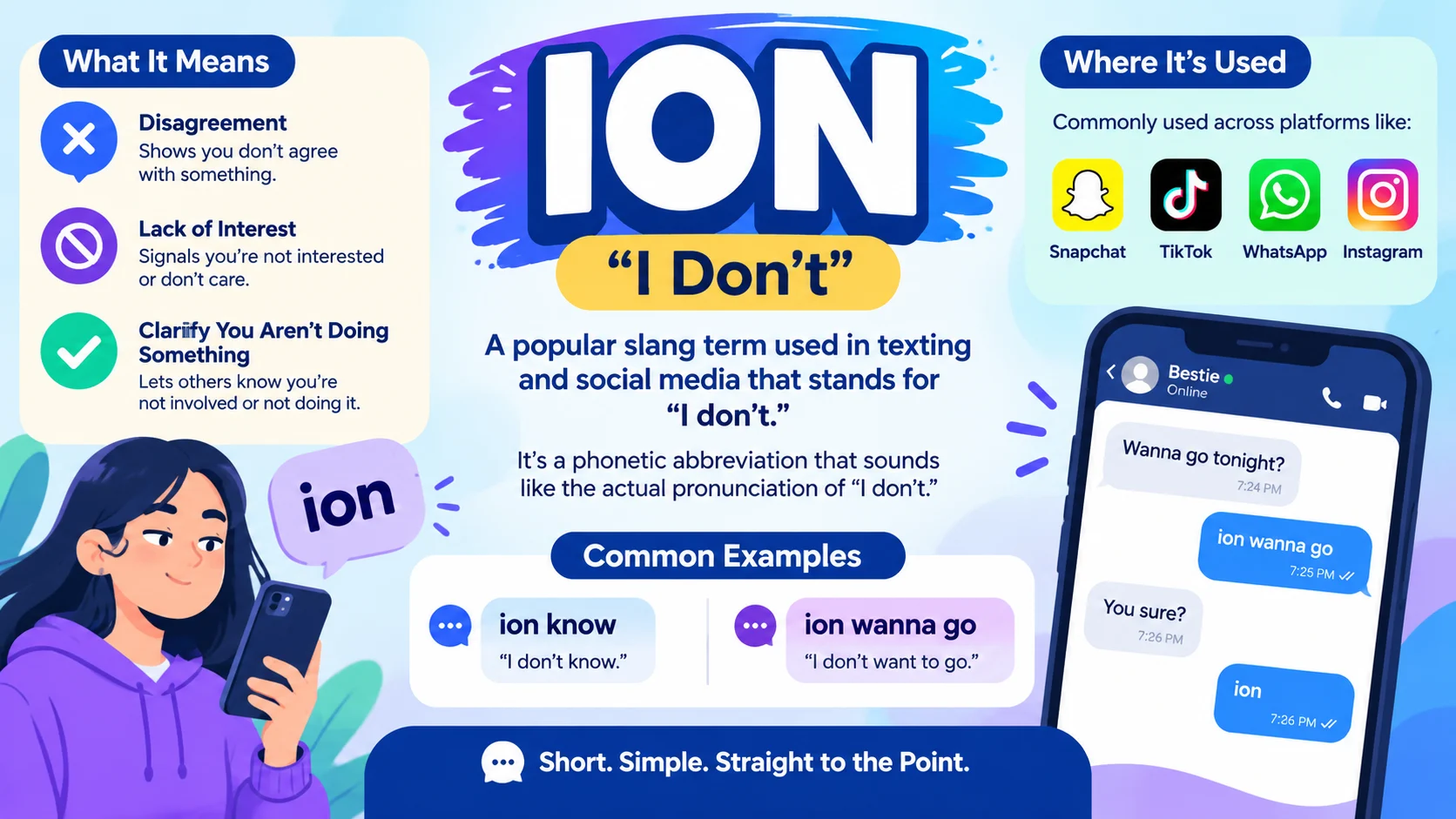
In texting, “ion” usually means “I don’t.” It is an informal, phonetic spelling used in casual conversations. For example, “ion know” means “I don’t know,” while “ion care” means “I don’t care.”
Introduction
ion meaning in text usually refers to “I don’t,” a casual spelling used in online conversations. You may see phrases such as “ion know,” “ion care,” or “ion wanna go.” The spelling reflects the way “I don’t” can sound when spoken quickly.
This slang appears in texts, DMs, comments, captions, group chats, and other informal spaces. It is especially useful when someone wants their writing to sound relaxed and conversational. However, context matters because ION can also have other meanings, including “In Other News.”
Quick Answer Table
| Category | Answer |
|---|---|
| Meaning | “I don’t” |
| Type | Informal texting slang |
| Common contexts | Texts, DMs, comments, group chats |
| Example | “Ion know what happened.” |
| Standard English | “I don’t know what happened.” |
| Tone | Casual, conversational, sometimes dismissive |
| Formal writing? | No |
What Does ion Mean in Text?
The most common ion meaning in text is “I don’t.”
Rather than being a traditional acronym, ion works as a speech-based spelling. It represents the way “I don’t” can blend together in fast, casual speech.
The easiest way to understand it is:
ion = I don’t
That meaning becomes clear when you look at the words that follow it.
For example:
- ion know = I don’t know
- ion care = I don’t care
- ion want it = I don’t want it
- ion like that = I don’t like that
- ion think so = I don’t think so
- ion remember = I don’t remember
In other words, ion usually carries the negative “I don’t” part of the sentence. The following verb completes the thought.
Why Do People Write “ion”?
People write ion because texting often imitates natural speech.
When someone says “I don’t” quickly, the two words can blend together. Informal writing sometimes captures that pronunciation rather than following standard spelling. (slangwordz.com)
This style also makes messages feel more conversational.
Compare these two versions:
Standard:
I don’t know what you mean.
Casual:
Ion know what you mean.
The second version is not grammatically standard, but it communicates the same basic idea.
There is also a cultural dimension to the slang. Some references connect this use of ion with African American Vernacular English (AAVE), from which it spread more broadly through online culture and social media. The exact origin is difficult to pinpoint, so it is better to describe its development carefully rather than assign it to a single creator or date. (SendBridge)
Common Examples of ion in Texting
Understanding common phrases makes the slang much easier to decode.
| Texting phraseStandard EnglishTypical meaning | ||
|---|---|---|
| ion know | I don’t know | Uncertainty |
| ion care | I don’t care | Indifference |
| ion wanna go | I don’t want to go | Refusal or reluctance |
| ion think so | I don’t think so | Doubt or disagreement |
| ion like it | I don’t like it | Dislike |
| ion remember | I don’t remember | Lack of memory |
| ion need it | I don’t need it | Rejection or lack of need |
| ion even know | I don’t even know | Stronger confusion |
One useful trick is to replace ion with “I don’t.” If the sentence still makes sense, that is probably the intended meaning.
Context and Tone: What Does ion Really Express?
The basic meaning stays the same, but the tone can change.
Casual or Neutral
“ion know yet lol”
This simply means:
“I don’t know yet.”
The writer may be uncertain without sounding upset.
Playful
“ion even know 😭”
Here, the emoji adds humor or exaggerated confusion.
Dismissive
“ion care.”
The same slang can sound blunt when the surrounding conversation is tense.
Refusal
“ion wanna go tonight.”
This communicates a clear lack of interest in going.
Therefore, ion itself is not automatically rude. Tone comes from the entire message, including punctuation, emojis, surrounding words, and the relationship between the people communicating.
Real-Life Conversation Examples
1. Texting a Friend
Mia: Are you coming to the party?
Jay: Ion know yet.
Meaning: Jay does not know whether they are coming.
2. Showing Disinterest
Mia: You should watch that new show.
Jay: Ion care about reality shows 😂
Meaning: Jay is not interested.
3. Expressing Doubt
Mia: I think they canceled the event.
Jay: Ion think so. I saw a post about it today.
Meaning: Jay does not think the event was canceled.
4. Refusing an Invitation
Mia: Wanna come out tonight?
Jay: Ion wanna go anywhere tonight. I’m staying home.
Meaning: Jay does not want to go out.
5. Expressing Confusion
Mia: Why did he leave so early?
Jay: Ion even know 😭
Meaning: Jay has no idea why he left.
These examples show an important point: ion does not provide the entire meaning by itself. The verb or phrase after it completes the sentence.
Platform-Specific Usage
Snapchat Usage
On Snapchat, ion can appear in private messages, group chats, Story replies, and casual exchanges. A message such as “ion know” normally means “I don’t know.”
Because Snapchat conversations tend to be informal, phonetic spellings can fit naturally into the platform’s conversational style.
TikTok Usage
TikTok comments and captions frequently use informal internet language. You may see expressions such as:
- “ion even know”
- “ion wanna hear it”
- “ion care fr”
- “ion think y’all ready”
The surrounding text helps establish whether the writer is joking, disagreeing, refusing, or simply expressing uncertainty.
Instagram Usage
Instagram users may use ion in DMs, comments, captions, and Story replies.
For example:
“ion know why everyone is mad.”
The standard version would be:
“I don’t know why everyone is mad.”
Text Messaging Usage
Traditional texting is another common setting for ion. Friends may use it because the spelling feels quick and conversational.
It is most appropriate when the conversation is relaxed. Formal messages should use “I don’t” instead.
Is ion an Acronym?
Usually, no.
In the slang expression “ion know,” the letters do not represent three separate words. Instead, ion is a phonetic spelling of “I don’t.”
That distinction matters because people sometimes assume that every short online expression is an acronym.
Compare:
- LOL = laughing out loud
- IDK = I don’t know
- ION = usually “I don’t” in this slang usage
The last one behaves differently because it represents pronunciation rather than the initial letters of a phrase.
Other Meanings of ION
Context can give ION another meaning.
“In Other News”
Some texting references use ION to mean “In Other News.” This version works as a conversational transition when someone wants to change the subject.
For example:
“That meeting was exhausting. ION, did you watch the game?”
Here, ION introduces a new topic.
However, this meaning should not automatically be assumed whenever you see the letters ION. If the phrase is “ion know” or “ion care,” the intended meaning is almost certainly “I don’t.”
The Chemistry Meaning
Outside slang, an ion is a charged atom or molecule.
For example, chemistry uses terms such as:
- positive ion
- negative ion
- sodium ion
- calcium ion
That scientific meaning has nothing to do with the slang expression.
The surrounding words usually make the distinction obvious.
ion vs. Similar Texting Terms
Several expressions can look or feel similar to ion, but they do not have exactly the same function.
| Term | Meaning | Example |
|---|---|---|
| ion | I don’t | “ion know” |
| idk | I don’t know | “idk tbh” |
| idc | I don’t care | “idc anymore” |
| nah | No / not really | “Nah, I’m good.” |
| nope | No | “Nope, not today.” |
| ngl | Not gonna lie | “ngl, I liked it.” |
| imo | In my opinion | “imo, it’s better.” |
The key difference is that ion can introduce many different negative statements.
For instance:
ion know
ion care
ion want
ion like
ion think
By contrast, idk specifically communicates “I don’t know.”
Common Mistakes With ion
Mistake 1: Thinking It Always Means “I Don’t Know”
This is one of the most common misunderstandings.
Ion means “I don’t,” not automatically “I don’t know.”
The rest of the sentence determines the meaning.
“ion care” = I don’t care
“ion want it” = I don’t want it
Mistake 2: Assuming It Is Always Rude
A message can be casual without being intentionally disrespectful.
For example:
“ion know lol”
sounds very different from:
“ion care. Leave me alone.”
The second message feels harsher because of its context.
Mistake 3: Using It in Formal Writing
Avoid ion in academic essays, business emails, resumes, applications, and professional reports.
Use:
I don’t
instead.
Mistake 4: Confusing It With the Scientific Word
If someone writes:
“ion know what happened”
they are almost certainly not discussing chemistry.
The phrase structure tells you that ion = I don’t.
Mistake 5: Assuming Every Capitalized ION Has the Same Meaning
Capitalization can make several meanings possible. ION may refer to slang, “In Other News,” or the scientific term.
Look at the surrounding words before deciding.
How to Respond to “ion” Naturally
You usually do not need a special response.
If someone says:
“ion know.”
You can reply:
- “Same 😂”
- “No worries.”
- “Fair enough.”
- “I got you.”
- “That’s okay.”
When the person says:
“ion wanna go.”
A natural response might be:
- “No problem.”
- “All good.”
- “Maybe another time.”
- “Fair, stay home and relax.”
The best response depends on the conversation rather than the slang itself.
When Should You Use ion?
Use ion when the setting is clearly informal.
Good situations
- Texting close friends
- Casual group chats
- Social media comments
- DMs
- Informal online communities
- Joking conversations
Better to avoid it in
- Business emails
- School assignments
- Job applications
- Formal reports
- Professional messages
- Official documents
A simple rule is helpful:
Casual conversation → “ion” can work.
Formal communication → use “I don’t.”
Using the standard form does not make your writing less natural. It simply matches the expectations of a more formal setting.
FAQ
What does ion mean in text?
In text slang, ion usually means “I don’t.” It is an informal, phonetic spelling used in casual conversations. Common examples include “ion know,” “ion care,” and “ion think so.”
What does ion know mean?
“Ion know” means “I don’t know.” Someone might use it in a text, comment, or DM to express uncertainty. The phrase is informal and often reflects conversational speech.
What does ion care mean?
“Ion care” means “I don’t care.” Depending on context, it can communicate indifference, confidence, humor, or dismissal. The surrounding conversation determines how strongly it sounds.
What does ion wanna mean?
“Ion wanna” means “I don’t want to.” It usually expresses reluctance or refusal. For example, “ion wanna go” means the person does not want to attend.
Is ion short for I don’t?
Yes. In the common slang usage, ion is a phonetic form of “I don’t.” It is not usually an acronym. The spelling imitates how the phrase can sound in quick, casual speech.
Does ion mean “In Other News”?
Sometimes. ION can mean “In Other News” when someone changes the subject. However, when it appears in phrases such as “ion know” or “ion care,” it usually means “I don’t.”
Is ion appropriate in professional writing?
Generally, no. Ion is informal slang and can look unprofessional in workplace, academic, or official communication. In those settings, write “I don’t” for clarity and proper tone.
Is ion the same as an ion in chemistry?
No. In chemistry, an ion is an electrically charged atom or molecule. In texting slang, ion usually means “I don’t.” The context makes the intended meaning clear.
Conclusion
Now you know what “ion” means. In casual texting, ion usually means “I don’t,” making it a quick, speech-based form used in phrases such as “ion know” and “ion care.” Its meaning becomes clear from the words around it, while tone depends on the conversation. The same spelling can occasionally mean “In Other News,” and the lowercase word can also refer to the scientific term in another context. For texts, DMs, and social media, ion can sound natural and relaxed. In school, work, or formal writing, stick with “I don’t.” Once you recognize the pattern, modern slang becomes easier to read, understand, and use with confidence.









3 thoughts on “ion meaning in text| Complete Meaning & Usage Guide”