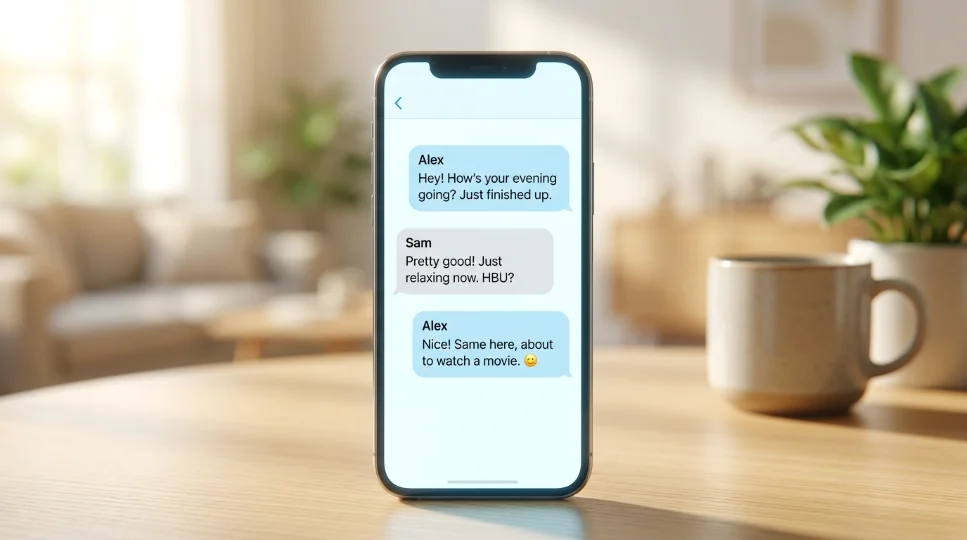
HBU meaning in text is “How About You?” People use this casual abbreviation to ask for someone else’s answer, opinion, feelings, or plans after sharing their own. It keeps conversations balanced and makes everyday texting quicker.
When someone shares how they feel or what they plan to do, HBU gives you a quick way to turn the question back to them. The abbreviation stands for “How About You?” and invites the other person to share their own answer.
For example, someone might text, “I’m watching a movie tonight, HBU?” They are asking what you plan to do, too. You could reply with your own plans or explain that you have not decided yet.
HBU works in many everyday conversations, including chats about moods, preferences, activities, and opinions. You will often see it in text messages, group chats, and social media DMs because it is short and easy to understand.
The tone is generally casual and conversational. Although HBU often shows interest in the other person, the surrounding message helps determine whether the sender is being friendly, making small talk, or simply keeping the exchange moving.
Quick Answer Box
| Aspect | Details |
| Meaning | How About You? |
| Part of Speech | Acronym / Abbreviation |
| Context | Casual text messaging, social media, online chat |
| Platforms | WhatsApp, Snapchat, TikTok, Instagram, SMS, Discord |
| Primary Use | Returning a question to the sender |
| Tone | Informal, conversational, friendly |
| Similar Terms | WBU (What About You?), HBU (How Bout You) |
Full Definition of HBU
What Does HBU Stand For?
HBU is an acronym that stands for “How About You?” It is used in text based communication to ask someone about their response to a question that was just asked of them.
The Linguistic Breakdown
Let’s break down what HBU actually means:
H = How
B = About
U = You
When someone uses HBU, they are essentially saying: “I’ve just shared my answer or asked you something now I want to know your response to the same question.”
The Role of HBU in Conversation
HBU serves a specific conversational function: it maintains the flow of dialogue and signals that the speaker expects a reciprocal answer. Without it, conversations can feel one sided or incomplete.
For example:
- Person A: “I’m doing well, HBU?”
- Person B: “I’m good too, thanks!”
In this exchange, Person A has asked about Person B’s well-being by using HBU instead of typing out “how about you?” in full.
A Brief History of HBU
HBU emerged during the rise of SMS texting in the late 1990s and early 2000s. Character limits on phones made abbreviations necessary, and acronyms like HBU allowed people to communicate more efficiently.
As smartphones and social media platforms grew in popularity, HBU transitioned from a cost saving abbreviation to a cultural shorthand used by millions across the globe.
Context & Usage
When Do People Use HBU?
HBU is used in various contexts, but it always serves the same purpose: asking for reciprocal information. Here are the most common scenarios:
Casual Greetings
People often use HBU in greeting scenarios:
“Hey! How’s your day going, HBU?”
Checking In
When friends or family check on each other, HBU makes the conversation more engaging:
“I’ve been feeling under the weather lately, HBU?”
Planning Events
When making plans, HBU helps coordinate:
“I’m free on Saturday, HBU?”
Sharing News
After sharing personal news, people use HBU to invite the other person to share theirs:
“I got the job! HBU? How’s work going?”
Comparing Preferences
When discussing likes or dislikes, HBU prompts the other person to share their opinion:
“I love Italian food, HBU?”
Is HBU Formal or Informal?
HBU is strictly informal. You would never use HBU in a professional email, job application, academic paper, or formal letter. It belongs exclusively to the realm of casual, digital communication.
Acceptable contexts:
- Text messages between friends and family
- Direct messages on social media
- Casual group chats
- Personal emails between acquaintances
Not acceptable contexts:
- Business correspondence
- Cover letters or resumes
- Academic writing
- Formal speeches or presentations
The Psychology Behind Using HBU
Using HBU in conversations demonstrates social awareness and a genuine interest in the other person. It shows you’re not just talking about yourself, you want to know about them too.
When you use HBU, you’re effectively:
- Acknowledging the other person’s presence
- Inviting them to participate in the conversation
- Showing that you value their input
- Maintaining a balanced dialogue
Real Life Examples
Conversation Example 1: Casual Check In
Person A: Hey! How was your weekend?
Person B: It was pretty chill, just hung out with the family. HBU?
Person A: I went hiking with some friends! It was a nice break from work.
Conversation Example 2: Sharing News
Person A: I just got promoted at work! I’m so excited.
Person B: That’s amazing! Congratulations! HBU? Wait, you already told me. But how are you feeling about it?
Person A: Honestly, I’m a bit nervous but mostly thrilled. Thanks for asking!
Conversation Example 3: Making Plans
Person A: Are you free this Friday night?
Person B: I think so! HBU? Are you free too?
Person A: Yes! Let’s plan something fun.
Conversation Example 4: Food Preferences
Person A: I’m craving pizza so bad right now.
Person B: Same! What toppings do you like? HBU?
Person A: I love pepperoni and mushrooms. HBU?
Conversation Example 5: Emotional Check In
Person A: I’ve been feeling overwhelmed with school work lately.
Person B: I feel that. HBU? Like, how are you managing everything?
Person A: Honestly, just taking it one day at a time. Some days are harder than others.
Platform Specific Meaning
HBU on WhatsApp
On WhatsApp, HBU is widely used in both group chats and private conversations. It’s one of the most common texting abbreviations on the platform and functions exactly as “how about you?” would in spoken language.
Usage tips for WhatsApp:
- Use HBU in personal chats with friends and family
- Avoid using it in work related WhatsApp groups
- It’s suitable for both one on one and group conversations
HBU on Snapchat
Snapchat users often incorporate HBU in quick exchanges, especially since the platform’s ephemeral nature encourages fast communication.
Usage tips for Snapchat:
- Use HBU in snaps (photos/videos with text overlay)
- It’s common in streaks where friends are checking in regularly
- The casual nature of Snapchat makes HBU a perfect fit
HBU on TikTok
While TikTok comments and direct messages frequently use HBU, the platform’s video first nature means you’ll often see HBU in captions and comments rather than verbal communication.
Usage tips for TikTok:
- Use HBU in comments to engage with creators
- Common in question based content (e.g., “What’s your favorite song, HBU?”)
- Often appears in duet or stitch videos that invite responses
HBU on Instagram
Instagram users deploy HBU primarily in direct messages and comments, particularly on posts that ask questions or encourage engagement.
Usage tips for Instagram:
- Use HBU in DMs for casual conversations
- Effective in comments on question box Stories
- Suitable for captions that invite interaction
HBU in Text Messaging (SMS)
As the original home of HBU, SMS remains a primary platform for this acronym. The limited character count of SMS historically made abbreviations like HBU essential.
Usage tips for SMS:
- Perfect for quick text exchanges
- Ideal for sending to contacts who understand internet slang
- Works well in group texts
HBU on Discord
In Discord servers, especially those focused on gaming or casual conversation, HBU appears frequently in chat.
Usage tips for Discord:
- Use in casual text channels
- Common in voice chat description boxes
- Suitable for community conversations and check ins
Alternative Meanings
While HBU almost always means “How About You?” in digital communication, it’s worth noting a few rare alternative interpretations:
HBU as “Hug Back Up” (Rare)
In some extremely niche contexts, HBU can mean “hug back up,” but this usage is exceptionally rare and not recognized in mainstream digital communication.
HBU as “Health Benefits Unit”
In corporate or healthcare contexts, HBU might be used to refer to a health benefits unit, but this is not a common texting abbreviation.
HBU as “How Be You?” (Dialectal)
Some people use HBU as a phonetic spelling of “how be you?” a dialectal variation of “how are you?” but this is uncommon.
Why HBU Always Means “How About You?”
Despite these rare alternatives, HBU has become so strongly associated with “how about you?” that its meaning is almost never misunderstood in casual communication.
Related Terms & NLP Variations
Common Synonyms and Variations
| Term | Meaning | Usage Context |
| WBU | What About You? | Often used interchangeably with HBU |
| U | You | Sometimes used alone to mean “you? |
| And the U? | And you? | A slightly more explicit version |
| What about you? | What about you? | The full phrase in text form |
| Ur turn | Your turn | Inviting the other person to respond |
| How are you? | How are you? | A question that invites a response |
| HBY | How About You? | An alternative spelling of HBU |
| And you? | And you? | Formal version used in text |
Semantic Relationships
HBU exists within a network of conversational markers and relationship building terms. Understanding these relationships helps you use HBU more effectively:
Initiating Questions: Terms that start conversations and invite responses, such as “What’s up?” or “How’s it going?”
Response Markers: Terms that acknowledge what someone has said, like “Got it” or “I see.”
Turn Taking Signals: HBU falls into this category, helping to pass the conversational turn to the other person.
How to Respond to HBU
Step by Step Response Guide
When someone uses HBU in a message, here’s how to respond naturally:
Step 1: Recognize What They’re Asking
The person is asking for your answer to whatever question they just asked or whatever topic they just discussed.
Step 2: Answer the Question
Provide your answer to the question they’ve posed.
Step 3: Keep It Conversational
Your response should match the tone of the conversation, casual and friendly.
Sample Responses to HBU
When HBU follows “How are you?”:
“I’m doing great! Just finished a big project. How about yourself?”
When HBU follows “What are you doing?”:
“I’m just relaxing at home today. What about you?”
When HBU follows “How was your day?”:
“It was pretty good actually! Got a lot of work done. How was yours?”
When HBU follows a personal update:
“Yeah, I’m feeling the same way, ngl. What about you? You okay?”
When HBU follows a question about preferences:
“I’m definitely a dog person. What about you?”
What If You Don’t Want to Answer?
Sometimes you might not want to respond to HBU, whether because the question is too personal or you’re simply not in the mood. Here are polite ways to deflect:
“I’d rather not talk about that right now, if that’s okay.”
“I’m not really sure how I feel about it yet. HBU?”
“Honestly, I don’t know how to answer that.”
Misinterpretations & Common Mistakes
Misunderstanding 1: Thinking HBU Means “Happy Birthday to You”
Some people, especially those new to internet slang, mistakenly assume HBU means “happy birthday to you.” However, “happy birthday” is almost always abbreviated as HBD or HBDAY.
The difference:
- HBU = How about you?
- HBD = Happy birthday
Misunderstanding 2: Using HBU in Formal Settings
Never use HBU in professional or formal contexts. This can come across as unprofessional or lazy.
Wrong: “Could you review the attached document by Friday, HBU?” ❌
Right: “Could you review the attached document by Friday, please?” ✅
Misunderstanding 3: Forgetting the Question
Sometimes people use HBU without actually having asked a question first. This leaves the recipient confused.
Wrong:
“I’m going to the store.” (Then immediately) “HBU?”
In this case, there’s no clear question for the HBU to reference.
Right:
“I’m going to the store. Are you free? HBU?”
Misunderstanding 4: Overusing HBU
Using HBU too frequently in a single conversation can make it feel repetitive and forced. Use it naturally, not as a default phrase for every message.
When NOT to Use HBU
1. In Professional Communication
As mentioned, HBU has no place in professional emails, job applications, or business messages.
2. When Writing Formal Documents
Reports, proposals, and formal publications should never include acronyms like HBU.
3. When the Recipient Won’t Understand
If you’re communicating with someone who isn’t familiar with internet slang such as an older relative or someone from a different generation avoid using HBU to prevent confusion.
4. During Emotional Conversations
When discussing serious or emotional topics, using HBU can come across as dismissive or insensitive. Use full phrases to show care and respect.
Better: “I’m here for you. How are you feeling about everything?”
Worse: “I’m here for you. HBU?”
5. In Large Group Chats
In a group chat with 10+ people, asking “HBU” can be confusing because it’s unclear who you’re directing the question to.
Usage Tips & Best Practices
Tip 1: Keep It Casual
HBU is a relaxed, informal abbreviation. Use it when the conversation feels light and comfortable.
Tip 2: Use It Sparingly
While HBU is useful, variety in your language makes conversations more interesting. Mix in phrases like “what about you?” or “and you?” to keep things fresh.
Tip 3: Match the Platform
Consider the platform you’re on. For example, HBU might feel more natural on Instagram than in a work related email.
Tip 4: Know Your Audience
Before using HBU, think about who you’re talking to. If they use similar acronyms, HBU is probably fine. If not, consider spelling things out.
Tip 5: Follow Up
When someone responds to your HBU, make sure to acknowledge their answer. This shows you’re actually listening and keeps the conversation flowing.
Tip 6: Pair HBU with Other Conversational Cues
Add other phrases to make your messages feel more human:
“I’m good fr, HBU?”
“Just got back from the gym. I’m exhausted ngl, HBU?”
Tip 7: Use HBU in Story Replies
On platforms like Instagram and Snapchat, replying to someone’s story with HBU can be a great way to start a conversation:
“Love your outfit! HBU? Where’d you get it?”
FAQs
1. What does HBU mean in text?
HBU stands for “How About You?” It’s used in texting and social media to ask someone about their answer to a question that was just asked.
2. Is HBU the same as WBU?
Yes and no. Both HBU and WBU mean essentially the same thing asking about the other person’s response. However, WBU (What About You?) can sometimes feel slightly different depending on context.
3. Can I use HBU in an email?
No. HBU is informal and should not be used in professional or formal emails.
4. Does HBU mean “happy birthday to you”?
No. “Happy birthday” is abbreviated as HBD (Happy Birthday) or HBDAY. HBU exclusively means “How About You?
5. How do you respond to HBU?
To respond to HBU, provide your answer to whatever question was asked previously. For example, if someone asked, “How are you? HBU?” you would say, “I’m good, thanks!”
6. Is HBU used internationally?
While HBU originated in US texting culture, it’s now understood and used by English speakers worldwide, particularly among younger generations.
7. What’s the difference between HBU and WBU?
The main difference is linguistic. HBU = “How About You?” and WBU = “What About You?” In practice, they’re often used interchangeably.
8. Can HBU be used in voice chats?
Not typically. HBU is a written abbreviation and sounds unnatural when spoken aloud. You would generally say “how about you?” in speech.
9. Is HBU considered Gen Z slang?
HBU is more of a Millennial texting acronym, though Gen Z uses it too. It has been around since the early 2000s.
10. Are there any inappropriate meanings for HBU?
No. HBU has no inappropriate or offensive meanings. It’s a neutral, casual conversational tool.
11. Can I use HBU at work?
Only in extremely casual, internal communications with colleagues you know well. Avoid it in any official or client facing communication.
12. What if I type HBU and the other person doesn’t understand?
If someone doesn’t understand HBU, simply explain that it means “how about you?” and continue the conversation using full phrases.
13. Is HBU used more by men or women?
HBU is used equally by all genders. It’s a gender neutral abbreviation.
14. Should I use HBU in the first message?
It’s generally better to avoid HBU in the first message you send to someone, as it can feel abrupt or impersonal. Save it for established conversations.
15. How do I pronounce HBU?
Each letter is pronounced individually: “H B U.” It’s not spoken as a single word.
Conclusion:
Now you know everything there is to know about HBU in text messaging and social media. This versatile acronym stands for “How About You?” has become an essential tool in digital conversations, helping to maintain balance and engagement in chat.
Remember these key takeaways:
- HBU is strictly informal
- It means “How About You?
- Use it in casual conversations with friends and family
- Never use it in professional contexts
- Respond naturally by answering the question being asked
Whether you’re texting on WhatsApp, snapping on Snapchat, or messaging through Instagram DMs, HBU is a useful shorthand that makes conversations flow more naturally. While the internet slang landscape continues to evolve, HBU has proven its staying power as a communication staple.
Ready to Use HBU with Confidence?
Now that you understand what HBU means in text and how to use it, you can start incorporating it into your own conversations. Just remember to keep it casual, be natural, and always consider your audience. No cap, understanding these digital acronyms can seriously level up your texting game.
“So, what’s your opinion on this guide? Let us know in the comments, HBU? 😉”







8 thoughts on “HBU Meaning in Text| The Easy Way to Return a Question”