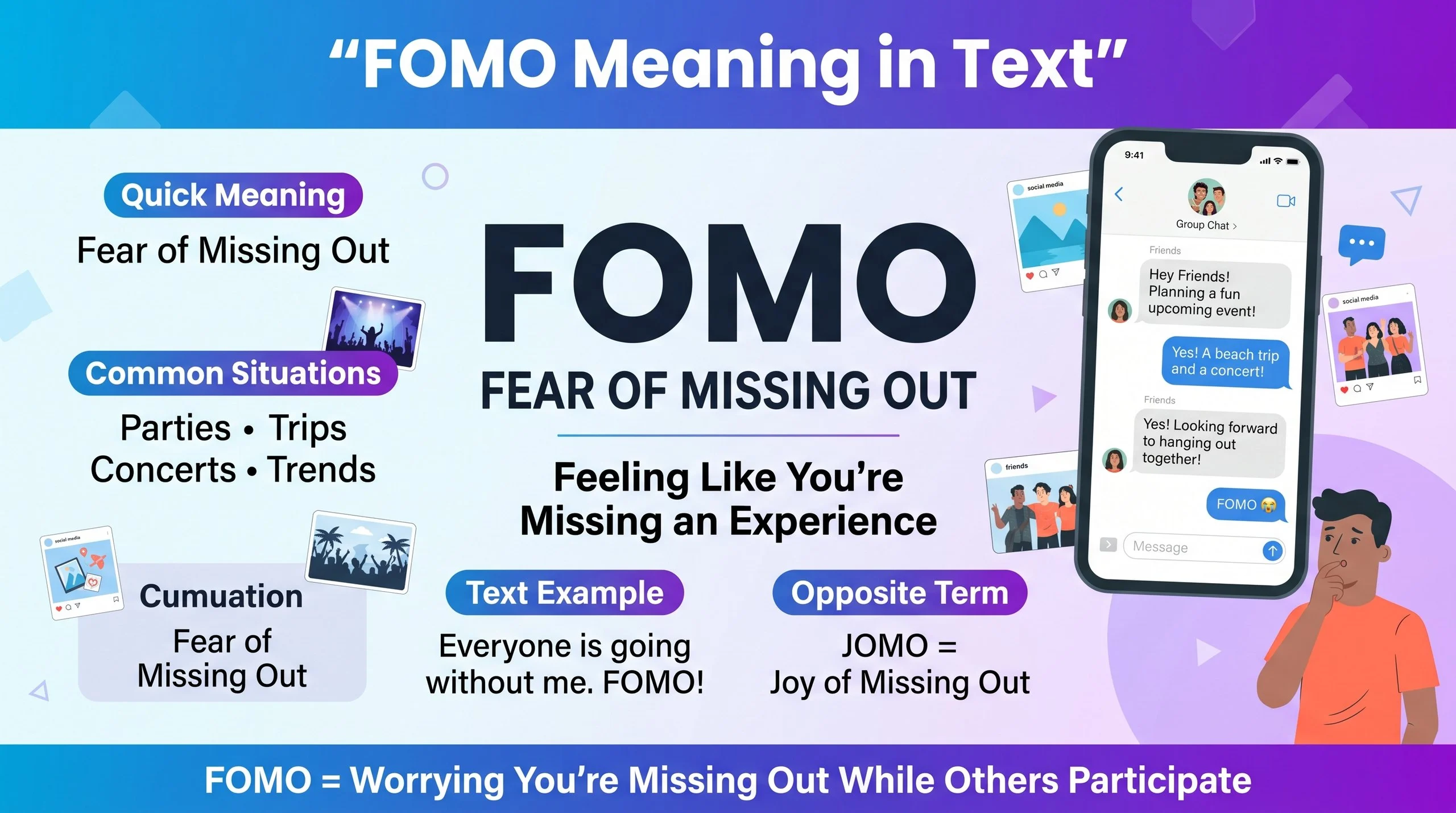
FOMO means “Fear of Missing Out.” In text messages and social media, it describes the feeling that you might miss an exciting, important, or enjoyable experience while other people are participating. It often relates to parties, events, trends, trips, and social plans.
If you are searching for FOMO meaning in text, FOMO stands for “Fear of Missing Out.” It describes the feeling that other people are enjoying something without you. As a result, you may feel left out or worry that you are missing an important experience.
The term appears often in texting, social media posts, group chats, and online conversations. For example, someone might say, “I have serious FOMO seeing everyone at the concert.” Here, the person wishes they could be there too.
Moreover, FOMO does not always describe a serious emotional problem. People often use it casually to express curiosity, regret, or excitement about joining a plan. Therefore, the exact tone depends on the context.
What Does FOMO Mean in Text?
| Question | Answer |
|---|---|
| FOMO meaning in text | Fear of Missing Out |
| Type | Common slang term and initialism |
| Main idea | Feeling worried about missing an experience |
| Common contexts | Parties, trips, events, trends, social media |
| Tone | Casual, emotional, humorous, or serious |
| Opposite term | JOMO, or Joy of Missing Out |
| Common platforms | Texting, TikTok, Instagram, Snapchat, group chats |
| Example | “Everyone is going without me. FOMO!” |
What Does FOMO Stand For?
FOMO stands for “Fear of Missing Out.”
The phrase describes concern that other people are experiencing something enjoyable, exciting, or important while you are not there.
For example:
“I wasn’t going to the party, but now I have FOMO.”
This means the person has started feeling that they might miss something fun.
Similarly, someone could say:
“Everyone is traveling this summer. My FOMO is real.”
Here, FOMO describes the desire to participate because other people appear to be having enjoyable experiences.
What Does FOMO Mean in Texting?
In texting, FOMO usually describes feeling left out or worrying about missing something.
People often use it when discussing social plans. For instance:
“Are you going to the game tonight?”
“No 😭 I’m already getting FOMO.”
The second person is worried that they will miss the experience.
However, FOMO can also be used humorously. Someone might say:
“You guys ordered pizza without me? FOMO 😂”
In this case, the speaker is probably joking about missing the pizza rather than expressing serious distress.
Why Do People Use FOMO?
People use FOMO because it communicates a specific feeling quickly. Instead of explaining that they wish they could participate, they can simply say they have FOMO.
To Express Feeling Left Out
Someone may use FOMO when friends are doing something without them.
“Everyone is hanging out tonight. I have major FOMO.”
To Explain Changing Plans
FOMO can also explain why someone suddenly wants to join.
“I wasn’t going to go, but now I have FOMO.”
The person changed their mind because they do not want to miss the experience.
To React to Social Media
Social media can make FOMO especially noticeable.
For example:
“Seeing everyone’s vacation pictures is giving me FOMO.”
The speaker sees other people’s experiences and wishes they were participating.
To Make a Joke
FOMO is also common in playful messages.
“You ate all the fries without me? FOMO!”
Therefore, the term does not always indicate a deep emotional reaction.
FOMO and Social Media
FOMO is strongly associated with social media because platforms constantly show users what other people are doing.
A person may see friends attending a concert, traveling, eating at a popular restaurant, or attending a party. Consequently, they may feel that they are missing something.
For example:
“My whole feed is at the beach while I’m working. FOMO.”
This message expresses a humorous sense of being left out.
However, social media does not always show the complete reality. Posts usually highlight selected moments rather than someone’s entire experience. Therefore, comparing your life with social media posts can create an exaggerated sense of missing out.
What Does FOMO Mean on Snapchat?
On Snapchat, FOMO usually means Fear of Missing Out.
Someone might see friends posting Snaps from a party or event and message:
“Why did nobody tell me? FOMO 😭”
The speaker feels left out because they were not included.
Similarly, someone may post:
“Everyone’s at the concert and I’m home. FOMO.”
Here, FOMO expresses disappointment about missing the event.
What Does FOMO Mean on TikTok?
On TikTok, FOMO commonly describes the feeling of missing trends, events, experiences, or activities that other people are enjoying.
For example:
“Everyone is trying this trend and I’m still at home. FOMO.”
TikTok can also create FOMO around viral products, travel destinations, concerts, challenges, and social experiences.
As a result, people may use FOMO casually in captions, comments, or direct messages.
What Does FOMO Mean on Instagram?
On Instagram, FOMO often appears when someone sees friends, influencers, or creators sharing exciting experiences.
For example:
“Your vacation photos are giving me FOMO!”
This means the person wishes they were also on the vacation.
Similarly, a person might comment:
“Okay, now I have FOMO.”
That response can express playful jealousy or a genuine desire to join.
What Does FOMO Mean From a Girl?
If a girl says “I have FOMO,” she usually means that she feels like she is missing an enjoyable or important experience.
For example:
“You guys are going out tonight? I have FOMO.”
She may simply wish she could join the group.
However, FOMO does not automatically indicate flirting or romantic interest. The meaning depends on the situation and the people involved.
What Does FOMO Mean From a Guy?
If a guy uses FOMO in a text, he generally means that he feels he might be missing something.
For example:
“Everyone’s going to the game. I got FOMO.”
He may regret staying home or wish he had made different plans.
Again, FOMO does not have a specific romantic meaning. It describes the feeling of missing out.
Is FOMO a Negative Feeling?
FOMO can be uncomfortable because it involves worry, comparison, or feeling excluded. However, people often use the term casually.
For example:
“I have FOMO because I skipped brunch.”
This could simply mean, “I wish I had gone.”
On the other hand, persistent worry about missing social experiences can become more stressful. Therefore, the seriousness of FOMO depends on how the term is being used and how strongly the person experiences the feeling.
What Is the Opposite of FOMO?
A popular opposite of FOMO is JOMO, which means “Joy of Missing Out.”
FOMO focuses on worrying about what you are missing. In contrast, JOMO describes feeling comfortable or happy about staying away from an activity.
| Term | Meaning | Main feeling |
|---|---|---|
| FOMO | Fear of Missing Out | Worry about missing something |
| JOMO | Joy of Missing Out | Happiness about staying out |
| YOLO | You Only Live Once | Encouragement to enjoy life or take a chance |
For example:
“Everyone is going out, but I’m enjoying a quiet night. Total JOMO.”
That statement shows satisfaction rather than concern.
Common FOMO Examples in Text
Here are several natural examples of FOMO in everyday messages:
Example 1:
“Everyone went to the concert without me. FOMO!”
Meaning: I wish I had gone.
Example 2:
“Your pictures are giving me FOMO.”
Meaning: Your pictures make me wish I were there.
Example 3:
“I wasn’t going to travel, but now I have FOMO.”
Meaning: I am starting to worry that I will miss the experience.
Example 4:
“Don’t post everything! You’re giving me FOMO 😂”
Meaning: Your posts are making me wish I were participating.
Example 5:
“I skipped the party and now I have major FOMO.”
Meaning: I regret missing the party.
Real-Life Text Conversations Using FOMO
Conversation 1: Missing a Party
A: “Why aren’t you coming tonight?”
B: “I have work tomorrow.”
A: “Everyone is going.”
B: “Ugh, now I have FOMO.”
Here, FOMO means the person is beginning to regret staying home.
Conversation 2: Vacation FOMO
A: “Look at this beach!”
B: “Wow 😭”
A: “Wish you were here.”
B: “You’re giving me serious FOMO.”
The second person wishes they could participate.
Conversation 3: Playful FOMO
A: “We ordered burgers.”
B: “Without me?”
A: “Yep 😂”
B: “FOMO is real.”
This example uses FOMO humorously.
FOMO vs. Similar Slang Terms
FOMO has several related expressions, but they are not identical.
| Term | Meaning | Difference |
|---|---|---|
| FOMO | Fear of Missing Out | Worry about missing an experience |
| JOMO | Joy of Missing Out | Enjoying the decision to stay out |
| YOLO | You Only Live Once | Encourages enjoying life or taking chances |
| Left out | Excluded from something | Focuses more directly on exclusion |
| Jealous | Wanting what someone else has | Can involve people, possessions, or experiences |
| Regret | Feeling bad about a past choice | Often happens after the missed event |
For example, FOMO may lead someone to attend an event. Regret, however, often describes how they feel after deciding not to attend.
Common Mistakes When Using FOMO
One common mistake is assuming that FOMO always means serious anxiety. In casual texting, people often use it jokingly.
Another mistake is confusing FOMO with jealousy. Although the feelings can overlap, FOMO specifically focuses on missing an experience.
Also, FOMO is not limited to parties or social events. People can experience FOMO around travel, entertainment, trends, shopping, food, hobbies, and online activities.
Finally, avoid assuming that someone genuinely wants to attend something simply because they mention FOMO. Their message could be playful or exaggerated.
How Should You Respond to FOMO?
Your response depends on the situation.
If someone says:
“I have FOMO 😭”
You could respond:
“You should come with us!”
If they cannot join, you might say:
“We’ll send you pictures!”
For a playful conversation, you could say:
“Haha, that’s why you should’ve come!”
If someone seems genuinely upset, a more supportive response may work better:
“We’ll plan something together soon.”
Therefore, match your response to the person’s tone.
When Should You Use FOMO?
FOMO works well in casual conversations, social media captions, comments, and group chats.
You can use it when:
- You wish you could join an event.
- Friends are doing something without you.
- Social media makes you want to participate.
- You regret skipping an activity.
- You are joking about missing food, plans, or experiences.
- You want a short way to describe the “Fear of Missing Out.”
However, avoid using FOMO in formal writing unless the audience already understands the term or the topic specifically discusses it.
Frequently Asked Questions
1. What does FOMO mean in text?
FOMO means “Fear of Missing Out.” In texting, it describes the feeling that you might miss an exciting, enjoyable, or important experience while other people are participating.
2. What does FOMO stand for?
FOMO stands for “Fear of Missing Out.” The phrase describes concern about missing experiences, activities, events, trends, or social moments that other people are enjoying.
3. Is FOMO slang?
Yes. FOMO is a widely used informal term in texting, social media, and everyday conversation. It is especially common when people discuss social plans, trends, travel, entertainment, and online experiences.
4. What does FOMO mean from a girl?
From a girl, FOMO generally means she feels she may be missing an enjoyable experience. It does not automatically indicate flirting or romantic interest. The surrounding conversation provides the important context.
5. What does FOMO mean from a guy?
From a guy, FOMO usually means he feels like he is missing something other people are enjoying. It can describe genuine disappointment or simply a humorous reaction to being left out.
6. What does FOMO mean on social media?
On social media, FOMO describes the feeling created when someone sees other people enjoying events, trips, trends, or activities they are not experiencing. It can be serious or playful depending on context.
7. What is the opposite of FOMO?
The popular opposite of FOMO is JOMO, meaning “Joy of Missing Out.” JOMO describes feeling satisfied or happy about skipping an activity instead of worrying about what you might be missing.
8. How do you use FOMO in a sentence?
You can use FOMO casually, such as “I have FOMO seeing everyone at the concert.” This means you wish you were there and feel like you are missing the experience.
Conclusion
FOMO meaning in text is “Fear of Missing Out.” People use FOMO when they feel worried about missing an enjoyable, exciting, or important experience. Moreover, the term is common in texting, social media, group chats, and everyday conversations. It can describe genuine disappointment, but it can also be used humorously. For example, someone may say they have FOMO after seeing friends at a concert. In contrast, JOMO describes enjoying the choice to miss something. Therefore, always consider the conversation before judging the tone. Overall, FOMO is a simple way to describe the feeling of wishing you were part of an experience happening without you.





23 thoughts on “FOMO Meaning in Text| What Does FOMO Mean in Texting?”