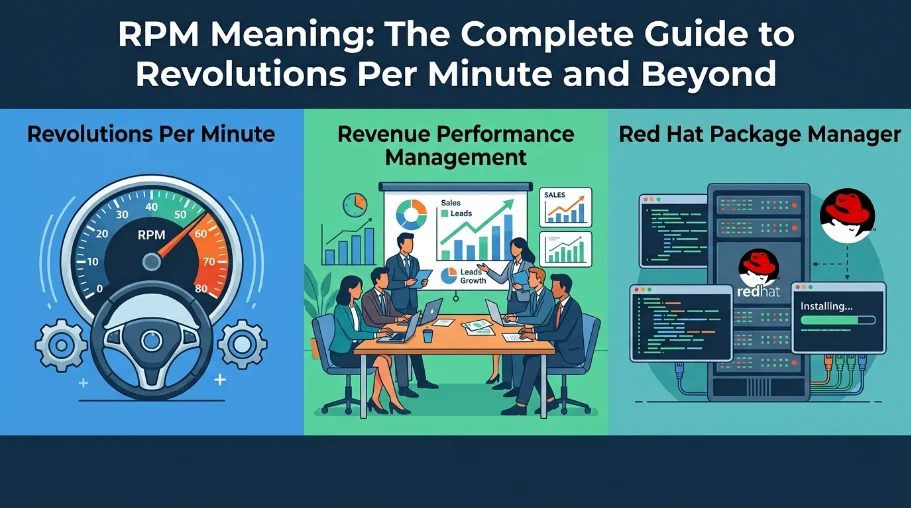
RPM stands for “Revolutions Per Minute,” a unit of measurement for rotational speed. It indicates how many complete rotations an object makes around a fixed axis in one minute . While most common in automotive contexts to measure engine speed, RPM has various other meanings across different industries including business and computing.
Have you ever looked at your car’s dashboard and wondered what the numbers on the tachometer mean? That gauge showing “RPM” is one of the most important instruments in your vehicle. Understanding RPM is essential for anyone who drives, works with machinery, or wants to understand how things work.
The term RPM appears everywhere. It shows up on car dashboards, in song descriptions, and even in business terminology. The RPM meaning changes depending on the context. This versatility can create confusion, but once you understand the basics, it becomes simple.
This article clears up the confusion around RPM once and for all. You will learn the primary definition, see real examples from different fields, and discover how RPM applies to everyday life. By the end, you will confidently understand what RPM means in any situation. Good technical knowledge depends on understanding these important concepts.
Key Takeaway
The main takeaway is that RPM primarily stands for “Revolutions Per Minute,” a unit measuring rotational speed . It is most commonly associated with car engines, where it indicates how fast the engine’s crankshaft is spinning . However, RPM also has other meanings in business (Revenue Performance Management), computing (Red Hat Package Manager), and various other specialized contexts .
Definitions and Explanations
What Does “Revolutions Per Minute” Mean?
“Revolutions Per Minute” is a unit of measurement for rotational speed. It tells you how many complete rotations an object makes around a fixed axis in one minute . For example, if a wheel completes 60 full turns in one minute, it is rotating at 60 RPM.
RPM is not recognized as an official unit by the International System of Units (SI) because “revolution” is considered a semantic annotation rather than a formal unit of measurement . The official SI unit for frequency is hertz (Hz), where 1 Hz equals one cycle per second, which is equivalent to 60 RPM . Despite this, RPM remains widely used in everyday applications and industries worldwide.
| Measurement | Definition | Common Use |
| RPM | Revolutions Per Minute | Engine speed, record players, hard drives |
| Hz | Cycles Per Second | Frequency, scientific applications |
RPM in Automotive Contexts
In the automotive world, RPM is the measure of how fast your car’s engine is spinning . Specifically, it measures how many times the engine’s crankshaft makes one full rotation every minute . When the engine runs, the pistons move up and down in their cylinders, turning the crankshaft. Each full rotation of the crankshaft is one revolution.
Most cars display engine RPM on a tachometer, which sits alongside the speedometer on the dashboard . This gauge shows the driver how hard the engine is working at any given moment. The numbers on the tachometer typically range from 0 to 8,000 or higher, depending on the vehicle.
| Engine Type | Typical Idle RPM | Typical Redline |
| Petrol Engine | 500-600 RPM | 6,000-7,000 RPM |
| Diesel Engine | 600-750 RPM | 4,000-5,000 RPM |
| High-Performance | 800-1,000 RPM | 8,000-15,000 RPM |
What Is a Tachometer?
A tachometer is the gauge that displays engine RPM. It is often called an RPM meter, RPM gauge, or rev-counter . The tachometer works by counting each engine revolution through the car’s ignition system. It then calculates and displays how fast the engine is turning.
The tachometer has a “redline” zone at the top of its range, highlighted with a red line or red numbers. This redline indicates the maximum safe RPM for the engine. Exceeding this limit, known as “redlining” the engine, can cause serious mechanical damage .
In many modern cars with automatic transmissions, the tachometer is less critical because the car shifts gears automatically to keep the engine in a safe and efficient RPM range . However, for drivers with manual transmissions, the tachometer is essential for knowing when to shift gears to avoid over-revving the engine.
Why RPM Matters in Driving
Engine RPM directly affects power and fuel efficiency. Generally, engines produce more power as they spin faster. However, this power increase is not linear. An engine produces peak horsepower and peak torque at specific RPM points .
- Low RPM: Better fuel efficiency, smoother operation, less engine stress
- Mid RPM: Optimal balance of power and efficiency for most driving
- High RPM: Maximum power output, but consumes more fuel and creates more wear
For fuel-efficient driving, the goal is to keep the engine in a low-to-mid RPM range. A modern passenger car cruising down the highway in top gear might run somewhere between 1,500 RPM and 2,000 RPM . Changing to a higher gear early helps save fuel by keeping the engine RPM low.
The History of RPM in Record Players
RPM has a fascinating history in the world of recorded music. Vinyl records were manufactured with different playback speeds, typically measured in RPM . The most common speeds were:
| Record Speed | RPM | Common Use |
| 78 RPM | 78 | Early recordings (pre-1950s) |
| 45 RPM | 45 | Singles (pop music) |
| 33 1/3 RPM | 33⅓ | Albums (LPs) |
| 16 RPM | 16 | Speech recordings (rare) |
The musical composition “RPM” by an Australian composer captures the feeling of unrelenting speed, acceleration, and momentum, inspired by heavy metal music . This shows how the concept of RPM has influenced art and culture beyond its technical applications.
Business and Technology Meanings of RPM
RPM as “Revenue Performance Management”
In the business world, RPM stands for “Revenue Performance Management” . This is a business methodology and operating model that helps companies optimize their revenue generation across sales and marketing departments .
Revenue Performance Management brings together several key capabilities:
- Unified Sales Planning: Setting revenue targets and capacity assumptions
- Revenue Excellence: Territory design, quota setting, and account segmentation
- Optimized Incentives: Crediting and compensation logic
- Revenue Insights: Using data to guide business decisions
Companies employing Revenue Performance Management achieve better results than those that do not. Statistics show that businesses using RPM close 40% of their sales qualified leads, compared to 25% for non-RPM businesses . They also achieve 102% of their revenue target on average, versus 76% for others .
RPM as “Red Hat Package Manager”
In the world of Linux and computing, RPM originally stood for “Red Hat Package Manager” . It is a package management system used primarily by Red Hat-based Linux distributions. The system helps users install, update, and remove software packages.
Interestingly, the name evolved over time. To avoid trademark issues, the acronym was repurposed to become “RPM Package Manager,” which is a recursive acronym . This is a common practice in the open-source community, similar to “GNU” (GNU’s Not Unix).
RPM as “Remote Print Manager”
In information technology, RPM can also stand for “Remote Print Manager” . This is a software application used to manage printing across networks. It allows administrators to control print jobs from remote locations.
Other RPM Meanings
RPM has dozens of other meanings across various fields . Some include:
| Context | Meaning |
| Military | Rounds Per Minute (firearm rate of fire) |
| Medicine | Respiration, Pulse, Mental status (triage) |
| Politics | Rally for Mali (political party) |
| Real Estate | Resale Price Maintenance (anti-competitive practice) |
| Music | RPM (Canadian music magazine) |
Advantages and Disadvantages
Advantages of Understanding RPM
Better Vehicle Operation: Knowing about engine RPM helps you drive more efficiently. You can shift gears at the right time, save fuel, and reduce engine wear .
Improved Performance: Understanding RPM helps you get the most power from your engine. You can keep the engine in its optimal power band for better acceleration.
Reduced Risk of Damage: Knowing the redline and avoiding excessive RPM prevents engine damage. This can save you from costly repairs .
Informed Technology Choices: Understanding RPM helps you make better choices about equipment, whether buying a car, choosing a record player, or selecting computer components.
Disadvantages and Challenges
Information Overload: For some drivers, too much information from the tachometer can be distracting. Many modern cars with automatic transmissions make the tachometer largely redundant for everyday driving .
Misunderstanding Context: The different meanings of RPM can cause confusion. You might misinterpret a conversation about business RPM as being about engine speed if you do not understand the context.
Incorrect Usage: Some people incorrectly add an “s” to make it plural (RPMS). Since RPM already means “Revolutions Per Minute,” it is already plural . Adding the “s” is technically redundant.
Regional and Global Usage
Global Automotive Standards
RPM as a measurement is used consistently across all English-speaking regions and most of the world. The term appears on car dashboards in the United States, United Kingdom, Canada, Australia, and beyond. While some countries use the metric system for speed and distance, RPM remains the standard for rotational speed measurement.
International Terminology
Different languages use different abbreviations for revolutions per minute. In French, it is “tr/mn” (tours par minute) . In German, it is “U/min” (Umdrehungen pro Minute). However, the English abbreviation RPM is widely understood internationally.
Cultural References
The term RPM has permeated popular culture. In addition to the musical composition mentioned earlier, RPM was the name of a Canadian music magazine . The phrase has become synonymous with speed and energy in various contexts.
Common Mistakes
Mistake 1: Saying “RPMS”
One of the most common mistakes is adding an “s” to RPM to make it plural. Since RPM stands for “Revolutions Per Minute,” it is already plural and does not need an additional “s” . This error is so widespread that it is not likely to cause confusion, but avoiding it demonstrates better grammar.
Correction: Use “RPM” for both singular and plural contexts. For example, “The engine is running at 3,000 RPM” (not “RPMS”).
Mistake 2: Confusing RPM with Speed
Some people incorrectly assume that higher RPM always means higher vehicle speed. While engine RPM and vehicle speed are related, the relationship depends on the gear ratio . You can have high RPM in a low gear without high road speed.
Correction: Understand that RPM measures engine speed, not vehicle speed. The gear you are in determines how engine RPM translates to road speed.
Mistake 3: Ignoring the Redline
Some drivers, especially those with manual transmissions, ignore the redline on the tachometer. This can cause severe engine damage if you rev the engine too high .
Correction: Pay attention to the tachometer and shift gears before reaching the redline. Most cars with automatic transmissions prevent this by shifting automatically.
Mistake 4: Misunderstanding Context
Using RPM in conversation without specifying which meaning is intended can create confusion. For example, if you say “We need to improve our RPM,” it could mean “Revolutions Per Minute” or “Revenue Performance Management.
Correction: Define the acronym when you first use it, especially if there is any chance of ambiguity.
Exercises
Exercise 1: Fill in the Blank
Choose the correct term to complete each sentence.
- The car’s engine was running at 3,000 _________ on the highway.
- The record player plays vinyl at 33 1/3 _________.
- The company implemented RPM to improve its _________.
- The tachometer displays the engine’s _________.
Exercise 2: Identify the Meaning
Determine what RPM means in each context.
- “The Formula One car’s engine reached 18,000 RPM.”
- “Our RPM strategy has increased sales by 40%.”
- “This Linux distribution uses RPM for package management.”
- “The vinyl record plays at 45 RPM.”
Answer Key
Exercise 1 Answers:
- RPM (Revolutions Per Minute)
- RPM (Revolutions Per Minute)
- RPM (Revenue Performance Management)
- RPM (Revolutions Per Minute)
Exercise 2 Answers:
- Revolutions Per Minute (automotive context)
- Revenue Performance Management (business context)
- Red Hat Package Manager (computing context)
- Revolutions Per Minute (record player context)
Related Concepts and Comparisons
RPM vs. Hertz
| Term | Meaning | Context |
| RPM | Revolutions Per Minute | Automotive, mechanical |
| Hertz | Cycles Per Second | Scientific, electrical |
1 Hz is equal to 60 RPM. Hertz is the official SI unit for frequency and is used in scientific contexts.
RPM vs. Speed
| Term | Meaning | Relationship |
| RPM | Engine rotational speed | Affects vehicle speed through gearing |
| Speed | Vehicle speed (mph, km/h) | Depends on RPM and gear ratio |
RPM vs. Torque
| Term | Meaning | Relationship |
| RPM | How fast the engine spins | Power = Torque x RPM |
| Torque | Rotational force | Pulling power |
FAQs
What does RPM stand for?
RPM stands for “Revolutions Per Minute.” It is a unit of measurement for rotational speed. However, it can also stand for “Revenue Performance Management” in business or “Red Hat Package Manager” in computing .
What does RPM mean in a car?
In a car, RPM measures how fast the engine’s crankshaft is spinning . It indicates how many times the engine completes a full rotation in one minute. This information appears on the tachometer on the dashboard .
What is a good RPM for driving?
For most passenger cars, cruising on the highway at 1,500-2,000 RPM is fuel-efficient . Idle speed is typically around 500-750 RPM . For optimal performance, keep the engine out of the redline zone.
What happens if you redline an engine?
Redlining an engine means running it at maximum RPM. This can cause engine damage if done excessively . Modern cars often have rev limiters that prevent the engine from exceeding safe RPM limits.
What is RPM in business?
In business, RPM stands for “Revenue Performance Management.” It is a methodology for optimizing revenue generation across sales and marketing departments . Companies using RPM typically outperform those that do not.
What is RPM in Linux?
In Linux, RPM originally stood for “Red Hat Package Manager.” It is a system for installing, updating, and removing software packages on Red Hat-based Linux distributions .
Why do record players use RPM?
Record players use RPM to describe the speed at which the record rotates . Standard speeds are 33⅓ RPM for albums and 45 RPM for singles . This ensures consistent playback quality.
Is RPM an SI unit?
No, RPM is not an official SI unit . The official SI unit for frequency is hertz (Hz). One hertz equals one cycle per second, which is equivalent to 60 RPM. However, RPM remains widely used in practical applications.
How do you pronounce RPM?
RPM is pronounced by saying each letter individually: “R-P-M” . It is not pronounced as a single word. The full term is “revolutions per minute.”
What is the difference between RPM and RPMS?
“RPM” is the correct abbreviation for “Revolutions Per Minute.” Adding an “s” to make it “RPMS” is redundant and technically incorrect because the “S” in “RPM” already stands for the plural “per minute” .
Conclusion
This guide has explored the various meanings of RPM across different contexts. The most common definition is “Revolutions Per Minute,” a unit of rotational speed widely used in automotive and mechanical applications . This measurement is essential for understanding engine performance, saving fuel, and preventing engine damage . However, RPM also has important meanings in business (Revenue Performance Management) and computing (Red Hat Package Manager).
The best practical advice is to always consider the context when encountering RPM. In automotive settings, it refers to engine speed. In business discussions, it likely refers to revenue management. In computing, it refers to package management. Understanding these distinctions will help you communicate more clearly and professionally.
Good technical knowledge depends on understanding these important concepts. Now you have the knowledge to interpret and use RPM correctly in any context.











3 thoughts on “RPM Meaning | What Does RPM Stand For? Complete Guide to All Meanings”