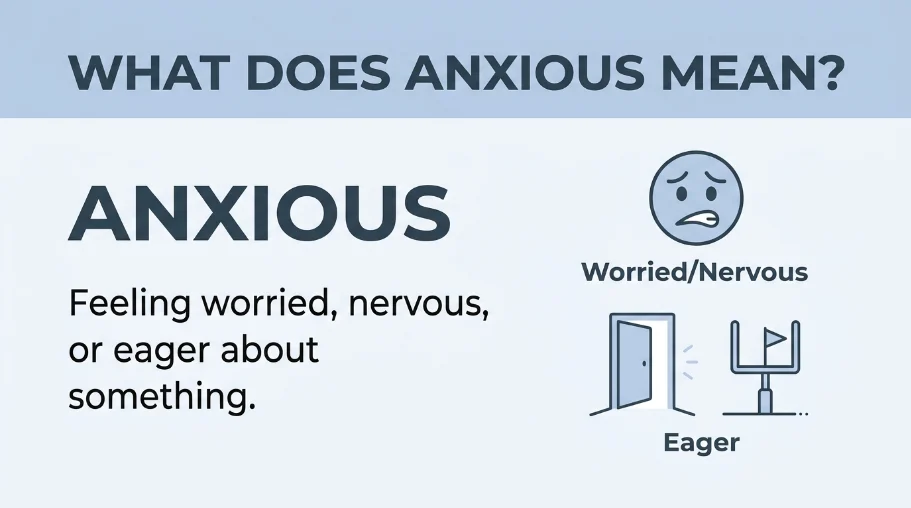
The word anxious is an adjective that describes a feeling of worry, nervousness, or unease about something with an uncertain outcome . It can also mean being eager or very desirous of something, as in “anxious to succeed” . The meaning depends on the context, with one use being negative (worry) and the other being more neutral or positive (eagerness) .
Have you ever used the word anxious to describe how you feel before a big test or a job interview? You are not alone. The word is incredibly common, but its meaning is more complex than many people realize. It can describe a feeling of dread, but it can also describe a feeling of eager anticipation. This dual nature often creates confusion.
Understanding the anxious meaning is important because it is a word you will likely use every day to express your feelings. Using it correctly helps you communicate your emotional state with precision and clarity. In a world where we are more open about mental health, knowing the difference between feeling anxious and having an anxiety disorder is also crucial .
The challenge with anxious is that it is a “false friend” of sorts. Many people mistakenly use it as a synonym for “nervous” or “worried,” which is correct, but they forget it also has a secondary meaning of “eager . This leads to ambiguity. Are you anxious about a test because you are worried, or are you anxious to take it because you are excited? This guide will clear up this confusion, show you how to use the word properly, and help you understand its deeper context.
Key Takeaway
The main takeaway is that anxious has two distinct meanings. The primary and most common meaning is “feeling worried or nervous about something . The secondary meaning is “eager or very desirous to do something . The word is an adjective, and its noun form is anxiety . Understanding the context is the key to using it correctly.
Definitions and Explanations
What Does “Anxious” Mean?
The anxious meaning is multifaceted. At its core, it describes a state of unease or worry. According to the Oxford Advanced Learner’s Dictionary, it means “feeling worried or nervous . Britannica defines it as “afraid or nervous especially about what may happen” . This is the feeling you get when you are uncertain about the future.
However, anxious can also mean “wanting or eager to do or have something . This is often used in a context where there is a strong desire, and it is completely separate from the feeling of worry. For example, “She was anxious to succeed” means she wanted to succeed very much, not that she was worried about it .
The Two Main Uses
| Context | Meaning | Example |
| Fear/Worry | Feeling unease or nervousness about something | “She felt anxious about the exam.” |
| Desire/Eagerness | Wanting something very much | “I am anxious to meet you.” |
Anxiousness vs. Anxiety: Understanding the Difference
One of the most important distinctions is between feeling anxious and having an anxiety disorder. Feeling anxious is a normal human emotion. It is a reaction to stress or a perceived threat . It is usually temporary and often linked to a specific trigger, like a job interview or a test .
An anxiety disorder, on the other hand, is a mental health condition. It involves excessive, hard-to-control worry that occurs most days and lasts for months . It is out of proportion to the actual situation and can significantly impair a person’s ability to function normally .
Key Differences
| Feature | Normal Anxiousness | Anxiety Disorder |
| Nature | A normal, temporary emotion | A mental illness requiring diagnosis |
| Trigger | Typically tied to a specific stressor | Can occur without an obvious cause or persist long after a trigger is gone |
| Duration | Short-term, resolves when the stressor passes | Persistent, often lasting for 6 months or more |
| Impact | Does not significantly impair daily life | Impairs the ability to function normally |
The Etymology and Origin
The word anxious has a fascinating history. It comes from the Latin word anxius, which means “troubled” or “distressed . This Latin word is derived from angere, a verb that means “to strangle” or “to cause anxiety . This gives us a powerful image of the physical sensation of anxiety a tightness in the chest or throat. It entered the English language around the 1520s .
Advantages and Disadvantages
Advantages of Correctly Understanding “Anxious”
- Better Self-Expression: Using the word correctly allows you to precisely articulate your feelings, whether you are worried or merely eager.
- Improved Communication: It prevents misunderstandings in conversation. If you say “I’m anxious to see the movie,” people will know you are excited, not scared.
- Mental Health Awareness: Understanding the difference between normal anxiousness and an anxiety disorder is crucial for recognizing when to seek help .
Disadvantages of Misusing “Anxious”
- Ambiguity: The dual meaning can create confusion. If you say “I’m anxious about the meeting,” it could mean you are worried about it or looking forward to it .
- Unprofessionalism: Using “anxious” incorrectly in a formal context can undermine your authority or clarity.
- Trivializing Mental Health: Using “anxious” casually to describe everyday worries can sometimes diminish the severity of actual anxiety disorders .
Real-World Examples
Examples of “Anxious” Meaning “Worried”
- “She was anxious about her exam results.”
- “We had an anxious couple of weeks waiting for the test results.”
- “He was waiting at the door with an anxious expression on his face.”
- “People are anxious about the future.”
- “As the deadline approached, he became increasingly anxious about completing the project on time.”
Examples of “Anxious” Meaning “Eager”
- “She was anxious to succeed in school.”
- “He was anxious for more news.”
- “I am anxious that there should be no delay.”
- “The team will be anxious to make up for a disappointing start to the season.”
Common Phrases and Collocations
The word anxious commonly appears with specific prepositions and in set phrases .
Common Phrases
- Anxious about: Used for worry. Example: “She is anxious about her health.”
- Anxious for: Used for desire or concern for someone. Example: “I am anxious for my daughter’s safety.”
- Anxious to: Used for eagerness. Example: “I am anxious to get started.”
- Anxious moment: A time of nervousness. Example: “It was an anxious moment waiting for the results.”
- Anxious wait: A period of waiting nervously.
Regional and Global Usage
The word anxious is a standard English word used globally, but there are some interesting regional nuances. In American English, the pronunciation often emphasizes the first syllable: /ˈæŋkʃəs/ . British English also uses the same pronunciation, though the “sh” sound can be slightly softer .
In terms of usage, the secondary meaning of “eager” has become less common in modern American English. While it is still correct, many grammar purists dislike it . In British English, this usage remains more widely accepted.
| Region | Pronunciation | Usage Notes |
| American English | /ˈæŋkʃəs/ | Primary meaning is worry; “eager” usage is less common and sometimes criticized . |
| British English | /ˈæŋkʃəs/ | Both meanings are accepted and widely used . |
Common Mistakes
Mistake 1: Using “Anxious” When You Mean “Eager”
This is one of the most common mistakes. While you can use “anxious” to mean “eager,” it can be ambiguous . For example, “I am anxious to go on holiday” could mean you are worried about it (e.g., because you fear flying) or that you are excited about it. To be clear, use “eager” when you are excited.
Correction: Use “eager” or “excited” if you are looking forward to something. Use “anxious” if you are worried.
Mistake 2: Using “Anxious” to Describe Physical Illness
Sometimes, people might say they “feel anxious” when they have a physical symptom like a racing heart. While anxiety can cause physical symptoms , it is an emotional state. If you have a medical problem, describe the symptom.
Correction: If you have physical symptoms like a headache or a rapid heartbeat, say “I am having palpitations” or “I have a headache,” not “I am feeling anxious.”
Mistake 3: Confusing “Anxious” with “Nervous” or “Worried”
These words are close, but not identical. Oxford Learner’s Dictionary notes that anxious can describe a stronger feeling than worried and is more formal . Nervous is more often used before an event like an exam or interview, while anxious can describe a personality trait .
Correction: Use nervous for temporary, event-based feelings. Use worried for a general sense of concern. Use anxious for stronger, more persistent worry.
Exercises
Exercise 1: Fill in the Blank
Choose the best word to complete each sentence.
- “I’m ________ about the test tomorrow.” (Anxious/Eager)
- “I’m ________ to get started on the project.” (Anxious/Eager)
- “The students were ________ about their final grades.” (Anxious/Eager)
- “She was ________ for news about her son.” (Anxious/Eager)
Exercise 2: Identify the Meaning
Determine whether “anxious” means “worried” or “eager” in each sentence.
- “He was anxious to avoid any further misunderstandings.”
- “The anxious parents waited for news about their child’s surgery.”
- “They are anxious for jobs and security.”
- “The long wait for the doctor really made me anxious.”
Answer Key
Exercise 1 Answers:
- Anxious (the test is a source of worry)
- Eager (positive desire to start)
- Anxious (worry about grades)
- Anxious (concern for her son)
Exercise 2 Answers:
- Eager (he wants to avoid them)
- Worried (concern for the child)
- Eager (strong desire for jobs)
- Worried (the wait caused unease)
Related Concepts and Comparisons
Anxious vs. Nervous
Nervous is a temporary feeling before a specific event like a performance or exam . Anxious can be a more general, persistent feeling of worry about the future .
| Term | Meaning | Usage |
| Nervous | Temporary, event-based | “I am nervous about my job interview.” |
| Anxious | Persistent, future-based | “I am anxious about my financial situation.” |
Anxious vs. Worried
Worried is a common, everyday feeling. Anxious can be a stronger, more formal feeling . “Worried” often has a specific focus, while “anxious” can be more diffuse.
| Term | Meaning | Usage |
| Worried | Concerned about a specific problem | “I am worried about my friend’s health.” |
| Anxious | Stronger, more persistent worry | “I am anxious about the state of the world.” |
Anxious vs. Concerned
Concerned is often used for more serious or logical issues that affect others . It is more detached than anxious.
| Term | Meaning | Usage |
| Concerned | Serious, logical worry | “The government is concerned about the rising inflation.” |
| Anxious | Emotional, personal worry | “I am anxious about losing my job.” |
FAQs
What does “anxious” mean in simple terms?
Anxious means feeling worried, nervous, or uneasy about something that might happen . It can also mean being very eager or wanting something very much .
Is “anxious” a positive or negative word?
It can be both. The primary meaning (worry) is negative. The secondary meaning (eager) is neutral or positive .
What is the difference between “anxious” and “eager”?
Eager” means you are excited or looking forward to something. “Anxious” can also mean this, but it is ambiguous because it more commonly means “worried” . To be precise, use “eager” for excitement and “anxious” for worry.
What is the noun form of “anxious”?
The noun form is anxiety .
What is the difference between “anxious” and “anxiety”?
“Anxious” is an adjective that describes a feeling (I am anxious). “Anxiety” is a noun that names the feeling (I have anxiety) .
Is feeling anxious normal?
Yes, feeling anxious is a normal reaction to stress, uncertainty, or danger . It becomes a problem when it is excessive, persistent, and interferes with daily life, which could indicate an anxiety disorder .
What are some synonyms for “anxious”?
Some common synonyms for “anxious” (worry) are worried, concerned, uneasy, and apprehensive . For the “eager” meaning, synonyms include eager, keen, and impatient .
How do you pronounce “anxious”?
Anxious is pronounced /ˈæŋkʃəs/ in both American and British English .
Can “anxious” describe a personality?
Yes, anxious can describe someone who is often or usually nervous, as in “an anxious child” .
Conclusion
This guide has explored the rich and nuanced meaning of the word anxious. It is an adjective that primarily describes a feeling of worry, unease, and nervousness about an uncertain future . However, it also carries a secondary meaning of eager desire or keenness . Understanding this dual meaning is key to using the word correctly and avoiding confusion.
The best practical advice is to consider your audience and your meaning. If you are trying to express excitement, it is often better to use a less ambiguous word like eager or excited. Reserve anxious for situations involving worry, nervousness, or concern. And most importantly, understand the difference between a normal feeling of anxiousness and a potentially debilitating anxiety disorder . Knowing when a feeling is “normal” and when it might require professional help is a vital aspect of mental health awareness.









5 thoughts on “Anxious Meaning | Definition, Examples and When to Use It Correctly For 2026”