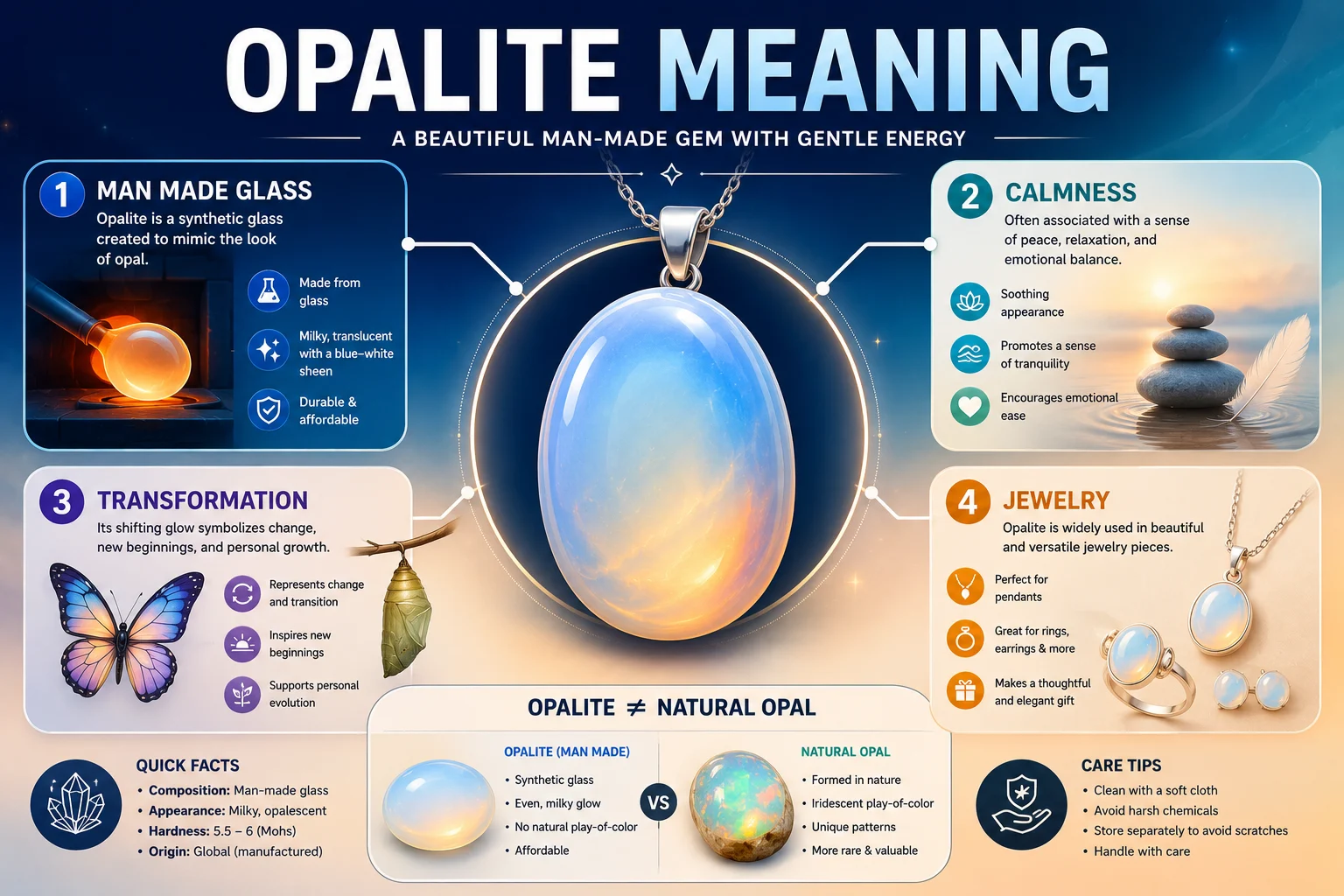
Opalite is a commercially used name for a man made, iridescent glass material that resembles natural opal. It typically has a milky, translucent appearance with blue or orange flashes. Opalite is popular in jewelry, decorative objects, and crystal collecting. Despite its gemstone appearance, common opalite is not natural opal.
Opalite meaning is closely associated with its distinctive glowing appearance, calming symbolism, and popularity in jewelry and crystal culture. The material typically looks milky or translucent and can show blue, white, yellow, or orange flashes when light passes across its surface.
However, there is an important distinction to understand. Commercial opalite commonly refers to a synthetic glass product rather than a naturally occurring gemstone. Therefore, opalite and natural opal should not automatically be treated as the same material.
People encounter opalite in several settings. Jewelry makers use it for necklaces, bracelets, earrings, and pendants. Crystal enthusiasts may associate it with emotional balance, calmness, communication, and personal transformation. Meanwhile, collectors may simply appreciate its attractive appearance.
This guide explains what opalite is, what the name means, its symbolism, appearance, common uses, spiritual associations, care instructions, and the difference between opalite and natural opal.
Quick Answer
| Element | Explanation |
|---|---|
| What is opalite? | Usually a man made iridescent glass material |
| Appearance | Milky, translucent, and softly glowing |
| Common colors | White, blue, cream, yellow, and orange flashes |
| Primary use | Jewelry and decorative pieces |
| Symbolic associations | Calmness, communication, emotional balance, and transition |
| Natural gemstone? | Common commercial opalite is generally synthetic glass |
| Similar material | Natural opal |
| Hardness | Often around 5.5 to 6.5 for common opalite glass, depending on composition |
| Common jewelry | Pendants, bracelets, earrings, rings, and beads |
What Does Opalite Mean?
The term opalite does not have one universal scientific definition.
In the commercial gemstone and jewelry market, it most commonly refers to a man made opalescent glass designed to imitate the appearance of opal.
The material can display a soft internal glow.
Depending on the lighting, it may appear:
- white
- cream
- pale blue
- translucent
- yellow
- orange
- pink
- rainbow like
Consequently, people sometimes mistake it for natural opal.
The confusion becomes greater because the name sounds like a direct variation of opal.
However, commercially sold opalite is generally a manufactured material.
Is Opalite a Real Gemstone?
This question requires some clarification.
Opalite is a real material that is widely sold and used in jewelry. However, common commercial opalite is not a naturally formed gemstone in the same sense as natural opal.
Most jewelry labeled opalite consists of manufactured glass.
Therefore, calling opalite a “gemstone” in casual conversation is understandable, but it can be scientifically misleading.
Why Does Opalite Look Like Opal?
Manufacturers create opalite to produce an opalescent appearance.
Light interacts with the material and creates a soft, glowing effect.
This can produce attractive blue or orange reflections.
As a result, opalite can resemble inexpensive varieties of natural opal from a distance.
Opalite vs. Natural Opal
The distinction between these materials is important.
| Feature | Opalite | Natural Opal |
|---|---|---|
| Origin | Usually man made | Naturally occurring |
| Material | Commonly glass | Hydrated silica |
| Formation | Manufactured | Geological |
| Appearance | Milky and glowing | Can show distinctive play of color |
| Value | Generally inexpensive | Can range from inexpensive to highly valuable |
| Availability | Widely manufactured | Naturally limited |
| Jewelry use | Very common | Very common |
| Scientific classification | Usually synthetic glass | Natural mineraloid |
Natural opal can display play of color, where spectral colors appear to shift as the stone or light moves.
Opalite may create a similar visual impression, but its optical behavior comes from manufactured material rather than natural opal formation.
What Does Opalite Symbolize?
In crystal and spiritual communities, opalite is commonly associated with several symbolic ideas.
These associations are cultural or spiritual beliefs rather than scientifically established effects.
Common symbolic meanings include:
- calmness
- emotional balance
- communication
- self expression
- transition
- optimism
- inner peace
- confidence
- personal growth
- emotional clarity
Different crystal traditions may assign different meanings.
Therefore, there is no single official symbolic interpretation.
Opalite and Calmness
Many crystal enthusiasts associate the soft appearance of opalite with calmness.
Its pale colors can create a peaceful visual impression.
Consequently, some people choose opalite jewelry or decorative pieces as reminders to slow down and maintain emotional balance.
This represents a personal or spiritual association rather than a medically demonstrated effect.
Opalite and Communication
Another common association involves communication.
Some crystal traditions describe opalite as a stone connected with expressing thoughts and feelings.
For example, someone might wear an opalite pendant as a personal reminder to communicate openly.
Again, this is symbolic rather than scientifically proven.
Opalite and Transformation
Opalite is also frequently associated with transition and change.
Its shifting appearance can serve as a metaphor for personal transformation.
People may therefore choose it during periods involving:
- a new job
- a move
- a relationship change
- personal development
- a new stage of life
- emotional reflection
The symbolism comes from cultural interpretations of the material’s appearance.
Opalite Meaning in Crystal Culture
Within modern crystal culture, opalite often receives a broad range of spiritual interpretations.
Some people associate it with emotional healing, while others connect it with energy, intuition, or personal growth.
These claims should be understood as belief based interpretations.
There is no established scientific evidence that wearing or carrying opalite produces specific psychological, medical, or supernatural effects.
Still, people may find symbolic objects meaningful.
A crystal can function as a personal reminder, decorative object, or part of a meditation routine without requiring a literal supernatural explanation.
Opalite and Emotional Healing
Some crystal sellers describe opalite as an emotional healing stone.
Common claims include associations with:
- emotional stability
- reduced negativity
- peacefulness
- confidence
- emotional release
However, these are not established medical properties.
Opalite should not replace professional care for emotional or mental health concerns.
Instead, someone can use an opalite object as a personal symbol while relying on evidence based methods for health needs.
Opalite and Love
Opalite is sometimes connected with love and relationships.
Crystal traditions may associate it with:
- emotional openness
- romantic communication
- trust
- relationship harmony
- self acceptance
For example, someone might give an opalite pendant as a symbolic gift during a relationship milestone.
The meaning comes from the giver and recipient rather than from a scientifically proven property of the material.
Opalite and Confidence
Some spiritual interpretations connect opalite with confidence and self expression.
The idea often relates to the stone’s luminous appearance.
Someone might carry or wear it as a reminder to speak confidently or embrace personal change.
This makes the object meaningful as a symbol even without assuming that the material itself changes behavior.
Opalite and Intuition
Another popular association is intuition.
Some crystal enthusiasts believe opalite can support reflection or intuitive awareness.
From a scientific perspective, however, there is no established evidence that opalite enhances supernatural perception.
People may still use it during meditation or journaling as a symbolic focus.
What Does Opalite Look Like?
Opalite typically has a soft, translucent appearance.
Common visual characteristics include:
- milky white color
- pale blue glow
- translucent body
- glassy surface
- orange or yellow reflections
- subtle iridescence
The appearance can change significantly under different lighting conditions.
Opalite in Natural Light
Under natural light, opalite may look pale and translucent.
It can show blue or white reflections.
Some pieces appear almost colorless when viewed from certain angles.
Opalite Under Artificial Light
Artificial lighting can reveal stronger warm tones.
You may see:
- orange
- yellow
- cream
- pink
- blue
This shifting appearance contributes to its popularity in jewelry.
Why Is Opalite Blue?
The blue glow associated with opalite comes from how light interacts with the manufactured glass.
The material can display different colors depending on its composition, thickness, lighting, and viewing angle.
Therefore, blue opalite does not necessarily mean the material contains a naturally blue mineral.
Is Opalite Natural?
Most material sold commercially as opalite is manufactured.
However, the term can occasionally be used in other contexts, including references to naturally occurring materials or specific varieties of opalescent substances.
This is why the label alone should not determine what a particular specimen actually is.
If you’re buying an expensive specimen, ask the seller whether it is:
- natural opal
- synthetic opal
- opalite glass
- another opalescent material
Clear terminology matters.
How Is Opalite Made?
Commercial opalite is generally produced by manufacturing glass with properties that create an opalescent appearance.
Manufacturers control the composition and processing of the glass to create the desired visual effect.
The finished material can then be:
- cut
- polished
- shaped
- drilled
- turned into beads
- used in decorative objects
This manufacturing process allows producers to create attractive pieces at relatively low cost.
Opalite in Jewelry
Opalite is particularly popular in affordable jewelry.
You may find it in:
- necklaces
- bracelets
- earrings
- rings
- pendants
- bead strands
- charms
Its soft appearance makes it suitable for both minimalist and decorative designs.
Opalite Pendants
Pendants are among the most recognizable forms.
A polished opalite cabochon can display a strong glow when suspended from a necklace.
Because the material is generally inexpensive, large pendants can be affordable.
Opalite Bracelets
Beaded bracelets are also common.
Round beads allow light to pass through different sections of the material.
This can produce changing reflections as the bracelet moves.
Opalite Earrings
Opalite earrings can provide a subtle translucent appearance.
The material works especially well with simple designs because its glow becomes the primary visual feature.
Opalite in Home Decor
Beyond jewelry, opalite can appear in decorative objects.
Examples include:
- carved figures
- spheres
- polished stones
- ornaments
- decorative bowls
- display pieces
Collectors may appreciate these pieces for their appearance rather than their spiritual associations.
Opalite and Birthstones
Opalite is not a traditional birthstone.
Official birthstone systems generally recognize specific natural gemstones for particular months.
However, jewelry sellers may market opalite as an alternative stone for people who like its appearance.
Therefore, do not confuse a commercial association with an officially recognized birthstone designation.
Opalite and the Moon
Opalite is sometimes associated with the moon because of its pale, luminous appearance.
Crystal communities may connect it with:
- lunar energy
- intuition
- emotional reflection
- feminine symbolism
- cycles of change
These interpretations come from modern spiritual traditions.
They are not scientific properties of the material.
Opalite and Water
Some crystal communities recommend placing crystals in water for cleansing.
However, this is not automatically appropriate for every material.
Opalite glass can generally tolerate ordinary handling, but prolonged exposure to water, chemicals, or harsh environments is unnecessary.
Furthermore, jewelry settings can contain materials that react differently.
For routine care, gentle cleaning is safer.
How to Clean Opalite
Because commercial opalite is usually glass, basic cleaning is relatively straightforward.
Use:
- lukewarm water
- mild soap when needed
- a soft cloth
- gentle handling
Avoid aggressive chemicals and abrasive materials.
After cleaning, dry the piece thoroughly.
What to Avoid
Avoid:
- harsh chemical cleaners
- abrasive powders
- rough brushes
- prolonged exposure to extreme heat
- careless impacts
Even though glass can be reasonably durable, it can still scratch or break.
How to Store Opalite
Store opalite jewelry separately from harder materials.
A soft pouch or lined jewelry box can help prevent scratches.
If you own several pieces, avoid allowing them to knock against one another.
This is particularly useful for polished beads and cabochons.
Is Opalite Durable?
Commercial opalite glass has reasonable durability for ordinary jewelry use.
However, it is still glass.
A strong impact can cause:
- chips
- scratches
- cracks
- breakage
Therefore, remove delicate opalite jewelry before activities that involve significant physical impact.
Is Opalite Expensive?
Usually, no.
Commercial opalite is generally inexpensive compared with high quality natural opal.
Its affordability comes partly from the fact that it can be manufactured in large quantities.
Price can still vary based on:
- size
- cut
- craftsmanship
- jewelry setting
- design
- seller
- quality of finishing
A large handmade pendant may cost substantially more than a simple bead.
However, the material itself is usually accessible to budget conscious buyers.
Why Is Opalite So Popular?
Several factors contribute to its popularity.
Attractive Appearance
Its glowing, translucent appearance works well with many jewelry styles.
Affordable Price
Manufactured material can cost considerably less than valuable natural gemstones.
Versatility
It can be cut and shaped into many forms.
Symbolic Appeal
Crystal enthusiasts may appreciate its associations with calmness and transformation.
Easy Availability
Opalite is widely available through jewelry stores, crystal shops, craft suppliers, and online marketplaces.
Consequently, it appeals to both casual jewelry buyers and crystal collectors.
How to Tell Opalite From Natural Opal
Identifying gemstones accurately can require professional testing.
Still, several general clues can help.
| Feature | Common Opalite Glass | Natural Opal |
|---|---|---|
| Appearance | Smooth milky glow | Often shows natural color play |
| Material | Glass | Hydrated silica |
| Uniformity | Often highly consistent | Natural variation is common |
| Price | Usually inexpensive | Wide range |
| Origin | Manufactured | Geological |
| Surface | Glass like | Depends on opal type |
However, visual inspection alone is not always reliable.
If a seller claims a piece is valuable natural opal, professional identification can provide greater confidence.
Opalite vs. Synthetic Opal
These terms should also be distinguished.
Opalite commonly refers to an opalescent glass product.
Synthetic opal refers to laboratory produced material designed to reproduce characteristics of natural opal.
They are not automatically the same material.
Therefore, a seller should clearly identify what they are offering.
Opalite vs. Moonstone
Opalite and moonstone can sometimes look similar.
However, they are different materials.
| Opalite | Moonstone |
|---|---|
| Usually manufactured glass | Natural feldspar mineral |
| Commonly milky and translucent | Often displays adularescence |
| Generally inexpensive | Price varies significantly |
| Manufactured | Naturally occurring |
Both can show attractive glowing effects.
However, their geological origins differ substantially.
Opalite vs. Glass
Commercial opalite is generally a type of manufactured glass.
Therefore, saying that opalite is “fake” can be misleading.
It is better to describe it accurately as a man made glass material.
Manufactured materials can still be attractive, durable, useful, and valuable as decorative objects.
The important issue is whether the seller represents the material honestly.
Common Misconceptions About Opalite
Misconception 1: All Opalite Is Natural
Most commercial opalite is manufactured.
Therefore, buyers should not assume that an opalite product is a naturally formed gemstone.
Misconception 2: Opalite Is Simply Another Name for Opal
The terms are related in appearance but do not necessarily describe the same material.
Natural opal and commercial opalite have different origins.
Misconception 3: Opalite Has Proven Healing Powers
Spiritual traditions may assign healing symbolism to opalite.
However, scientific evidence does not establish that opalite treats diseases or medical conditions.
Misconception 4: Expensive Opalite Is Automatically Better
Price can reflect jewelry design, craftsmanship, branding, or size.
A high price does not necessarily mean the underlying opalite material is rare.
How to Buy Opalite Responsibly
When buying opalite, ask clear questions.
Ask What the Material Is
Ask whether the item is:
- opalite glass
- natural opal
- synthetic opal
- another material
Check the Product Description
Reliable sellers should identify the material accurately.
Be cautious when descriptions use vague language to make inexpensive glass sound like rare natural opal.
Compare Prices
If a seller claims that ordinary opalite is an exceptionally rare gemstone, investigate further.
Unusually high prices deserve careful scrutiny.
Consider the Setting
If you’re purchasing jewelry, inspect the metal and craftsmanship too.
The value of a finished piece may come primarily from the design or metal rather than the opalite itself.
Real Life Examples of Opalite Meaning
Example 1: Jewelry
“She chose an opalite necklace because she liked its soft blue glow.”
Here, the appeal is primarily aesthetic.
Example 2: Crystal Collection
“He keeps an opalite sphere with his other crystals.”
Here, the material functions as a decorative or symbolic object.
Example 3: Gift
“I gave her an opalite pendant as a symbol of new beginnings.”
Here, opalite represents personal transformation.
Example 4: Jewelry Shopping
“Is this natural opal or opalite?”
The buyer is asking about the material’s origin.
Example 5: Spiritual Practice
“She keeps opalite nearby while journaling.”
Here, the object functions as a personal symbolic reminder.
Frequently Asked Questions
What does opalite mean?
Opalite commonly refers to a man made, iridescent glass material that resembles natural opal. In crystal culture, it also carries symbolic associations with calmness, communication, and transformation.
Is opalite a real stone?
Commercial opalite is usually manufactured glass rather than a naturally occurring stone. It is a real material, but it should not automatically be classified as natural opal.
Is opalite natural or man made?
Most commercially sold opalite is man made. It is typically manufactured as an opalescent glass product.
What is opalite used for?
Opalite is commonly used for jewelry, decorative objects, crystal collections, beads, pendants, bracelets, and ornamental pieces.
What does opalite symbolize?
In modern crystal traditions, opalite is commonly associated with calmness, emotional balance, communication, confidence, intuition, and personal transformation. These are spiritual or symbolic associations rather than scientifically established effects.
Is opalite the same as opal?
No. Commercial opalite is usually manufactured glass, while natural opal forms naturally and consists primarily of hydrated silica.
Is opalite valuable?
Commercial opalite is generally affordable. However, finished jewelry can vary in price based on craftsmanship, size, design, and materials used in the setting.
Can opalite get wet?
Occasional gentle contact with water is generally not a major concern for ordinary opalite glass. Nevertheless, avoid prolonged exposure and harsh chemicals, especially with jewelry containing metal or other materials.
Is opalite good for jewelry?
Yes. Its attractive appearance and affordability make it popular for necklaces, bracelets, earrings, pendants, and beads. However, remember that it is glass and can chip or break under strong impact.
How can you tell opalite from natural opal?
Commercial opalite is usually manufactured glass and often has a consistent milky appearance. Natural opal has a geological origin and can display distinctive natural play of color. Professional testing is the safest option when identification or value matters.
Conclusion
Opalite meaning combines a distinctive visual identity with a wide range of cultural and symbolic interpretations.
In commercial jewelry, opalite usually refers to man made opalescent glass. Its milky body and shifting blue, white, yellow, or orange reflections make it popular for pendants, bracelets, earrings, beads, and decorative pieces.
In crystal culture, people commonly associate opalite with calmness, communication, emotional balance, confidence, intuition, and transformation. However, these meanings represent spiritual and personal beliefs rather than scientifically demonstrated properties.
The most important distinction is between opalite and natural opal. Although the materials can look similar, they have different origins. Natural opal forms through geological processes, while commercial opalite is generally manufactured glass.
Furthermore, opalite should not be dismissed simply because it is synthetic. Manufactured materials can still offer attractive appearance, practical durability, affordability, and decorative value. The key is accurate labeling.
Whether you encounter opalite in a crystal shop, jewelry collection, decorative display, or personal gift, its meaning ultimately depends on context. For some people, its primary appeal is its luminous appearance. For others, it represents calmness, change, or personal growth.
Understanding both the material facts and the symbolic interpretations gives you a clearer and more accurate picture of what opalite represents.

Andrew Morris is a writer at Meaninga.com who specializes in word meanings, slang, idioms and modern language trends. He creates clear, accurate and easy to understand content for everyday readers.